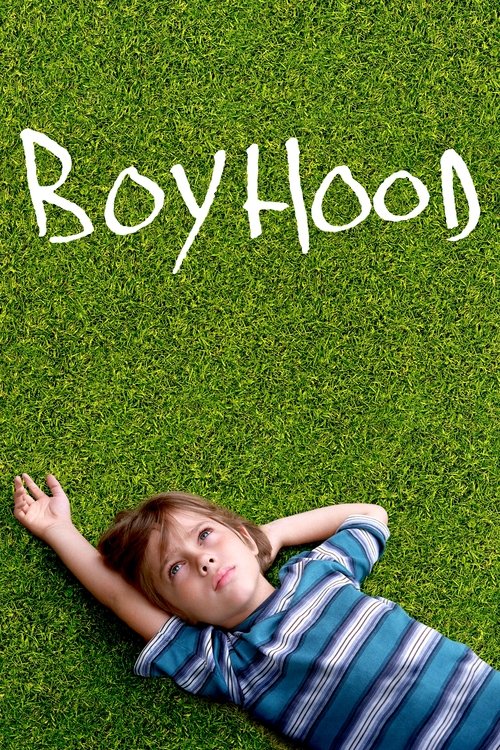
Boyhood
2014 · Richard Linklater
For a reflective evening when you want a film to sit with — one that makes you think about your own family, your own growing up, and where the years went. Bring patience for its nearly three hours; it pays off in feeling, not plot.
What it's about
One Texas boy, Mason, from first grade to his first week of college — and the movie was actually filmed that way, shot in short bursts every year for twelve years, so the same actors age before your eyes. Around him orbit a mother rebuilding her life through bad marriages and night classes, a charming weekend dad slowly growing up himself, and an older sister — the stuff of ordinary life: moves, haircuts, first jobs, first loves, leaving home.
The experience
Unhurried and quietly overwhelming — nothing dramatic 'happens,' and then suddenly you realize you've watched a childhood end and you're wrecked. It sneaks up on you the way time does, and the moment-to-moment texture is warm, funny, and true.
Performances
Ellar Coltrane literally grows up on camera, from dreamy six-year-old to lanky college freshman — a performance no other film could contain. Patricia Arquette is the emotional anchor as his mother, aging without vanity through a decade of struggle and sacrifice, and Ethan Hawke charts a father's slow maturation with easy, talkative charm.
The craft
The making is the miracle: Richard Linklater shot annually from 2002 to 2013 with the same cast, letting time itself do the work makeup and recasting usually fake. The editing hides the seams — years pass mid-scene without title cards, marked only by a haircut or a song on the radio — and the whole thing feels less directed than lived.
Why it matters
A landmark of American independent filmmaking — it won Linklater the Silver Bear at Berlin, swept critics' awards, earned Arquette an Oscar, and stands as maybe the boldest experiment in duration ever smuggled into a mainstream release.
Snapshot
Boyhood is a fiction feature shot in short annual increments between 2002 and 2013, following one Texas child, Mason Evans Jr. (Ellar Coltrane), from first grade to the first weeks of college. Its premise is deceptively simple and structurally radical: rather than casting multiple actors or applying prosthetics, Linklater let the same performers age on camera for twelve years, so that the film's chief special effect is time itself. The result is 165 minutes of largely unremarkable domestic incident — moves, divorces, haircuts, a shotgun for a birthday, a first job, a drive to college — arranged so that the ordinary accrues into something the film treats as the only real subject available. Premiering at Sundance in January 2014 and winning Linklater the Silver Bear for Best Director at that year's Berlinale, it became the critical event of its year, earned six Academy Award nominations, and won one, Patricia Arquette for Best Supporting Actress. Its lasting significance lies less in any single scene than in the demonstration that duration can be a formal instrument rather than a documentary accident.
Industry & production
The production is inseparable from the financing arrangement that made it possible. Linklater could not sign his cast to a twelve-year contract: California Labor Code Section 2855 — the so-called De Havilland rule — caps personal service contracts at seven years, and no completion bond or standard SAG agreement contemplates a decade-long shoot. IFC Films, through Jonathan Sehring, committed to funding roughly a fixed annual sum without a binding long-form contract, effectively renewing the film on trust each year. Linklater's Detour Filmproduction produced alongside IFC Productions, with Cathleen Sutherland, a longtime Linklater production hand, carrying the year-to-year continuity. Total costs are widely reported in the low single-digit millions — extraordinary for a film that occupied a studio's release slate for over a decade — because the actual shooting amounted to only a few days per year, reported at fewer than forty days in total.
The project was known during production as "The Twelve Year Project" or simply "12 Years," partly for secrecy and partly because there was no guarantee of a finished film. Linklater has said he asked Ethan Hawke to complete the picture if he died before it was done. That contingency is not a colorful anecdote so much as the governing production condition: every element — an actor's willingness to return, a distributor's continued patience, the survival of the director — was renegotiated annually. Locations stayed within Linklater's home territory in Texas: Houston, San Marcos, Austin, the Hill Country, and finally Big Bend Ranch State Park, keeping the logistical footprint small enough that a year's work could be mounted quickly.
Technology
The single most consequential technical decision was to shoot on 35mm film throughout. Between 2002 and 2013 digital acquisition went from an experimental option to the industry default, passing through at least three or four generations of incompatible sensors, codecs and workflows. Any digital origination chosen in 2002 would have looked visibly archaic — and been unsupportable — by 2013. Photochemical capture on Super 35 gave Linklater a stable, format-agnostic image across the whole span, so that the visible aging belongs to the people and the world rather than to the technology recording them. It is one of the rare cases where a conservative technical choice is the more experimental one.
Technology also functions inside the film as its most precise clock. Mason's world is dated by a Game Boy Advance SP, a boxy monitor, the arrival of a Wii, Halo on an Xbox, the migration from MySpace-era internet to Facebook, and finally smartphones and the reflexive photograph. Mason himself takes up film photography and darkroom printing precisely as the medium becomes obsolete — a quiet rhyme with the production's own commitment to celluloid, and one of the few places where the film allows itself a legible metaphor.
Technique
Cinematography
Lee Daniel and Shane F. Kelly share credit. Daniel had shot Slacker, Dazed and Confused and Before Sunrise; Kelly had shot A Scanner Darkly. The public record does not cleanly document which years each photographed, and it is better to say so than to guess. What is legible on screen is a consistent house style: naturally motivated light, medium-wide compositions in 1.85:1, few close-ups, and a camera that walks alongside characters rather than dramatizing them. There is no attempt to differentiate the years by look — no grading shift to mark 2004 from 2010, no visual "period" signaling. The refusal is deliberate. Style is held flat so that the changes in faces and bodies register without competition.
Editing
Sandra Adair, Linklater's editor since Dazed and Confused, cut the material as it arrived, meaning the film existed as a growing assembly for over a decade rather than being solved in a single post period. Her Academy Award nomination recognized a problem no other editor had faced at this scale: how to join twelve discrete shoots into one continuous experience. Her solution is to hide the joins in plain sight. There are no chapter titles, no year cards, no dissolves, no time-lapse montages. Transitions are hard cuts, frequently carried by a music change or a match on movement, and the audience is left to register elapsed time from a haircut, a new apartment, a deepened voice. The effect is that the ellipses feel like memory rather than structure — you notice the child has changed a beat after the scene has already begun.
Mise-en-scène / staging
Linklater stages for continuity of behavior rather than for composition. Scenes tend to run on foot or in cars, with dialogue overlapping and business — dishes, packing boxes, homework — running underneath. Domestic spaces are specific and downwardly mobile: rented houses, a series of stepfathers' homes, dorm rooms. The film's most concentrated set piece, the household of Professor Bill Welbrock (Marco Perella), builds coercion through ordinary staging — a dinner table, a haircut administered without consent — and then exits it abruptly, refusing the confrontation scene the genre would normally supply. Milestones that a conventional coming-of-age film would build to are either handled obliquely or elided entirely.
Sound
There is effectively no original score. The soundtrack is source music placed chronologically, from Coldplay's "Yellow" over the opening image of Mason on his back in the grass, through Britney Spears, Soulja Boy and Gotye, to Arcade Fire and Family of the Year in the final movement. Because each cue is anchored to its release year, the music does double duty as emotional accompaniment and calendar. Otherwise the mix is ambient and unforced — traffic, wind, room tone, kids offscreen — with dialogue frequently competing against it rather than being isolated. The absence of a unifying score means no authorial voice tells the audience which moments matter.
Performance
Ellar Coltrane was cast at six. His performance is not a constructed arc so much as a documented one: the open, unguarded child of the early years gives way to a watchful, mumbling adolescent, and the change is partly a real person's development rather than acting choices. This is the film's great risk. Coltrane is more compelling at some ages than others, and the film absorbs that unevenness as data. Patricia Arquette's Olivia carries the film's most conventional dramatic weight — a mother who earns degrees, escapes two bad marriages, and arrives at the end with nothing scheduled, delivering the devastating "I just thought there would be more." Hawke's Mason Sr. ages from an absent man with a GTO into a remarried father with a minivan and an insurance job, a trajectory the film treats as neither triumph nor defeat. Lorelei Linklater, the director's daughter, plays Samantha; it has been widely reported that she asked to leave the project partway through and was declined.
Narrative & dramatic mode
Boyhood operates in an anti-climactic, episodic mode that deliberately withholds the architecture of the bildungsroman. There is no inciting incident, no midpoint reversal, no graduation framed as arrival. Threats are raised and then simply outlived: the abusive stepfather is escaped rather than defeated; a second marriage fails offscreen; a first love ends in a phone call. Deaths, births and other conventional turning points occur between segments or not at all. What the film substitutes for plot is accumulation — the sense, available only in retrospect, that a person has been assembled out of unremarkable weekends. Its closing exchange, in which Mason and a new acquaintance agree that the moment seizes us rather than the reverse, is the nearest the film comes to stating a thesis, and even that is delivered as stoned undergraduate chatter.
Genre & cycle
Nominally a coming-of-age drama, the film sits inside the American independent "hangout" tradition Linklater largely defined with Slacker and Dazed and Confused: loose, conversational, indifferent to the goal-oriented protagonist. It belongs to the Sundance-descended cycle of low-budget domestic realism that ran from the 1990s indie boom through the mumblecore years, though it is more compositionally disciplined than most of that work. It is also a divorce film and a working-poor film, tracking class precarity — the moves, the debt, the return to school, the service jobs — with unusual patience for a picture whose reception emphasized universality.
Authorship & method
Linklater's method here extends practices visible across his career. He wrote a broad twelve-year architecture at the outset but composed each year's material shortly before shooting, incorporating what had actually happened to his cast and to the country. Actors contributed dialogue and biographical detail, though Linklater holds sole screenplay credit and was nominated for Original Screenplay on that basis. The collaborators are the same ones who shaped his earlier work: Daniel and Kelly behind the camera, Adair in the cutting room, Sutherland producing, Hawke as both performer and creative interlocutor — a relationship already twenty years deep by the time Boyhood wrapped. The absence of a composer is itself an authorial signature; Linklater has repeatedly preferred curated source music to score.
Movement / national cinema
The film is a product of Austin's regional independent culture, which Linklater helped build by founding the Austin Film Society in 1985 and which produced a distinctly non-coastal American cinema alongside Robert Rodriguez and, earlier and adjacently, Terrence Malick's Texas work. That regional base explains both the production's feasibility — cheap, familiar, repeatable — and its texture: the film's Texas is specific in its Baptist grandparents, its Hill Country ranches, its Houston suburbs, and its 2008 Obama canvassing, without ever announcing itself as regional portraiture.
Era / period
The twelve years the film crosses — 2002 to 2013 — comprise the post-9/11 American interval: the Iraq War (embodied in a stepfather who is a returning veteran), the 2008 election, the recession, and the total conversion of daily life to networked screens. History is admitted only as ambience. No character explains the period; the period arrives as a yard sign, a deployment, a phone. This is one of the film's most durable achievements — a portrait of a decade constructed almost entirely from peripheral detail.
Themes
The governing subject is impermanence, treated without consolation. Parenting is shown as provisional and improvised: both parents get better at it too late to matter in the way they hoped. Masculinity is presented as a menu of inadequate models — the absent charmer, the authoritarian professor, the resigned veteran, the wary artist Mason becomes. Class runs beneath everything, in the recurrence of moving boxes and the arithmetic of tuition. And there is the film's structural theme, inseparable from its method: that a life is not made of decisive moments but of the intervals between them, and that this is only visible from a distance the cinema does not usually allow.
Reception, canon & influence
Boyhood met near-unanimous critical acclaim on release, topping a large share of year-end lists, including Sight & Sound's critics' poll for 2014. It won BAFTAs for Best Film and Best Director and Golden Globes for Best Motion Picture (Drama), Best Director and Best Supporting Actress, then entered the Academy Awards as the presumptive Best Picture winner and lost to Birdman — an outcome still cited in accounts of that season. It performed strongly for a specialty release, grossing well above its cost. Dissent existed and was substantive: critics questioned whether the twelve-year conceit was doing the work the acclaim attributed to it, whether the film's white, male, Texan vantage was being mistaken for universality, and whether its refusal of dramatic shape amounted to profundity or evasion. Those arguments have aged better than the consensus rhetoric of 2014 and are now part of how the film is read.
Its backward lineage is clear. Michael Apted's Up series, begun in 1964, established filmed longitudinal observation of real children; François Truffaut's Antoine Doinel cycle, running from 1959 to 1979, let Jean-Pierre Léaud age across a fictional life; Satyajit Ray's Apu Trilogy staged a life in three parts with successive actors; Italian neorealism supplied the model of undramatized daily life as sufficient subject. Closest of all is Linklater's own Before trilogy, which had by 2013 tracked two characters across eighteen years in three discrete films — Boyhood compresses that experiment into a single sitting. Michael Winterbottom's Everyday (2012), shot over five years with one family, is a direct near-contemporary.
Forward, the influence has been more conceptual than imitative, largely because the model resists replication: the financing, the trust, and the luck required are not repeatable on demand. Its clearest descendant is Linklater's own adaptation of Merrily We Roll Along, in production since 2019 and designed to shoot across roughly two decades so that its reverse-chronology narrative runs against the actors' real aging. More broadly, Boyhood changed the critical vocabulary — duration became a discussable formal element in mainstream reviewing rather than an avant-garde specialty — and it strengthened the distributor-as-patient-financier arrangement that IFC modeled. Its most durable legacy may simply be the proof of concept: that an audience will sit for a film in which nothing is made to happen, provided it can watch a face change.
A Deleuzian reading
A boy lies on his back in the grass, looking up at the sky.
The full Deleuzian reading of Boyhood →
Reception
In 2014 it was received as an instant masterpiece — Sundance rapture, a record-setting Metacritic score, sweeping the critics' awards — before the Birdman Oscar upset kicked off a backlash; a decade on, film Twitter still relitigates whether it's a monumental epic of time or a modest movie elevated by its production method.
How Boyhood was received, from release to now →
How to watch Boyhood: what to notice on a first viewing
- Count how many seconds pass before you notice Mason aged. Adair joins twelve separate shoots with hard cuts. No year cards, no dissolves, no time-lapse. A scene is already running before a haircut or a deeper voice tells you a year is gone. The delay is the invention. You feel elapsed time the way memory delivers it, late.
- Listen for pop songs marking the year, starting with Coldplay's "Yellow". There is no original score. Every cue is source music placed by its release year, from Britney Spears through Soulja Boy to Arcade Fire. Nothing swells to tell you a moment is important. Without a composer pointing, you decide for yourself which ordinary moments matter.
- Notice how rarely Linklater cuts to a close-up of anyone. Daniel and Kelly hold medium-wide 1.85:1 frames in naturally motivated light, the camera walking alongside people rather than pressing in. The look never shifts to mark 2004 from 2010. With style held flat, the only thing visibly changing is the faces.
- Watch the dishes, homework and packing boxes running under the dialogue. Scenes play out on foot and in cars, with talk overlapping and household business continuing underneath. Traffic, wind and offscreen kids compete with the voices in the mix. The film stores a life in stretches where nothing advances, which the reading calls dead time.
- Track the gadgets: a Game Boy, a boxy monitor, a Wii, phones. No title tells you the year, so consumer devices do it. MySpace gives way to Facebook, an Xbox appears, then the reflexive phone photograph. An Iraq deployment and a 2008 yard sign arrive the same way. The world keeps moving around a boy who mostly watches it.
The whole guide to watching Boyhood, with the keys for a rewatch →
Influences: the films it descends from and the films it influenced
- Seven Up! (1964) — Established the fixed-interval return to the same faces as a structural device — Apted's subsequent installments prove that the cut between two ages carries dramatic weight no written scene can, which is precisely the load Boyhood's invisible year-joins are asked to bear.
- The 400 Blows (1959) — Built scenes out of Léaud's own biography and improvisation (the psychologist interview shot documentary-style against off-screen questions) and ended on an unresolved freeze instead of a climax — the same two moves as Linklater writing each year around what had actually happened to Coltrane, and refusing a final act.
- Love on the Run (1979) — Splices footage from the four earlier Doinel films directly into the cut so that Léaud's real aging becomes the text rather than the subtext; Boyhood internalizes that archival cut-in by generating all twelve years' footage inside a single continuous production.
- Aparajito (1956) — Stages a life as successive chapters with a different actor for each age and elides the milestones between them (the move, the schooling, the death offscreen); Boyhood keeps the chaptering and the elisions but solves the recasting seam by waiting for the body instead of replacing it.
- Bicycle Thieves (1948) — The neorealist warrant for the whole method: nonprofessional casting, location shooting with unisolated street sound, a child whose watching is the actual subject of the frame, and a withheld resolution — undramatized daily life treated as sufficient material.
- Before Sunset (2004) — Turned a nine-year production gap into the film's substance, with Hawke and Delpy co-writing their own dialogue and Sandra Adair cutting for behavioral rather than plot continuity — the same repertory and the same contract with real time, distributed across films rather than compressed into one sitting.
- Dazed and Confused (1993) — The plotless ensemble drift with no protagonist arc, cast for behavior rather than line readings, and a wall-to-wall needle-drop that dates the year without a title card — Boyhood's source-music-as-calendar is this soundtrack strategy stretched over a decade.
- American Graffiti (1973) — Made diegetic radio pop the film's only score and its clock; Linklater's refusal of a composer and his use of chart singles to mark each year (Coldplay to Gotye) descends directly from Lucas's Wolfman Jack running under every scene.
- The Long Day Closes (1992) — Renders childhood as elided episodes bound together by pop records and ambient household sound rather than by causation, holding the camera on a boy's attention while the events that would constitute a plot happen elsewhere or not at all.
- Hoop Dreams (1994) — Five years of longitudinal shooting on the same adolescents, then assembled retrospectively from hundreds of hours so that physical change carries the narrative — the exact editorial problem of finding joins across a decade of unevenly-shot material that Adair solved in the cutting room.
- Everyday (2012) — Shot in short blocks over five years with the same four siblings, staging the ellipsis of a prison sentence by simply letting the child actors grow between visits — the nearest contemporary application of the real-aging shoot as a structural rather than cosmetic choice.
- Au Revoir les Enfants (1987) — Pushes the accumulative, undramatized observational rhythm of childhood to its limit, refusing climactic plotting so that growth registers as the steady deposit of ordinary moments.
- Merrily We Roll Along (2019) — Designed to shoot across roughly two decades so that Sondheim's reverse chronology runs against the cast's forward aging — the Boyhood contract inverted, with the actors' bodies contradicting the story's direction instead of confirming it.
- Aftersun (2022) — Period-marks time through consumer devices rather than exposition (the MiniDV camcorder, Polaroids, a hotel karaoke machine), elides its central event entirely, and refuses the confrontation scene the material has set up — Boyhood's withheld-crisis grammar applied to a single fortnight.
- Minding the Gap (2018) — Twelve years of accumulated skate footage of the same three friends re-read and reassembled into a narrative of aging, making assembly-across-a-decade an editorial method rather than an archival accident.
- Nouvelle Vague (2025) — Demonstrates Linklater's obsessive fidelity to recovering how a specific time felt from inside it — the same period-immersion discipline applied to 1959 Paris.
- A Thousand and One (2023) — Sets the template for the longitudinal time-spanning epic tracing a child into adulthood; Rockwell adapts the ambition through recast actors rather than real-time shooting.
- Moonlight (2016) — Chapters one life across three actors kept deliberately apart during production and directed for continuity of gesture and posture rather than facial resemblance — the casting solution to the identity-across-time problem Boyhood chose to solve with duration.
- Apollo 10½: A Space Age Childhood (2022) — Constructs an entire year out of consumer objects, TV schedules, and source music instead of incident, again withholding a dramatic engine from a Texas childhood — the period-marking apparatus of Boyhood separated from the longitudinal shoot and run on its own.
- The Souvenir (2019) — Worked without a conventional screenplay (actors given outlines and pushed toward their own recall), recorded unisolated location ambience, cut hard across unmarked months, and kept the relationship's decisive crisis off-screen.
- The Tree of Life (2011) — Stages a Texas boyhood as behavioral fragments with child nonprofessionals given physical tasks rather than lines, shot available-light and handheld — the same faith that watched behavior outperforms written scenes, though Malick lyricizes the ellipses Boyhood leaves flat.
- C'mon C'mon (2021) — Childhood rendered as an accretion of small ordinary moments with the dramatic crisis deliberately withheld — the same refusal-of-crisis observational rhythm.
- The Eight Mountains (2022) — Uses performers visibly aging across years so that elapsed time itself becomes the film's structure, exactly the four-decade chronicle device deployed here.
- The Last 10 Years (2022) — Sibling in the editing device of compressing roughly a decade into a single arc so the audience physically registers time and aging as the film's central formal move.
Similar films
- The Tree of Life (2011) — influence & lineage
- Before Sunset (2004) — influence & lineage
- Moonlight (2016) — influence & lineage
- Before Midnight (2013) — shared sensibility
- Room (2015) — shared sensibility
- Beautiful Boy (2018) — shared sensibility
- Close (2022) — shared sensibility
- Interstellar (2014) — shared sensibility