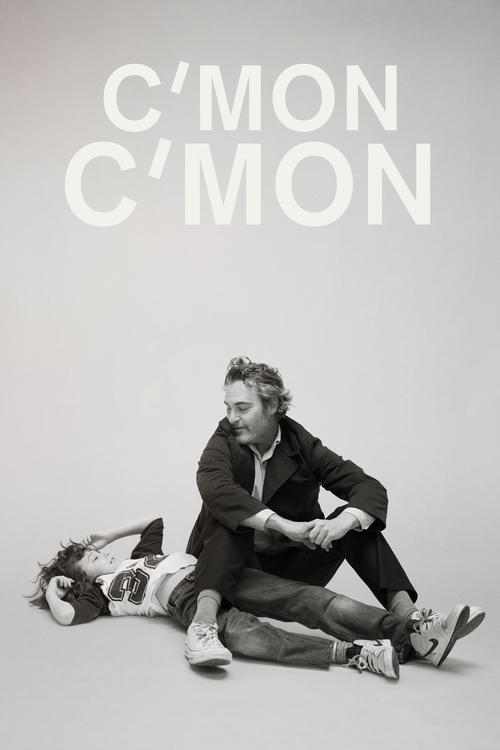
C'mon C'mon
2021 · Mike Mills
When you need to feel something and don't want to be manipulated into it — a good quiet cry, a phone call to someone you love afterward. Comfort viewing for grown-ups, especially anyone who's ever cared for a kid.
What it's about
Johnny is a radio journalist crossing America to interview kids about the future when his sister needs him to look after her nine-year-old son. What starts as a favor becomes a shared journey — Los Angeles to New York to New Orleans — as an unmarried, unpracticed uncle learns, hour by hour, what caring for a child actually takes, and the boy asks him questions he can't answer.
The experience
Gentle, funny, and quietly devastating — it moves at the pace of real conversations and sneaks up on you. No manufactured crisis, just the tenderness and exhaustion of looking after someone, and it leaves you soft-hearted for days.
Performances
Joaquin Phoenix in his gentlest register, all patience and fumbling goodwill, opposite Woody Norman, whose nine-year-old is startlingly natural — their back-and-forth never feels written.
The craft
Robbie Ryan shoots three American cities in silvery black-and-white that makes ordinary streets feel remembered rather than observed. Mills threads in passages read aloud from real books on motherhood and listening, and weaves real interviews with real children through the story — the documentary texture is the film's secret engine.
Why it matters
The film that completed Mike Mills's family trilogy — after portraits drawn from his father and mother, this one came from becoming a parent himself — and it cemented his standing as American cinema's great chronicler of ordinary care.
Mike Mills built Beginners from his father and 20th Century Women from his mother; this one he built from becoming a parent himself. Joaquin Phoenix, in his gentlest register since Her, plays a radio journalist crisscrossing America to interview children about the future, suddenly saddled with his nine-year-old nephew — a startling, unmannered Woody Norman. Robbie Ryan shoots Los Angeles, New York, and New Orleans in a silvery black-and-white that turns ordinary streets into something remembered rather than observed, and Mills threads in his signature device: passages read aloud from real books, here on motherhood and listening. The film's quiet radicalism is its refusal of manufactured crisis — the drama is simply the labor of caring for a child, hour by hour, and admitting how badly adults do it. Its emotional ballast comes from the interviews themselves, which are unscripted: actual kids in actual cities, telling a fiction film the truth.
A Deleuzian reading
A man holds a microphone out toward a nine-year-old and then says nothing.
The full Deleuzian reading of C'mon C'mon →
Reception
Premiered at Telluride in 2021 to warm reviews and instant 'awards player' chatter — then got completely shut out of the Oscars, a snub Letterboxd has never stopped grumbling about. It's since settled into beloved-sleeper status, the A24 drama people insist was criminally under-celebrated.
How C'mon C'mon was received, from release to now →
Influences: the films it descends from and the films it influenced
- Paper Moon (1973) — The template Mills revives: a rootless, ill-equipped adult paired on an episodic black-and-white road trip with a preternaturally articulate child who out-talks him.
- Alice in the Cities (1974) — A reluctant adult guardian ferries a sharp young girl across a shifting geography in observational monochrome, with drama dissolved into wandering, undramatic transit.
- The 400 Blows (1959) — The child interviewed in near-documentary direct address (the psychologist scene) — real, unscripted-feeling testimony punched into fiction, the device Mills turns into his kid-interview interludes.
- Manhattan (1979) — Gordon Willis's precedent for photographing a contemporary American metropolis as luminous, architectural black-and-white space rather than as period pastiche.
- Reds (1981) — Non-actor 'witness' interviews shot documentary-style and inter-cut with the fiction — the structural braid of real testimony and staged story that Mills adopts with actual children.
- Beginners (2010) — First panel of Mills's autobiographical trilogy, establishing the essayistic interleaving of personal history, quotation, and archival montage into intimate drama.
- 20th Century Women (2016) — Directly seeds C'mon C'mon's method: literary quotation read aloud over voiceover, braided ensemble intimacy, and a deliberate refusal of a single climactic crisis.
- Fish Tank (2009) — Robbie Ryan's collaborator method — available-light, handheld, actor-following naturalism — here honed on a volatile youth, the intimacy Mills reroutes into composed black-and-white.
- Close-Up (1990) — The porous border between documentary and fiction — real people playing near-versions of themselves — that legitimizes Mills mixing actual interviewed children with a scripted story.
- Manchester by the Sea (2016) — A reluctant-guardian-and-child dynamic sustained by naturalistic, overlapping, documentary-like dialogue in the Lonergan vein.
- Kikujiro (1999) — A gruff solitary man learning to parent a child across an episodic trip, organized by a diaristic frame and deliberately withheld sentiment — the surrogate-fatherhood road structure in a later register.
- The Holdovers (2023) — A contemporary black-and-white, period-textured chamber study of an ambivalent adult and a difficult child, foregrounding reticent grief through intimate two-handers.
- Aftersun (2022) — Extends the adult–child dyad and refusal of crisis into memory, with a recording device (camcorder) foregrounding listening and the act of capturing a child's voice.
- Petite Maman (2021) — Child interiority taken utterly seriously through patient, low-to-the-ground observation and attentive listening, plot pared to near nothing.
- American Honey (2016) — Robbie Ryan again: an immersive, observational road movie built from handheld proximity to young non-professionals rather than plot beats.
- Boyhood (2014) — Childhood rendered as an accretion of small ordinary moments with the dramatic crisis deliberately withheld — the same refusal-of-crisis observational rhythm.
- Frances Ha (2012) — Contemporary, literate American life shot in crisp digital black-and-white as an aesthetic choice for the present tense, not nostalgia.
- The Florida Project (2017) — A child's performance coaxed from documentary-style observation and improvisation, the camera held at and trusting of the kid's-eye register.
- The Kid with a Bike (2011) — Naturalist, unsentimental child performance opposite an adult reluctantly pulled into caretaking, emotion carried by behavior rather than scored catharsis.
- We Live in Time (2024) — Shares composer Bryce Dessner's restrained indie-classical idiom and a loosely associative, memory-inflected structure — the same sound-and-structure pairing that gives We Live in Time its emotional texture.
- Sing Sing (2024) — Shares Bryce Dessner's scoring idiom — piano and string figures that enter underneath speech and resolve after the cut rather than over it — and intercuts nonprofessional, quasi-documentary testimony with scripted scenes without changing camera language between them.
Similar films
- Boyhood (2014) — influence & lineage
- The Florida Project (2017) — influence & lineage
- Minari (2021) — shared sensibility
- Riceboy Sleeps (2023) — shared sensibility
- Close (2022) — shared sensibility
- Blue Heron (2026) — shared sensibility
- My Life as a Zucchini (2016) — shared sensibility
- Mars One (2022) — shared sensibility