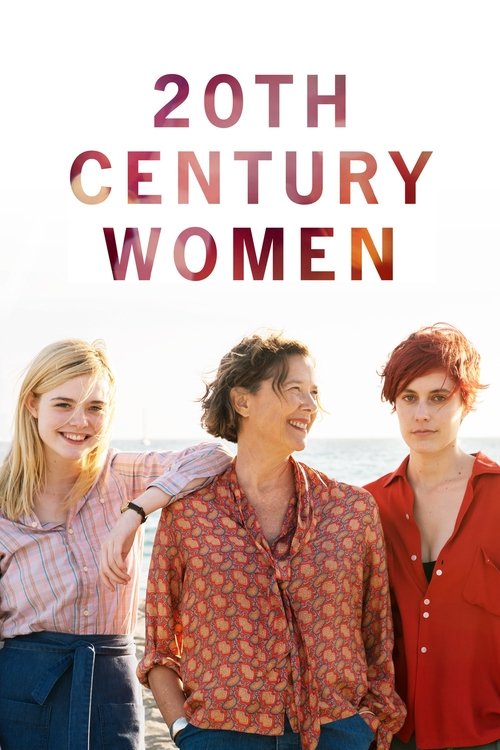
20th Century Women
2016 · Mike Mills
For when you're missing your mother, your younger self, or a house you once lived in — a thoughtful, tender watch for a quiet evening when you want to feel understood rather than thrilled.
What it's about
Santa Barbara, summer 1979: Dorothea, a chain-smoking single mother in her mid-fifties, decides she can't raise her teenage son Jamie alone and recruits two younger women to help — Abbie, the punk photographer renting a room in their rambling house, and Julie, the sharp, guarded girl next door who climbs through his window at night. What follows is less a plot than a portrait of five people teaching each other how to live at the exact moment the culture is changing under their feet.
The experience
Warm, funny, and unexpectedly moving, with a drifting, essay-like rhythm — voiceovers, old photographs, punk shows — that feels like flipping through a family album someone annotated with total honesty. It sneaks up on you; the ache arrives late and stays.
Performances
Annette Bening is extraordinary as Dorothea — curious, stubborn, unknowable even to her son — in one of the great late-career performances. Greta Gerwig and Elle Fanning give the two younger women full, prickly inner lives of their own.
The craft
Mike Mills builds the film like a collage: shifting narrators, archival images, needle-drops running from big band to Talking Heads, and a script full of lines people quote years later. The period detail is affectionate rather than nostalgic, and the structure — biography braided with history — is quietly daring for a mainstream drama.
Why it matters
It cemented Mills as a distinctive voice in autobiographical filmmaking and earned an Academy Award nomination for its screenplay, becoming a touchstone for warm, formally playful memoir cinema.
Snapshot
20th Century Women is Mike Mills's third narrative feature, an autobiographical ensemble drama set in Santa Barbara in the summer of 1979. Where his previous film, Beginners (2010), reconstructed his late father, this one is addressed to his mother: Dorothea Fields (Annette Bening), a fifty-five-year-old single parent who, feeling she cannot raise her teenage son alone, conscripts two younger women — the punk photographer-boarder Abbie (Greta Gerwig) and the neighbor's daughter Julie (Elle Fanning) — into the project of forming him. Structurally the film is less a plot than a braided set of biographies, narrated in shifting first-person voiceover that reaches confidently into each character's future. It sits at the intersection of the coming-of-age film, the memory film, and the essayistic collage, and it arrived as a signature A24-era release: modest in scale, formally adventurous, and pitched at prestige audiences. Its central historical anchor is a moment of national self-doubt — Jimmy Carter's July 1979 "Crisis of Confidence" address — which Mills uses to rhyme private and political uncertainty.
Industry & production
The film was produced by Annapurna Pictures, the company Megan Ellison founded to back director-driven work, and distributed in the United States by A24, then in its ascendant phase as a curator of American independent cinema. It premiered at the New York Film Festival in October 2016 and opened in limited release late that year to qualify for awards season before expanding in early 2017. As a character-driven period piece with no genre hook, it was an unmistakably specialty release, and the public financial record is thin and unremarkable; I will not assign box-office figures I cannot verify, but its commercial profile was that of a well-reviewed arthouse title rather than a breakout. Its principal industry validation came at the 89th Academy Awards, where Mills received a nomination for Best Original Screenplay — his first Oscar nomination — and at the Golden Globes, where the film competed in the Musical or Comedy categories and Bening was nominated as Best Actress. The production reflects the mid-2010s indie ecosystem in which a financier-producer (Annapurna) and a taste-making distributor (A24) together enabled personal, mid-budget authorship that the major studios had largely abandoned.
Technology
20th Century Women is a film about the texture of a specific past, and much of its craft is devoted to reconstructing the visual grain of 1979. It integrates archival and archival-seeming material — historical photographs, found footage, magazine and book imagery — into the fiction, so that private lives are continuously cross-cut with the twentieth century's public image bank. Its most conspicuous technological signature is a recurring optical device: cars and figures in motion smeared into streaks of saturated color, a psychedelic light-trail effect that punctuates transitions and stands in for memory's blur. I am not certain of the exact capture format and will not assert a specific film stock; what is clear is that the cinematography courts a warm, slightly grainy, photochemical period look consonant with the era's snapshots and its snapshot aesthetic, whatever the underlying acquisition method. The film's technological interest lies less in novel equipment than in the deliberate manufacture of pastness and in the seamless suturing of documentary artifacts into staged drama.
Technique
Cinematography
Sean Porter photographed the film in a register that balances naturalistic California light — the flat, bright interiors of a rambling old house under renovation — against the interruptive color of the streaked motion sequences. The house itself, perpetually half-restored, gives Porter a set of textured, lived-in spaces to work in, and the camera tends toward observational framing that lets the ensemble share the frame rather than isolating a single protagonist. The compositional logic is democratic: this is a film in which the mother, the boarder, the neighbor, and the boy each claim visual authority in turn.
Editing
Editing is arguably the film's most important formal instrument, and it was cut by Leslie Jones, an editor with deep experience in associative, non-linear construction. The film moves by montage as much as by scene — bursts of historical imagery, photographic inserts, and voiceover-driven biographical digressions that leap forward and backward in time. The rhythm is essayistic: a conversation will dissolve into a cascade of period photographs or a character's narrated fate, then return. This montage strategy converts a quiet domestic drama into something closer to a collage-essay about a decade.
Mise-en-scène / staging
The Fields house is the film's world — a communal, book-strewn, music-filled space whose ongoing renovation literalizes the theme of people being remade. Mills, trained as a graphic designer, treats the frame as a surface to be layered: album covers, feminist paperbacks (Our Bodies, Ourselves, writing by Betty Friedan and Audre Lorde), photographs, and objects carry as much argument as dialogue. Period costume and production design are precise without tipping into nostalgia kitsch, and props frequently double as thematic statements, as when a passed book becomes the vehicle for a character's education.
Sound
The soundtrack is a curated argument between generations. Abbie's world is punk and post-punk — Black Flag, the Raincoats, Talking Heads — set against the smoother rock Dorothea prefers, and the film stages an actual living-room debate over whether the music is "good." Source music does much of the emotional and ideological work; original scoring by Roger Neill (a returning Mills collaborator) is comparatively restrained, ceding the field to needle-drops that mark each character's cultural moment. Voiceover is a structural sound element in its own right, layered over image montages to carry the film's essayistic address.
Performance
The ensemble is the film's engine. Annette Bening gives a controlled, interior performance as Dorothea — a Depression-shaped woman raising a child amid a culture she finds bewildering and touching by turns — widely regarded as among her finest. Greta Gerwig's Abbie brings the film's punk energy and its most direct feminist pedagogy; Elle Fanning's Julie supplies the ache of adolescent intimacy withheld; Lucas Jade Zumann anchors the film as Jamie, and Billy Crudup rounds out the household as the sensitive, slightly adrift handyman William. The performances are pitched low and conversational, matching the film's observational grain.
Narrative & dramatic mode
The film's boldest choice is its narration. Multiple characters narrate — Dorothea, Jamie, Abbie, Julie — and their voiceovers frequently jump into the future to tell us, plainly and often movingly, how a life will end or unfold: a technique Mills had already used in Beginners and here expands into the film's organizing principle. This future-tense biography drains conventional suspense and replaces it with elegy; we watch the present knowing its outcomes, which turns the whole film into an act of retrospective love. The dramatic mode is memoir refracted through essay-film: episodic, digressive, structured around portraits rather than a goal-driven plot. Conflict is low-key and internal — how to raise a boy, how to be free, how to face mortality — and the film trusts accumulation over climax.
Genre & cycle
Nominally a coming-of-age story, 20th Century Women deliberately decenters its adolescent. Jamie's formation is the pretext, but the film's real subjects are the three women, and especially the mother, so it reads equally as a portrait-of-a-woman and a family-ensemble drama. It belongs to the cycle of autobiographical American memory films — personal, period-specific, first-person — and more broadly to the mid-2010s wave of intimate A24/Annapurna indies. It also sits within a small tradition of feminist-inflected period pieces that treat second-wave feminism not as backdrop but as living text. Its cousin within its own moment is Greta Gerwig's Lady Bird (2017), another California coming-of-age film organized around a mother; the resonance is notable, though I would not overstate direct causation.
Authorship & method
The film is a fully authored work: Mike Mills wrote and directed it, drawing on his own upbringing much as Beginners drew on his father's late-life coming-out. Mills's background as a graphic designer, album-art maker, and music-video and commercial director is legible throughout — in the collage sensibility, the typographic and photographic inserts, the essayistic layering of image and text. His method is autobiographical reconstruction filtered through formal play: he treats real people as material for stylized, generous portraiture. Key collaborators shape the result decisively: cinematographer Sean Porter grounds the stylization in naturalistic light; editor Leslie Jones translates memoir into associative montage; composer Roger Neill supplies restrained original music beneath a dense source-music design; and the ensemble cast, led by Bening, gives the essayistic structure its human weight. Mills's screenplay — the film's most decorated element — is where authorship is most concentrated, building character through narrated biography and cultural artifact.
Movement / national cinema
This is American independent cinema of the A24 era: director-driven, mid-budget, distributed and marketed as prestige art film. It descends from the personal, autobiographical strain of US indie authorship and shares DNA with the essay-film tradition in its collage of found imagery and narration. Its debts to European art cinema are stylistic rather than doctrinaire — the direct address, temporal freedom, and tender treatment of ordinary lives recall the freedoms the French New Wave licensed — but the film is thoroughly American in idiom, rooted in a specific California place and a specific national mood. I would locate it less within any organized movement than within the loose contemporary formation of autofictional auteur cinema.
Era / period
The film is exactingly dated: Santa Barbara, 1979, on the cusp of the 1980s. That specificity is thematic. It sits at the hinge between the exhausted idealism of the 1970s and the Reagan turn to come, and it makes Carter's "Crisis of Confidence" speech — with its diagnosis of a national spiritual malaise — into a mirror for its characters' private uncertainties. Punk's arrival marks the generational fault line; second-wave feminism is the intellectual weather; and the impending decade hangs over the narration's future-tense revelations. The film is simultaneously a period reconstruction and a meditation on how one historical moment gives way to another.
Themes
The film's central concern is formation — how people are made by other people, and specifically how a boy is shaped by the women around him. From that flow its major themes: motherhood and its limits; the impossibility of fully knowing one's child or one's mother; feminism as lived practice and as text (the film literally passes feminist literature between characters as instruction). Mortality runs beneath everything — Abbie's illness, tied to the DES generation, and the narration's habit of announcing deaths — making the film an extended reflection on impermanence and the effort to love people across the distance of time. It also examines masculinity in the making, generational rupture (musical, sexual, political), and the way large historical forces are metabolized in a single household. Above all it is about the ache of retrospect: understanding people fully only once they are gone or grown.
Reception, canon & influence
Critical reception was strongly positive, with particular praise for Mills's screenplay and for Bening's performance, and the film's awards profile — the Original Screenplay Oscar nomination and Bening's Golden Globe nomination — confirmed its standing as a critics' film. Looking backward, its influences are primarily internal and formal: it extends the autobiographical method and future-tense narration of Mills's own Beginners, marries them to an essay-film logic of found imagery and voiceover, and draws on the direct-address freedoms of European art cinema and the humane, ensemble-sharing tradition of American character drama. Its intellectual sources are worn openly on screen in the feminist texts it cites. Looking forward, the honest assessment is that its legacy is still forming; a decade on, its influence is best understood as part of A24's consolidation of a personal-indie house style and within a contemporaneous cluster of mother-centered California coming-of-age films — Gerwig's Lady Bird most conspicuously, though shared sensibility is not the same as demonstrable causation. It endures most securely as a high point in Mills's authorship and as a touchstone for the autofictional memory film. Claims of broader canonical influence would, at this remove, outrun the record.
Reception
A warmly reviewed but modest-grossing indie in 2016, best remembered at the time for Annette Bening's shocking Oscar snub — since then it's steadily climbed into the beloved-comfort-film tier of the A24 era, especially with younger cinephiles.
How 20th Century Women was received, from release to now →
Influences: the films it descends from and the films it influenced
- Beginners (2010) — Mills's own prior film established his template of autobiographical reconstruction narrated in a future-tense, obituary-inflected voiceover and studded with photographic/typographic inserts cataloging an era's objects — the exact method 20th Century Women scales up to three narrators.
- Jules and Jim (1962) — Truffaut's rapid omniscient narrator delivering characters' biographies and future fates over freeze-frames and montage is the New Wave source for Mills's device of narrating a person's whole life in a compressed burst while the image holds on them.
- Annie Hall (1977) — Allen's essayistic first-person address, digressive associative cutting, and willingness to break chronology to explain a character to the audience model the voiceover-address and essay-film logic Mills uses to step outside the 1979 scene.
- American Graffiti (1973) — Lucas pioneers the wall-to-wall period-pop needle-drop scored to a single community over one stretch of time, capped by end-card texts announcing each character's later fate — both the source-music density and the future-tense epilogue reappear in Mills.
- Sans Soleil (1983) — Marker's essay-film grammar — found and archival imagery organized not by plot but by a reflective voiceover threading associations across time — is the documentary-essay backbone under Mills's archival-collage montages.
- Days of Heaven (1978) — Malick's commitment to naturalistic available and magic-hour light paired with an unforced interior voiceover gives Mills and DP Sean Porter the model of grounding a stylized memory in believable natural illumination.
- The Royal Tenenbaums (2001) — Anderson's narrated-biography structure — a storybook voice introducing an ensemble via chaptered captions, inserts, and cataloged personal detail — is the design-forward antecedent for Mills's typographic and photographic character dossiers.
- Y Tu Mamá También (2001) — Cuarón's omniscient narrator that interrupts the drama to state a character's unseen past or future death models Mills's habit of pausing the scene so a voiceover can reveal how and when a character's life will end.
- Amélie (2001) — Jeunet's narrator who defines people by inventorying their specific likes and dislikes is the direct precedent for Mills introducing Dorothea, Julie, and Abbie through cataloged biographical and cultural particulars.
- Crooklyn (1994) — Extends the autobiographical, plotless family-texture memory-piece scored by curated period needle-drops and narrated recollection of a specific household era.
- C'mon C'mon (2021) — Mills extends his own method — essayistic voiceover, documentary-interview inserts, and text-on-screen citation of books read aloud — carrying the found-material-plus-narration structure of 20th Century Women forward.
- Roma (2018) — An autobiographical reconstruction of one specific year and household treated as material for stylized portraiture, sharing Mills's autofictional-memory-film project even as it swaps his collage for long-take realism.
- Aftersun (2022) — The autofictional memory film's next generation — reconstructing a parent through associative editing and literal archival-video (camcorder) collage, deploying the retrospect-and-mortality framing that structures Mills's remembering of Dorothea.
- The Tree of Life (2011) — A contemporaneous memory film built from associative, non-linear montage and whispered voiceover over naturally-lit fragments — the same essayistic assembling of recollection rather than plot that Mills practices.
- Frances Ha (2012) — Shares the conversational-ensemble, character-first American-indie register and needle-drop scoring of a specific milieu, treating overheard talk and pop songs as the primary means of characterization.
- Lady Bird (2017) — The clearest sibling — a mother-centered California coming-of-age shot in the same naturalistic light and built on ensemble-conversational performance, part of the same A24 personal-indie cluster (correlation of sensibility, not proven causation).
- Licorice Pizza (2021) — A period California coming-of-age driven by dense era-specific needle-drops and loose ensemble staging, reconstructing a remembered 1970s Southern California with the same nostalgic-yet-precise source-music design.
- Dreams (2024) — Uses intergenerational women and a literary chapter/voiceover structure to dramatize how people narrate and 'write up' one another, the same authorship-ethics engine as Dreams.
- Little Women (2019) — Memory-structured, retrospectively narrated portrait of women authoring their own lives, using a warm nostalgic palette and freeze-frame biography — a sibling in retrospection and warm-toned recollection.
Similar films
- Lady Bird (2017) — influence & lineage
- C'mon C'mon (2021) — influence & lineage
- Young Mothers (2025) — same viewing thread
- Amélie (2001) — influence & lineage · often watched together
- American Graffiti (1973) — influence & lineage · often watched together
- Saving Face (2004) — often watched together
- The Worst Person in the World (2021) — often watched together
- Mommy (2014) — often watched together
All the films related to 20th Century Women →
Watch it with: curated runs of related films
- Families Made and Unmade — A run of intimate domestic portraits — watch these together and feel marriages dissolve, mothers improvise, and love keep redrawing the shape of a family across sixty years.