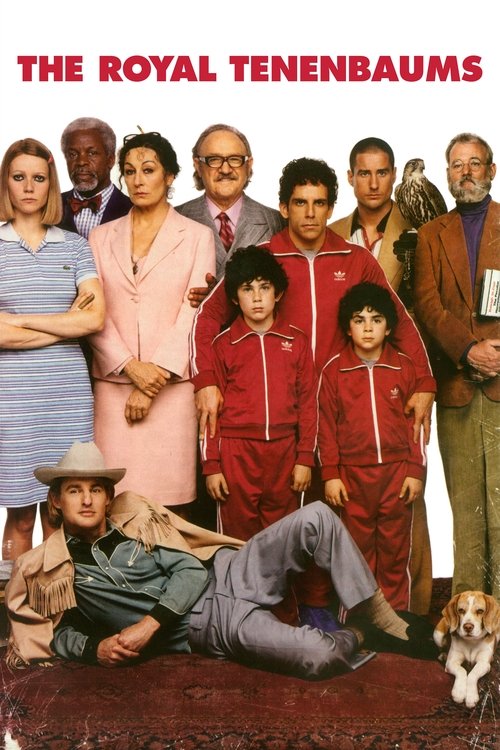
The Royal Tenenbaums
2001 · Wes Anderson
His style became so recognizable it turned into a TikTok filter trend and AI-parody genre, prompting discourse about whether pastiche had swallowed the artist; Asteroid City and The Phoenician Scheme kept the "self-parody or late-style depth" argument alive. Finally won his first Oscar for a Roald Dahl short.
For when you're feeling wistful about family, exes, or the person you were supposed to become — melancholy you can laugh at. A cozy watch that sneaks up on you emotionally.
What it's about
The Tenenbaums were a family of child geniuses — a business prodigy, a playwright, a tennis champion — whose brilliance collapsed into two decades of failure and estrangement, most of it their father's fault. Now Royal Tenenbaum, broke and freshly evicted, fakes a terminal illness to worm his way back into the household he wrecked. What follows is the family's grudging reassembly under one roof, old wounds and old loves included.
The experience
Deadpan and meticulous on the surface, genuinely sad underneath — the jokes land dry and fast, and then a needle-drop ambushes you with real grief. It's the rare comedy that gets more moving the stiller everyone's face is.
Performances
Gene Hackman is magnificent as Royal — a charming, selfish old fraud you love against your better judgment — and Gwyneth Paltrow's eyeliner-and-fur-coat Margot became an icon of secret sorrow. Anjelica Huston, Ben Stiller, and Luke Wilson all do wonders with very few words.
The craft
Every frame is composed like a page from a storybook — symmetrical rooms, hand-lettered titles, costumes that never change because these people are frozen in their childhoods. The narration and chaptered structure make it feel like a novel you're being read, and the soundtrack of melancholy pop songs carries half the film's emotion. It rewards close, repeated viewing.
Why it matters
This is the film that made Wes Anderson's style a genre unto itself — imitated, parodied, and beloved — and it defined a whole wistful, literate strain of 2000s American indie cinema.
Snapshot
Wes Anderson's third feature is a deadpan elegy for squandered promise — a mock-novel about a dynasty of child prodigies whose brilliance curdled into adulthood's ordinary wreckage. Set in a mythologized, temporally indeterminate New York that resembles no actual decade, the film follows the Tenenbaum family's grudging reassembly after patriarch Royal (Gene Hackman) engineers a fake terminal illness to reclaim his estranged children. The result is simultaneously Anderson's most emotionally vulnerable work and his most architecturally controlled: every composition, costume, and needle-drop locked into a system of meaning that is never quite cold enough to exclude grief. It became the defining text of a particular strain of American indie cinema — wistful, symmetrical, literate to the point of self-consciousness — and the template against which much of the decade's independent film would be measured, sometimes admiringly, often satirically.
Industry & production
The Royal Tenenbaums was produced by Scott Rudin and Wes Anderson, distributed by Touchstone Pictures (a Disney subsidiary), and shot largely on location in New York City during the summer of 2000. Anderson had established himself with Bottle Rocket (1996) and Rushmore (1998), the latter earning him sustained critical attention and a devoted cult following; this third film represented a significant step in budget and ambition. The screenplay was written by Anderson and Owen Wilson, continuing the writing partnership that had begun on Bottle Rocket. The film received a limited release in December 2001 ahead of a wide release in early 2002, a strategy designed to position it for awards consideration. It performed respectably at the box office given its decidedly uncommercial sensibility; precise revenue figures are in the public record but the film's commercial significance was secondary to its critical and cultural impact. Gene Hackman, a two-time Oscar winner approaching the end of his career, was the marquee casting and reportedly the most challenging to secure — accounts suggest he required considerable persuasion from producers before agreeing to work with Anderson, whose reputation for meticulous, director-driven sets was not universally appealing to actors of the old guard. The ensemble also included Bill Murray (deepening his collaboration with Anderson begun in Rushmore), Anjelica Huston, Gwyneth Paltrow, Ben Stiller, Luke Wilson, and Owen Wilson, along with Seymour Cassel and Kumar Pallana, both of whom Anderson had been casting since Bottle Rocket, building the repertory-company feel that would become a signature of his productions.
Technology
The film was shot on 35mm by Robert Yeoman, Anderson's cinematographer of record since Bottle Rocket. The format choice was consistent with Anderson's preference for the grain and tonal richness of photochemical film; the move to digital acquisition that would overtake the industry later in the decade held no appeal for this production's aesthetic. The aspect ratio — 1.85:1 — suited the film's tableau-oriented staging, giving frames a slightly squarish quality that reinforced the storybook illustrations Anderson had in mind. Production design was handled by David Wasco (with set decoration by Sandy Reynolds-Wasco), and the Tenenbaum family home — its exterior shot at 339 Convent Avenue in Harlem, its interior reconstructed as a studio set — was built as a dense accumulation of props, textures, and period-ambiguous furnishings that function as a material autobiography of the family's history. The visual construction of the house required an encyclopedic approach to set dressing: rotary phones, children's books, sporting trophies, and theatrical ephemera coexist in a space that refuses any single historical moment.
Technique
Cinematography
Yeoman's camera work here is among the most disciplined of his career. The dominant mode is the static or laterally tracking master shot — what critics would come to call Anderson's "tableau" style — in which characters are arranged in bilateral symmetry within the frame and the camera observes rather than pursues. Overhead shots punctuate the film at key moments, looking straight down onto figures laid out like specimens. When the camera moves, it tends to do so in slow, deliberate dollies or zooms that carry an air of ceremony, as if the act of observing these damaged people requires measured restraint. Depth of field is characteristically moderate: backgrounds are legible, not bokeh-blurred, preserving the environment as a co-equal element in every image. Slow-motion sequences — most devastatingly in the flashback of Margot and Richie's childhood, set to Nick Drake's "Fly" — use temporal dilation not for action-cinema emphasis but for something closer to lyric time: the past as a country one can almost enter.
Editing
Dylan Tichenor's editing enforces the film's literary conceit through a rhythm that is stately rather than propulsive. Cuts tend to honor the duration of a gesture or expression rather than compress it; the film rarely feels hurried, even in its compressed narrative jumps. The chapter-title cards that interrupt the action — styled in Futura, Anderson's typographic signature — function less as genuine narrative organizers than as ironic breathing room, pauses for the audience to register what genre expectations are being manipulated. The editing's most characteristic move is the matched cut that rhymes action across time, binding the family's present disappointments to the childhood footage Anderson deploys in brief, idealized flashbacks.
Mise-en-scène / staging
The film's staging is theatrical in the original sense: characters do not move naturalistically through space but take up positions within it. Anderson's blocking tends toward frontality — actors face the camera more often than they face each other — which creates a quality of address, as if the characters know they are being observed and have organized themselves accordingly. The color-coding of characters is systematic: Chas and his sons move through the film in matching red Adidas tracksuits; Margot's fur coat, kohl eyeliner, and barrette are so precisely calibrated that they constitute a character portrait before she speaks; Richie's tennis headband, Ray-Bans, and safari-style clothing signal a man trying to become anonymous within the iconography of his own athletic past. The Tenenbaum house accumulates meaning across the film's running time, each room a sediment layer of the family's mythology.
Sound
Mark Mothersbaugh composed the original score, as he had for Bottle Rocket and Rushmore. His palette here is unusual: harpsichord-led miniatures, spare orchestral gestures, and melancholic piano figures that tilt the film toward Baroque formalism without quite landing there. The score occupies a deliberately modest register, making space for the film's more celebrated sonic element: its licensed music. Music supervisor Randall Poster assembled a selection — Nick Drake, The Rolling Stones ("She Smiled Sweetly"), Elliott Smith, Nico, Paul Simon, The Clash, the Vince Guaraldi Trio — that functions as a second emotional track running beneath the action. The choices are consistently melancholic and canonically impeccable, and their curation contributed materially to the film's cultural impact; the soundtrack album sold well and introduced portions of its audience to artists they would not otherwise have encountered. The narration by Alec Baldwin, delivered in the flat declarative cadences of an audiobook reader, constitutes a third sonic layer — ironic in its evenhandedness, it refuses to privilege any character's interiority while lending the whole enterprise the authority of a text that already exists.
Performance
Gene Hackman's performance is the film's greatest surprise. Known for naturalistic intensity, he plays Royal Tenenbaum with a loose, almost improvisatory quality that simultaneously undercuts the film's stylization and anchors it. He finds the pathos inside the monster without requesting audience sympathy he hasn't earned. Gwyneth Paltrow's Margot — depressive, secretive, mysteriously self-enclosed — achieves something difficult: she makes stillness charismatic. Ben Stiller's Chas, wound to the point of rupture with grief and rage, is the film's emotional baseline. Anderson's characteristic mode of direction produces a consistency across the ensemble: performers tend toward understatement, restraint, a withholding of affect that the audience is invited to interpret as concealed depth.
Narrative & dramatic mode
The film's narrative is delivered in the mode of a Penguin paperback: a library-card image opens the film as the eponymous novel is stamped and checked out, and Baldwin's narration proceeds chapter by chapter. This self-conscious literariness is not merely decorative. Anderson and Wilson are working within a tradition of the family saga as elegiac comedy — stories in which the decline of an exceptional household stands in for some broader cultural loss. The narrative engine is a con: Royal's fabricated cancer diagnosis, which temporarily reunites the family, eventually collapses under scrutiny, and the film turns on whether a man capable of that deception can nonetheless perform a genuine act of love. The dramatic mode is what might be called affectless melodrama: the situations — suicide attempt, incestuous desire, bereavement — are classic melodramatic materials, but they are handled without the tonal heightening melodrama conventionally employs.
Genre & cycle
The film belongs to the dysfunctional-family comedy, a genre with deep roots in American theater and film, but it inflects that genre through the sensibility of literary fiction — specifically the short-story tradition of the New Yorker, whose particular combination of irony, melancholy, and formal elegance is the film's atmospheric register. Within its immediate historical context, it represents a refinement of the American indie aesthetic that had emerged through the Sundance circuit in the late 1980s and 1990s: post-Tarantino in its self-consciousness, but fundamentally opposed to Tarantino's kineticism and genre violence, reaching instead toward Hal Ashby's meditative, character-driven comedies of the 1970s.
Authorship & method
Anderson co-wrote the script with Owen Wilson (their third collaboration), and Wilson's contribution to the Andersonian voice — warmer, more rangy, more openly sentimental than Anderson alone tends to be — is worth acknowledging, though the precise allocation of creative labor between the two writers is not publicly documented with any precision. The collaboration ended here; Anderson has written his subsequent films with Roman Coppola, Jason Schwartzman, and Hugo Guinness, and the shift is perceptible. Yeoman's cinematography translates Anderson's storyboard-level precision into photographic images without flattening the work into illustration; his willingness to function as a technical executor of a highly specific vision, rather than an auteur in his own right, has been foundational to the consistency of Anderson's visual world. Mothersbaugh's scores through these early films provide an idiosyncratic tonal signature, though Anderson would later move toward Alexandre Desplat and original compositions by other musicians.
Movement / national cinema
The Royal Tenenbaums is American independent cinema at its most elaborately constructed. It belongs to what might be called the post-Sundance studio-indie hybrid: pictures with modest budgets and genuinely personal visions that nonetheless secured mainstream distribution through the specialty-film divisions of major studios. This model — which had enabled films like Rushmore, Being John Malkovich, and Election — was at its commercial and artistic apex in the late 1990s and early 2000s, and the Tenenbaums represents its apogee of formal ambition. The film engages with New York as a literary and cinematic geography while systematically refusing the realism that ordinarily governs New York films: it is a city of the imagination, closer to J.D. Salinger's Upper East Side than to any documentable borough.
Era / period
The early 2000s in American cinema were a moment of unusual vitality for mid-budget literary adaptations and auteur-driven comedies: P.T. Anderson, Alexander Payne, Spike Jonze, and Sofia Coppola were all producing distinctive work within or adjacent to the studio system. The Royal Tenenbaums appeared in December 2001, three months after September 11th, into a cultural moment characterized by both profound disruption and a hunger for the comfort of enclosed, elaborately imagined worlds. Whether this context shaped the film's reception is difficult to establish with precision, but the film's themes of family reunion and the possibility of imperfect redemption resonated in ways that pure critical assessment alone cannot account for.
Themes
Failure and inheritance are the film's twin concerns. All three Tenenbaum children have been defined by a brief period of exceptional achievement followed by decades of diminishment, and the film examines whether such people are the victims of their circumstances or the authors of their own stagnation — a question it refuses to answer cleanly. Royal Tenenbaum himself embodies the film's most uncomfortable thesis: that a person can be genuinely lovable and genuinely destructive simultaneously, and that neither quality cancels the other. Grief is present throughout — Chas has recently lost his wife, Richie has suffered a collapse whose origins are revealed gradually — and the film treats it not as an obstacle to overcome but as a permanent alteration of the self. The tension between singularity and belonging, between the isolated genius and the family that both produced and damaged them, drives the emotional logic of every subplot.
Reception, canon & influence
Critical reception was strongly positive, with particular praise directed at Hackman's performance and the film's tonal complexity. It was nominated for the Academy Award for Best Original Screenplay (Anderson and Wilson), recognition that confirmed Anderson's arrival as a filmmaker whose ambitions extended beyond the merely stylistic. The film did not win. Its canonical status solidified quickly: by the mid-2000s it was regularly cited in lists of the decade's best American films, and it entered the curriculum of film programs as a central document of contemporary American indie aesthetics.
Backward influences are legible and have been variously acknowledged: J.D. Salinger's Glass family stories (Franny and Zooey, the Seymour Glass stories) provided the template of the brilliant, spiritually troubled family as subject. Orson Welles's The Magnificent Ambersons (1942) — the story of an aristocratic family's decline narrated at a remove that transforms tragedy into irony — is a structural ancestor. Hal Ashby's films, especially Harold and Maude (1971), supply the tonal key: comedy that takes death and failure seriously without becoming solemn. The French New Wave, particularly Truffaut's sensitivity to childhood experience and Malle's formal play, inform Anderson's literary self-consciousness. The New Yorker, as an institution — its typographic conventions, its tone of knowing regret — is more an atmospheric source than a specific textual one.
Forward influence has been enormous and, in some quarters, pernicious. The film's visual grammar — the symmetrical frame, the flat tableau, the color-coded costume, the Futura title card, the needle-drop as emotional signal — became the most widely imitated stylistic package in American independent film of the 2000s, generating a wave of imitators whose adoption of the surface without the substance produced the "quirky indie" cycle that critics grew quickly to resent. Films like Little Miss Sunshine (2006) represent sympathetic descendants; countless others represent the style unmoored from Anderson's discipline. The film also had a subtler influence on literary fiction, graphic novels, and visual art: the idea of the film-as-book, with its typographic and compositional vocabulary, made Anderson's approach legible as a design methodology, not merely a filmmaking one. His work became a touchstone in design and illustration communities in a way that few narrative films have achieved.
A Deleuzian reading
Margot steps off the Green Line bus in slow motion, and Richie watches her from the dock, and Nick Drake sings "Fly," and for twenty-odd seconds the film stops being a comedy about a family of failures.
The full Deleuzian reading of The Royal Tenenbaums →
Reception
Warmly received in 2001 (an Oscar nod for the screenplay and Anderson's biggest box office hit to that point), it has since hardened into the consensus pick for peak Wes Anderson — the film even his skeptics tend to allow.
How The Royal Tenenbaums was received, from release to now →
Influences: the films it descends from and the films it influenced
- Harold and Maude (1971) — Ashby's use of Cat Stevens needle-drops as emotional surrogates for affect-blocked, deadpan characters establishes the method Anderson inherits wholesale: the licensed song does the grieving the performer refuses to perform, so the gap between music and face becomes the film's emotional engine.
- Barry Lyndon (1975) — Kubrick's chapter-title intertitles framing a rogue's rise and fall with ironic literary detachment are the direct formal precursor to Anderson's Futura-typeset chapter cards — both deploy the mock-novel apparatus to signal authorial distance from a protagonist's self-serving delusions.
- Playtime (1967) — Tati's method of positioning figures in architecturally symmetrical widescreen compositions and observing them from a fixed, unhurried camera distance — the frame as a stage to be read, not a window to enter — establishes the static-tableau grammar Anderson codifies as a personal signature.
- Badlands (1973) — Sissy Spacek's voiceover narrates murders and romantic disasters in the same tonally neutral register as weather observations, pioneering the affectless-narrator mode Anderson adopts: the gap between the speaker's emotional flatness and the events' magnitude generates comedy and grief simultaneously.
- The Magnificent Ambersons (1942) — Welles's mock-biographical structure — an off-screen narrator reconstructing a great family's decline through domestic interiors dense with accumulated objects — maps directly onto Anderson's Tenenbaum chronicle, including the technique of using material possessions as a family's externalized autobiography.
- The Umbrellas of Cherbourg (1964) — Demy's integrated chromatic design — costume, set dressing, and props coordinated into a unified emotional color system rather than naturalistic décor — is the direct antecedent of Anderson's character-coding through wardrobe, where Richie's tennis whites, Margot's fur coat, and Royal's chalk-stripe suit each function as a semiotic unit.
- Tom Jones (1963) — Richardson's film performs its own novelness through chapter headings, a wry literary narrator, and meta-cinematic asides — treating cinema as illustrated prose fiction rather than a transparent window — establishing the mock-novel apparatus Anderson imports wholesale for Tenenbaums even though there is no source novel.
- Bande à part (1964) — Godard's chapter-title intertitles and his staging of characters who perform theatrical gestures for the camera rather than inhabit space naturalistically — the Louvre sprint, the café dance — are formal antecedents to Anderson's anti-naturalist blocking in which actors face the lens more often than they face each other.
- The Big Lebowski (1998) — Anderson directly extends Lebowski's costume-as-character-coding — Richie's headband, Margot's fur coat, Royal's suit as complete biographical statements — combined with the eclectic needle-drop soundtrack (Nico, Nick Drake, Elliott Smith) assembled from unexpected period sources to mark tonal shifts, a technique Anderson absorbed and systematized into a signature method.
- Rushmore (1998) — Directly elaborates the Rushmore kit — chapter cards, symmetrical vitrine framing, slow-motion needle-drop finale, Mothersbaugh score, and Murray as melancholy totem — onto a multi-generational family canvas.
- Good Morning (1959) — Planimetric frontal symmetry, direct near-to-camera address, and graphic-match cutting between geometrically balanced set-ups extend Ozu's frontal-tableau and graphic-match devices into deadpan family comedy.
- Ariel (1988) — Anderson's flat frontal 'planimetric' framing, centered symmetry and melancholic deadpan delivery extend the same head-on staging logic into ornate maximalism.
- The Squid and the Whale (2005) — Baumbach extends Anderson's dysfunctional-literary-family mode into confessional autobiography, retaining the cultural-marker-saturated mise-en-scène — Bernard's bookshelves, dinner-table literary disputes — as psychological topography while stripping the symmetrical visual grammar and replacing deadpan with unguarded pain.
- Little Miss Sunshine (2006) — Dayton and Faris apply Anderson's dysfunctional-ensemble-in-color-coordinated-costumes model to a road structure, retaining the affective-withholding-until-collapse architecture and the method of staging characters in group tableaux whose visual arrangement maps the family's internal fractures.
- Submarine (2010) — Ayoade's chapter-title structure, Oliver Tate's deadpan literary voiceover, and the foregrounding of bookishness as character armor constitute a direct adaptation of Anderson's mock-novel apparatus to a British coming-of-age register, including the adolescent narrator's systematic inability to read his own emotional situation.
- Moonrise Kingdom (2012) — Anderson pushes the Tenenbaums mock-novel apparatus to its logical extreme by introducing a diegetic metafictional narrator (Bob Balaban) who physically appears within the storyworld, converting the chapter-title structure and theatrical frontality from implied self-consciousness into overt formal declaration.
- Igby Goes Down (2002) — Creates the immediate marketplace for the ironic ensemble portrait of upper-class WASP dysfunction, including cast-against-type stunt casting and a chaptered literary framing device.
- The Life Aquatic with Steve Zissou (2004) — Introduces the storybook chaptering and the dollhouse cross-section interior (the Tenenbaum house) that the Belafonte's cutaway hull explicitly expands into a full diorama.
- 20th Century Women (2016) — Anderson's narrated-biography structure — a storybook voice introducing an ensemble via chaptered captions, inserts, and cataloged personal detail — is the design-forward antecedent for Mills's typographic and photographic character dossiers.
- Hunt for the Wilderpeople (2016) — Codifies the literary chapter-intertitle as a comic pacing device that frames deadpan family dysfunction, the editing grammar Tom Eagles borrows for Wilderpeople's chapter cards.
- Captain Fantastic (2016) — Trained-prodigy child ensemble whose uniform is the family doctrine worn on the body, staged in frontal symmetrical group tableaux; Ross takes the costume-as-ideology grammar and then has Fontaine's handheld deliberately break the symmetry so it never sets into diorama.
- The Phoenician Scheme (2025) — Anderson's own source for the illustrated-chapter structure and for the house shot as a room-by-room set of frontal plates, plus the moral arithmetic of a delinquent father auditing his children — restaged here as literal ledger and inheritance.
- Election (1999) — Payne's multiple deadpan voiceovers from characters who systematically misread themselves and each other — narrators unreliable through emotional limitation rather than dishonesty — operate the same dramatic irony machine as Anderson's mock-literary narrator who frames the Tenenbaums' self-deceptions without correction.
- The Ice Storm (1997) — Lee's use of period-specific production design — every object in the Hood household as a topographic map of repression — shares Anderson's method of externalizing inexpressible interior states through accumulated material culture, applied to the same subject of American family dysfunction and affective blockage.
- Punch-Drunk Love (2002) — Jon Brion's score functions as the emotional nervous system for an affect-blocked protagonist who cannot name his own feelings, directly paralleling Wes Anderson's use of curated needle-drops to carry the emotional register that his deadpan performers deliberately suppress — both films locate music as the film's only honest register.
- Lost in Translation (2003) — Coppola deploys licensed music — Squarepusher, Air, The Jesus and Mary Chain — as the primary carrier of emotional states for characters incapable of speech, and casts Bill Murray performing the same affective-withholding mode he brings to Tenenbaums; the overlap constitutes parallel formal invention, not derivation.
- Pulp Fiction (1994) — Wes Anderson adopts the chapter-title narrative segmentation and wall-to-wall pop/rock compilation soundtrack as structural skeleton — a direct inheritance of Tarantino's device of using named episodes and anachronistic music to organize a morally complex ensemble.
- Gosford Park (2001) — Anderson's single-house ensemble, choral narration and dollhouse staging extend the Altmanesque mode of a family-society mapped room by room with the camera as anthropologist.
- Amélie (2001) — Shares the omniscient literary narrator, chaptered episodic structure, and meticulously color-keyed, prop-curated production design as a parallel storybook formalism.
- Juno (2007) — Popularizes the illustrated storybook chapter-title device and meticulous curated production design that Juno's rotoscoped animated titles and seasonal-chapter structure echo.
Similar films
- Moonrise Kingdom (2012) — influence & lineage
- The Squid and the Whale (2005) — influence & lineage
- The Magnificent Ambersons (1942) — influence & lineage
- Rushmore (1998) — shared sensibility
- The Grand Budapest Hotel (2014) — shared sensibility
- Synecdoche, New York (2008) — shared sensibility
- Fantastic Mr. Fox (2009) — shared sensibility
- Boyhood (2014) — shared sensibility
All the films related to The Royal Tenenbaums →