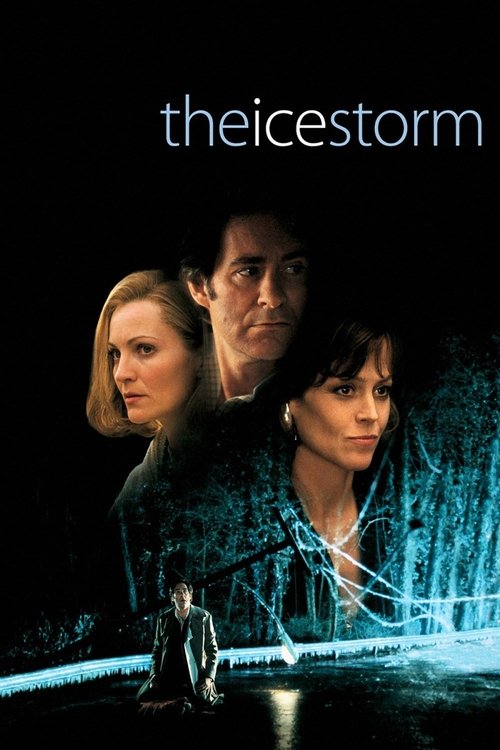
The Ice Storm
1997 · Ang Lee
For a wintry night when you want something grown-up and aching rather than comforting — the kind of film you sit with afterward. Not a pick-me-up; it's for when you're ready to feel a slow, beautiful heartbreak.
What it's about
Two well-off families in 1973 Connecticut drift through the weekend after Thanksgiving, the parents numbing themselves with affairs and cocktail-party swinging while their teenage kids run their own risky experiments across the hedge. Watergate hums on the TV, nobody says what they mean, and the worst ice storm in a century is rolling in over the whole brittle arrangement.
The experience
Quiet, chilly, and slow-burning — it works by accumulation, small humiliations and silences stacking up until the air feels dangerous. It's sad in a way that sneaks up on you, with flashes of awkward comedy that make the melancholy land harder.
Performances
Joan Allen does devastating work with almost no dialogue, and Sigourney Weaver plays cool detachment with a razor edge. Christina Ricci, Tobey Maguire, and Elijah Wood make the kids' storylines every bit as vivid as the adults'.
The craft
Ang Lee shoots suburbia like a landscape of glass — every frame is ice, windows, and reflections, matched by a spare, chiming score that sounds like the weather. The 1973 period detail is exact without ever winking, and the whole thing has a hushed precision that rewards watching in a quiet room where you can hear it breathe.
Why it matters
It confirmed Ang Lee as a director who could dissect any culture from the inside, and it became a touchstone for how movies portray 1970s suburban disillusionment. Its young cast went on to define the next decade of American acting.
Snapshot
The Ice Storm is Ang Lee's adaptation of Rick Moody's 1994 novel, a chamber tragedy of two affluent families unraveling over the Thanksgiving weekend of 1973 in New Canaan, Connecticut. As Watergate plays on the television and the sexual revolution curdles into suburban ritual, the Hood and Carver households drift through adultery, adolescent experiment, and emotional anesthesia until a literal ice storm — and a sudden, arbitrary death — arrives to break the spell. It was Lee's fifth feature and his first set wholly in American suburbia, made directly after the prestige success of Sense and Sensibility (1995). Scripted by his long-time partner James Schamus, it is at once a precise period reconstruction and a study of repression, mistaking the chilly New England exterior for a moral climate. Restrained, melancholic, and formally exact, the film won the Best Screenplay prize at the 1997 Cannes Film Festival and has since become a touchstone of the late-1990s "suburban malaise" cycle.
Industry & production
The film was produced by Good Machine, the influential independent outfit run by Schamus and Ted Hope that had backed Lee's earliest features, in partnership with Fox Searchlight Pictures — the specialty division Twentieth Century Fox had launched in 1994. The Ice Storm was an early, defining title for Searchlight, the kind of literary, director-driven, mid-budget adult drama the division was built to release. Coming off the Oscar-nominated Sense and Sensibility, Lee had the industry standing to attract a deep ensemble of established and rising actors, and the production positioned itself squarely in the awards-season specialty market rather than the multiplex.
Commercially the film was modest; it was never conceived as a wide hit, and I will not assign it specific box-office figures, as I cannot verify them here. Its returns came in the form of prestige and durability: a Cannes screenplay award, strong critical notices, and a reputation that has grown rather than faded. The production reflects the late-1990s American independent ecosystem at its most confident — a foreign-born auteur, a writer-producer of literary sensibility, and a studio specialty arm collaborating on material with no obvious mainstream hook. The decision to mount a chilly, ironic, downbeat period piece with a tragic core, and to release it through a major studio's art-house wing, is itself a marker of that brief moment when such films could find institutional support.
Technology
The Ice Storm is a conventionally photographed 35mm film of its era, and its technological interest lies less in apparatus than in disciplined craft. There are no showy optical or digital effects; the ice itself is the film's central "effect," rendered through practical means — coated branches, wires, and surfaces glazed to catch light — and through the photographic treatment of cold, reflective surfaces. The climactic electrocution of a teenage boy by a downed, ice-laden power line is staged for restraint rather than spectacle. The film belongs to the pre-digital-intermediate age of American cinema, where mood was built in-camera and in the lab through lens choice, lighting, and color timing rather than through post-production manipulation. Its technological signature, such as it is, is the careful integration of practical winter atmospherics with a controlled, desaturated palette.
Technique
Cinematography
The cinematography is by Frederick Elmes, a major figure best known for his work with David Lynch on Eraserhead, Blue Velvet, and Wild at Heart. Elmes brings a cool, glassy precision to The Ice Storm, favoring muted, wintry tones, reflective surfaces, and a sense of enclosure within tasteful modern interiors. Glass, ice, water, and polished wood recur as motifs, and the camera repeatedly frames characters through windows, doorways, and partitions — emphasizing separation and the voyeuristic, observed quality of suburban life. The imagery grows progressively more crystalline as the storm approaches, with the ice transforming the familiar landscape into something beautiful and lethal. Elmes's restraint — long, composed takes, careful but unobtrusive movement — lets the period production design and the actors carry the frame, while the increasingly icy light externalizes the emotional freeze at the center of the story.
Editing
Editing is by Tim Squyres, Lee's regular collaborator from The Wedding Banquet onward. Squyres cuts the film as an ensemble piece, cross-cutting between the two households and between the adult and adolescent worlds to draw rhyming parallels — the parents' key party answers the children's furtive sexual experiments, and vice versa. The pacing is deliberate and measured through most of the film, accumulating small domestic observations, then tightens as the storm and the converging plotlines bring the characters into collision. The structure is essentially a slow build to a single catastrophic accident and its aftermath, and the editing manages this gathering pressure with patience, withholding the release until the storm itself has done its work.
Mise-en-scène / staging
Production design and staging are central to the film's meaning. The period detail of 1973 — furniture, fashion, water beds, modernist suburban architecture, the textures of upper-middle-class New England — is rendered with anthropological exactness, but never as nostalgic pastiche. Interiors feel cold, spacious, and emotionally vacant; objects and décor signify the families' material comfort and spiritual emptiness. Lee stages domestic scenes with characters dispersed across rooms, physically near but rarely connecting, and uses the architecture of the houses to express isolation. The recurring iconography — the empty swimming pool, the dinner table, the children's bedrooms, the bottle of liquor — builds a visual vocabulary of containment. The film treats its props (Nixon masks, a Fantastic Four comic, the "key bowl" at the party) as concentrated symbols rather than mere set dressing.
Sound
The score is by Mychael Danna, another frequent Lee collaborator. Rather than reaching for period rock, Danna composed a spare, unconventional score drawing on non-Western and quasi-archaic textures — Native American flute timbres and gamelan-like percussion are characteristic of his approach in this period — producing music that feels alien to the suburban setting and lends the film an estranged, ritualistic atmosphere. The effect is to defamiliarize 1973 suburbia, treating its rites as anthropological ceremony. This is balanced against carefully chosen period source sound and the diegetic presence of television (Watergate hearings, broadcasts), which roots the film in its precise historical moment. The sound design of the storm — cracking ice, falling branches, the hum of electricity — is essential to the climax.
Performance
The ensemble is among the film's chief glories. Kevin Kline plays Ben Hood with a hollow, self-deceiving bonhomie; Joan Allen, as his wife Elena, gives a study in suppressed fury and quiet disintegration that is widely regarded as one of the film's finest turns. Sigourney Weaver plays Janey Carver, the neighbor with whom Ben is having an affair, as brittle and contemptuous; her performance drew significant awards attention, including recognition from BAFTA. The younger cast is remarkable in retrospect: Christina Ricci as the precociously transgressive Wendy Hood, Tobey Maguire as the watchful narrator-figure Paul, Elijah Wood as the doomed Mikey Carver, and Katie Holmes among the adolescents. The performances are pitched toward restraint — the film's drama is one of things unsaid — and Lee draws from his actors a uniform tone of muffled, articulate unhappiness.
Narrative & dramatic mode
The film operates in the mode of the literary ensemble drama, weaving multiple storylines across two families and two generations. Its dramatic engine is irony and dramatic understatement: the adults' transgressions and the children's experiments mirror one another, and the audience perceives connections the characters cannot. There is a framing device drawn from the novel — Paul Hood's reflective voice and his use of the Fantastic Four comic as a lens for understanding family ("the family is the void you emerge from and the place you return to when you die") — which lends the film a retrospective, meditative cast. The narrative withholds catharsis until a sudden, meaningless death imposes consequence on a world that has been coasting without it. This is tragedy in a minor, domestic key: the storm functions as both literal event and moral reckoning, and the ending turns on grief rather than resolution.
Genre & cycle
The Ice Storm is a domestic drama and a period film, but it is most usefully read as part of the late-1990s American cinema of suburban anomie — a loose cycle of films diagnosing the rot beneath affluent suburban surfaces. It arrived shortly before Happiness (1998), American Beauty (1999), and The Virgin Suicides (1999), and it shares with them an interest in repression, adolescent sexuality, parental failure, and the gap between manicured exteriors and inner desolation. Within that cycle, The Ice Storm is the most restrained and least satirical, trading the savage irony of Solondz or the theatrical bitterness of American Beauty for a cooler, more elegiac register. It also belongs to a longer American tradition of literary suburban critique stretching back to John Cheever and John Updike, whose chronicles of WASP infidelity and quiet desperation are clear ancestors.
Authorship & method
The film is the product of a settled creative partnership. Ang Lee directs with the empathetic precision and tonal control already evident in his "Father Knows Best" trilogy (Pushing Hands, The Wedding Banquet, Eat Drink Man Woman) and Sense and Sensibility — films likewise concerned with family, repression, and the friction between social ritual and private feeling. The Ice Storm confirmed Lee as a director able to move across cultures and genres while retaining a consistent thematic preoccupation with familial duty and emotional restraint. The screenplay is by James Schamus, Lee's producing partner and co-author throughout his career, who adapted Moody's novel and won the Best Screenplay prize at Cannes for it. The collaboration with cinematographer Frederick Elmes, editor Tim Squyres, and composer Mychael Danna gives the film its distinctive surface: glassy, exact, estranged. Lee's method here is one of immersive period reconstruction married to a fundamentally humane, non-judgmental view of even his most foolish or cruel characters — the film observes its families without contempt.
Movement / national cinema
The film sits at an interesting cultural crossroads. It is an American story told by a Taiwanese-born director working within the American independent system, and it exemplifies the internationalization of US art cinema in the 1990s, when foreign-born auteurs brought outsider perspectives to quintessentially American material. Lee's "outsider's eye" is often credited with the film's anthropological clarity about American suburbia and its rituals. Institutionally, it belongs to the American independent / specialty-division movement of the decade — the Good Machine / Sundance / Fox Searchlight ecosystem — rather than to any stylistic school. It is also a literary adaptation in a period rich with them, part of the era's confidence that serious novels could anchor serious films.
Era / period
The film is doubly situated in time. Its setting — November 1973 — is rendered with deliberate specificity: Watergate on the television, the post-1960s hangover, the diffusion of the sexual revolution into the bored experiments of married suburbanites, the early-decade economic and political malaise. Lee uses the period not for nostalgia but as a diagnosis of a particular American moment of disillusionment and lost moral footing. As an artifact of its own moment — 1997 — it reflects the high-water mark of the American independent film, the prestige of the literary adaptation, and the late-90s cultural appetite for examining the failures of the Boomer generation's idealism. The film's retrospective gaze on 1973 is itself characteristic of the late-1990s.
Themes
The film's governing theme is repression — emotional, sexual, generational — and the failure of communication within the family. It examines the consequences of the sexual revolution stripped of its idealism, reduced to the joyless transaction of the "key party." It is concerned with the abdication of parental authority and the way children absorb and reenact their parents' confusions. Cold and ice serve as the central metaphor: the emotional freeze of the adults, the literal storm that crystallizes and then shatters their world. The Fantastic Four motif voices the film's meditation on the family as both origin and trap — "the negative zone" from which one cannot fully escape. Underlying it all is a sense of moral drift in a comfortable society that has lost its bearings, and the arbitrary, undeserved nature of the suffering that finally arrives.
Reception, canon & influence
Critically, The Ice Storm was well received, praised for its ensemble performances (Joan Allen and Sigourney Weaver in particular), its meticulous period craft, and Lee's controlled, compassionate direction; some reviewers found its chilly restraint emotionally distancing, a criticism that has attached to the film throughout its life. Its most prominent honor was the Best Screenplay award at the 1997 Cannes Film Festival for James Schamus, and Sigourney Weaver's performance drew significant awards recognition, including from BAFTA. I am cautious about reciting a fuller awards ledger here, as I cannot verify every nomination from memory.
Looking backward, the film draws on the literary tradition of suburban WASP fiction — Cheever and Updike above all — and on Moody's novel directly; its sensibility also descends from the American family melodramas and the dramas of repression that precede it. Looking forward, it became a key early text in the late-1990s suburban-malaise cycle, anticipating American Beauty, Happiness, and The Virgin Suicides, and it remains a frequent reference point in discussions of how American film depicts the hollowness beneath suburban prosperity. For Lee personally, it consolidated his standing as a serious, versatile auteur between Sense and Sensibility and the later triumphs of Crouching Tiger, Hidden Dragon and Brokeback Mountain — the latter sharing this film's interest in repressed feeling and emotional cost. The film's reputation has appreciated over time, and it is now widely regarded as one of the finest American dramas of the 1990s and a high point of the decade's independent cinema.
A Deleuzian reading
The branches go first.
The full Deleuzian reading of The Ice Storm →
Reception
It won Best Screenplay at Cannes in 1997, then underperformed at the box office and was shut out entirely at the Oscars — Sigourney Weaver's snub still gets brought up. Now it's Criterion-canonised and routinely ranked among the best American films of the '90s.
How The Ice Storm was received, from release to now →
Influences: the films it descends from and the films it influenced
- The Swimmer (1968) — Adapts Cheever directly, translating suburban WASP anomie into a journey across symbolic props (pools, lawns, cocktails) — the exact literary-symbolic tradition The Ice Storm inherits.
- Ordinary People (1980) — Pioneers the immaculate affluent home as a vessel of unspoken grief, with ensemble acting built on suppressed gesture and the dramatic irony of politeness masking collapse.
- Interiors (1978) — Imports Bergman's chilly chamber-drama formalism to a WASP family — desaturated palette, glassy compositions, and stillness as the visual grammar of emotional paralysis.
- The Graduate (1967) — Establishes framing characters through glass, aquariums, and pool surfaces to render suburban entrapment — the through-windows vocabulary Elmes and Lee reprise.
- Blue Velvet (1986) — Frederick Elmes' cinematography of rot beneath placid suburban surfaces — the same DP's hyper-exact, estranged surface that gives The Ice Storm its glassy menace.
- Sense and Sensibility (1995) — The Lee/Schamus method of staging social ritual against suppressed feeling, with performances calibrated to restraint and decorum cracking under private pressure.
- Eat Drink Man Woman (1994) — Lee's editing of familial duty through ritual (the family meal) and cross-cut parallel lives, observing foolish characters without contempt.
- Short Cuts (1993) — Literary ensemble adaptation (Carver) structured on cross-cutting between repressed middle-class households, building toward a single catastrophic weather event.
- Exotica (1994) — Mychael Danna's cold, hypnotic, faintly Eastern score underscoring voyeurism and frozen grief — the same composer's sonic signature Lee deploys for emotional distance.
- Shampoo (1975) — Ports the key-party device — a single gathering where a sexual economy is publicly settled — against a Watergate broadcast on television as counterpoint, staged in flat, mirror-heavy suburban interiors that quote the Sylberts' class-legible décor.
- Happiness (1998) — Extends the ensemble of repressed suburbanites into deadpan dramatic irony, observing cruelty and longing through static, symmetrical framing without judgment.
- American Beauty (1999) — Builds the suburban-anomie satire on symbolic props, ironic retrospective voiceover framing, and the affluent house as architecture of isolation.
- The Virgin Suicides (1999) — Recreates 1970s suburban malaise with a desaturated period palette and retrospective voiceover framing that turns adolescent repression into elegy.
- In the Bedroom (2001) — Carries the slow-build, ensemble-restraint mode into New England repression that detonates into tragedy, withholding emotion until structurally maximal.
- Far from Heaven (2002) — Reconstructs an earlier era as melodrama of repression, with controlled symbolic mise-en-scène and surface perfection concealing forbidden feeling.
- Brokeback Mountain (2005) — The Lee/Schamus continuation of repressed feeling and emotional cost rendered through ensemble restraint and landscape standing in for what cannot be spoken.
- Little Children (2006) — Deploys an omniscient ironic voiceover over suburban repression, using dramatic irony to frame characters' self-deceptions from a literary remove.
- Revolutionary Road (2008) — Stages period suburban repression as the architecture of isolation, with ensemble performances of decorum masking despair in an immaculate home.
- Manchester by the Sea (2016) — Gray-winter New England palette married to frozen domestic repression, ruptured by a sudden death the surviving family cannot articulate.
- Ride with the Devil (1999) — Assembled the exact crew (Elmes, Squyres, Danna, designer Mark Friedberg) and the method: weather as the film's clock, ellipsis across a freeze, and catastrophe arriving with no musical warning whatsoever.
- Wildlife (2018) — The adaptation model Wildlife follows — a literary novel of family dissolution rendered with an offscreen weather system as the structuring correlative, and adolescent characters used as the film's limited, uncomprehending register.
- The Royal Tenenbaums (2001) — Lee's use of period-specific production design — every object in the Hood household as a topographic map of repression — shares Anderson's method of externalizing inexpressible interior states through accumulated material culture, applied to the same subject of American family dysfunction and affective blockage.
- L.I.E. (2001) — Adjacent suburban-disquiet study where adult dysfunction endangers adolescents, using restrained staging of domestic neglect rather than melodrama — a parallel reading of turn-of-millennium suburbia.
- The Sweet Hereafter (1997) — Shares composer Mychael Danna's elegiac score and the frozen-landscape ensemble structure in which a community's catastrophe crystallizes around its children.
Similar films
- Short Cuts (1993) — influence & lineage
- Interiors (1978) — influence & lineage
- Eat Drink Man Woman (1994) — influence & lineage
- American Beauty (1999) — influence & lineage
- Eve's Bayou (1997) — shared sensibility
- The Lovely Bones (2009) — shared sensibility
- Safe (1995) — shared sensibility
- The Sweet Hereafter (1997) — shared sensibility