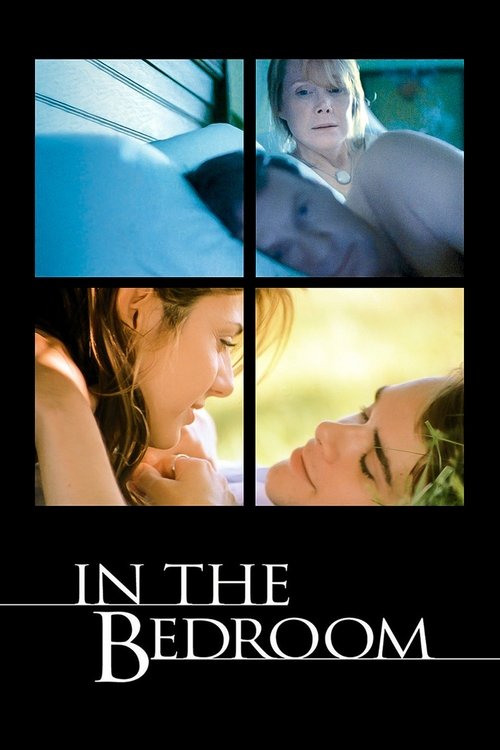
In the Bedroom
2001 · Todd Field
Tár's Lydia Tár became so real people argued about her as an actual person — "cancel culture film" claims, Cate Blanchett discourse, and Marin Alsop's public objection. The film that launched a thousand seminar arguments.
For when you want a serious, adult drama that earns its emotion honestly — not comfort viewing, but the kind of film you reach for when you want to feel something true and sit with it for days.
What it's about
On the coast of Maine, over one brief bright summer, a doctor and his music-teacher wife watch their college-age son fall for Natalie, an older single mother not yet free of her volatile estranged husband. What starts as a parents'-eyebrows-raised summer romance slowly gathers pressure, and when tragedy strikes the family, the marriage at the film's center begins to buckle under everything the couple can't bring themselves to say.
The experience
Quiet, patient, and absolutely devastating — the film moves at the pace of real grief, in silences and small domestic moments that suddenly detonate. It leaves you wrung out and thinking hard about what you'd have done.
Performances
Tom Wilkinson and Sissy Spacek are extraordinary as the married couple, playing decades of intimacy and buried resentment in glances and half-finished sentences; their late confrontation is one of the great marriage scenes. Marisa Tomei brings warmth and guilt to Natalie without ever asking for easy sympathy.
The craft
Todd Field's directorial debut, adapted from an Andre Dubus short story, and it's a masterclass in restraint — long-held shots, ambient coastal quiet, and violence kept largely off-screen so its aftermath lands harder. The editing trusts silence in a way almost no American drama does.
Why it matters
It announced Todd Field as a major American filmmaker in a single stroke and became a touchstone for patient, novelistic grief dramas made outside the studio machine.
Snapshot
In the Bedroom is the feature directorial debut of Todd Field, an actor turned filmmaker who adapted Andre Dubus's 1979 short story "Killings" into a patient, devastating study of grief, marriage, and vengeance in coastal Maine. The film tracks the Fowler family — Matt, a country doctor (Tom Wilkinson); Ruth, a high-school music teacher (Sissy Spacek); and their college-age son Frank (Nick Stahl), drifting through a summer romance with an older, separated mother, Natalie Strout (Marisa Tomei) — until a sudden act of violence by Natalie's estranged husband Richard (William Mapother) shatters the household. What follows is less a thriller than an anatomy of mourning: the slow corrosion of a long marriage under unspoken blame, and a final, terrible decision that the film refuses to either celebrate or condemn. Premiering at the 2001 Sundance Film Festival and released by Miramax, it became one of the most acclaimed American films of its year, earning five Academy Award nominations including Best Picture, Best Actor, Best Actress, Best Supporting Actress, and Best Adapted Screenplay. Its title is a regional term — the rear chamber of a lobster trap where the catch is held — folding domestic intimacy and entrapment into a single image.
Industry & production
The film belongs squarely to the American specialty-cinema ecosystem of the late 1990s and early 2000s, when Sundance functioned as both incubator and marketplace and Miramax dominated the prestige-acquisition game. In the Bedroom was produced independently on a modest budget — figures commonly cited place it in the low single-digit millions, though I would treat any precise number with caution — and financed outside the studio system before Miramax acquired it out of Sundance. That acquisition placed the picture on a familiar trajectory: festival launch, fall platform release, and a sustained awards campaign of the kind Harvey Weinstein's company had perfected. The film's commercial performance substantially exceeded its cost, making it a model of the era's specialty economics, in which a restrained, adult drama could become genuinely profitable through critical momentum and Oscar visibility rather than wide opening weekends. (I'd hedge on exact gross receipts rather than risk a wrong figure.)
For Field, the project was a long-gestating personal mission. He had known and admired Dubus, and the adaptation carried the weight of fidelity to a writer who had died in 1999, before the film was completed. The casting reflects the production's prestige-independent character: Wilkinson, a British character actor not yet widely known to American audiences, was a bold lead choice; Spacek brought Oscar-winning gravitas; Tomei and Stahl supplied a younger register. Mapother — Tom Cruise's cousin — delivered the menacing Richard. The shoot took place largely on location in mid-coast Maine, around Camden and the surrounding towns, grounding the film in a specific, weathered New England geography rather than a soundstage approximation.
Technology
In the Bedroom is a film of conventional, even deliberately unshowy, technical means for its moment. It was shot photochemically on 35mm, the standard for serious narrative features in 2001, well before the digital-acquisition shift of the following decade. There is no reliance on visual effects, digital compositing, or post-production manipulation as expressive tools; the film's power is built almost entirely from analog craft — lensing, performance, cutting, and recorded sound. This conservatism is itself a choice consonant with the material: the technology recedes so that behavior and duration can occupy the foreground. The most "technological" dimension of the work is its sound recording and mix, which privileges the textured ambience of small-town Maine — screen doors, distant boat engines, summer insects, the hum of domestic rooms — as a continuous, almost documentary substrate beneath the drama.
Technique
Cinematography
Antonio Calvache's cinematography is observational and composed, favoring stillness over movement. The camera tends to hold, framing characters within doorways, windows, and the cluttered geometry of lived-in interiors, so that the house itself becomes a structure of compartments — an echo of the lobster-trap title. Maine's brief, luminous summer is rendered without postcard prettiness; the light is warm but the palette stays muted, and as the film moves into autumn and grief, the imagery cools and closes in. Calvache and Field repeatedly use the frame to express emotional distance: characters separated by thresholds, caught in deep-focus compositions that keep the domestic environment present and pressing. The visual restraint — few camera flourishes, little overt symbolism — forces the viewer to attend to faces and to the spaces between people.
Editing
The editing, by Frank Reynolds, is the film's defining formal signature. Field and Reynolds let scenes run long past the point where a more conventional drama would cut, allowing silences, hesitations, and the dead air of grief to accumulate weight. The pacing is deliberately slow-burn, structured so that the central act of violence arrives as a rupture rather than a climax, after which the film decelerates further into the durational experience of mourning. The most celebrated passage — an extended, escalating confrontation between Matt and Ruth — is sustained as a near-unbroken two-hander, its length essential to its devastation. The cutting withholds catharsis, refusing the reassurances of momentum, and the final stretch generates an almost unbearable suspense precisely through patience rather than acceleration.
Mise-en-scène / staging
Field's staging is rooted in the specificity of place and class. The Fowler home is dense with the accumulated objects of a settled professional family; the Strout household and Richard's milieu carry markers of working-class Maine and the fish-cannery economy. Costume, décor, and behavior quietly encode the social fault line that drives Ruth's disapproval of Frank's relationship. Field stages domestic ritual — meals, card games, music, chores — with anthropological attention, so that the ordinary becomes the medium through which catastrophe and its aftermath register. Blocking often places characters at angles to one another, physically and emotionally misaligned within the frame, dramatizing estrangement without dialogue.
Sound
Sound is central to the film's realism and its dread. The Maine soundscape is rendered with granular fidelity, and Field uses ambient sound and silence as expressive instruments — the absence of music in key scenes makes the eventual return of Thomas Newman's score more affecting. The film is notably comfortable with quiet, letting rooms breathe and conversations stall, so that small sonic events carry disproportionate force.
Performance
Performance is where the film's reputation was made. Wilkinson's Matt is a study in containment — a decent, mild man whose grief and rage move beneath an unbroken surface until they don't. Spacek's Ruth is colder and more guarded, her sorrow turned inward and weaponized into blame; the role earned wide recognition as among her finest. Tomei brings warmth and vulnerability to Natalie, and Mapother makes Richard frighteningly plausible rather than cartoonish. The ensemble works in a register of underplaying that the direction protects and amplifies.
Narrative & dramatic mode
The film's dramatic architecture is unusual and deliberate. It withholds its inciting violence until well into the running time, spending its first movement on the texture of ordinary family life and a seemingly low-stakes generational romance. The killing then reorganizes the entire narrative: the middle section abandons plot almost entirely for the stalled, recursive experience of grief and the marital warfare it ignites, and the final movement turns toward a quiet, premeditated reckoning. This is realist tragedy in a domestic key — closer to the chamber drama and the literary short story than to genre cinema. Field adapts Dubus's compression by expanding the interiority of the marriage, so that the question driving the film is less "what happened" than "what does it do to two people, and what will they become." The mode is observational, elliptical, and morally unresolved.
Genre & cycle
In the Bedroom sits at the intersection of family melodrama, slow-burn psychological drama, and the revenge thriller, while subverting all three. It deploys the skeleton of a vigilante-justice story but strips it of the genre's gratifications — there is no triumph, no release, only a deepened void. It belongs to a recognizable cycle of turn-of-the-millennium American independent dramas about families in crisis and the violence beneath suburban or small-town placidity, kin to films that treat grief and moral compromise with novelistic seriousness. Its lineage runs through the literary realist tradition of American regional fiction rather than through Hollywood thriller conventions.
Authorship & method
The film is foundationally a work of adaptation and of authorial debut. Field, who had built a career as a character actor — memorably as the pianist Nick Nightingale in Kubrick's Eyes Wide Shut (1999) — and trained at the American Film Institute, brought a director's discipline and an actor's trust in performance to the material. He co-wrote the screenplay with Robert Festinger, expanding Dubus's spare story into a fuller marital portrait while preserving its terrible logic. The source, Dubus's "Killings," supplies the moral premise; Field and Festinger supply the psychological excavation of the marriage that the story leaves largely implicit.
The key collaborators shape the film's restraint. Cinematographer Antonio Calvache provides the composed, observational image; editor Frank Reynolds sustains the durational rhythm that defines the experience; and composer Thomas Newman contributes a characteristically spare, melancholy score, used sparingly enough that its absences are as meaningful as its presence. Newman's idiom — minimalist, textural, emotionally reticent — is ideally matched to a film that distrusts overstatement. The collective method is one of subtraction: removing emphasis, music, and momentum until what remains is behavior under duress.
Movement / national cinema
The film is a product of American independent cinema in its prestige-realist mode — the Sundance-to-Miramax pipeline that defined serious specialty filmmaking around 2000. It does not belong to a formal movement so much as to a sensibility: the literary, performance-driven, regionally specific American art film descended from 1970s naturalism and the New England fiction of writers like Dubus, Richard Russo, and Andre's contemporaries. Its Maine setting situates it within a small but distinct tradition of New England regional cinema, where landscape, weather, and a reticent, class-stratified culture are constitutive of the drama rather than mere backdrop.
Era / period
Released in 2001, the film arrived at the high-water mark of the American independent prestige drama, just before digital production and the gradual contraction of the mid-budget adult film began to reshape the landscape. It also reached audiences in the immediate aftermath of September 11, 2001, and a number of contemporary observers found its meditation on grief and the impulse toward retributive violence to resonate, perhaps unintentionally, with the national mood — though the film was conceived and made before those events. As a period artifact it captures both a moment in industry history, when such a film could thrive commercially and at the Oscars, and a durable picture of small-town New England life.
Themes
The film's central subject is grief — its silence, its unfairness, and its capacity to turn intimacy into accusation. Closely bound to this is the anatomy of a long marriage, exposed in its fault lines once shielding routines collapse. Class and social judgment run throughout: Ruth's resistance to Natalie, the gulf between the professional Fowlers and the Strout family, and the resentment those distinctions breed. The film interrogates masculinity and the logic of vengeance, presenting Matt's final act as both comprehensible and morally annihilating — a refusal to let the audience feel cleansed by retribution. Underneath lies a meditation on the unspoken: the things couples do not say, the rage that has no socially sanctioned outlet, and the entrapment encoded in the title's image of the lobster trap's hidden chamber.
Reception, canon & influence
Critically, In the Bedroom was among the most celebrated American films of 2001, praised for its restraint, its performances, and its moral seriousness; it appeared on numerous year-end best lists and accumulated significant critics'-group honors before its five Academy Award nominations confirmed its standing. The acting in particular — Wilkinson's breakthrough to American prominence and Spacek's late-career triumph — became the touchstone of its reputation, with Spacek sweeping many critics' best-actress citations.
Looking backward, the film's influences are primarily literary and naturalistic: Andre Dubus's fiction provides the direct source and the moral framework, while the broader inheritance runs through American regional realism and the patient, performance-centered dramas of the 1970s. Kubrick's example — Field's experience on Eyes Wide Shut — is sometimes invoked in connection with the film's controlled rhythm and refusal of sentimentality, though one should be careful not to overstate a direct stylistic debt.
Looking forward, the film established Field as a major directorial voice and set the template for his subsequent work — Little Children (2006) and, much later, Tár (2022) — all marked by literary adaptation or construction, moral ambiguity, and a cool, exacting style. Within the broader culture, In the Bedroom helped affirm the viability of the slow-burn, adult, grief-centered American drama at the turn of the century and stands as a benchmark of the form. Its specific influence on later filmmakers is harder to trace cleanly, and I would resist overstating it; its more secure legacy is as a high-water mark of early-2000s independent prestige cinema and as the launch of an unusually deliberate, infrequent, and respected directorial career.
A Deleuzian reading
The title is a fisherman's word.
The full Deleuzian reading of In the Bedroom →
Reception
An instant Sundance 2001 sensation that rode to five Oscar nominations including Best Picture, it then quietly slipped out of the conversation for two decades — until Tár sent everyone back through Todd Field's tiny three-film catalog and it got re-crowned as one of the great directorial debuts.
How In the Bedroom was received, from release to now →
Influences: the films it descends from and the films it influenced
- Ordinary People (1980) — The template for a death-haunted bourgeois family anatomized through performance-centered restraint, where grief is excavated beneath composed surfaces rather than dramatized — the marital-fracture-via-underplaying model Field directly inherits.
- Eyes Wide Shut (1999) — Field acted in it as Nick Nightingale and absorbed Kubrick's glacial controlled rhythm, durational long takes held past comfort, and categorical refusal of musical/sentimental emphasis.
- The Deer Hunter (1978) — Anthropological-ritual staging — extended communal set pieces observed at length before violence detonates — and the delayed-inciting-violence structure that lets behavior accrue before catastrophe.
- Scenes from a Marriage (1973) — The unsparing long-take anatomy of a marriage where expressive silence and withheld speech between spouses carry the drama, deep-focus framing pinning two people in shared rooms.
- A Woman Under the Influence (1974) — Performance-as-subject under durational observation, the camera waiting on behavior under duress until psychology surfaces without authorial underlining.
- Five Easy Pieces (1970) — New Hollywood regional naturalism with observational stillness and underplayed performance, locating tragedy in unglamorous domestic and working spaces.
- The Sweet Hereafter (1997) — Literary adaptation of a small community's grief after a child's death, built on cool observational framing and withheld catharsis instead of melodramatic release.
- The Ice Storm (1997) — Carries the slow-build, ensemble-restraint mode into New England repression that detonates into tragedy, withholding emotion until structurally maximal.
- Mystic River (2003) — Working-class New England grief and revenge after a child's death, structured around delayed violence and moral seriousness, extending the subverted-revenge American tragedy.
- Little Children (2006) — Field's own continuation: literary adaptation expanded into a suburban marital portrait, cool exacting framing, moral ambiguity, and underplayed performance.
- Tár (2022) — Field's mature method of long takes, anthropological observation of professional ritual, expressive silence, and withheld emotional emphasis taken to its furthest.
- Rabbit Hole (2010) — Domestic-realist tragedy of a couple's grief after a child's death, sustained by underplaying and withheld catharsis rather than cathartic breakdown.
- Manchester by the Sea (2016) — New England working-class grief rendered through ambient realism, expressive silence, and a pointed refusal of redemptive release — the withheld-catharsis form perfected.
- Margaret (2011) — A protracted moral reckoning in the aftermath of a sudden death, prioritizing messy behavior and withheld resolution over thriller mechanics.
- We Need to Talk About Kevin (2011) — Maternal grief and dread organized by elliptical withholding of the violent event, the domestic catastrophe felt through its negative space and ambient sound.
- House of Sand and Fog (2003) — A faithful Andre Dubus adaptation (father of the seed's novelist Dubus III) sharing the same slow-accreting grief-tragedy built from restrained domestic staging and accelerating dread.
- Hope (2013) — Aftermath-of-a-crime family drama built on performative restraint and offscreen violence, its pressure held in silences the way Hope holds the parents' contained rage.
- Affliction (1997) — Snowbound New England small-town slow-burn in which repressed male grievance curdles toward violence, naturalistic and durational rather than thriller-paced.
- American Beauty (1999) — Shares Thomas Newman's minimalist, textural, emotionally reticent scoring idiom used sparingly against suburban-American malaise — the same restraint-by-subtraction in the music.
- You Can Count on Me (2000) — Same-year practice of holding the shot several beats after the dialogue stops so grief accumulates in dead air, with a small-town drama confined to a fixed set of domestic rooms shot in available light.
Similar films
- Ordinary People (1980) — influence & lineage
- Manchester by the Sea (2016) — influence & lineage
- Mystic River (2003) — influence & lineage
- True Grit (2010) — often watched together
- sex, lies, and videotape (1989) — often watched together
- Long Day's Journey Into Night (1962) — shared sensibility
- A History of Violence (2005) — shared sensibility
- Amour (2012) — shared sensibility
All the films related to In the Bedroom →