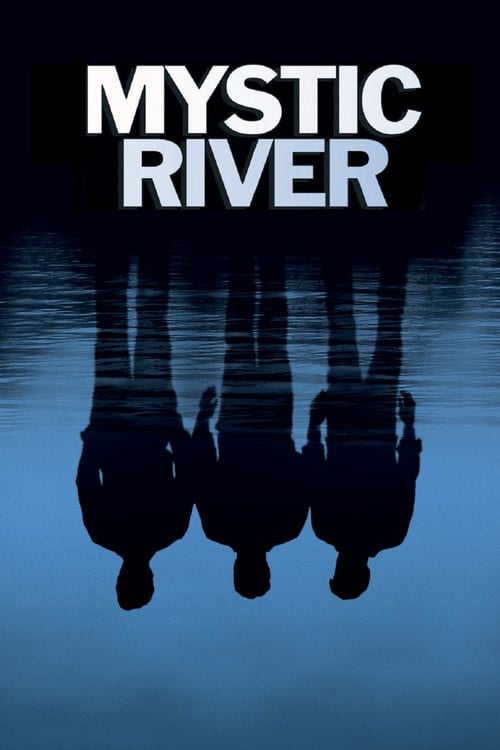
Mystic River
2003 · Clint Eastwood
When you want something grown-up that actually hurts — a crime story to sit with quietly afterward, not background viewing. Save it for a night when you can give it your full attention and a strong drink.
What it's about
Three boys are playing on a working-class Boston street when two men posing as police take one of them away; he escapes days later, but none of them is ever the same. Twenty-five years on — one now an ex-con shopkeeper, one a homicide detective, one a haunted husband — the shopkeeper's teenage daughter is murdered, and the investigation drags all three back into each other's lives while the neighborhood's suspicion settles on the man who never recovered.
The experience
Heavy, mournful, and slow-burning — it grips like a whodunit but lands like a tragedy, with an undertow of grief that builds scene by scene. It leaves you shaken rather than satisfied, in the way only serious drama can.
Performances
Sean Penn's volcanic, grief-maddened father and Tim Robbins's hollowed-out, half-broken Dave both won Academy Awards, and deserve them; Kevin Bacon, Marcia Gay Harden, and Laura Linney do quieter, equally precise work around them.
The craft
Eastwood directs with almost austere patience — muted blue-gray Boston light, no flash, long scenes that trust the actors — so that when emotion finally detonates it hits with full force. The restraint is the craft: a pulpy murder plot told with the gravity of classical tragedy.
Why it matters
The film that opened Eastwood's late-career run of grave, acclaimed dramas, and a high-water mark for the Boston working-class crime story on screen.
Snapshot
Mystic River is Clint Eastwood's grave, tragic adaptation of Dennis Lehane's 2001 bestselling novel, a crime story that uses the machinery of a murder investigation to excavate a deeper wound. In a working-class Boston neighborhood, three boys — Jimmy, Sean, and Dave — are playing in the street when two men posing as police abduct Dave and subject him to days of sexual abuse before he escapes. Twenty-five years later the three are estranged adult men: Jimmy Markum (Sean Penn) is an ex-con turned corner-store owner; Sean Devine (Kevin Bacon) is a state homicide detective; Dave Boyle (Tim Robbins) is a haunted, half-broken husband and father. When Jimmy's nineteen-year-old daughter Katie is murdered, the investigation draws all three back together, and a neighborhood's suspicion settles on Dave — who came home bloodied the night of the killing. The film builds toward a double catastrophe: Jimmy executes Dave for a crime he did not commit, while Sean discovers the real, almost senseless killers. It is at once a procedural, a neighborhood elegy, and a study of how childhood violence metastasizes across a lifetime. The film won Academy Awards for Penn (Best Actor) and Robbins (Best Supporting Actor) and is widely regarded as the work that confirmed Eastwood's late-career resurgence as one of American cinema's preeminent directors of moral gravity.
Industry & production
Mystic River was produced by Eastwood's long-standing Malpaso Productions in partnership with Warner Bros., the studio that had housed Eastwood for decades. Lehane's novel had been a critical and commercial success, and the rights drew studio interest; by most accounts Eastwood pursued the material himself, responding to its tragic architecture rather than its genre mechanics. He produced alongside Robert Lorenz and Judie Hoyt. The screenplay was entrusted to Brian Helgeland, the Oscar-winning co-writer of L.A. Confidential, whose adaptation is notably faithful to Lehane's structure while compressing its sprawl.
The production exemplified Eastwood's famously economical method. Working on a modest budget — reported in the neighborhood of thirty million dollars, very lean for a film with this caliber of cast — Eastwood shot quickly and largely on location in and around Boston, grounding the story in the actual textures of its triple-decker neighborhoods. The director's reputation for minimal takes, a quiet set, and an on-schedule, on-budget shoot allowed a starry ensemble to commit at rates well below their usual quotes. The film premiered in competition at the 2003 Cannes Film Festival before its autumn theatrical release, an unusual platform for a studio crime drama and a signal of its prestige ambitions. Commercially it performed strongly relative to its cost, becoming one of Eastwood's most successful dramas of the era; I am avoiding precise gross figures here rather than risk misstating them, but the film was unambiguously a substantial earner and a major awards player.
Technology
Mystic River was shot photochemically on 35mm film, consistent with industry-standard practice for a major studio drama in 2003 and with Eastwood's traditionalist preferences. There is nothing technologically ostentatious about the production; its innovations are tonal and procedural rather than mechanical. The most consequential "technology" of the film is arguably its lighting approach — a deliberately under-exposed, shadow-dominant image achieved with restrained, naturalistic sources, which became a defining trait of Eastwood's films across the decade. The picture predates the widescreen digital-capture transition that would reshape the industry later in the 2000s, and it belongs firmly to the celluloid era of prestige filmmaking. Post-production followed conventional analog-to-digital finishing of the period. The record on specialized technical apparatus for this particular film is thin, and I will not invent detail where it does not exist.
Technique
Cinematography
Mystic River marked the early flowering of Eastwood's collaboration with cinematographer Tom Stern, who had risen through the Malpaso camera and lighting departments (long serving as gaffer under Jack Green) before becoming Eastwood's regular director of photography. Stern's signature here — and going forward — is darkness: deep, enveloping shadow, pooled and motivated light, faces that recede into blackness. Interiors are lit as if by practical lamps; exteriors carry an overcast, desaturated Boston gloom. This low-key, near-tenebrist style does thematic work, literalizing a world in which crucial things happen in the dark and the past is never fully illuminated. The camera is patient and unshowy, favoring composed frames and slow developments over coverage-driven cutting. The film's most celebrated visual gesture is the soaring crane shot that rises above Jimmy as police restrain him from his daughter's crime scene — the camera lifting to a near-godlike vantage as Penn's grief erupts, a moment that converts private anguish into something almost mythic.
Editing
Joel Cox, Eastwood's Oscar-winning editor from Unforgiven and a constant of the Malpaso method, cut the film. The editing reflects Eastwood's preference for clean, unfussy assembly built from a small number of takes. Scenes are allowed to breathe; the rhythm is deliberate, even slow, trusting performance and duration over momentum. The cross-cutting that braids the three men's storylines is handled without flashiness, and the film's procedural beats are integrated into its emotional ones rather than accelerated. The restraint is purposeful — the tragedy accrues weight precisely because the film refuses to hurry toward it.
Mise-en-scène / staging
The film's staging is rooted in the specificity of its neighborhood: the corner store, the stoops and porches, the bars, the river itself as a recurring boundary and dumping ground. Eastwood stages confrontations frontally and lets actors hold the frame. Two set pieces define the film's spatial imagination. The first is the riverbank where Jimmy and his crew corner Dave — an open, exposed killing ground. The second is the closing street parade, where the surviving characters appear in daylight among flags and crowds, and Sean's wordless, ambiguous finger-gun gesture at Jimmy across the avenue condenses the film's moral verdict into a single piece of blocking. The recurring image of wet cement — the boys' unfinished names, "Dave Boyle" interrupted — is a planted motif that pays off as a symbol of arrested, incomplete lives.
Sound
The film's sound design favors quiet and the ambient hum of the neighborhood, punctuated by sudden ruptures of violence and grief. Eastwood's characteristic preference for low volume and naturalistic restraint extends to the mix: there is little of the aggressive sonic underscoring typical of studio thrillers. The most striking sonic event is Penn's raw, animal cry of grief, left exposed against the crane shot with minimal scoring — sound used as an instrument of devastation precisely through its starkness.
Performance
Performance is the film's center of gravity, and Eastwood's actor-friendly, hands-off direction gave his ensemble room. Sean Penn's Jimmy is a study in barely contained violence and ferocious paternal love, escalating to the operatic — the "Is that my daughter in there?" scene and the riverbank execution are among the most discussed of his career. Tim Robbins plays Dave with a hunched, hesitant, dissociated physicality, a man perpetually half-present, the boy who "got in the car" still living inside the adult. Both men won Academy Awards. The supporting ensemble is exceptional: Kevin Bacon's contained, watchful Sean; Marcia Gay Harden's frightened, unraveling Celeste, whose suspicion helps doom her husband (an Oscar-nominated turn); Laura Linney's Annabeth, whose late Lady Macbeth–like monologue reframes Jimmy's act as tribal loyalty; and Laurence Fishburne as Sean's partner Whitey. The performances are pitched at varying registers — Penn's expansive, Robbins's withdrawn — and Eastwood lets that contrast stand rather than smoothing it.
Narrative & dramatic mode
The film operates in the mode of tragedy dressed in the clothes of a police procedural. Its structure is classical: a prologue establishes the originating wound, a long present-tense investigation generates suspense, and the climax delivers a catastrophe driven by character rather than plot mechanics. Crucially, the film withholds and reveals along two tracks — the audience and Sean close in on the truth while Jimmy acts on a false certainty — producing dramatic irony of a punishing kind. The "mystery" is almost a feint; the real engine is fate, the sense that the abduction of one boy decades earlier has set an inexorable machine in motion. Lehane's and Helgeland's narrative resists the consolations of the genre: there is no redemptive closure, no justice that heals, only a survivor (Jimmy) who has murdered an innocent and a community that closes ranks around the lie.
Genre & cycle
Mystic River sits at the intersection of neo-noir, the literary crime adaptation, and the domestic tragedy. It belongs to a cycle of early-2000s adult, character-driven crime dramas made before franchise filmmaking fully colonized the studios' prestige slate. More specifically, it inaugurated a wave of Dennis Lehane screen adaptations and helped crystallize a recognizable subgenre — the working-class Boston crime tragedy, steeped in Catholic guilt, neighborhood loyalty, and inherited violence. Within Eastwood's own filmography it extends the revisionist concern with the moral cost of violence that he had crystallized in Unforgiven (1992), trading the Western's frontier for the urban parish.
Authorship & method
Mystic River is a paradigmatic late-Eastwood film and a showcase for the Malpaso "repertory company" method. Eastwood directed and also composed the film's spare, melancholy score — a practice he had adopted across his later work, favoring simple piano-and-strings themes over genre bombast, and continuing his long association with orchestrator-collaborators in the Malpaso music chain. As director he is the great minimalist: small crews, few takes, fast schedules, trust in actors, and an aversion to coverage and reshoots. The collaboration with cinematographer Tom Stern is the visual signature of this period, establishing the shadow-soaked palette that would carry through Million Dollar Baby, Letters from Iwo Jima, Changeling, and beyond. Editor Joel Cox and the screenwriter Brian Helgeland complete the principal authorship; Helgeland's disciplined, faithful adaptation preserves Lehane's tragic shape while making it cinematically lean. The result is a film whose authorship is genuinely distributed — Lehane's source, Helgeland's script, Stern's light, the ensemble's performances — but unmistakably stamped by Eastwood's gravity and restraint.
Movement / national cinema
The film belongs to no avant-garde or formal movement; it is, rather, a high exemplar of classical American studio craftsmanship surviving into the twenty-first century. Eastwood positions himself as an inheritor of studio-era economy and clarity — a director who tells stories plainly, without irony or stylistic hedging, in the tradition of the Hollywood professionals he came up admiring. As American national cinema, Mystic River is deeply regional: it is a Boston film, attuned to the ethnic and class textures of a specific urban world, and part of a broader cinematic fascination with that city's working-class neighborhoods as sites of crime, loyalty, and tribal honor.
Era / period
Released in the autumn of 2003, the film arrived in a post-9/11 American moment preoccupied with violence, retribution, and the question of whether vengeance can ever be just — anxieties its plot of mistaken, irreversible punishment cannot help but echo, even if the film makes no explicit topical claim. It belongs to the last sustained era of mid-budget, star-driven adult dramas occupying the center of the studio system's awards strategy. Within Eastwood's career it stands at a hinge: it reignited his standing as a serious director and immediately preceded Million Dollar Baby (2004), which would win Best Picture, inaugurating the most acclaimed stretch of his directorial life.
Themes
The film's governing theme is the long half-life of childhood trauma — the conviction that the boy who "got in the car" is never fully free, and that a single act of violation can deform three lives and a whole community across decades. Around this radiate its other concerns: fate and inevitability, the sense of a tragedy foreordained; vigilante justice and its catastrophic fallibility, dramatized in Jimmy's execution of an innocent man; masculinity and violence, the codes of honor and silence that bind working-class men and license their brutality; tribalism and community complicity, culminating in Annabeth's chilling absolution of Jimmy as a "king" who protects his own; and a pervasive Catholic sense of guilt, fate, and unredeemed sin. The river itself is the master symbol — a boundary, a grave, a current carrying the past forward — and the unfinished name in the cement insists that some lives are interrupted before they can be written.
Reception, canon & influence
Mystic River was received as a major work on release, drawing strong critical acclaim for its performances, its tragic ambition, and Eastwood's controlled direction, though some critics found its operatic intensity or its tidy thematic symbolism less than fully persuasive. It became a centerpiece of the 2003–04 awards season: nominated for the Academy Award for Best Picture and Best Director, with Helgeland nominated for Adapted Screenplay and Marcia Gay Harden for Supporting Actress, and winning acting Oscars for Sean Penn and Tim Robbins. That dual acting victory, rare for a single film, cemented its reputation.
Influences on the film (backward): the work draws on classical tragedy — its sense of fate, its chorus-like neighborhood, its catastrophe born of character — as much as on film noir's moral fatalism. It is rooted in Dennis Lehane's novel and its meticulously observed Boston, and it extends Eastwood's own decades-long reckoning with the cost of violence, most directly the revisionism of Unforgiven. The literary crime adaptations and ensemble dramas of the prior decade, including Helgeland's L.A. Confidential, inform its prestige-procedural register.
Legacy (forward): Mystic River helped launch a productive cycle of Dennis Lehane screen adaptations — Gone Baby Gone (2007), Shutter Island (2010), and The Drop (2014) — and reinforced the working-class Boston crime film as a durable American subgenre that The Departed (2006) and others would extend. For Eastwood it confirmed a late-career renaissance, anchoring a remarkable run of somber, morally weighted dramas. Its twin acting awards and its template of literary source, restrained direction, and shadow-drenched cinematography made it a reference point for prestige crime tragedy in the years that followed. It endures as one of the defining American films of its decade and a touchstone in the study of violence, trauma, and the limits of justice on screen.
A Deleuzian reading
Wet cement, and a name left unfinished.
The full Deleuzian reading of Mystic River →
Reception
It premiered at Cannes 2003 to rapturous reviews and rode straight to Oscar glory as Eastwood's late-career masterpiece. It's still deeply respected, but two decades of meme-ification of Sean Penn's big grief scene have chipped a little irony into what was once treated as untouchably solemn.
How Mystic River was received, from release to now →
Influences: the films it descends from and the films it influenced
- Unforgiven (1992) — Eastwood's own template of revisionist violence-as-cost, shot in low-key tenebrism with minimal coverage and a spare self-composed piano theme — the direct authorial precursor to Mystic River's moral gravity and restraint.
- L.A. Confidential (1997) — Brian Helgeland's prior adaptation method — compressing a dense crime novel into a lean ensemble of moral compromise — supplies the prestige-procedural screenwriting register Mystic River inherits.
- The Searchers (1956) — Ford's study of a vengeance-warped man framed against a 'chorus' community, with the doorway/threshold blocking of the outsider, models the finger-gun benediction and the neighborhood-as-Greek-chorus staging.
- On the Waterfront (1954) — The working-class urban-tribe milieu and Method-driven operatic grief — Brando's raw register — is the performance lineage Sean Penn's exposed-grief cry openly extends.
- Chinatown (1974) — Neo-noir built on tragic dramatic irony where the detective's pursuit of truth completes the catastrophe — the fatalistic structural engine Mystic River reuses with Jimmy's misdirected vengeance.
- In the Heat of the Night (1967) — The literate, place-rooted American crime procedural anchored by a clipped naturalistic investigation supplies the prestige-crime template Eastwood works in a restrained key.
- In the Bedroom (2001) — Working-class New England grief and revenge after a child's death, structured around delayed violence and moral seriousness, extending the subverted-revenge American tragedy.
- Midnight in the Garden of Good and Evil (1997) — The emotionally expansive, ensemble, literary-source Eastwood film that Midnight's 'softer project' tendency points toward, extending the same Malpaso patience to weightier material.
- Changeling (2008) — Another Stern-shot, Cox-cut Eastwood study of childhood trauma and the failure of justice, using crane reveals over period exteriors and the same self-composed melancholic theme.
- Gone Baby Gone (2007) — Part of the Lehane adaptation wave Mystic River launched — same Boston working-class moral terrain, same agonized 'justice that destroys' irony driving the climax.
- Shutter Island (2010) — A later Lehane adaptation extending the cycle Mystic River opened, building dramatic irony from a trauma-shattered protagonist's distorted perception — the dissociative register Robbins prefigures.
- The Drop (2014) — Lehane adapting his own work into the same hushed, naturalistic crime-tragedy register — restrained sound design and slow-burn dread descended from Mystic River's playbook.
- The Departed (2006) — Extends the durable working-class Boston crime subgenre Mystic River reinforced, foregrounding the same childhood-loyalty/neighborhood-code fatalism as engine of catastrophe.
- Prisoners (2013) — Roger Deakins's low-key tenebrist palette and the agonized vigilante-father whose pursuit of a missing child curdles into tragedy directly inherit Mystic River's craft and theme.
- Manchester by the Sea (2016) — Working-class Boston-area grief drama built on naturalistic-restraint sound and a buried childhood catastrophe surfacing through dissociated performance — Mystic River's emotional grammar in a non-genre key.
- Chithha (2023) — Traces the lifelong aftermath and buried shame of childhood sexual abuse, letting trauma surface through restrained adult performance instead of flashback spectacle.
- Million Dollar Baby (2004) — The same Malpaso unit — Tom Stern's shadow-drowned, single-source-light tenebrism, Joel Cox's unhurried cutting, and Eastwood's own elegiac piano score — carried directly forward into another tragedy of fate.
- Letters from Iwo Jima (2006) — Stern's near-monochrome, desaturated low-key palette and Eastwood's minimal-coverage, few-takes shooting method extend the same visual signature established on Mystic River.
- Mr. Brooks (2007) — Shares the post-Mystic-River prestige-thriller appetite for Method-operatic male duality and tragic-irony plotting, marketed on the same serious-actor-as-haunted-killer register Penn and Robbins legitimized.
- A History of Violence (2005) — Contemporary interrogation of vigilante violence and buried past identity, using restrained naturalistic staging and sudden eruptions of grief/violence as moral reckoning, paralleling Eastwood's revisionist project.
- Absolute Power (1997) — Joel Cox's editing rhythm persists under a new cinematographer (Tom Stern replacing Green), and the Jacobean resolution—the guilty escape, the innocent destroyed by the same institutional logic—combined with ensemble depth and the paternal guilt/legacy theme constitutes a structural recapitulation of Absolute Power's architecture in a different generic register.
- The Town (2010) — Eastwood's Boston crime drama established the prestige-cinema emotional register for working-class male loyalty as tragedy—Tom Stern's desaturated low-key palette, the neighborhood as inescapable determinant of fate—that The Town inherits as its dramatic mode before tipping it toward genre resolution rather than Shakespearean catastrophe.
- House of Sand and Fog (2003) — Same-year literary-tragedy prestige film built on working-class grief performances and a clockwork sense of doom, where wounded male pride detonates an irreversible chain of harm.
- The Invisible Guest (2017) — Sibling in guilt-and-deception plotting where a confession's meaning inverts once identity is clarified, deploying orchestral gravity to sell a moral rug-pull.
Similar films
- Manchester by the Sea (2016) — influence & lineage · often watched together
- Unforgiven (1992) — influence & lineage
- The Departed (2006) — influence & lineage
- Million Dollar Baby (2004) — influence & lineage
- On the Waterfront (1954) — influence & lineage
- Shutter Island (2010) — influence & lineage
- Gone Baby Gone (2007) — influence & lineage
- Changeling (2008) — influence & lineage
All the films related to Mystic River →
Watch it with: curated runs of related films
- American Crime, Long Memory — A run of mob epics, noir, and neighborhood tragedies that all circle the same wound — loyalty, masculine violence, and the past that never lets go — so watch them close together and let the decades and cities blur into one long American story.