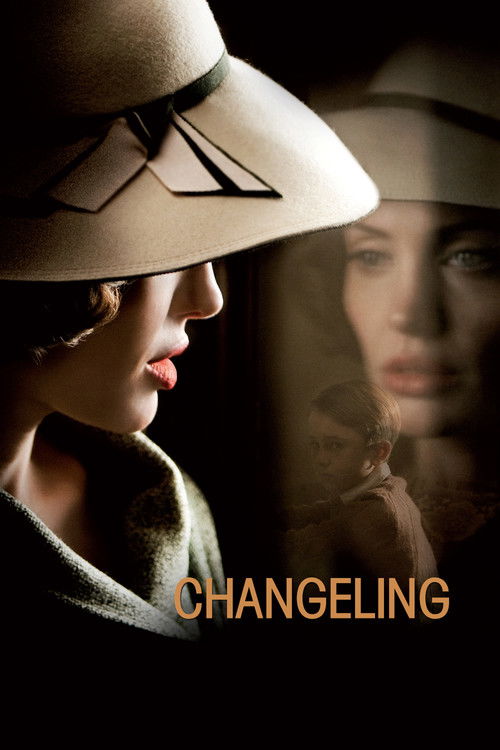
Changeling
2008 · Clint Eastwood
For when you want a serious, absorbing true-story drama that makes your blood boil — an injustice tale you can yell at the screen about. This is a challenge, not comfort viewing; save it for a night you have emotional room.
What it's about
Los Angeles, 1928. Christine Collins, a single mother, comes home from work to find her nine-year-old son gone. Five months later the police stage a triumphant reunion — but the boy they hand her isn't her child, and when she says so, the LAPD closes ranks against her. What begins as a missing-child case becomes one woman's fight against a police department willing to destroy her rather than admit a mistake.
The experience
A slow-burning outrage machine — it moves with grave, unhurried confidence and keeps tightening the screws, so you spend two hours somewhere between heartbreak and fury. It's grim and wrenching, but the anger has a spine of hope in it.
Performances
Angelina Jolie carries the film in nearly every scene, playing Christine's grief and stubbornness without a false note — polite and composed on the surface, steel underneath. John Malkovich brings crackling moral energy as a crusading radio preacher who takes up her cause.
The craft
Eastwood directs with his signature restraint: muted colors, pooled shadows, a spare piano score he composed himself, and a meticulous recreation of Prohibition-era Los Angeles — streetcars, cloche hats, and all. J. Michael Straczynski's script was built from archival research on the real case, and the period detail rewards a big screen.
Why it matters
It premiered in competition at Cannes and earned Jolie an Oscar nomination, standing as one of the defining dramas of Eastwood's remarkable late-career run and reviving public memory of a buried true-crime scandal.
Snapshot
Changeling is Clint Eastwood's fictionalized reconstruction of the 1928 Christine Collins case, in which a Los Angeles single mother, told that a missing boy returned to her by the LAPD was her vanished son, insisted the child was an impostor — and was punished by the police for saying so. The film braids that maternal ordeal into two larger true histories: the institutional corruption and abuse of authority within the Los Angeles Police Department of the era, and the Wineville Chicken Coop murders committed by Gordon Stewart Northcott. Written by J. Michael Straczynski from archival research and directed by Eastwood in his characteristically austere, fast-working manner, the film pairs Angelina Jolie's central performance with a muted, period-exact recreation of Prohibition-era Los Angeles. It premiered in competition at the 2008 Cannes Film Festival and earned Academy Award nominations for Jolie, for cinematography, and for art direction. It stands as a late-career example of Eastwood's interest in ordinary people crushed and occasionally vindicated by unjust systems.
Industry & production
The project originated with Straczynski, a television writer best known for creating the science-fiction series Babylon 5, who came to the Collins story through documentary source material and municipal records. By his own account he conducted extensive archival research — he has cited thousands of pages of city and court documents — and the screenplay is unusual in drawing so heavily on the historical record rather than a single prior book or article. The script circulated in Hollywood and drew the interest of Imagine Entertainment, the company of Ron Howard and Brian Grazer. Howard was at one point attached to direct but moved to Frost/Nixon, remaining as a producer while Eastwood took over the direction; the two productions were developed in overlapping windows, which is part of why Howard's role shifted.
The film was produced through Eastwood's Malpaso Productions in partnership with Imagine and released by Universal Pictures, with additional financing arrangements typical of a mid-budget prestige picture of the period. Eastwood's working method is legendary for its economy: he shoots quickly, prints few takes, keeps sets quiet, and famously prefers not to bark "action." Changeling was completed on the kind of compressed schedule that has become a Malpaso signature, which held costs down for a period film requiring substantial recreation of 1920s Los Angeles. Angelina Jolie, then among the most bankable stars in the world, anchored the commercial case for the film, while the supporting cast — John Malkovich, Jeffrey Donovan, Michael Kelly, Amy Ryan, Colm Feore, and Jason Butler Harner — gave it dramatic weight. The Cannes competition slot signaled its awards-season ambitions, and it was positioned as a fall prestige release; Eastwood's Gran Torino arrived the same year, underscoring the extraordinary productivity of this phase of his career.
Technology
Changeling was shot photochemically on 35mm film, consistent with Eastwood's lifelong preference for celluloid and for the working rhythms of a traditional film camera. The image is composed in a widescreen scope format that suits the horizontal sprawl of Los Angeles and the film's frequent use of receding architectural space; the exact anamorphic specification is a matter for technical sources, but the wide frame is integral to the picture's look.
The film's most significant technological dimension is its digital reconstruction of period Los Angeles. Because 1928 downtown, its Red Car streetcars, its storefronts, and its civic buildings no longer exist in usable form, the production combined built sets, dressed locations, and digital extension and set augmentation to conjure the city. Streetcars, signage, skylines, and crowds were extended or created digitally so that practical foreground staging could sit inside a believable historical whole. This is a quieter application of visual effects than the spectacle of a genre blockbuster — the aim is invisibility, effects in service of verisimilitude rather than display — but it is central to how the film achieves its sense of place. The result is a period picture whose technology is deployed to disappear.
Technique
Cinematography
Tom Stern, Eastwood's regular director of photography since the early 2000s, shot Changeling, and his work here earned an Academy Award nomination. Stern's signature — low-key lighting, motivated source light, deep and often near-black shadow, and a willingness to let faces fall into darkness — is applied to a desaturated, faintly sepia-inflected palette that reads as period without tipping into pastiche. Interiors, particularly the police offices and the psychiatric ward, are lit with a controlled gloom that literalizes the film's themes of concealment and institutional opacity. The camera is generally restrained and classical: measured moves, clean compositions, and a preference for holding on performance rather than cutting into it. This economy of camera is of a piece with Eastwood's directorial temperament — the style withdraws so that the story and the actors carry the weight.
Editing
The film was cut by Joel Cox and Gary D. Roach, Eastwood's editorial team. Cox is a long-standing Eastwood collaborator whose approach favors clarity, unhurried rhythm, and confidence in the sustained shot. Changeling is a long film that moves through several distinct movements — the disappearance, the false reunion, Christine's institutionalization, the parallel murder investigation, and the legal and public reckoning — and the editing's task is to hold these strands in legible relation across a wide time span. The cutting is generally patient, sometimes to the point that critics found the film's several successive climaxes and its extended coda taxing. That deliberateness is a deliberate choice rather than a lapse: it reflects Eastwood's preference for letting scenes breathe and for trusting the audience to sit with duration.
Mise-en-scène / staging
Production designer James J. Murakami and set decorator Gary Fettis received an Academy Award nomination for their recreation of 1928 Los Angeles, and the film's mise-en-scène is one of its principal achievements. The world is built from the texture of the period — telephones, streetcars, municipal interiors, domestic detail — and staged so that Christine, in Deborah Hopper's precisely observed costumes (the cloche hats and tailored coats that fix her in her moment), moves through spaces that dwarf and constrain her. Eastwood stages the institutional scenes for their power geometry: the small citizen framed against the scale of a police department or an asylum. The staging is classical and readable, prioritizing the human figure within the historical frame rather than restless movement.
Sound
The sound design is naturalistic and unshowy, keyed to the environments — the clangor of a streetcar, the institutional hush of a ward, the ambient life of period streets. The score, composed by Eastwood himself, is spare and melancholy, jazz-inflected in a way that gestures at the era without literal pastiche, and used sparingly. Eastwood's music as a director-composer tends toward restraint — a few notes, a simple melodic figure — and Changeling follows that pattern, leaning on silence and ambient sound as often as on scoring to let the drama land without emotional underlining.
Performance
Angelina Jolie's Christine Collins is the film's center and earned her an Academy Award nomination for Best Actress. The performance is built on containment: a woman who must remain composed and articulate precisely because the men around her are eager to read any distress as hysteria and to use it against her. Jolie plays grief and defiance in a lower key than the melodrama might invite. Around her, John Malkovich brings measured moral force as the crusading Presbyterian minister Gustav Briegleb; Jeffrey Donovan is chillingly bureaucratic as Captain J.J. Jones; and Jason Butler Harner delivers an unsettling, jittery turn as the killer Gordon Northcott. Amy Ryan, as a fellow inmate in the psychiatric ward, and Michael Kelly, as the detective who uncovers the murders, give the supporting fabric its credibility.
Narrative & dramatic mode
Changeling operates in several registers at once. At its core it is a maternal melodrama — the story of a mother's love and her refusal to accept a false child — but Eastwood plays it against the grain of melodrama's usual emotional amplitude, favoring understatement. It is simultaneously a social-problem film about institutional abuse, dramatizing how the LAPD's "Code 12" detention power could be used to silence an inconvenient citizen by declaring her insane. And it is, in its second half, a crime narrative and quasi-procedural, as the discovery of the Wineville murders reframes the disappearance and supplies both horror and a bitter, partial answer. The film's structure is episodic and cumulative rather than tightly unified, tracking a real history that resists tidy resolution; its refusal to grant Christine full closure — the ambiguity of her son's fate — is faithful to the record and to the film's larger argument about the limits of institutional justice.
Genre & cycle
The film sits at the intersection of the period crime drama, the "based on a true story" prestige picture, and the courtroom/institutional exposé. It belongs to a long tradition of films about Los Angeles as a city of buried corruption — a lineage that runs through Chinatown and L.A. Confidential — and shares their fascination with the 1920s–1940s municipal power structures, though Changeling is less noir stylist than sober historical reconstruction. Within Eastwood's own filmography it belongs to a recurring cycle of works about the vulnerable individual pitted against a corrupt or indifferent system, and about violence's long aftermath. Its maternal focus also connects it to the woman's picture, a genre Eastwood does not often work in, giving the film an unusual profile among his directorial efforts.
Authorship & method
Changeling is a characteristic Eastwood production in method even as its subject — a woman's ordeal — is somewhat atypical for him. His directorial signature is legible throughout: the fast, few-takes shooting; the reliance on a stable, trusted crew; the classical, self-effacing style; the thematic preoccupation with ordinary people ground down by institutions and with the moral cost of violence. The film is also, importantly, a writer's picture: J. Michael Straczynski's research-driven screenplay supplied the architecture and the fidelity to the historical record, and the density of period and procedural detail is his contribution. Eastwood's core collaborators shape the rest — Tom Stern's photography, Joel Cox and Gary D. Roach's editing, Eastwood's own score, James J. Murakami's production design, Deborah Hopper's costumes. The unusual credit of a director composing his film's music is a defining feature of Eastwood's late authorship and applies here. The film thus represents a meeting of Straczynski's archival specificity with Eastwood's restraint.
Movement / national cinema
Changeling is a product of mainstream American studio filmmaking in its prestige mode — the fall-release, awards-oriented adult drama financed and distributed by a major studio (Universal) in partnership with established production companies. It does not belong to a formal movement; rather, it exemplifies a strand of classical American filmmaking that Eastwood has kept alive largely on his own terms, resisting the faster cutting and heavier stylization of much contemporary Hollywood. Its Cannes competition berth placed it within the international festival circuit's embrace of Eastwood as an American auteur, a status European critics had conferred on him well before it was universal at home.
Era / period
The film is doubly period: made in 2008, set in 1928. Its production year falls within an astonishingly prolific stretch of Eastwood's directing career — Mystic River (2003), Million Dollar Baby (2004), Flags of Our Fathers and Letters from Iwo Jima (2006), Changeling and Gran Torino (both 2008), Invictus (2009), and beyond. That context matters: Changeling is the work of a filmmaker in his late seventies operating at a rare cadence, treating each project as a piece of durable classical craftsmanship. Its historical setting, Prohibition-era Los Angeles on the cusp of the Depression, is rendered with the fascination for early-twentieth-century American institutions that also marks the era's cinema of civic corruption.
Themes
The film's governing theme is the individual against institutional power — specifically, the way authority protects itself by pathologizing dissent. Christine's core transgression is epistemic: she claims to know something the police deny, and for that she is declared mad and detained. The film is acute about gender in this dynamic, showing how a woman's certainty is recast as hysteria, and how the language of care (a psychiatric ward) becomes an instrument of control. Motherhood and loss form the emotional spine, with the "changeling" of the title invoking the folkloric horror of a substituted child. Justice runs throughout as an unstable value — sometimes achieved through public pressure and reform, sometimes withheld entirely — and the film insists that truth and closure do not always coincide. Faith and moral witness enter through the reformer minister, and the coexistence of ordinary bureaucratic evil with monstrous criminal evil gives the film its bleak double structure.
Reception, canon & influence
Changeling was generally well received critically, with particular praise for Jolie's performance, Tom Stern's cinematography, and the exacting recreation of period Los Angeles; its Cannes competition placement and subsequent Academy Award nominations for Jolie, cinematography, and art direction confirmed its prestige standing. Reservations clustered around its length and its structure: some critics found the film emotionally overwrought or protracted, faulting a succession of climaxes and an extended coda, and a few felt Eastwood's restraint kept the material at a certain remove. The precise commercial figures are best confirmed against box-office records rather than asserted here.
Looking backward, the film draws on the tradition of Los Angeles corruption dramas — the shadow of Chinatown and L.A. Confidential is unmistakable in its portrait of a rotten LAPD — as well as on the woman's picture and the social-problem film, and above all on the documentary weight of Straczynski's archival research. Looking forward, its influence is best understood as consolidating rather than originating: it reinforced Eastwood's late-career model of the sober, classically made true-story drama and contributed to renewed popular and scholarly attention to the historical Christine Collins case and the LAPD reforms that followed it. Within Eastwood's body of work it stands as a significant, if not universally beloved, entry — a demonstration that his cinema of the wronged individual could extend to a woman's story told with his customary economy and moral seriousness. Claims for a broader stylistic legacy would overstate the record; its lasting value lies in its performance, its craftsmanship, and its faithful revival of a nearly forgotten American injustice.
A Deleuzian reading
The police bring back a boy, and the mother looks at him, and she knows.
The full Deleuzian reading of Changeling →
Reception
It premiered in competition at Cannes 2008 to a divided response — some critics called it handsome but inert awards-bait — and then got overshadowed by Eastwood's own Gran Torino released months later; today it's a favorite 'actually underrated late Eastwood' pick, with defenders arguing it was unfairly written off.
How Changeling was received, from release to now →
How to watch Changeling: what to notice on a first viewing
- Watch Jolie hold herself still while she is disbelieved. Jolie plays Christine composed and articulate at every turn, because the men around her are waiting to read any distress as proof of unfitness. The grief stays under the surface. Her stillness is not temperament. It is evidence management, and you can watch her doing it.
- Notice how the police offices dwarf whoever is asking. Eastwood stages every institutional scene for power geometry: the small citizen set against the scale of a department, a ward or a hearing room, held inside a wide scope frame. Who holds authority is stated by the architecture before anyone in the room opens their mouth.
- Look at how often a face falls into full darkness. Tom Stern lights from motivated sources and lets shadow go nearly black, especially in the police interiors. The palette stays desaturated and faintly sepia without sliding into costume-drama gloss. Concealment is built into the lighting, so institutional opacity is something you look at rather than infer.
- Notice the cloche hats, the streetcars, the telephones. James Murakami and Gary Fettis built 1928 Los Angeles out of period texture, with digital extensions designed to disappear. Deborah Hopper's costumes fix Christine precisely in her year. The world is solid enough that the injustice inside it reads as history rather than as a plot device.
- Notice how rarely music plays under a scene. Eastwood wrote the score himself, spare and jazz-inflected, and uses it sparingly. Streetcar clangor and institutional hush carry long stretches of the film with nothing over them. Nothing tells you how to feel, so each scene has to land on its own terms.
The whole guide to watching Changeling, with the keys for a rewatch →
Influences: the films it descends from and the films it influenced
- Chinatown (1974) — Supplies the anamorphic-scope neo-noir template of civic Los Angeles corruption refracted through one powerless individual — John Alonzo's warm, wide-frame compositions that Stern's period exteriors quote directly.
- L.A. Confidential (1997) — Establishes the model of dramatizing LAPD institutional brutality procedurally, with Dante Spinotti's exacting recreation of a specific historical Los Angeles that Changeling's art direction and staging extend.
- I Am a Fugitive from a Chain Gang (1932) — The Warner Bros. social-problem film built from a documented true case, indicting a penal/state institution by tracking one man it destroys — the exact structural and moral machinery Straczynski's script revives.
- The Snake Pit (1948) — The prototype exposé of a woman forcibly committed to a psychiatric ward as institutional silencing — its terrified-inmate corridor grammar is echoed almost shot-for-shot in Changeling's psychopathic-ward sequence.
- Stella Dallas (1937) — Codifies the maternal-melodrama grammar of a mother's suffering framed for maximum audience identification, the woman's-picture register Eastwood adopts around Jolie's contained anguish.
- Mildred Pierce (1945) — Fuses the maternal woman's picture with a noir crime investigation and flashback testimony structure, the same hybrid of melodrama and procedure that organizes Changeling.
- The Godfather (1972) — Gordon Willis's deliberately underexposed, top-lit chiaroscuro — figures dropping into shadow inside period interiors — is the photographic lineage Tom Stern's low-key work descends from.
- City Lights (1931) — The founding case of the director composing his own film's score, the auteur-as-composer tradition that Eastwood's self-penned, restrained piano themes here consciously continue.
- Unforgiven (1992) — Sets the Malpaso house style — Jack N. Green's underlit, source-motivated lighting shot fast in few takes — that Stern (then a gaffer) inherited and carried into Changeling as DP.
- Mystic River (2003) — First fully realizes Stern's shadowed palette wedded to Eastwood's economical, self-effacing staging of ordinary people ground down by crime and unresponsive institutions.
- Million Dollar Baby (2004) — Perfects the pools-of-light-against-black chiaroscuro and Eastwood's own spare score as emotional restraint, the precise craft package reused on Changeling.
- Letters from Iwo Jima (2006) — Immediate precursor in Stern's near-monochrome desaturation and photochemical period recreation, demonstrating the muted-color true-history look Changeling applies to 1928 Los Angeles.
- J. Edgar (2011) — Carries forward Stern's murky low-key photography and the individual-versus-institution frame into another archival true-history portrait, confirming the late-Eastwood sober biopic model Changeling consolidated.
- Hereafter (2010) — Extends Changeling's use of invisible VFX absorbed into a classical, restrained style, keeping effects subordinate to Eastwood's naturalistic staging rather than foregrounding them.
- Zodiac (2007) — Shares the research-driven fidelity to a real, partly unsolved California case dramatized as institutional procedure, plus invisible digital set-extension VFX rebuilding a vanished period city block.
- Prisoners (2013) — Reworks the child-abduction-plus-failing-authorities procedural in the same muted, photochemical-look register, centering a parent's ordeal against a police apparatus that cannot deliver justice.
Similar films
- Million Dollar Baby (2004) — influence & lineage
- Mystic River (2003) — influence & lineage
- Unforgiven (1992) — influence & lineage
- Chinatown (1974) — influence & lineage
- Mildred Pierce (1945) — influence & lineage
- J. Edgar (2011) — influence & lineage
- Searching (2018) — shared sensibility
- Missing (1982) — shared sensibility