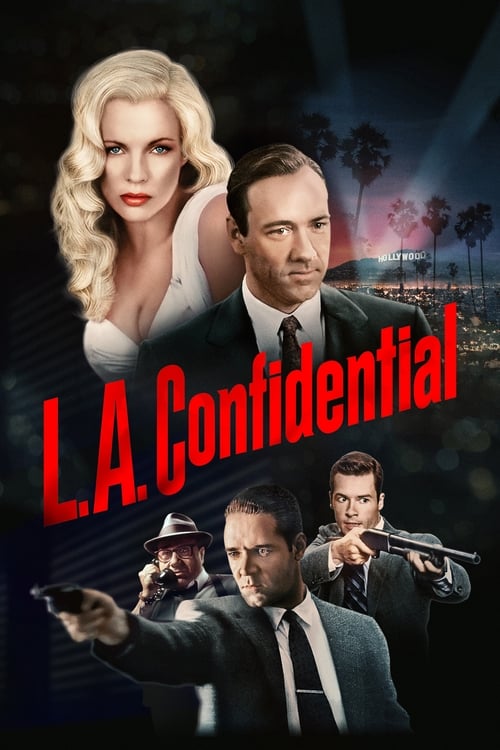
L.A. Confidential
1997 · Curtis Hanson
For when you want to be told a real story — a meaty, grown-up crime picture for a full evening's immersion, ideally with the lights down. Pure high-grade entertainment with brains, not a challenge piece.
What it's about
Los Angeles, early 1950s: a shotgun massacre at an all-night diner called the Nite Owl leaves six people dead, and three very different LAPD detectives pull at separate threads of the case. Ed Exley is a ruthlessly ambitious straight arrow, Bud White a bruiser with a code, Jack Vincennes a slick celebrity cop moonlighting for a scandal rag — and their investigations converge on corruption that runs far deeper than one crime. Around them swirl call girls cut to look like movie stars, tabloid headlines, and a city selling a sunshine dream it doesn't believe in.
The experience
Twisty, propulsive, and immensely satisfying — a dense plot that clicks together piece by piece, spiked with sudden violence and dry wit. It's the rare labyrinthine mystery that rewards close attention without ever feeling like homework.
Performances
Guy Pearce and Russell Crowe, both near-unknowns in Hollywood at the time, are electric as opposite poles of the same corrupt department, and Kevin Spacey gives Vincennes a wounded slickness. Kim Basinger won the Best Supporting Actress Oscar as a Veronica Lake look-alike escort who sees through all of them.
The craft
The Oscar-winning screenplay compresses James Ellroy's sprawling novel into a mystery machine where every scene advances three stories at once — it's a masterclass in adaptation. Curtis Hanson shoots 1950s Los Angeles in warm, sunlit color rather than shadow, which makes the rot underneath land harder. Jerry Goldsmith's brassy score and the period detail reward a good screen and speakers.
Why it matters
Nominated for nine Academy Awards and famously beaten to Best Picture by Titanic, it revived the noir tradition for the 1990s and launched Crowe and Pearce into stardom. It remains the modern benchmark for the L.A. crime epic.
Snapshot
A neo-noir crime film set in early-1950s Los Angeles, L.A. Confidential follows three LAPD detectives — the ruthlessly ambitious Ed Exley (Guy Pearce), the brutally idealistic Bud White (Russell Crowe), and the celebrity-adjacent Jack Vincennes (Kevin Spacey) — whose separate investigations into the shotgun massacre of six people at the Nite Owl diner converge on a conspiracy reaching into the highest reaches of the department itself. Adapted from James Ellroy's 1990 novel, the film triangulates noir fatalism with procedural rigor and a scalpel-sharp reading of postwar Los Angeles as a city whose sun-drenched promise conceals institutional rot. It was nominated for nine Academy Awards, winning two — Best Supporting Actress (Kim Basinger) and Best Adapted Screenplay — and lost Best Picture to Titanic in one of the decade's most debated Oscar outcomes.
Industry & production
Curtis Hanson and co-writer Brian Helgeland spent years developing the adaptation, working from Ellroy's novel — the third installment of his L.A. Quartet, following The Black Dahlia (1987) and The Big Nowhere (1988) — which runs to over six hundred pages and sustains an almost bewildering proliferation of subplots, minor characters, and nested crimes. The compression required to make the novel filmable without losing its structural intricacy was itself a significant creative achievement. Hanson and Helgeland stripped back several major secondary storylines while preserving the moral architecture of three distinct detective archetypes — the careerist, the enforcer, the showman — whose perspectives triangulate the same corruption from incompatible angles.
Produced by Arnon Milchan and David L. Wolper and released by Warner Bros., the film was shot on location across Los Angeles, taking advantage of streetscapes and buildings that retained enough period-plausible character to double as their 1950s selves. Production designer Jeannine Oppewall supervised an exceptionally detailed reconstruction of the era's material culture — domestic interiors, police headquarters, diners, motels — calibrated against period photography and archival research. The casting was unconventional in ways that proved commercially shrewd: both Guy Pearce and Russell Crowe were essentially unknown to American audiences, which freed the viewer from preexisting star associations and made the moral stakes feel genuinely uncertain. Kevin Spacey, already an established figure after The Usual Suspects (1995), lent Vincennes a burnished, self-aware celebrity quality that made his disillusionment register as earned loss rather than simple corruption.
Technology
L.A. Confidential did not pioneer any specific technology, and its technical choices were broadly conservative by mid-1990s standards — a deliberate decision oriented toward period authenticity rather than formal novelty. The film was shot on 35mm anamorphic format, which Dante Spinotti and Hanson chose partly to invoke the widescreen grammar of 1950s Hollywood cinema and partly for the depth and warmth the format contributed to the amber-heavy palette they were constructing. No significant digital effects work was required or sought. The film's technological interest lies instead in its disciplined application of classical tools — anamorphic optics, careful photochemical timing, practical lighting rigs — in service of a historical simulation that aimed for felt authenticity rather than overt period pastiche.
Technique
Cinematography
Dante Spinotti, the Italian-born cinematographer who had previously collaborated with Michael Mann on Heat (1995) and The Last of the Mohicans (1992), developed with Hanson a visual scheme grounded in warm amber and golden tones — sunlight through venetian blinds, the lacquered interiors of upscale bars, the dusty sprawl of mid-century residential Los Angeles. The lighting consistently evokes the photographic conventions of 1950s Hollywood while remaining legible as a contemporary film: there is enough shadow and contrast to sustain noir atmosphere without the distortions of overt stylization. Spinotti's camera tends toward deliberate, composed framings; handheld agitation is used sparingly and purposefully, making its appearances in scenes of physical violence register as disruptions of an otherwise controlled world. The anamorphic frame frequently places characters at different depth planes simultaneously, allowing scenes to layer tension between foreground action and background observation without cutting.
Editing
Peter Honess edited the film with a discipline that matches the screenplay's compression. Given the source novel's structural density, the editing required not just rhythm but information management — the audience must track three investigative lines, a conspiratorial hierarchy, and a cast of close to a dozen significant characters without expository scaffolding. Honess and Hanson solved this partly through a rigorously purposeful approach to crosscutting, establishing early that the three detectives' cases are parallel before revealing them as convergent. Scene length is generally longer than the mid-1990s thriller norm, which supports the performances and allows moral complexity to settle rather than forcing it through montage shorthand.
Mise-en-scène / staging
Hanson's staging consistently exploits the gap between performance and reality that runs as a thematic current through the entire film. The Fleur-de-Lis call-girl operation — in which women are surgically altered to resemble film stars — literalizes a broader principle: in this version of Los Angeles, surface appearances are manufactured commodities, and the institutions (the police department, the tabloid press, the entertainment industry) that administer those appearances are complicit in the violence they conceal. Kim Basinger's Lynn Bracken, who models herself on Veronica Lake, is staged and lit with reference to classical Hollywood glamour portraiture; the film at once aestheticizes and interrogates that glamour. Hanson repeatedly positions characters in doorways and thresholds, underscoring the film's interest in who has access to which version of events. The Nite Owl diner, the film's pivotal crime scene, is designed with a kind of garish American innocence — neon, formica, period signage — that sharpens the violence done to it.
Sound
Jerry Goldsmith composed the score, working in a register that blends 1950s-inflected jazz and big-band orchestration with the darker harmonic language of his classical Hollywood period work. The score does not attempt full period pastiche — it is not a facsimile of a 1950s film score — but rather uses period musical materials as emotional texture within a contemporary dramatic framework. The film's use of diegetic period popular music (heard through radios, at clubs) reinforces the historical atmosphere without tipping into nostalgia. Sound design in the film's violence sequences is notable for its restraint: the Nite Owl massacre is reconstructed rather than depicted in real time, and gunfire throughout the film is rendered with a blunt, practical weight rather than the amplified spectacle common in 1990s action filmmaking.
Performance
The film's performance culture is one of its most discussed achievements. Pearce and Crowe, both Australian, were not simply cast against type but cast against established Hollywood star-persona entirely — neither carried associations that would allow an American audience to predict their characters' moral trajectories. Pearce's Exley is all coiled precision: correct posture, clipped diction, the performance of procedural virtue over a bedrock of calculating ambition. Crowe's White is physicality and suppressed injury, a man whose violence is a displaced form of grief — a more interior performance than his physical presence suggests. Spacey plays Vincennes as a man who has so thoroughly inhabited his public role that his authentic self is only legible in its absence; the moment when Vincennes confronts what he has actually done to a life is one of the film's most quietly devastating scenes. Basinger won the Academy Award for a performance that operates with significant economy — Lynn Bracken is precisely as much as she reveals, no more.
Narrative & dramatic mode
The film works as a braided procedural mystery: three investigative strands, apparently discrete, gradually disclosed as facets of a single criminal architecture. The dramatic mode is ironic in the classical noir sense — the audience frequently knows more than any individual detective does, and the gap between their partial knowledge and the concealed truth generates sustained suspense. The screenplay's most audacious structural move is to convict three innocent men of the Nite Owl massacre well before the midpoint, then reveal that conviction as a founding error; the entire back half of the film is driven by the detectives' belated, reluctant recognition that the institutional narrative they helped construct was false. The film's resolution is one of the darkest available to a mainstream Hollywood crime picture: a partial justice, purchased at high cost, administered outside the law, with no systemic change implied.
Genre & cycle
L.A. Confidential belongs to the neo-noir cycle that ran through American cinema from the 1970s through the 1990s, of which Chinatown (1974) is the acknowledged antecedent. Like Chinatown, it uses the 1930s–50s Los Angeles setting as a way to examine the mythologies of American prosperity — the sunlit, planned cityscape as a veneer over foundational violence and corruption. The film also participates in the 1990s revival of adult-oriented crime drama, a cycle that included The Usual Suspects (1995), Heat (1995), Se7en (1995), and Fargo (1996). Within that cycle, L.A. Confidential is distinguished by its period setting and its concern with institutional rather than individual criminality — corruption as structural rather than aberrant. The film also draws on the tradition of the Hollywood romans à clef about the film industry's dark underside, from Sunset Blvd. (1950) onward.
Authorship & method
Curtis Hanson had directed commercially successful thrillers (The Hand That Rocks the Cradle, 1992; The River Wild, 1994) before L.A. Confidential, but neither prepared audiences for the ambition and control of this film. Hanson's directorial method on the production was notable for its emphasis on preparation and restraint: he and Spinotti developed the visual language extensively before shooting, and the rehearsal period with the cast was unusually extended for a studio production of its scale. Hanson gave particular attention to the historical research that underpinned design and performance decisions. The Bloody Christmas scandal of 1951 — an actual incident in which LAPD officers beat detained prisoners while drunk during the Christmas holiday — was both a source for specific story material and a governing example of the kind of institutional violence the film wanted to anatomize.
Brian Helgeland's contribution to the screenplay was substantial: the problem of transforming Ellroy's maximalist, deliberately unfilmable novel into a workable feature structure was solved through genuine co-authorship rather than mechanical adaptation. Helgeland has spoken about the difficulty of identifying which of the novel's hundreds of moving parts were structurally essential; the decision to anchor everything in the three-detective architecture was the foundational screenwriting choice that made the rest possible.
Dante Spinotti's cinematographic collaboration with Hanson was a genuine creative partnership. The amber, sun-drenched aesthetic they developed was not a default period choice but a deliberate argument about Los Angeles as a city whose beauty is inseparable from what it hides.
Movement / national cinema
L.A. Confidential is emphatically an American film — specifically a Los Angeles film, in the tradition of cinema that takes the city as both subject and symptom. It belongs to a lineage of Hollywood self-examination that includes Sunset Blvd., Chinatown, and Robert Altman's The Player (1992): films that use the city and its industries as a lens for American cultural pathology. Within American cinema of the 1990s, it represents a tendency toward adult dramatic filmmaking that was commercially viable but increasingly under pressure from the decade's blockbuster economics; the film's strong Oscar performance despite modest theatrical returns is a marker of its position in that tension.
Era / period
Set between approximately 1951 and 1953, the film uses the early postwar period as historical material with considerable precision. The era carried specific resonances available to a 1997 audience: McCarthy-era paranoia, the expansion of the Sun Belt, the LAPD's documented culture of brutality and corruption under Chief William Parker (who is not named in the film but whose influence is present in its institutional depiction), and the consolidation of the entertainment industry's tabloid press economy around publications like the real Confidential magazine — the likely model for Sid Hudgens's Hush-Hush. The film's title itself puns on Confidential, locating it immediately within that economy of exposure and concealment.
Themes
The film's dominant preoccupation is with the gap between official narrative and institutional reality — between what the law says it is and what it does. This is enacted at every level: in the LAPD's management of its public image through celebrity informants and compliant press; in the Fleur-de-Lis operation's literal manufacturing of Hollywood likeness; in the three detectives' different relationships to the department's authorized fictions. L.A. Confidential is also consistently interested in masculine performance and its costs — the physical violence that Bud White's persona demands, the affectless careerist persona Exley maintains until it begins to crack, the hollow showmanship Vincennes wears until it swallows him. The film engages seriously with questions of class and social mobility in postwar America: Exley's ambition is legible partly as a patrician's expectation of advancement; White's violence is legible partly as a working-class man's relation to power. The American Dream's postwar variant — prosperity, safety, suburban order — is shown to be constitutively dependent on the violence the dream's official version denies.
Reception, canon & influence
L.A. Confidential received exceptional critical notices on its 1997 release, with reviewers across the American press identifying it as one of the most accomplished crime films in many years and frequently invoking Chinatown as its nearest precedent. The film's theatrical performance was solid but unspectacular by studio standards; it became one of the defining cases in arguments about the Academy's relationship to prestige genre films after its Best Picture loss to Titanic.
Working backward: the film's most direct cinematic inheritance is Chinatown (1974) — the period Los Angeles setting, the conspiracy reaching into civic foundations, the partial and costly resolution. Behind that stands classical noir of the 1940s and 1950s, particularly the institutional corruption strand represented by films like The Big Heat (Fritz Lang, 1953) and On the Waterfront (Elia Kazan, 1954). Ellroy's own literary antecedents — Raymond Chandler, Dashiell Hammett, the hardboiled tradition — are legible in the film's verbal economy and its detective archetypes.
Looking forward: the film's influence on subsequent crime drama is substantial if diffuse. Its template of morally complex institutional procedural with period setting has been identified as a touchstone for the prestige television crime drama that emerged in the 2000s — The Shield, The Wire, and their successors in the genre. The film's casting of relatively unknown Australian actors in lead roles is sometimes credited with opening the Hollywood market to a generation of Australian talent. It remained a reference point in critical discussions of Hollywood's capacity for adult genre filmmaking throughout the 2000s and 2010s, and its canonical status has only consolidated with time. A television adaptation pilot was produced in 2018 but was not picked up to series. Among the small category of Hollywood films that are simultaneously commercially viable, critically serious, and formally accomplished, L.A. Confidential occupies a position that continued availability and repeated viewership have only strengthened.
A Deleuzian reading
The thing you'll probably remember is a woman lit like the memory of a woman.
The full Deleuzian reading of L.A. Confidential →
Reception
A critics' darling on release — it swept nearly every critics' group Best Picture prize in 1997 — only to be steamrolled by Titanic at the Oscars, winning just 2 of its 9 nominations. Time has been kind: it's now routinely called the best film of 1997 and the modern noir standard.
How L.A. Confidential was received, from release to now →
Influences: the films it descends from and the films it influenced
- The Maltese Falcon (1941) — Arthur Edeson's high-contrast portraiture lighting renders each male archetype as a social performance — the convention of using close illumination to morally distinguish three incompatible investigators that Hanson inherits for Exley, White, and Vincennes.
- Double Indemnity (1944) — John Seitz's venetian-blind shadow patterns and warm tungsten interior lighting establish the grammar of glamorized complicity that Spinotti's amber-golden palette modernizes, preserving the equation of seductive warmth with dangerous criminality.
- The Big Sleep (1946) — Sidney Hickox's deep-focus photography and Hawks's convention that braided procedural subplots may remain deliberately unresolved — moral atmosphere outranks narrative closure — establish the structural permission Hanson exercises in compressing Ellroy's labyrinthine novel.
- Touch of Evil (1958) — Russell Metty's anamorphic widescreen compositions place characters at multiple depth planes simultaneously without cutting — the staging technique Spinotti systematically applies in L.A. Confidential's two-hander scenes where foreground and background action carry equal dramatic weight.
- The Godfather (1972) — Gordon Willis's amber-warm, underexposed portraiture lighting for men exercising institutional power establishes the visual grammar equating golden warmth with dangerous authority that Spinotti extends in L.A. Confidential's LAPD precinct and high-society interiors.
- The Long Goodbye (1973) — Altman's deployment of extended scene length and performance naturalism to sustain moral ambiguity — trusting behavior over expository dialogue to register complex ethics — is the staging patience Hanson inherits for his elongated confrontation scenes between Exley, White, and their institutional superiors.
- Chinatown (1974) — John A. Alonzo's anamorphic widescreen photography and Polanski's institutional-conspiracy procedural — where the detective exposes a network of power too systemic to defeat — establish the template Hanson directly descends from, including the fatalistic structure where investigation reveals the investigator's own complicity.
- Miller's Crossing (1990) — The Coens' adaptation methodology — compressing multiple interlocking betrayals from hard-boiled source material into a structure where the mystery's solution is subordinate to the moral world it reveals — is the direct template Hanson and Helgeland apply to Ellroy's maximalist novel.
- Heat (1995) — Dante Spinotti, who shot both films, developed with Mann the specific cinematographic toolkit Hanson hired him to deploy — the warm amber Los Angeles palette, anamorphic depth-plane compositions, and parallel procedural crosscutting between multiple male protagonists pursuing each other across a shared institutional terrain.
- The Untouchables (1987) — Hanson crystallizes the prestige period crime paradigm The Untouchables helped establish: Dante Spinotti's chiaroscuro period lighting, the lawman-criminal binary corroded by institutional corruption, and a literary-grade screenplay functioning as the structural equivalent of Mamet's contribution.
- The Usual Suspects (1995) — Hanson directly extends Singer's procedural-grammar-as-misdirection: the neo-noir ensemble navigates an investigation whose institutional staging systematically misleads toward a hidden criminal sovereign revealed through a final-act retroactive recontextualization of every prior scene's trusted authority figure.
- Se7en (1995) — Participates directly in the prestige crime cycle Se7en launched: city-as-corruption-body staging, procedural investigation that exposes systemic evil rather than individual transgression, and the elevation of the crime film to literary moral tragedy through controlled cinematography and withheld revelation.
- Mystic River (2003) — Tom Stern's cinematography and Eastwood's staging deploy three male protagonists with incompatible moral frameworks whose separate responses to a crime converge on an institutional false conviction — extending Hanson's triangulated-detective structure with the same extended-scene patience for moral complexity to settle through performance.
- Memories of Murder (2003) — Bong extends the braided three-investigator procedural — two detectives with incompatible methods joined by a third specialist — using Kim Hyung-ku's anamorphic depth-plane compositions and the parallel crosscutting structure, culminating in an institutional-false-conviction moral architecture that mirrors Hanson's.
- Zodiac (2007) — Fincher extends Hanson's crosscutting-three-strands structure across a decade-spanning case — three investigators with incompatible methods in parallel — sharing the extended-scene-length discipline and procedural evidence-management-as-drama approach, concluding with the same institutional failure that allows injustice to persist.
- No Country for Old Men (2007) — Roger Deakins's anamorphic depth-plane compositions and the Coens' extended scene length discipline — staging moral confrontations through behavior and staging rather than montage shorthand — extend the visual and editorial patience Hanson established, while the three-protagonist triangulation reconfigures his detective archetypes into genre.
- Inherent Vice (2014) — Robert Elswit's amber-warm anamorphic photography of period Los Angeles and Anderson's extended scene length that trusts performance over cutting apply the Spinotti-lineage visual discipline and braided procedural mystery structure to a 1970s milieu where institutional rot is revealed through the investigation's own dissolution.
- The Nice Guys (2016) — Dante Spinotti's anamorphic 35mm reconstruction of period Los Angeles and the film's structural nesting of a buddy investigation within a systemic institutional conspiracy — two morally opposed detectives forced into alliance who expose corruption too entrenched to be punished — make it a direct formal model for The Nice Guys' visual architecture and plot mechanics.
- 8 Mile (2002) — Hanson's own classically structured, character-first direction of disreputable material is the discipline he reapplies — treating the rap milieu as a classical drama rather than a music video.
- Changeling (2008) — Establishes the model of dramatizing LAPD institutional brutality procedurally, with Dante Spinotti's exacting recreation of a specific historical Los Angeles that Changeling's art direction and staging extend.
- Zootopia (2016) — Neo-noir in which the mystery's true villain is institutional rot inside the force itself, the reveal architecture Zootopia mirrors in the Bellwether conspiracy.
- 42 (2013) — Helgeland's own adaptation work established his scene construction: period drama driven by institutional talk in offices, newsrooms and back rooms, power negotiated in dialogue rather than action — Rickey's office is a Hanson/Helgeland room transplanted to Brooklyn.
- Mulholland Drive (2001) — Peter Deming's glamour portraiture lighting deploys studio-era Hollywood illumination to expose manufactured identity as institutional violence — the same visual grammar Spinotti uses for Basinger's Veronica Lake scenes, inverted so the glamour itself becomes the instrument of psychic and systemic destruction.
- The Black Dahlia (2006) — De Palma adapts the first novel of Ellroy's L.A. Quartet using the same period-reconstruction Los Angeles milieu, Vilmos Zsigmond's amber anamorphic photography echoing Spinotti's palette, and the same maximalist-compression narrative challenge — a direct sibling of the same literary source world, diverging only in De Palma's more baroque reflexive staging.
- Nightmare Alley (2021) — Hanson's film is the genre template for prestige literary-noir: Dante Spinotti's anamorphic widescreen period compositions, ensemble casting as genre-seriousness credential, and the adaptation of an intractable literary source (Ellroy) with scholarly fidelity to period production design — the model del Toro follows when treating Gresham with comparable seriousness.
- Asura: The City of Madness (2016) — The Ellroy-esque vision of a city as a totalising web of graft where every badge is compromised, the corruption-as-ecosystem worldview Asura transposes to Annam.
Similar films
- Chinatown (1974) — influence & lineage · same viewing thread · often watched together
- Heat (1995) — influence & lineage · same viewing thread · often watched together
- The Long Goodbye (1973) — influence & lineage · same viewing thread
- Mulholland Drive (2001) — influence & lineage · often watched together
- The Big Sleep (1946) — influence & lineage
- Inherent Vice (2014) — influence & lineage
- Casino (1995) — same viewing thread · often watched together
- Mystic River (2003) — influence & lineage · same viewing thread
All the films related to L.A. Confidential →
Watch it with: curated runs of related films
- American Crime, Long Memory — A run of mob epics, noir, and neighborhood tragedies that all circle the same wound — loyalty, masculine violence, and the past that never lets go — so watch them close together and let the decades and cities blur into one long American story.