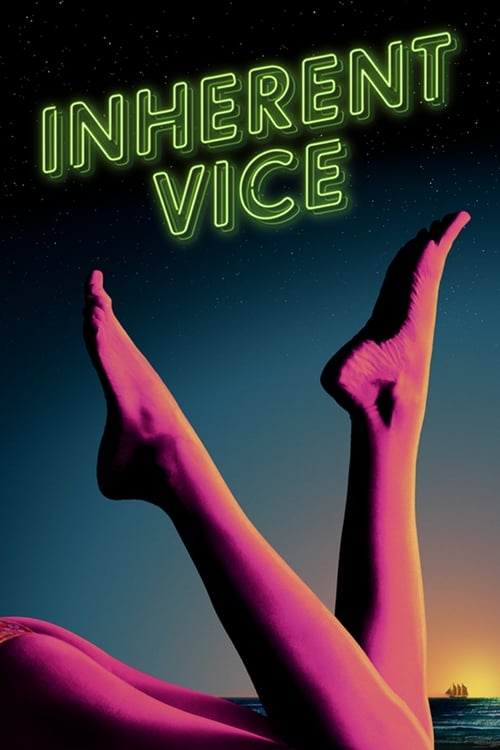
Inherent Vice
2014 · Paul Thomas Anderson
The critics' consensus "greatest living American director" finally made a commercial-scale film with One Battle After Another, instantly triggering debates about its politics, its reported $130M+ budget, and whether the best-reviewed film of 2025 could actually win Best Picture. PTA fandom is a Letterboxd personality type.
For when you want to surrender rather than solve — a late-night, lava-lamp state of mind where confusion is part of the pleasure. If you need a mystery that ties up neatly, save it for another evening.
What it's about
Los Angeles, 1970: the sixties are curdling, and Doc Sportello — a private investigator who conducts most of his business through a haze of pot smoke — gets a visit from his ex-girlfriend, who's tangled up with a married real-estate tycoon and fears a plot against him. Then she vanishes. Doc's investigation sprawls into kidnappings, a shadowy syndicate called the Golden Fang, a supposedly dead saxophonist, and a flat-topped LAPD nemesis named Bigfoot, with every lead dissolving into two more.
The experience
Woozy, funny, and deliberately disorienting — you're meant to lose the thread of the plot and float on the mood, which swings from slapstick to sudden, aching melancholy. It's a shaggy hangout movie wearing a detective story's trench coat, and it gets funnier and sadder on a second watch.
Performances
Joaquin Phoenix plays Doc as a mutton-chopped holy fool, all double-takes and wounded eyes, and Josh Brolin nearly steals the film as Bigfoot Bjornsen — a civil-rights-violating cop who's also the movie's strangest, saddest running joke.
The craft
Paul Thomas Anderson did what was long thought impossible — filmed a Thomas Pynchon novel — and the movie honors the book's paranoid sprawl instead of taming it. Shot on film in warm, smoggy period colors with long unbroken takes and a needle-drop soundtrack, it looks and sounds like a transmission from 1970 itself.
Why it matters
The first Pynchon novel ever brought to the screen, it divided audiences on release and has steadily grown into a cult favorite — a key entry in the tradition of stoned, sun-bleached LA detective stories.
Snapshot
Inherent Vice is Paul Thomas Anderson's seventh feature and the first cinematic adaptation of a novel by Thomas Pynchon, whose famously dense, paranoid, allusive prose had long been considered unfilmable. Set in the fictional South Bay beach community of Gordita Beach in 1970, it follows Larry "Doc" Sportello (Joaquin Phoenix), a perpetually stoned private investigator, as his ex-girlfriend Shasta Fay Hepworth (Katherine Waterston) reappears to enlist his help against a plot involving her current lover, the real-estate magnate Mickey Wolfmann. From that premise the film unspools a deliberately bewildering noir: kidnappings, a shadowy maritime drug-and-tax syndicate called the Golden Fang, a presumed-dead saxophonist (Owen Wilson), a flat-topped LAPD detective named Bigfoot Bjornsen (Josh Brolin), and a sprawl of informants, dentists, addicts, and federal agents. The plot is, by design, nearly impossible to hold in the mind at once; the film's true subject is the texture of a historical hinge moment — the souring of the 1960s counterculture into the paranoia and reaction of the Nixon era — refracted through a haze of marijuana smoke, loss, and tenderness. It is at once a stoner comedy, a shaggy detective story, and an elegy.
Industry & production
The film was produced by Anderson with his longtime collaborators JoAnne Sellar and Daniel Lupi, and financed and distributed by Warner Bros., with Ghoulardi Film Company (Anderson's banner, named for his father Ernie Anderson's television persona) and IAC Films involved. Budgets reported for the film cluster around the low-to-mid $20-million range, though exact figures should be confirmed against a reliable source. Shooting took place largely on location in and around the South Bay of Los Angeles in 2013, with Manhattan Beach and neighboring communities standing in for Pynchon's invented Gordita Beach.
The production's defining backstory is its source. Anderson adapted the screenplay himself from Pynchon's 2009 novel, working — by the accounts that have circulated — with at least the author's tacit cooperation; Pynchon's near-total reclusiveness means the precise nature of any collaboration is not publicly documented, and persistent rumors that the author appears in a brief cameo have never been confirmed by Anderson, who has declined to discuss it. The film premiered as the centerpiece of the 52nd New York Film Festival in October 2014 before a platform release through the awards season. It arrived on the heels of The Master (2012), extending a remarkable run of Anderson features made with substantial creative autonomy inside or alongside the studio system.
Technology
Inherent Vice was shot photochemically on 35mm film, consistent with Anderson's avowed commitment to celluloid in a period of near-total industry conversion to digital acquisition. Cinematographer Robert Elswit exposed the film to render the warm, slightly degraded, sun-bleached palette of period Southern California — an aesthetic that depends on film grain and the particular way emulsion handles highlight roll-off and skin tones. The choice is of a piece with Anderson's broader advocacy (alongside contemporaries such as Christopher Nolan and Quentin Tarantino) for the preservation of photochemical filmmaking. There is no signature novel apparatus here; the technological statement is conservationist, using film stock and period-appropriate optics to evoke the look of early-1970s American cinema rather than to simulate it digitally in post-production.
Technique
Cinematography
Elswit, who had shot most of Anderson's earlier work and won the Academy Award for There Will Be Blood (2007), gives the film a deceptively relaxed, naturalistic surface. Much of the photography favors medium and close framings that keep Doc's bemused face at the center, often shooting through doorways, windows, and smoke. The film is notably restrained in its camera movement compared to the bravura long takes of Boogie Nights or the gliding Steadicam of earlier Anderson pictures; here the camera tends to settle and hold, letting performance and dialogue carry long, unbroken scenes. The palette runs to hazy daylight, fluorescent interiors, and the muted earth tones of the period, with a softness that reads as both nostalgic and faintly narcotic. The visual strategy mirrors Doc's perception: drifting, watchful, occasionally sharpening into paranoid clarity.
Editing
Edited by Leslie Jones, the film's cutting is patient and dialogue-driven, tolerating extended two-handers that run well past conventional scene length — most famously the long, fraught reunion between Doc and Shasta. The editing does not try to clarify the labyrinthine plot through montage or compression; it instead preserves the disorientation, allowing information to arrive in a wash that the viewer, like Doc, cannot fully organize. Scenes are frequently allowed to play in long takes, and the rhythm is loose and conversational rather than propulsive. This refusal to streamline is a deliberate aesthetic of bafflement: the editing keeps the audience inside Doc's fogged, associative experience rather than reconstructing the mystery into legibility.
Mise-en-scène / staging
The production and costume design are central to the film's effect. Costume designer Mark Bridges — another regular Anderson collaborator — earned an Academy Award nomination for his meticulous period wardrobe, from Doc's mutton-chop scruffiness and sandals to Bigfoot's square establishment uniformity. The staging frequently isolates Doc within cluttered, lived-in interiors — his beach bungalow, massage parlors, dentists' offices, institutional corridors — that externalize the encroachment of commerce and authority on the fading bohemian enclave. Anderson stages many encounters as long, near-theatrical dialogues, blocking characters in sustained two-shots that let the comic and melancholic registers coexist. The world is dense with period bric-a-brac, but the detail serves atmosphere and characterization rather than spectacle.
Sound
The sound and music design is essential to the film's mood. Jonny Greenwood's score — his third for Anderson — blends original orchestral and textural cues with a curated selection of period and period-evoking recordings, including Neil Young's "Journey Through the Past," the German band Can, Minnie Riperton's "Les Fleurs," and Kyu Sakamoto's "Sukiyaki," among others. The needle-drops function almost as emotional narration, threading nostalgia and unease through the comedy. Equally distinctive is the spoken voiceover delivered by the musician Joanna Newsom as Sortilège, a character largely invented or expanded for the film from Pynchon's text; her dreamy, oracular narration lifts passages of Pynchon's prose directly onto the soundtrack, giving the film a literary, incantatory voice that frames Doc's misadventures as something closer to myth and lament.
Performance
The acting operates in a precisely calibrated comic-melancholic key. Phoenix's Doc is a marvel of reactive, physical comedy — flinching, mumbling, scribbling paranoid notes ("not hallucinating") — anchored by a genuine wounded tenderness toward Shasta. Brolin's Bigfoot Bjornsen is a broad yet unsettling creation, a "Renaissance cop" of repressed appetites and casual brutality, and his scenes with Phoenix generate much of the film's friction and its funniest beats. Waterston gives Shasta a fragile, haunting gravity, particularly in the long reunion scene. The deep supporting ensemble — Owen Wilson as the haunted Coy Harlingen, Reese Witherspoon, Benicio del Toro, Jena Malone, Martin Short as a coked-up dentist, Eric Roberts, Maya Rudolph, and Newsom's narrating presence — fills the film's margins with vivid, often grotesque comic turns that never quite tip into caricature.
Narrative & dramatic mode
Inherent Vice adopts the structure of hardboiled detective fiction — the investigator pulled into an expanding conspiracy — only to frustrate the genre's promise of eventual clarity. The plot deliberately exceeds comprehension: leads multiply, the Golden Fang shifts meaning, and resolutions are partial, withheld, or absurd. This is faithful to Pynchon, whose narratives use the detective form as a vehicle for paranoia — the dread and seduction of a hidden order connecting everything. The dramatic mode is therefore digressive and associative rather than causal; momentum comes from comic set pieces and shifting moods rather than tightening suspense. Beneath the comedy runs an undertow of genuine grief, and the emotional throughline — Doc's effort to recover Shasta and, with her, a vanishing way of life — supplies the coherence the plot refuses. The film asks not "who did it?" but "what was lost, and can anything be held onto?"
Genre & cycle
The film is a hybrid: a stoner comedy crossed with a private-eye noir and a counterculture elegy. It belongs to a lineage of revisionist Los Angeles detective films that turn Chandler's template inward and ironic — most directly Robert Altman's The Long Goodbye (1973), with Elliott Gould's anachronistic, out-of-step Marlowe, and Roman Polanski's Chinatown (1974), with its vision of corruption woven into the city's land and water. Its comic register and its drifting, perpetually intoxicated protagonist align it equally with the Coen brothers' The Big Lebowski (1998), itself a stoner inversion of the noir mystery. Within Anderson's own filmography it forms part of a loose California cycle examining the state's mythologies — alongside Boogie Nights, Magnolia, The Master, and later Licorice Pizza — and it sits inside a broader strain of period films reckoning with the end of the 1960s and the disillusionment that followed.
Authorship & method
Inherent Vice is a thoroughgoing auteur work, but one built on an unusually close-knit creative family. Anderson adapted the screenplay himself, reportedly retaining large stretches of Pynchon's dialogue and prose and preserving the novel's intricacy rather than simplifying it for the screen — a fidelity that doubles as authorial signature, since the film's bafflement is a chosen aesthetic. His method favors long takes, generous rehearsal, and trust in actors to inhabit eccentric tonal mixtures of comedy and pathos.
The film's identity is inseparable from his recurring collaborators. Robert Elswit's photography supplies the warm, grainy period surface. Jonny Greenwood, in his third collaboration with Anderson, provides a score that braids original composition with curated music to govern the film's emotional weather. Costume designer Mark Bridges, a fixture of Anderson's productions, earned an Oscar nomination for the precise period wardrobe that defines character and class. Editor Leslie Jones shaped the film's patient, anti-clarifying rhythm. Producers JoAnne Sellar, Daniel Lupi, and Anderson sustained the conditions for this kind of risk-tolerant, voice-driven filmmaking inside a studio framework. The result is a film whose every department serves a single, consistent register of hazy, melancholic comedy.
Movement / national cinema
The film is a work of American auteur cinema operating in conscious dialogue with the New Hollywood of the late 1960s and 1970s — the era it both depicts and stylistically channels. Its loose narrative structure, character-forward digressions, location naturalism, and tonal ambiguity descend directly from the filmmakers of that period, Altman foremost among them. It is also a distinctly Los Angeles film, part of a long tradition — literary and cinematic — that treats Southern California as the privileged landscape of American dreams curdling into corruption, real-estate avarice, and spiritual exhaustion. As an adaptation of one of postwar America's central novelists, it occupies a specific place in the national culture's ongoing effort to film its own literature of paranoia.
Era / period
Set in 1970, the film is precisely calibrated to a transitional moment: the Manson murders have recently shattered the utopian self-image of the counterculture (the film alludes to the climate of fear they produced), Nixon is in the White House, and the optimism of the 1960s is congealing into surveillance, reaction, and commercial cooptation. The encroachment of organized capital and law enforcement on the loose bohemian world of Gordita Beach is the period's defining tension. Made and released in 2014, the film also speaks to its own moment of nostalgia for analog culture and of renewed concern with state surveillance and conspiracy, though its primary energies are turned toward the historical fracture of 1970 itself.
Themes
The governing theme is loss — of an era, of innocence, of love. The title is a legal and insurance term, named in the film, for a hidden defect inherent in a thing that causes it to deteriorate regardless of care — eggs that break, chocolate that melts — and the film extends the phrase metaphorically to the counterculture and to America itself: a flaw built in from the start, ensuring decay. Paranoia is the film's epistemology; the Golden Fang functions as a floating signifier for every system of power and exploitation, never fully resolved into a single conspiracy. Against the encroachment of money, surveillance, and "straight" authority (embodied by Bigfoot), the film sets the fragile solidarity of the drifting and the stoned. Memory, regret, and the ache of a vanished relationship run beneath the comedy; the recurring motif of fog, smoke, and disorientation externalizes both Doc's chemical haze and the cultural moment's loss of bearings. Communication, connection, and their failures — the difficulty of holding onto another person, or a time — are the film's persistent preoccupations.
Reception, canon & influence
Critically, Inherent Vice was admired and divisive in roughly equal measure. Many reviewers praised its audacity, its performances (Phoenix and Brolin especially), Greenwood's score, and its faithful capture of Pynchon's tone, while a substantial number found it frustratingly opaque, shapeless, or willfully impenetrable. The bafflement was, for admirers, the point; for detractors, a defect. The film earned Academy Award nominations for Best Adapted Screenplay (Anderson) and Best Costume Design (Bridges), and it has accumulated a devoted critical following in the years since, with reassessments tending to credit its emotional depth and its standing as the most serious attempt yet to translate Pynchon to the screen. Its commercial performance was modest, in keeping with its difficulty and specialty release; precise grosses should be checked against a reliable source.
Looking backward, its influences are explicit and several: Pynchon's novel above all; the revisionist L.A. noir of Altman's The Long Goodbye and Polanski's Chinatown; Chandler's hardboiled tradition and its mid-century screen adaptations; the New Hollywood's loose, character-driven storytelling; the stoner-comedy lineage running through Cheech and Chong; and the Coens' The Big Lebowski. Anderson's own evolving California project and his collaborations with Elswit and Greenwood are the immediate creative antecedents.
Looking forward, the film's most concrete legacy is as a proof of concept: it demonstrated that Pynchon's prose could be brought to the screen with its texture intact, and it deepened the critical conversation about adapting "unfilmable" maximalist fiction. Within Anderson's career it served as a tonal bridge toward the lighter, more nostalgic register of Licorice Pizza (2021), confirming his turn toward Southern California memory pieces. More diffusely, it has become a touchstone for a certain mode of mood-forward, plot-resistant filmmaking — admired by other directors and cinephiles for its willingness to subordinate narrative legibility to atmosphere, period feeling, and elegiac emotion. Its full influence is still settling, and the dossier records its standing as a growing rather than a fixed reputation.
A Deleuzian reading
Start with the note.
The full Deleuzian reading of Inherent Vice →
Reception
Booed-at-worst, shrugged-at-best in 2014 — a rare PTA box-office flop that critics called incomprehensible — it's since been reclaimed as a beloved stoner-noir hangout movie, with a vocal contingent now calling it top-tier Anderson.
How Inherent Vice was received, from release to now →
Influences: the films it descends from and the films it influenced
- The Long Goodbye (1973) — Establishes the template Anderson copies wholesale: a Chandler detective drifting bemused through a case he never masters, the plot deliberately left murky so mood and milieu outrank solution.
- Chinatown (1974) — Model for period-exact L.A. noir reconstruction in which the investigator understands the conspiracy only when it is already too late, the detective's comprehension always lagging the audience's dread.
- The Big Lebowski (1998) — Direct precursor of stoner-noir method: grafts a convoluted Chandler kidnapping mechanism onto a passive, perpetually baked protagonist who is carried through the plot rather than driving it.
- Night Moves (1975) — Defines the post-60s existential detective whose investigation dissolves into futility and disillusion, the case becoming an elegy for a lost decade rather than a soluble mystery.
- The Conversation (1974) — Source for the paranoid-surveillance register—the sense of unseen networks (here Golden Fang, there the corporation) closing around a lone watcher who can map but never escape them.
- McCabe & Mrs. Miller (1971) — Vilmos Zsigmond's flashed-negative, light-fogged photochemical image is the ancestor of Elswit's warm, grainy, sun-bleached 35mm surface that softens the period into memory.
- Days of Heaven (1978) — Néstor Almendros's golden naturalistic light paired with a drifting, oracular female voiceover that floats above the action is the model for Sortilège's hovering narration over the film's hazy palette.
- Up in Smoke (1978) — The Cheech & Chong stoner-comedy rhythm—scenes that meander on weed-time and find their comedy in distraction and non-sequitur—supplies the film's comic metabolism beneath the noir frame.
- Cutter's Way (1981) — Sun-faded Santa Barbara noir of post-60s burnout in which a doper drifter stumbles into class conspiracy he can barely articulate—the closest tonal antecedent to Doc's curdled California idealism.
- There Will Be Blood (2007) — Where the Elswit-photography/Greenwood-score method crystallizes—Greenwood's dissonant strings governing emotional weather over long takes—the working process Inherent Vice inherits and softens.
- Klute (1971) — Gordon Willis's shadowed, surveillance-anxious framing and the procedural-as-mood approach prefigure the way Anderson lets dread and atmosphere, not clue-logic, carry the investigation.
- The Master (2012) — Companion Anderson/Greenwood period piece built on patient two-shot long takes and a comic-melancholic performance register, trusting eccentric actor chemistry over narrative propulsion.
- Licorice Pizza (2021) — The direct continuation of the Southern-California memory-piece turn: anamorphic period nostalgia, curated needle-drops, and an anti-plot structure of drifting episodic encounters.
- The Nice Guys (2016) — Extends the 1970s L.A. comic-noir hybrid—a bumbling detective duo, period-exact production design, and pratfall comedy threaded through a corporate conspiracy plot.
- Under the Silver Lake (2018) — Carries forward the plot-resistant L.A. paranoid noir in which a stoned drifter chases an unsolvable conspiracy, privileging dreamlike atmosphere and dead-ends over resolution.
- Once Upon a Time in Hollywood (2019) — Parallel mood-forward period reconstruction of end-of-the-sixties Los Angeles, using wall-to-wall era needle-drops and hangout pacing to mourn a vanishing California.
- One Battle After Another (2025) — Direct precursor and laboratory: Robert Elswit's long-lens California light, Greenwood's dissonant score, and the Pynchon adaptation strategy of privileging peripheral accumulation over plot resolution are all inherited wholesale — One Battle After Another extends the same method to Vineland's more explicitly political subject.
- Phantom Thread (2017) — Shares the restrained-camera, 35mm photochemical aesthetic and a Greenwood score that braids original composition into the emotional weather rather than underscoring plot beats.
Similar films
- The Big Lebowski (1998) — influence & lineage
- The Master (2012) — influence & lineage
- Chinatown (1974) — influence & lineage
- The Nice Guys (2016) — influence & lineage
- There Will Be Blood (2007) — influence & lineage
- The Long Goodbye (1973) — influence & lineage
- Licorice Pizza (2021) — influence & lineage
- Phantom Thread (2017) — influence & lineage
All the films related to Inherent Vice →