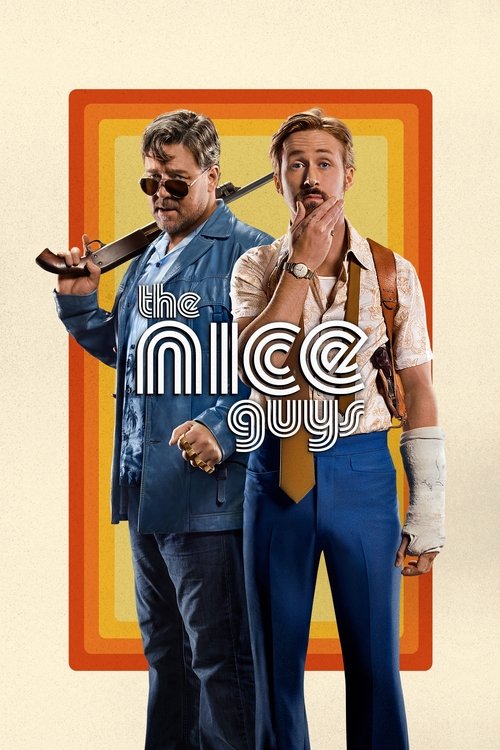
The Nice Guys
2016 · Shane Black
For when you want to laugh at a movie with actual style — a Friday-night pick when you're craving banter, action, and a little sleaze, no homework required.
What it's about
Los Angeles, 1977: a hapless, hard-drinking private eye and a bruiser who beats people up for a living get tangled together looking for a missing young woman. The case starts in the porn industry and keeps climbing — toward a conspiracy far bigger than either of them is equipped to handle. Mostly they stumble, bicker, and fall off things while the bodies pile up around them.
The experience
A fast, filthy good time — the mystery is genuinely twisty, but the real engine is the comedy, with slapstick pratfalls and rapid-fire insults landing inside real gunfights. It moves like a thriller and plays like a hangout movie.
Performances
Ryan Gosling is a revelation as a physical comedian — his shrieks, drunken tumbles, and bathroom-stall panic are worthy of silent-era clowns — and Russell Crowe plays the perfect weary straight man; their chemistry is the whole movie.
The craft
Shane Black's script is a machine of setups, payoffs, and running gags stitched into a real detective plot, and the production drenches everything in smoggy '70s Los Angeles texture — billboards, polyester, pool parties. The dialogue alone is worth the ticket.
Why it matters
A box-office underperformer that became a beloved cult favorite almost immediately, now a standard answer to 'why don't they make movies like this anymore' — and a high-water mark for the buddy formula its writer helped invent.
Snapshot
The Nice Guys is a period buddy-comedy neo-noir set against the smog-choked backdrop of Los Angeles in late 1977. A hired enforcer named Jackson Healy (Russell Crowe) and a hapless private detective named Holland March (Ryan Gosling) are thrown together to locate a missing young woman named Amelia, only to discover that her disappearance threads back through the underground pornography industry to a government-automotive conspiracy of Watergate proportions. Written and directed by Shane Black and co-written with Anthony Bagarozzi, the film is simultaneously a genre exercise in the tradition of Robert Altman's The Long Goodbye and a sharp comedy of male incompetence — a film that asks what the hardboiled detective story looks like when the detective cannot stop screaming and dropping his gun. Released by Warner Bros. in May 2016, The Nice Guys was a critical success but a commercial disappointment, failing to launch the franchise its ending so pointedly set up. It remains among the most accomplished neo-noirs of its decade.
Industry & production
Shane Black's career follows an unusual parabola. He broke into Hollywood as a screenwriter in 1987 with Lethal Weapon, the buddy-cop blockbuster that effectively codified the late-1980s action genre. Throughout the early 1990s he commanded extraordinary script fees — his deal for The Long Kiss Goodnight (1996) was among the largest in Hollywood history for a spec screenplay at the time — yet several projects from this period met with mixed commercial results. After a prolonged hiatus from the industry, Black returned as a director with Kiss Kiss Bang Bang (2005), a self-aware neo-noir meta-comedy that revived his critical reputation if not his box office. Iron Man 3 (2013) gave him a massive franchise hit, and Warner Bros. granted him the latitude to make The Nice Guys as a mid-budget original — the kind of studio picture that was becoming endangered by 2016.
The film was produced by Joel Silver, Black's long-time producing partner (Silver produced the Lethal Weapon series and many subsequent Black projects), alongside Steve Chapnick and Celia Costas. The budget was reportedly in the range of $50 million — substantial for an original R-rated comedy with no pre-existing intellectual property. Warner Bros. scheduled it against the summer tentpole season, an environment that may have compressed its commercial ceiling. The film earned a reported $62 million worldwide against that budget, widely characterized as a disappointment relative to its critical reception. A sequel was discussed publicly by Black and Crowe, but as of this writing none has been produced.
Anthony Bagarozzi, who had developed the underlying story concept in an earlier form before Black's involvement, co-wrote the screenplay. The details of the project's development history are not extensively documented in the public record. The film was produced largely in Atlanta, Georgia — then as now a dominant production center for Hollywood location work, owing to the state's film tax incentive program — with supplemental work in Los Angeles itself. The production design team undertook the considerable task of reconstructing 1977 Los Angeles on Atlanta streets and interiors, achieving a period environment of evident specificity.
Technology
The Nice Guys was photographed by Philippe Rousselot, the French director of photography who had won the Academy Award for A River Runs Through It (1992) and whose credits include Interview with the Vampire, Charlie and the Chocolate Factory, and Guy Ritchie's Sherlock Holmes pictures. Rousselot shot the film on 35mm photochemical stock — a deliberate choice in keeping with the period setting and a desire for the warm, slightly degraded optical texture characteristic of 1970s cinematography. In an era of near-universal digital acquisition, the choice to shoot on film had both aesthetic and philosophical dimensions: it anchors the image in the material conditions of the cinema the film invokes.
The film was composed in anamorphic widescreen, lending it the wider aspect ratio and characteristic optical properties of the scope format — lens flares, slight edge softness, the particular shallow depth of field that anamorphic glass produces. This choice connects the film formally to the Hollywood of its setting: anamorphic was the dominant widescreen format of 1970s American studio production, and using it here is a technical form of period fidelity, aligning the film's image with the films it references as ancestors.
Technique
Cinematography
Rousselot's palette is saturated and warm: the amber-orange of Los Angeles smog at dusk, the deep blue of swimming pools at night, the garish yellows and browns of 1970s interior decor. The film is lit practically where possible, with period-appropriate sources — neon, tungsten, fluorescent — visible within the frame. The overall visual register avoids the cool steel-blue grammar of contemporary crime cinema in favor of a warmer, more analog-looking palette that consciously invokes Chinatown and The Long Goodbye. This is not accidental nostalgia but a formal argument: the film's visual texture announces its genre inheritance.
The camera moves between modes as the action demands: handheld during combat and chase sequences, locked or dolly-mounted for comic setups where spatial clarity governs. The choreography of physical gags — particularly the elaborate business built around Gosling's character — requires precise framing so that pratfalls and misplaced props land on cue. Rousselot's work here is disciplined in a way that criticism sometimes overlooks: the camera is in service of joke architecture as much as mood, and the two demands are not always compatible.
Editing
The film was edited by Joel Negron, who had worked with Black on Iron Man 3. The editing strategy reflects Black's writing instincts: scenes are cut for pace and rhythm, with comic beats built around withholding and release. Negron's cuts frequently truncate the aftermath of physical comedy, trusting the audience to complete the joke in imagination — a technique with origins in silent film comedy and refined through decades of rapid-fire genre cutting. The theatrical cut runs approximately 116 minutes, lean by the standard of contemporary blockbuster comedy.
The handling of action sequences is notable for its spatial clarity: geography is established before kinesis, participants are oriented within the frame before movement begins, and cuts fall on action rather than concealing confusion. This openness — itself a period stylistic choice, since 1970s action cinema was cut more transparently than the post-Bourne grammar of disorientation — allows comedy embedded within action to register without the audience losing track of who is where.
Mise-en-scène / staging
Black's staging practice organizes scenes around the comic logic of spatial miscoordination: characters enter at the wrong moment, objects appear in foreground or background to undercut dialogue, and the blocking consistently places Gosling's Holland March in positions of physical vulnerability or absurdity. The film's most celebrated piece of staging — a bathroom-stall sequence in which March discovers a body while in acute physical distress — works almost entirely through Gosling's body language in a confined space, with Black's choreography calibrated to maximize escalating humiliation through geometry alone.
Richard Bridgland's production design is period-specific to a degree of evident research: automobiles, hotel conference rooms, commercial signage, and San Fernando Valley storefronts are rendered with precision. This specificity functions thematically rather than merely decoratively. The film's 1977 is a site of historically specific anxiety — the Carter era's atmosphere of institutional distrust, California's smog crisis, the tail-end of the Golden Age of Porn — and the visual environment makes those anxieties legible to an audience that may not consciously register the period detail producing them.
Sound
The sound design deploys period-appropriate music cues extensively — Earth, Wind & Fire, Kool & the Gang, Jigsaw among others — functioning both as period signposting and as tonal counterpoint. The use of upbeat funk and soul against violence and chaos draws on a technique native to 1970s crime cinema, where popular music was deployed non-ironically against narrative disorder; Black recovers that non-ironic quality here, using it neither as commentary nor as the ironic juxtaposition of later Tarantino-influenced cinema, but as something closer to the original register of pleasure and menace coexisting without comment.
The score by John Ottman and David Buckley — Ottman known principally as a film editor (The Usual Suspects) and occasional composer for Bryan Singer's films; Buckley an experienced television and film composer — is largely subordinated to the needle-drops, surfacing primarily in action sequences to provide propulsive rhythm. The dialogue mix is engineered for clarity: Black's scripts depend on rapid verbal exchanges landing, and overlapping delivery is mixed to ensure intelligibility.
Performance
The performances are the film's most immediately celebrated element. Ryan Gosling, by 2016 an established dramatic actor of considerable standing (Blue Valentine, Drive, The Place Beyond the Pines, with La La Land released the same year), commits entirely to a register of physical comedy rarely seen from performers of his profile. Holland March is a screamer — a man whose response to the unexpected is operatic distress — and Gosling plays this not as mugging but as something approaching psychological coherence: this is a character for whom being unprepared is not a comic pose but a condition. The pratfalls, the fumbling, the shrieking are executed with a performer's discipline that prevents them from collapsing into self-parody.
Russell Crowe's Jackson Healy is the structural counterweight: controlled, economical, tired. Crowe brings deadpan gravity to an essentially absurdist role — Healy is a brute for hire who is also something like a competent professional, and Crowe plays this contradiction straight, resisting any temptation to wink at the comedy around him. The film's comic engine runs on the tension between Gosling's chaos and Crowe's suppressed exasperation, and the chemistry between the two is sustained across the full runtime without visibly forcing.
The genuine breakout performance is Angourie Rice as Holly March, Holland's teenage daughter. Rice — a young Australian actress without previous significant American studio credits — plays Holly as the film's only consistently functional adult: the most competent figure in nearly every room she enters. The performance is assured and unshowy, and Rice went on from The Nice Guys to Spider-Man: Homecoming, The Beguiled, and other substantial roles, a trajectory the performance fully anticipates. Kim Basinger appears in a late-film role as the antagonist Judith Kuttner; the casting carries a resonance — Basinger is an LA figure by cultural association — that the film may or may not have intended, but which lands.
Narrative & dramatic mode
The Nice Guys operates in a mode of comic noir that depends on the systematic deflation of hardboiled convention. The private detective figure — the linchpin of noir — is here rendered incompetent, alcoholic, and grieving: Holland March solves crimes mostly by accident and survives largely through his daughter's intervention. The enforcer figure — morally ambiguous muscle in classical noir — is rendered not as villain but as the investigation's most reliably capable participant, and thus as the effective straight man in a sustained comedy of male uselessness.
The film's conspiracy plot follows the structural logic of 1970s paranoia cinema — The Parallax View, All the President's Men, Chinatown — without fully committing to their tonal gravity. The conspiracy is presented as real and its stakes as consequential: the suppression of clean-air emissions technology through government-corporate arrangement is framed as a genuine crime with mass public health implications. But the film declines to hold that weight against its comic momentum for long, and the ending resolves the mystery without fully closing the emotional gap between its thriller architecture and its comedy. This tonal balancing act is both the film's distinctive achievement and the source of its slight structural dissatisfaction: the comedic mode has somewhat dissipated the investment that dramatic resolution requires. The narrative is otherwise told chronologically, with no formal experimentation, and the mystery mechanics are clear and fairly distributed.
Genre & cycle
The Nice Guys inhabits several overlapping genre cycles simultaneously.
It is a neo-noir: a modern work engaging critically and affectionately with the conventions of classical film noir and the hardboiled detective tradition. It participates in a sustained cycle of Los Angeles neo-noirs that includes Altman's The Long Goodbye (1973), Chinatown (1974), Lawrence Kasdan's Body Heat (1981), Curtis Hanson's L.A. Confidential (1997), Paul Thomas Anderson's Inherent Vice (2014), and Black's own Kiss Kiss Bang Bang — a cycle that treats genre conventions as objects of simultaneous homage and critique, using Los Angeles itself as a recurring emblem of American moral geography.
It is simultaneously a buddy-action comedy — the genre Black helped codify with Lethal Weapon. The pairing of a volatile, emotionally reactive figure with a more controlled, physically imposing partner; the initially antagonistic relationship that resolves into grudging loyalty; the running verbal comedy of incompatible personalities in enforced proximity: these are Black's formal signatures across three decades, and The Nice Guys is their most refined distillation.
The period setting additionally places the film within a cycle of 1970s-set American nostalgia cinema — Boogie Nights (1997), Almost Famous (2000), American Hustle (2013) — that uses the decade as a site of moral and social disorder, associating it with institutional corruption, sexual excess, and the erosion of postwar certainty. The Nice Guys draws on this cycle's established iconography while anchoring it more specifically in the San Fernando Valley's particular ecology of smog, pornography, and automotive culture.
Authorship & method
Shane Black is one of the clearest auteurist cases in mainstream American commercial cinema. His recurring signatures are precise: the buddy pair of mismatched male protagonists; the precocious, morally competent child who illuminates adult failure; the deployment of Christmas or holiday settings as ironic backdrops (The Nice Guys is set in late autumn — one of the few Black films that does not use Christmas explicitly, though holiday decorations are visible in certain interiors, and the omission is itself notable as a variation on the formula); the self-aware engagement with genre convention; rapid, wisecracking, overlapping dialogue; and the neo-noir Los Angeles environment as a recurring moral landscape. The Nice Guys represents a summa of these preoccupations, and its relationship to Kiss Kiss Bang Bang in particular is that of a more confident, more deeply resourced return to identical territory.
Rousselot's contribution as cinematographer is not merely executional. The decision to shoot on 35mm and in anamorphic widescreen reflects an aesthetic argument about the kind of film The Nice Guys was intended to be, and the warm, physically textured visual result is partly the consequence of those material choices. Anthony Bagarozzi's contribution as co-writer is harder to parse from outside the collaboration; the extent to which the final screenplay represents Black's voice versus Bagarozzi's is not extensively documented in the public record. Black's writing signature — the irony folded into sentiment, the farce cutting suddenly to genuine melancholy — is recognizable throughout.
Movement / national cinema
The Nice Guys is unambiguously a product of Hollywood studio filmmaking — a mid-budget, star-driven genre entertainment produced by and distributed by Warner Bros. It affiliates with no national cinema movement in the formal sense and belongs to no film school tradition. Its debts are to the American genre inheritance: Chandler and Hammett, classical noir, and the 1970s Hollywood Renaissance that Black absorbed as a formative cinephile. If there is a movement context, it is the loosely constituted grouping of auteurist-adjacent Hollywood directors — Paul Thomas Anderson, David O. Russell, and peers — who have used studio resources to produce films with the texture and ambition typically associated with independent cinema, without formally departing from commercial production structures.
Era / period
The film was released in May 2016, a moment when the mid-budget original studio comedy was under acute commercial pressure from franchise blockbusters and the expanding streaming market. Its underperformance was part of a visible pattern: several accomplished, original mid-budget films from this period failed at the theatrical box office in ways that could not be attributed to quality. The Nice Guys appears in retrospect as an argument for a mode of filmmaking the studio system was in the process of abandoning — the adult genre comedy without sequel apparatus, without pre-sold intellectual property, rated R, made for a general audience that had partly migrated elsewhere.
The film's 1977 setting is historically specific in its resonances. 1977 Los Angeles was the year of the Carter inauguration, the height of the San Fernando Valley's pornography industry (the latter years of the so-called Golden Age of Porn), and the nadir of the California smog crisis. The conspiracy at the film's center — auto industry interests bribing government officials to suppress clean-air technology — is rooted in these specific anxieties, and the film positions its heroes' bumbling investigation as a microcosm of post-Watergate civic decay: institutions are corruptible, authority is purchasable, and competence is the anomaly. This is the 1970s American imaginary that Black absorbed as a child and reconstructs here with both affection and acidity.
Themes
Institutional corruption and civic cynicism. The film's central conspiracy is not a gangland plot but a government-corporate arrangement: Department of Justice officials working with Detroit automakers to silence a witness who carries evidence of emissions fraud. This is Watergate's lesson — that authority is not trustworthy — applied to environmental regulation and corporate accountability, and the film takes it seriously enough to articulate it explicitly through Holly's narration, while the comedy prevents any tendency toward solemnity from congealing.
Male incompetence and its consequences. Holland March is, structurally, a failure — a bad detective, a neglectful father, an alcoholic in qualified denial. The film does not rehabilitate him in the conventional arc of male self-improvement that the buddy-action genre typically requires. He remains more or less as incompetent at the end as at the beginning. The Nice Guys is unusual in treating male uselessness not as a problem to be overcome but as a condition that comedy can accommodate and children must compensate for, and in refusing to falsify this by granting its protagonist a redemptive arc he has not earned.
The precocious child as moral compass. Holly March is the film's most reliable intelligence — she understands what is happening faster than either adult, identifies when adult behavior is ethically wrong, and provides the investigation's emotional continuity. This figure — the child who is more functional than the adults surrounding her — recurs persistently across Black's work (in Kiss Kiss Bang Bang, in Iron Man 3) and reflects a consistent worldview: adulthood in Black's films is a state of arrested development, while children retain a pragmatic moral clarity that adults have trained themselves to suppress.
The buddy bond as substitute for institutional trust. In the absence of reliable institutions — the police are incompetent or corrupt, the DOJ is compromised, the auto industry is criminal — the only thing March and Healy can trust is each other. The affective core of the film, as in all of Black's major work, is the grudging development of loyalty between two men who began as adversaries. This bond is presented not as a solution to the systemic problems the film identifies but as an accommodation of them: in a corrupt world, small loyalties are what you have.
Reception, canon & influence
Critical reception. The Nice Guys received strongly positive reviews on release, with particular praise for Gosling's physical comedy, the script's wit, and the film's confident tonal management. Critical consensus placed it in the company of the best action-comedies in recent memory and situated it in the lineage of Altman's The Long Goodbye and the broader neo-noir tradition. It appeared on numerous critics' year-end lists for 2016 and maintains a high standing on review aggregation platforms.
Influences on the film (backward). The most direct cinematic precedents are: Altman's The Long Goodbye (1973), which established the template of the Chandleresque detective figure displaced into moral confusion and produced the definitive Los Angeles-as-moral-miasma visual vocabulary; Chinatown (1974), the canonical Los Angeles neo-noir, whose conspiracy structure, period specificity, and bitter institutional conclusions The Nice Guys explicitly echoes; Paul Thomas Anderson's Boogie Nights (1997) and Inherent Vice (2014), which use the same San Fernando Valley milieu and 1970s temporal setting; and Black's own Kiss Kiss Bang Bang, from which The Nice Guys inherits its meta-noir self-awareness and its structural double-act. The buddy-comedy tradition of Lethal Weapon — a genre Black helped create — is present throughout as a formal inheritance being both honored and interrogated. Behind the cinematic lineage lies the hardboiled fiction of Raymond Chandler, whose Philip Marlowe provides the ghost against which Holland March's incompetence is measured.
Legacy and forward influence. The Nice Guys arrived too recently and underperformed too significantly to have established a traceable forward influence on subsequent filmmaking as of this writing. Its most measurable legacy has been in launching Angourie Rice's career — she moved directly from this film to significant roles in major productions — and in consolidating the critical reputation of Shane Black as an auteurist director working within Hollywood genre conventions rather than against them. The film occupies a specific canonical position: the beloved, accomplished, underseen work — a film critics cite when arguing that the mid-budget original studio comedy deserves preservation, and that audiences cite when arguing that studios do not know how to market or protect the things they make. Whether it will prove generatively influential as a younger generation of filmmakers absorbs it is a question the record cannot yet answer; the conditions that produced it — a studio willing to fund a non-franchise, R-rated original — are more difficult to replicate now than they were when it was made.
A Deleuzian reading
Picture Holland March on a bathroom floor, trousers at his ankles, one hand groping for a dropped revolver, and a corpse he has just discovered slumped against the stall.
The full Deleuzian reading of The Nice Guys →
Reception
Critics liked it in 2016, but it flopped hard — infamously losing its opening weekend to The Angry Birds Movie — and Shane Black's hoped-for franchise died on the vine. In the decade since it's become the textbook streaming-era vindication story: a beloved cult comedy everyone now claims they saw in theaters.
How The Nice Guys was received, from release to now →
Influences: the films it descends from and the films it influenced
- The Long Goodbye (1973) — Vilmos Zsigmond's restless zoom-lens photography and Altman's systematic undercutting of hardboiled convention — Marlowe as bewildered anachronism, Los Angeles as morally indifferent sprawl — established the formal template of the deflated detective-in-LA that The Nice Guys inherits as its foundational genre argument.
- Chinatown (1974) — Robert Towne's screenplay architecture — private investigator drawn into an institutional conspiracy too deeply entrenched to be defeated, resolved with a demonstrably bitter institutional ending — provides the direct narrative structure The Nice Guys replicates in its government/DOT cover-up plot and identically bleak tonal resolution.
- 48 Hrs. (1982) — Hill established the hostile-partnership action-comedy template — two men forced together by circumstance, generating comedy from temperamental and physical incompatibility before bonding under shared duress — that Black absorbed, codified in Lethal Weapon, and then consciously elevated in the Crowe/Gosling dynamic.
- Fletch (1985) — Chevy Chase's sardonic deadpan — the investigator who maintains composure while being physically overwhelmed by circumstances — established a comic performance register for the deflated LA detective that Gosling's Holland March directly inherits and hyperbolizes into full pratfall.
- Lethal Weapon (1987) — Black's own screenplay codified the buddy-pair architecture — mismatched partners whose temperamental opposition generates comedy through physical and verbal friction before crisis-forced bonding — which The Nice Guys reprises as both formal inheritance and self-aware interrogation of the genre conventions Black himself created.
- Midnight Run (1988) — The De Niro/Grodin two-hander — overlapping antagonistic dialogue conducted as verbal sparring, comedy derived from forced proximity of incompatible temperaments, slapstick arising from shared adversity — provides the performance template that Crowe and Gosling replicate and amplify throughout The Nice Guys.
- Boogie Nights (1997) — Robert Elswit's warm anamorphic 35mm photography of the San Fernando Valley in the 1970s — including his technique of embedding period needle drops as structural and emotional devices rather than ironic commentary — provided the visual and sonic vocabulary that Philippe Rousselot and Black consciously reference and update.
- L.A. Confidential (1997) — Dante Spinotti's anamorphic 35mm reconstruction of period Los Angeles and the film's structural nesting of a buddy investigation within a systemic institutional conspiracy — two morally opposed detectives forced into alliance who expose corruption too entrenched to be punished — make it a direct formal model for The Nice Guys' visual architecture and plot mechanics.
- The Big Lebowski (1998) — The Dude as a deliberately degraded Marlowe — hardboiled detective conventions repurposed to stage comic incompetence against a conspiracy centrally involving the adult film industry — is the nearest structural precedent for Holland March's identical positioning within The Nice Guys' equally porn-adjacent cover-up plot.
- Kiss Kiss Bang Bang (2005) — Black's directorial debut established the meta-noir double-act structure — a mismatched pair working a murder mystery they simultaneously perform and self-consciously comment upon, with Val Kilmer and Robert Downey Jr. — which The Nice Guys reprises with Crowe and Gosling as a more resourced, formally confident return to identical terrain.
- Inherent Vice (2014) — Robert Elswit's anamorphic 35mm cinematography of the same San Fernando Valley/Los Angeles 1970s coordinates, combined with Anderson's staging of the Chandleresque protagonist as comic incompetent navigating paranoid conspiracy through a fog of procedural confusion, positions this as the immediate formal precedent The Nice Guys' script and visual approach directly answer.
- Iron Man 3 (2013) — Black's deployment of his signature authorial devices within blockbuster infrastructure — buddy dynamic between Stark and the boy Harley, precocious child as moral compass illuminating adult failure, holiday setting as ironic backdrop, physical comedy choreography within action set-pieces — demonstrates the same formal method as The Nice Guys, making this an intra-auteur sibling within the same recurring signature system.
- The Sisters Brothers (2018) — Benoît Debie's anamorphic widescreen cinematography and Audiard's application of buddy-genre deflation to the Western — two mismatched siblings whose violence is simultaneously staged for comedy and rendered genuinely consequential, with period material texture grounding absurdist incident — extends The Nice Guys' genre-deflation formal method to a different historical setting.
- The Man from U.N.C.L.E. (2015) — Linus Sandgren's anamorphic period cinematography and Ritchie's staging of physical-comedy action within a retro-genre revival framework — deploying 1960s espionage conventions with contemporary self-awareness, generating a double-act from temperamental mismatch between a Soviet and an American — positions this as The Nice Guys' nearest formal contemporary in the period-buddy-action-comedy revival.
- Free Fire (2016) — Wheatley and DP Laurie Rose's technique of staging sustained physical comedy from a single-location gunfight — maintaining spatial clarity through escalating chaos while sustaining deadpan comic tone in the face of genuine bodily harm — works the same spatial-comedy-choreography method central to The Nice Guys' extended set-pieces.
- Once Upon a Time... in Hollywood (2019) — Black practices the same period-LA buddy-film hangout mode—anti-dramatic economy punctuated by climactic violence, two male leads whose dynamic trades on latent-menace-cool against genre obsolescence—working parallel to Tarantino in the same craft register and historical geography.
- Deadpool & Wolverine (2024) — A mismatched-buddy patter comedy where verbal friction and mutual contempt drive the action beats — the two-hander chemistry model the Reynolds–Jackman pairing extends.
- The Fall Guy (2024) — Template for the Gosling blunt-comic register and the action-comedy two-hander chemistry, where physical pratfalls and deadpan banter carry the set-pieces.
Similar films
- Kiss Kiss Bang Bang (2005) — influence & lineage · same viewing thread
- L.A. Confidential (1997) — influence & lineage
- The Big Lebowski (1998) — influence & lineage
- Lethal Weapon (1987) — influence & lineage
- The Long Goodbye (1973) — influence & lineage
- Inherent Vice (2014) — influence & lineage
- Chinatown (1974) — influence & lineage
- The Fall Guy (2024) — shared sensibility
All the films related to The Nice Guys →
Watch it with: curated runs of related films
- Schemers, Crews, and the Big Score — A run of witty crime pictures where somebody always has an angle — watch these together for intricate plans, colliding crooks, and heists that go gloriously sideways.