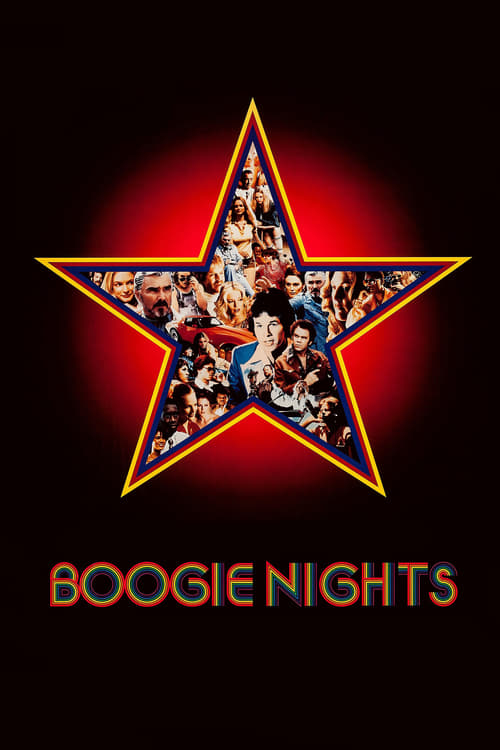
Boogie Nights
1997 · Paul Thomas Anderson
The critics' consensus "greatest living American director" finally made a commercial-scale film with One Battle After Another, instantly triggering debates about its politics, its reported $130M+ budget, and whether the best-reviewed film of 2025 could actually win Best Picture. PTA fandom is a Letterboxd personality type.
For when you want a big, propulsive American epic to lose an evening to — equal parts great hangout movie and cautionary tale. It's a wild ride that earns its emotional gut-punches.
What it's about
Los Angeles, 1977: a young dishwasher with one conspicuous gift is discovered by a paternal porn producer and reborn as adult-film star Dirk Diggler. Around him forms a makeshift family of performers and crew members chasing glamour, love, and legitimacy in the San Fernando Valley — until the disco decade ends, cocaine takes over, and the industry they built starts changing under their feet. It's a rise-and-fall epic set in the last place Hollywood wanted to look.
The experience
Euphoric, then harrowing — the first half plays like the best party you've ever crashed, all pool parties and needle drops, before the film pivots into something darker and more desperate. It's funny, tense, sad, and generous to every character, often in the same scene.
Performances
A murderers' row of an ensemble: Mark Wahlberg's career-defining mix of sweetness and vanity, Burt Reynolds's Oscar-nominated turn as the courtly producer Jack Horner, and Julianne Moore, also Oscar-nominated, heartbreaking as a porn star and would-be mother. Philip Seymour Hoffman, John C. Reilly, William H. Macy, and Don Cheadle all do indelible work in the margins.
The craft
Paul Thomas Anderson, just 27, directs with swaggering confidence — long unbroken Steadicam takes that glide through parties and nightclubs, a wall-to-wall '70s soundtrack that does half the storytelling, and an ensemble juggled with remarkable control. It's a film that rewards good speakers as much as a big screen; the music and the camera moves are the pulse.
Why it matters
It announced Anderson as one of the major American directors of his generation and revived Burt Reynolds's career; its ensemble sprawl and needle-drop bravura became a template for a wave of ambitious late-'90s American cinema.
Snapshot
Boogie Nights is Paul Thomas Anderson's sprawling, propulsive chronicle of the Los Angeles pornography industry across the cusp of the 1970s and 1980s, following the rise, fall, and tentative redemption of a well-endowed busboy turned adult-film star, Eddie Adams, who reinvents himself as "Dirk Diggler." Anderson's second feature — and his breakout — it transformed a then-27-year-old filmmaker into one of the most discussed American directors of his generation. The film is at once an ensemble family melodrama, a period pastiche soaked in disco and cocaine, and a meditation on the seductions and costs of manufactured intimacy. Its formal ambition is conspicuous: long Steadicam takes, a wall-to-wall pop soundtrack, a large ensemble orchestrated with Altmanesque density, and a structure that pivots from euphoric ascent to harrowing collapse as the calendar turns to the Reagan era. Anchored by Mark Wahlberg's vulnerable lead performance and a deep bench of supporting players — Burt Reynolds, Julianne Moore, Don Cheadle, William H. Macy, Heather Graham, Philip Seymour Hoffman, John C. Reilly — Boogie Nights established the thematic and stylistic preoccupations Anderson would carry through his subsequent career.
Industry & production
Boogie Nights was produced by New Line Cinema, the studio then known for the Nightmare on Elm Street franchise and the success of The Mask and Dumb and Dumber, but seeking to build a prestige profile. The film grew directly out of The Dirk Diggler Story, a mock-documentary short Anderson had made as a teenager in the late 1980s, which he later expanded into the feature screenplay. Anderson had directed one prior feature, Hard Eight (originally Sydney, 1996), a comparatively modest neo-noir whose troubled post-production with Rysher Entertainment — including disputes over final cut — left him determined to protect his authority on the next project.
The budget is commonly reported as roughly $15 million, modest for a film of its ensemble scale and period detail; New Line's involvement gave Anderson a degree of creative latitude unusual for a young director handling explicit subject matter. The casting itself became part of the film's lore. Burt Reynolds, whose career had badly faded, was reluctant and reportedly clashed with Anderson during the shoot; his performance as porn auteur Jack Horner nonetheless revived his standing and earned him his only Academy Award nomination. Mark Wahlberg, recently transitioning from his Marky Mark music persona and Calvin Klein modeling into acting, was cast in the lead. Several roles drew on Anderson's emerging stock company — John C. Reilly and Philip Baker Hall carried over from Hard Eight, and Philip Seymour Hoffman, in a small but indelible part, began a collaboration that would span much of Anderson's career.
The production was, by most accounts, an audacious bet that paid off critically. The film premiered at the Toronto International Film Festival and earned three Academy Award nominations — Reynolds for Supporting Actor, Julianne Moore for Supporting Actress, and Anderson for Original Screenplay. Beyond awards, it functioned as a launching pad: New Line's gamble on a young, formally aggressive director helped define the late-1990s American independent-adjacent studio film.
Technology
Boogie Nights was shot on 35mm film, the standard professional format of its moment, well before digital acquisition reshaped production. Its technological signature lies less in novel apparatus than in the virtuosic deployment of established tools — above all the Steadicam, the camera-stabilization rig that by the late 1990s was a mature technology but rarely orchestrated with the sustained choreographic ambition Anderson brought to it. The opening shot, a long unbroken Steadicam move that sweeps from a nightclub marquee into the club and threads through the principal characters, is a deliberate technological showpiece announcing the film's debt to long-take cinema.
The film's period setting (1977–1984) is rendered through analog-era production design rather than digital effects: practical sets, location shooting around the San Fernando Valley, and an immersion in the textures of 1970s film stock aesthetics. The one notable special-effects element — the prosthetic reveal in the final shot — is a practical prop rather than any digital intervention, consistent with the film's grounding in the material world of its era.
Technique
Cinematography
Anderson collaborated with cinematographer Robert Elswit, beginning a partnership that would become one of the defining director-DP relationships of contemporary American cinema (extending through Magnolia, There Will Be Blood, and beyond). Elswit's camerawork is mobile and expressive: gliding Steadicam takes, fluid tracking shots, and whip-pans that bind the ensemble into a single restless social organism. The visual strategy deliberately evokes the New Hollywood films of the 1970s — saturated color, naturalistic interiors, a roving camera reminiscent of Scorsese and Altman — so that style itself participates in the period evocation. As the film darkens in its second half, the cinematography grows more fractured and claustrophobic, the earlier exuberant mobility giving way to tenser, more confined compositions that mirror the characters' disintegration.
Editing
The film was edited by Dick Hallenbeck. Its construction balances long, unbroken takes against passages of accelerated, music-driven montage. The rhythmic interplay is central to the film's meaning: the euphoric ascent of the late 1970s is cut to the pulse of disco and pop, while the early-1980s collapse is marked by editing that becomes more jagged and anxious. The film's celebrated set pieces — particularly the climactic drug-deal sequence at Rahad Jackson's mansion, where firecrackers detonate against a soundtrack of period songs — depend on precise editorial control of escalating tension. Anderson's structural design, moving from communal exhilaration to scattered catastrophe and back toward a fragile reunion, is realized as much in the cutting as in the script.
Mise-en-scène / staging
Production designer Bob Ziembicki and costume designer Mark Bridges (another long-term Anderson collaborator) built a densely particular world of shag carpets, sunken living rooms, gold chains, bell-bottoms, and Valley swimming pools. Anderson stages his large ensemble in deep, busy frames where multiple performers and subplots coexist, a technique inherited from Robert Altman's overlapping social tableaux. The recurring use of Jack Horner's house as a gathering place visually argues the film's central metaphor — the porn crew as surrogate family — while the shift to colder, more isolating spaces in the second half registers that family's fracture. Costume and décor are not mere period decoration but a system of meaning, tracking each character's status and decline.
Sound
Sound is among the film's most aggressive and characteristic elements. Boogie Nights is saturated with a needle-drop soundtrack of 1970s and early-1980s pop, soul, and disco — the music functioning as period marker, emotional engine, and ironic commentary. Anderson uses songs structurally, scoring entire sequences to specific tracks so that the soundtrack drives narrative momentum. The contrast between the warm, danceable pop of the disco era and the harder New Wave textures of the early 1980s sonically charts the film's historical turn. Diegetic sound — the hum of pool filters, the crackle of a film set, the chaos of the drug-deal climax — is layered with this curated music to produce the film's distinctive sensory density.
Performance
Boogie Nights is, above all, an actors' film, and its ensemble performances are central to its reputation. Mark Wahlberg's Dirk Diggler is a study in naïveté curdling into self-destruction, the actor mining genuine pathos from a character defined by a single physical attribute. Burt Reynolds brings paternal gravity and melancholy to Jack Horner. Julianne Moore's Amber Waves — a porn actress and maternal figure mourning the custody of her real child — is the film's emotional core, blending warmth with addiction-fueled grief. Don Cheadle, William H. Macy, Heather Graham, John C. Reilly, and Philip Seymour Hoffman each render fully inhabited figures from relatively limited screen time. Anderson's direction favors long takes that demand sustained performance, allowing actors room to build moments without the safety net of frequent cutting.
Narrative & dramatic mode
The film operates in the mode of the ensemble melodrama crossed with the rise-and-fall epic. Its structure is broadly tripartite: a rapturous ascent through the late 1970s, a catastrophic unraveling at the turn of the decade, and a partial, bittersweet reconstitution of the surrogate family. Anderson interweaves numerous storylines — Dirk's stardom and ruin, Amber's maternal longing, Buck Swanson's bid for middle-class respectability, Little Bill's humiliation and violence, Jack Horner's artistic pretensions colliding with industry economics. The dramatic engine is the tension between the characters' yearning for family, dignity, and meaning and the degrading, transactional reality of their work and the encroaching cocaine economy of the 1980s. Tonally, the film moves fluidly between comedy, tenderness, and genuine horror, refusing easy moralism about its subjects while never sentimentalizing the damage they sustain.
Genre & cycle
Boogie Nights resists single-genre classification, blending the showbiz rise-and-fall narrative, the ensemble social panorama, the period piece, and elements of family melodrama and dark comedy. It belongs to a cycle of late-1990s American films that revisited the 1970s with both nostalgia and critique, and to a broader lineage of films about the entertainment industry's underbelly. Its closest generic kin are the "behind-the-scenes" showbiz sagas and the ensemble mosaics of 1970s New Hollywood. The film's self-conscious engagement with pornography as a subject — treating it not as titillation but as a workplace and a flawed family — distinguishes it from exploitation traditions and aligns it with serious dramatic treatments of marginal communities.
Authorship & method
Boogie Nights is the foundational statement of Paul Thomas Anderson's authorship. As writer-director he established the signatures that would recur across his work: the ensemble structure, the surrogate-family theme, the virtuosic long take, the music-driven sequence, the sympathetic attention to lonely and damaged characters, and the influence of Robert Altman and Martin Scorsese metabolized into a distinctly personal voice. The film also inaugurated Anderson's career-long practice of building a repertory of collaborators. Cinematographer Robert Elswit, costume designer Mark Bridges, and actors including Philip Seymour Hoffman, John C. Reilly, and Julianne Moore became recurring presences. Anderson's method is notable for its writing-driven approach grounded in deep character specificity, combined with a willingness to stage technically demanding sequences. While the film does not use Anderson's later composer-collaborators (his partnership with Jon Brion began on Magnolia, and with Jonny Greenwood on There Will Be Blood), its reliance on a curated pop soundtrack in place of original scoring is itself a deliberate authorial choice central to the film's identity.
Movement / national cinema
The film is a product of American cinema's late-1990s independent-and-studio convergence — the moment when formally ambitious young directors found backing from companies like New Line, Miramax, and the specialty divisions of the majors. It belongs to a generation often grouped loosely under the banner of the 1990s American independent renaissance, alongside figures such as Quentin Tarantino, the directors emerging from Sundance, and a wave of filmmakers steeped in cinephilia. Yet Boogie Nights is most precisely understood as an act of deliberate inheritance from New Hollywood — the 1967–1980 American auteur cinema of Altman, Scorsese, and their peers — reanimated by a director who treated that period as both subject and stylistic model.
Era / period
Boogie Nights is doubly an era film: produced in 1997, it is set across 1977 to 1984, dramatizing a specific historical hinge. The film's central historical argument concerns the transition from the comparatively communal, celluloid-based, quasi-artisanal pornography of the disco 1970s to the colder, videotape-driven, cocaine-saturated industry of the early 1980s. The shift from film to videotape within the story functions as a metaphor for cultural decline — the loss of craft, intimacy, and the fragile dream of legitimacy that Jack Horner clings to. The encroaching Reagan-era economy, the rise of harder drugs, and the cheapening of the work all mark the death of the film's idealized 1970s. This period specificity is not mere backdrop but the engine of the film's tragedy.
Themes
The film's governing theme is the search for family among the marginalized: the porn crew constitutes a chosen family for characters estranged from or failed by their biological ones, and the film's emotional weight rests on the fragility and resilience of these bonds. Adjacent themes include the seduction and hollowness of fame; the tension between self-image and reality; the commodification of intimacy and the body; addiction and self-destruction; and the American hunger for reinvention. Anderson treats his characters with notable compassion, locating genuine longing — for love, recognition, dignity, parenthood — beneath the tawdry surfaces of their world. The film also meditates on artifice itself: Jack Horner's delusion that pornography can be art parallels the larger human project of constructing meaning from manufactured images.
Reception, canon & influence
Boogie Nights was met with strong critical acclaim upon release and quickly established Anderson as a major talent; its three Academy Award nominations (Reynolds, Moore, and Anderson's screenplay) confirmed its institutional standing, though it won none. Over subsequent decades it has been widely canonized as one of the essential American films of the 1990s and a landmark of the decade's directorial renaissance. (Precise box-office and review-aggregate figures are beyond what should be asserted from memory here, but the consensus of acclaim is well documented.)
The influences on the film are openly worn. Robert Altman's ensemble mosaics — particularly Nashville — shape its overlapping social structure; Martin Scorsese's Goodfellas and Mean Streets inform its mobile camera, pop-soundtrack strategy, and rise-and-fall arc; and the broader New Hollywood aesthetic provides its visual and tonal vocabulary. Jonathan Demme's roving humanism and the period itself as documented in adult-industry history also inform the work, though Anderson has been careful to describe the film as fiction rather than biography (popular comparison to real industry figures notwithstanding).
The film's influence forward has been substantial. It helped legitimize the music-saturated, long-take ensemble film as a mode for ambitious American directors, and it cemented the surrogate-family ensemble drama as a recurring shape in subsequent cinema. It revived Burt Reynolds's critical reputation, launched Mark Wahlberg's dramatic career, and accelerated the rise of Julianne Moore, Don Cheadle, and especially Philip Seymour Hoffman within Anderson's evolving repertory. Most significantly, it announced Paul Thomas Anderson himself, whose subsequent body of work — Magnolia, There Will Be Blood, The Master, Phantom Thread — would build on the formal and thematic foundations laid here. The film endures as a touchstone for filmmakers seeking to marry technical bravura with deep ensemble feeling, and as one of the defining portraits of America's passage from the 1970s into the 1980s.
A Deleuzian reading
The camera comes down off a neon marquee in Reseda and refuses to stop moving.
The full Deleuzian reading of Boogie Nights →
Reception
Acclaimed right out of the gate in 1997 — three Oscar nominations and instant 'who is this 27-year-old?' buzz around PTA — and its stock has only climbed since, now sitting comfortably as one of the defining American films of the 90s.
How Boogie Nights was received, from release to now →
Influences: the films it descends from and the films it influenced
- Nashville (1975) — Supplies the multi-strand ensemble-mosaic architecture — dozens of equally-weighted characters orbiting a single industry — and the overlapping, atmosphere-first sound design Anderson adopts for the porn-set milieu.
- The Long Goodbye (1973) — Models the restless, perpetually-drifting camera and loose naturalistic blocking that lets actors wander frame, a roving aesthetic Anderson translates into Elswit's gliding Steadicam coverage.
- Goodfellas (1990) — The Copacabana Steadicam plunge is directly echoed in the opening Reseda-club tracking shot, and its wall-to-wall pop needle-drops scoring a rise-and-fall arc are the template for Boogie Nights' soundtrack strategy.
- Mean Streets (1973) — Establishes the practice of cutting scenes to pre-existing jukebox records rather than original score, the diegetic-feeling pop curation Anderson uses in place of a composer.
- Touch of Evil (1958) — The bravura unbroken opening crane-and-track shot is the foundational grammar for Boogie Nights' single-take introduction of its entire ensemble.
- I Am Cuba (1964) — Its physically impossible continuous-take choreography — the camera diving underwater at a pool party — prefigures the show-off poolside Steadicam descent and the film's faith in the long take as spectacle.
- Shampoo (1975) — Provides the sun-bleached 1970s Los Angeles sexual-economy ensemble, treating a louche industry as a social network rather than scandal.
- New York, New York (1977) — Scorsese's lavishly reconstructed-period showbiz melodrama models marrying meticulous era production design to a doomed-couple/rise-and-fall arc.
- A Star Is Born (1954) — The canonical showbiz rise-and-fall melodrama whose ascent-success-self-destruction skeleton structures Dirk Diggler's trajectory.
- Pulp Fiction (1994) — A contemporaneous experiment in using a curated pop-soundtrack as score and interlocking ensemble structure, the other 1990s landmark of soundtrack-driven New Hollywood inheritance.
- Casino (1995) — Anderson adopts Casino's Steadicam-through-an-institution long-take as opening gambit (the Reseda nightclub tracking shot) and its ironic pop-music counterpoint layered over a period-chronicle rise-and-fall of a criminal-adjacent enterprise.
- Carlito's Way (1993) — PTA directly cites and inherits De Palma's split-diopter compositions and Steadicam long-takes through period entertainment environments — the Boogie Nights opening shot is an acknowledged extension of the De Palma grammar developed across Scarface and Carlito's Way, including the overhead choreography of group performance spaces.
- Magnolia (1999) — Anderson's immediate expansion of the same machine — interlocking San Fernando Valley ensemble, surrogate-family yearning, and sequences built around music (the Aimee Mann sing-along) cut as emotional motor.
- Requiem for a Dream (2000) — Pushes the music-driven montage of decline into hyper-kinetic hip-hop-cut form, extending Boogie Nights' editing-to-rhythm portrait of addiction and collapse.
- Almost Famous (2000) — Inherits the 1970s music-world surrogate-family ensemble and the needle-drop-as-narration mode, with curated period tracks carrying scene-level emotion.
- The Wolf of Wall Street (2013) — Extends the same Scorsese DNA — voiceover-driven rise-and-fall of an excess industry, propulsive pop scoring, and bravura long takes through a debauched workplace.
- Once Upon a Time in Hollywood (2019) — Reconstructs late-period Los Angeles showbiz with the same loving period design and needle-drop saturation, weaving fictional industry figures through a real era as Anderson does.
- Licorice Pizza (2021) — Returns to the same San Fernando Valley period sandbox with episodic ensemble drift and needle-drop scoring, the late-career refinement of Boogie Nights' milieu and method.
- The Nice Guys (2016) — Robert Elswit's warm anamorphic 35mm photography of the San Fernando Valley in the 1970s — including his technique of embedding period needle drops as structural and emotional devices rather than ironic commentary — provided the visual and sonic vocabulary that Philippe Rousselot and Black consciously reference and update.
- American Hustle (2013) — Demonstrates the late-70s Scorsese-via-ensemble mode Russell adopts: roaming Steadicam through period interiors, jukebox scoring, and a damaged surrogate family of self-reinventing strivers.
- X (2022) — Gives West the affectionate ensemble treatment of a porn crew chasing legitimacy, and the dense wall-to-wall period-source-music scoring that grounds the era diegetically.
- Babylon (2022) — The roving Steadicam party opening and the empathetic ensemble portrait of an industry's transition (film-to-video there, silent-to-sound here) are the closest structural model for Chazelle's mobile-camera choreography and rise-and-fall ensemble.
- Bingo: The King of the Mornings (2017) — The template Bingo openly borrows: a propulsive Steadicam-and-montage rise-and-fall charted through one disreputable entertainment subculture, where period-specific pop textures and an ensemble's collective euphoria mask the performer's private collapse.
- City of God (2002) — Applies a kinetic, music-cut ensemble rise-and-fall structure to a criminal economy, sharing Boogie Nights' decade-spanning epic shape and roving virtuoso camera.
- Jackie Brown (1997) — Uses a period soul/funk diegetic soundtrack as structural architecture — not mood underscoring but scene-by-scene musical anchoring that encodes the 1970s milieu in the body — a parallel deployment of the same blaxploitation sonic tradition Jackie Brown inherits from Shaft and Across 110th Street.
- Blow (2001) — Anderson uses the same temporal color-temperature strategy as Kuras and Demme — photographic signature shifting across the 1970s-1980s boundary to encode moral and social decline — and structures his rise-and-fall through decade-defining needle-drop choices with the same ambivalent warmth toward its sympathetic transgressive milieu.
- One Battle After Another (2025) — California episodic accumulation with Altman-derived ensemble logic, source music integrated as period texture rather than composed underscore, and long-take sequences that require actors to sustain improvisational arcs across extended choreographed set-pieces — the Californian strand of Anderson's auteurism in its first fully developed form.
- The Fighter (2010) — Shares the Wahlberg working-class-Massachusetts persona deployed inside a sprawling needle-drop-scored ensemble, where a surrogate family's dysfunction is staged in restless crowded frames.
- Iruvar (1997) — Released the same year, an ensemble industry self-portrait tracking a rise-and-fall inside a film business — the same reflexive fascination with how an industry fabricates and consumes its performers.
Similar films
- Magnolia (1999) — influence & lineage
- Licorice Pizza (2021) — influence & lineage
- Pulp Fiction (1994) — influence & lineage
- Requiem for a Dream (2000) — influence & lineage
- Once Upon a Time... in Hollywood (2019) — influence & lineage
- GoodFellas (1990) — influence & lineage
- The Wolf of Wall Street (2013) — influence & lineage · same viewing thread
- American Psycho (2000) — same viewing thread
All the films related to Boogie Nights →
Watch it with: curated runs of related films
- The American Male Comes Apart — A run of self-made men — brokers, founders, dealers, drifters — hollowed out by the very thing they chase, each film pressing the same nerve where ambition curdles into alienation and violence.
Film essays and courses that include it
- Paul Thomas Anderson
- The Body Under the Influence: A Century of Addiction Cinema
- The Dream at the End of the Road: Los Angeles & California
- Skin and Obsession: The Erotic Film from Provocation to Revival
- The Second Act: When the Role Rhymes with the Career
- Drop the Needle: Pop Music as Cinema's Beating Heart
- The Decade the Outsiders Got In
- The Camera That Loves the Sin
- The Heir Who Became an Original
- The Ghost That Walks