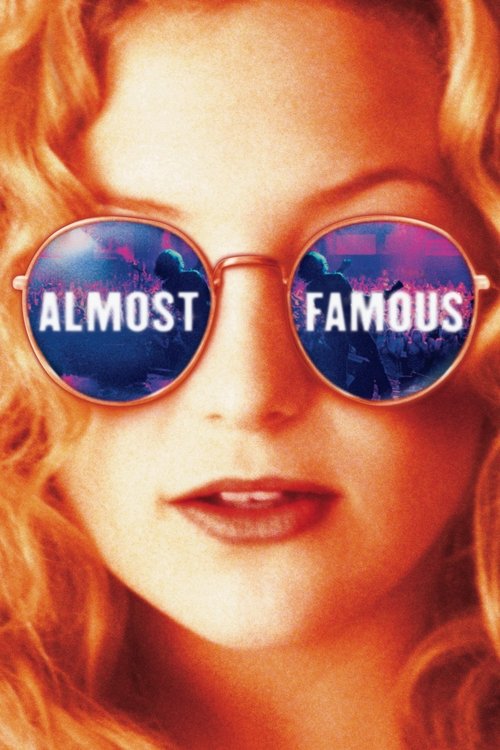
Almost Famous
2000 · Cameron Crowe
For a night when you want to feel young, in love with music, and a little homesick for a time you may never have lived through. Deep comfort viewing that still has something true to say.
What it's about
In 1973, fifteen-year-old William Miller — a sheltered kid who loves rock and roll more than anything — talks his way into a Rolling Stone assignment touring with Stillwater, a mid-tier band on the edge of making it. On the bus he falls in with the 'band aids' led by the magnetic Penny Lane, gets adopted and used by the musicians, and learns the hard difference between being a fan and telling the truth.
The experience
Warm, funny, and aching all at once — nostalgia with its eyes open. It flows like a great album, loose and generous, and sneaks up on you with how much it makes you feel about growing up and losing your illusions gently.
Performances
Kate Hudson's Penny Lane is radiant and heartbreaking in equal measure; Philip Seymour Hoffman steals the film in a handful of scenes as the critic Lester Bangs, dispensing life advice that fans still quote; Frances McDormand is fierce and hilarious as William's worried mother.
The craft
Cameron Crowe wrote it from his own teenage years as a rock journalist, and it won the Oscar for its screenplay — every character talks like a person, not a type. The period detail is loving without being fussy, and the soundtrack is used as memory, not decoration; the sing-along bus scene is one of the most beloved musical moments in modern movies.
Why it matters
It became the definitive movie about rock culture's golden hour and the ethics of writing about people you love, and it launched Kate Hudson while cementing Crowe's reputation as American film's great romantic about music.
Snapshot
Cameron Crowe's semi-autobiographical coming-of-age film follows fifteen-year-old William Miller (Patrick Fugit) through a 1973 assignment for Rolling Stone magazine, embedded on the tour bus of a fictional mid-tier hard rock band, Stillwater. Warm, nostalgic, and surprisingly unsparing about the mythology it inhabits, the film is both a love letter to a vanishing rock culture and a meditation on what it costs to tell the truth about it. Anchored by Philip Seymour Hoffman's towering cameo as critic Lester Bangs and launched into the cultural firmament by the "Tiny Dancer" bus sequence, Almost Famous occupies a singular position in American cinema: the period music film as memoir, scored less by its needle-drops than by the ache underneath them.
Industry & production
Almost Famous was produced under DreamWorks SKG and distributed by DreamWorks Pictures, with Cameron Crowe serving as writer, director, and co-producer. The project represented Crowe's most personally exposed work since Say Anything… (1989), drawing directly from his adolescence: Crowe had begun contributing to Rolling Stone as a teenager in the early 1970s, and the figure of William Miller is a transparent self-portrait, confirmed repeatedly in press by Crowe without qualification.
The film was greenlit on the basis of Crowe's track record following Jerry Maguire (1996), which had been both a substantial commercial success and an awards contender. The autobiographical subject matter gave the project unusual latitude, and the production secured access to the period's actual music catalog to a degree rare for a studio film, reflecting Crowe's existing relationships within the rock industry. The theatrical cut ran approximately 122 minutes; a longer version, titled Untitled, which Crowe has described as his preferred cut, runs approximately 162 minutes and restores several character arcs and narrative threads compressed in the theatrical release. That extended version was released on home video and later received theatrical screenings.
The fictional band Stillwater is a composite construction, drawing on Crowe's experiences with multiple acts, though the visual iconography of the band—its lineup configuration, its provincial arena-circuit status—has been linked in various accounts to his time with the Allman Brothers Band and other groups. The "Band-Aids" (Penny Lane and her circle, as distinct from groupies) are drawn from figures Crowe encountered in that milieu, with Penny Lane herself a composite of several women from the era. No specific real-world counterpart should be asserted with certainty.
Technology
Almost Famous was shot on photochemical 35mm film, using a Super 35 acquisition format. John Toll, ASC served as director of photography, and the choice of stock, lenses, and processing were oriented toward recreating the visual texture of early-1970s documentary and concert photography—Kodak stocks chosen for their grain character and response to warm practical light sources. The production made deliberate use of period-accurate incandescent and tungsten practicals on location to avoid the clean neutrality of contemporary HMI lighting rigs.
The film predates the DI (digital intermediate) era as a standard finishing tool; its color was managed photochemically, which contributes to the organic warmth of the image and its slight temporal haziness. Anamorphic lenses were not used throughout; the widescreen framing was achieved via Super 35 extraction. Post-production sound design relied on carefully sourced and licensed master recordings to preserve the fidelity of the period catalog, a priority that shaped the budget allocation considerably.
Technique
Cinematography
John Toll had won back-to-back Academy Awards for Legends of the Fall (1994) and Braveheart (1995), and brought to Almost Famous a command of landscape and golden-hour light already evident in those films, now redirected toward intimate interiors and the kinetic disorder of touring life. The film's defining visual register is warmth: late-afternoon window light falling on hotel rooms, the amber of backstage corridors, stage-wash bleeding into crowd coverage. Toll and Crowe pursued a look informed by the photojournalism of the era—by the work of photographers who actually documented the touring circuit—rather than the more stylized concert-film aesthetic of the period.
The bus sequences are a particular technical achievement: the integration of a moving vehicle interior, multiple performers, practical lighting, and the emotional weight of scripted scenes (the "Tiny Dancer" sequence chief among them) required coordination between the camera and the musical playback that underpins the scene's timing. The frame is often compositionally generous, allowing characters space within the image rather than compressing them into close-up reaction cutting.
Editing
The film was edited by Joe Hutshing and Saar Klein. Hutshing's prior collaboration with Oliver Stone (JFK, 1991; Natural Born Killers, 1994) and his work on Jerry Maguire gave him a background in managing dense, emotionally propulsive material; Klein's partnership brought a complementary sensibility. The theatrical cut required substantial compression from a longer assembly, and the structural decisions about what to trim—notably the fuller development of secondary characters and certain tour-sequence episodes—represent the most contested editorial choices in the film's production history, with the director's cut restoring many of these passages. The pacing of the theatrical version is notably fleet: it manages a lengthy timespan and an ensemble cast without losing its emotional throughline, though the Untitled cut makes clear that compression costs specific character depth.
Mise-en-scène / staging
Crowe's staging ethos in Almost Famous is rooted in the logic of lived space rather than theatrical arrangement. Hotel rooms are occupied as places people actually inhabit—beds unmade, clothes on floors, the paraphernalia of touring spread organically across surfaces. The Topanga Canyon sequences and the domestic scenes in San Diego (standing in for the Miller family home) contrast this transient disorder against the stable world William is departing. The concert performance sequences use real audience and genuine performance energy wherever possible, with Crowe's background as a witness to the actual touring circuit informing the specificity of crowd behavior and band backstage dynamics. The famous "I Am a Golden God" rooftop scene achieves its emotional clarity through staging simplicity: one figure, one ledge, the morning light.
Sound
The film's use of pre-existing music is its most discussed technical and aesthetic dimension. The needle-drop choices reflect Crowe's proprietary relationship with the catalog: Elton John's "Tiny Dancer," the Simon and Garfunkel song "America," material from Led Zeppelin and The Who all appear, and their licensing represented significant investment. The Stillwater original compositions—written for the film with period authenticity in mind—were developed in close collaboration with musicians working in the idiom of 1970s hard rock. Nancy Wilson, Crowe's then-wife and co-founder of Heart, composed the film's original score, which works in the negative space between needle-drops, underscoring emotional passages rather than competing with the period tracks. The sound design in concert sequences prioritizes the physical experience of the venue—the low-end pressure, the spatial smear of live rock—over studio clarity.
Performance
The ensemble is one of the most consistently praised aspects of the film. Philip Seymour Hoffman, in limited screen time as the real critic Lester Bangs, delivers a performance of such concentrated authority that it anchored critical reception disproportionately to its runtime. His Bangs—advice-dispensing, lonely, possessed of a moral clarity about the commodification of rock—functions as William's compass. Kate Hudson's Penny Lane was a career-defining role and earned her an Academy Award nomination for Best Supporting Actress; she inhabits the character's particular combination of worldliness and vulnerability without condescension to either quality. Frances McDormand's Elaine Miller—overprotective, intellectually rigorous, genuinely terrifying in her love—is the film's structural anchor, even in her absence from much of the second act. Patrick Fugit carries the film's observational center with appropriate restraint; his performance is partly reactive, which suits the autobiographical logic of a figure whose role is to witness.
Narrative & dramatic mode
The film deploys the Bildungsroman in its classic form: a young person of unusual sensibility leaves the domestic sphere, encounters a world that tests his values and attachments, and returns—transformed but not broken—to a clarified understanding of who he is. What distinguishes Almost Famous within this tradition is its layered temporal consciousness: the narrating intelligence is retrospective, nostalgic, and knowing in ways that complicate the present-tense naivety of William's experience. Crowe constructs the story so that the audience understands what William cannot yet know—about Stillwater's internal tensions, about Penny Lane's precarity, about the gap between rock mythology and rock reality—without reducing William to ignorance.
The film also operates as a study in journalistic ethics: the central tension is whether William will tell the truth in his Rolling Stone piece at the cost of his friendships, and the resolution insists, with unusual directness for a studio film, that the answer must be yes.
Genre & cycle
Almost Famous sits at the intersection of several genre traditions: the coming-of-age film, the road movie, the backstage music drama, and the nostalgic period piece. Its immediate generic context is the late-1990s/early-2000s cycle of adult-oriented dramatic comedies that DreamWorks and similarly positioned studios were producing—films with literary ambitions and ensemble casts, aiming for the Annie Hall/The Graduate demographic. The music film subgenre is a specific context: films like The Last Waltz (1978) and Stop Making Sense (1984) are documentary antecedents in terms of their approach to concert performance, while the dramatized backstage film has precedents stretching from A Star Is Born (1937 and its remakes) through the 1970s rock biopic.
Authorship & method
Cameron Crowe began his professional career as a music journalist for Rolling Stone while still a teenager, contributing to the magazine from approximately 1973 onward—the exact timeline of his early contributions is documented in press accounts if not always with precision. He transitioned to screenwriting and directing with Fast Times at Ridgemont High (1982, dir. Amy Heckerling, from his own book) before moving into the director's chair with Say Anything… (1989). His authorial signature is consistent across the body of work: meticulous music selection as narrative grammar, protagonists who are defined by their sincerity in ironic contexts, and a romantic idealism held in productive tension with structural disillusionment.
The collaboration with John Toll, Nancy Wilson, and editor Joe Hutshing constitutes the core creative team. Crowe's method involves deep personal research (in this case, memory) and extensive pre-production work on the music cues—the songs are not scored afterward but written into the script as structural elements, a practice traceable to his music background.
Movement / national cinema
Almost Famous is firmly within the American studio system, but its sensibility is shaped by the New Hollywood cultural environment it is dramatizing. The films being made in 1973—the year the story is set—constitute a kind of ambient backdrop: the post-Easy Rider landscape, the auteur movement, the sense that popular culture was briefly capable of housing serious artistic ambition. Crowe's nostalgic project is partly an elegy for that moment, even as the film acknowledges its contradictions. The film is not an exercise in the New Hollywood style but a film about the world that style briefly occupied.
Era / period
The film belongs to the late-1990s phase of American prestige cinema, a cycle characterized by autobiographical screenplays, ensemble casting, and a turn toward intimate storytelling within studio budgets. Its release in 2000 positions it at the end of a decade in which the CD reissue market and "classic rock" radio had re-canonized the 1970s rock catalog for younger audiences, creating the cultural conditions in which the film's nostalgic material could circulate effectively.
Themes
At its center, Almost Famous concerns the corruption and purification of enthusiasm—the process by which a genuine love of something encounters the institutional and economic pressures that commodify it, and what survives that encounter. Rock music in the film is perpetually on the verge of becoming something else: a product, a brand, a mythology rather than an experience. Lester Bangs articulates this as cultural criticism; William experiences it as a personal and ethical crisis.
The film is also substantially about female experience in patriarchal creative industries. The "Band-Aids"—explicitly distinguished from groupies by the women themselves—exercise a form of agency within a structure that does not formally recognize it, and Penny Lane's arc tracks the cost of that invisible labor with more complexity than the film's romantic surface suggests.
Family as competing allegiance—particularly the mother as the voice of the world outside the dream—runs through the film with unusual force. Elaine Miller is not merely protective; she is, within the film's moral logic, often right, and her rightness is not condescending.
Reception, canon & influence
Almost Famous received strong critical reception on release, with particular praise for the performances of Hoffman, Hudson, and McDormand. Roger Ebert awarded it four stars and placed it among his best films of the year. At the Academy Awards, the film won Best Original Screenplay for Crowe; Hudson received a nomination for Best Supporting Actress, as did McDormand. The film's commercial performance was modest by studio expectations—it did not recoup its production and marketing costs in theatrical release—and this gap between critical enthusiasm and commercial performance became one of the more discussed industrial stories of that awards season.
Backward influences: The film draws formally on the cinema of the New Hollywood period it depicts—the handheld intimacy of films like Mean Streets (1973) and the documentary rock film tradition. The work of Pauline Kael, referenced explicitly in the film and present as a cultural-critical touchstone for Bangs's worldview, represents a strand of American intellectual seriousness about popular culture that shapes the film's self-understanding. The memoir-film tradition, running from 400 Blows (1959) through Stand by Me (1986), provides generic scaffolding for the adolescent protagonist-as-witness structure.
Forward influence: The film's most durable legacy may be the "Tiny Dancer" scene as a template for the empathic music cue—the moment when a song is allowed to restore a group of people to each other. The scene has been cited, analyzed, and imitated widely in subsequent television and cinema. Kate Hudson's performance established a template for a specific kind of female charisma—unsentimental romanticism, self-aware vulnerability—that influenced casting and performance in subsequent ensemble dramas. The extended director's cut's afterlife on home video contributed to a modest critical reappraisal that elevated the film's standing; it is now routinely listed among the stronger American films of the first decade of the century. Philip Seymour Hoffman's Lester Bangs has become a reference point for how to render intellectual charisma onscreen in minimal runtime—a performance that seems to contain an entire biography. The film's insistence on journalistic honesty as moral virtue, dramatized in a Hollywood context, remains an unusual and relatively unimitated formal choice.
A Deleuzian reading
The bus has stopped being a bus.
The full Deleuzian reading of Almost Famous →
Reception
A box-office flop in 2000 despite glowing reviews — it couldn't crack back its budget — Almost Famous won Crowe the Original Screenplay Oscar and has since climbed into full comfort-classic status, one of the defining 'nobody saw it, everybody loves it' arcs of its era.
How Almost Famous was received, from release to now →
Influences: the films it descends from and the films it influenced
- Don't Look Back (1967) — Pennebaker's handheld vérité backstage grammar—performers in hotel rooms, tour buses, and unguarded corridor moments—is the direct observational template Almost Famous fictionalizes; Crowe's staging logic of cameras moving through lived spaces without theatrical composition descends structurally from this documentary mode.
- Easy Rider (1969) — The first American fiction film to structure a road narrative through a curated pre-existing rock catalog as its primary compositional score, establishing the template Almost Famous inherits: licensed songs that constitute rather than merely illustrate the emotional logic of the journey.
- Gimme Shelter (1970) — The grainy, available-light, multi-camera direct-cinema aesthetic for documenting a rock tour—human texture over spectacle, the unglamorous backstage as primary subject—that Toll and Crowe explicitly studied when calibrating their photochemical 35mm period-documentary visual reference.
- American Graffiti (1973) — Continuous period-radio playlist as narrative spine—each scene's emotional tone determined by the song playing rather than composed underscore—the direct structural predecessor to Almost Famous's use of its licensed catalog as retrospective emotional architecture rather than illustration.
- Nashville (1975) — Ensemble backstage music-industry staging in which cameo-weighted figures deliver moral deflation of the industry's self-mythology; Altman's use of peripheral characters as ethical anchors in a world of compromised performers directly precedes Crowe's deployment of Lester Bangs as the puncturing conscience outside the tour bus.
- The Last Waltz (1978) — Multi-camera backstage concert film—the band's off-stage spaces treated as primary subjects rather than interstitial material—that established the formal template for treating the rock backstage as a space worthy of sustained cinematic attention; cited by Crowe and Toll as a visual reference in production.
- Stand By Me (1986) — Adult retrospective narrator explicitly reconstructing a defining adolescent journey in past tense, the voiceover framing giving the adult protagonist interpretive authority over what his on-screen younger self couldn't yet understand—the narrative device Almost Famous uses to let William contextualize his 1973 self.
- Goodfellas (1990) — Retrospective voiceover narration synchronized with period needle-drops that function as emotional accelerants and temporal anchors rather than mood-setting underscore—the specific technique of a licensed catalog simultaneously marking historical time and organizing feeling that Almost Famous most directly inherits.
- Boogie Nights (1997) — Super 35 photochemical period entertainment-industry film using steadicam-and-zoom coverage with warm tungsten practicals to recreate 1970s documentary grain; female characters navigating a male-controlled creative industry; and cameo moral-compass figures (Ricky Jay, Philip Baker Hall) whose outside-the-glamour vantage structurally mirrors Hoffman's Bangs.
- The Doors (1991) — Crowe inherits The Doors' concert-reconstruction methodology — the staged recreation of specific historical performances as dramatic set-pieces, the rock concert as ritualized communal spectacle — while tempering Stone's expressionist excess with period realism; the film's treatment of the 1970s rock circuit as lost mythology is indebted to Stone's mythographic framing.
- Jerry Maguire (1996) — Crowe pushes the autobiographical-sincerity sensibility and the Nancy Wilson/needle-drop scoring method even further into nakedly personal terrain.
- Walk the Line (2005) — Backstage biographical music drama that inherits the period-catalog authenticity mandate and the biopic-as-bildungsroman format Almost Famous helped establish, structuring the protagonist's musical formation through live performance sequences rendered in a warm, photochemically-referenced look that traces its lineage to Toll's 35mm approach.
- I'm Not There (2007) — Deconstructed rock biography that extends Almost Famous's core problem—who has the authority to narrate a musician's story—by fracturing the single perspective into six; Haynes pushes the period-documentary visual simulation (16mm stocks, archival formats) further and more self-consciously than Crowe's warmer nostalgic treatment allows.
- The Runaways (2010) — Backstage rock drama centered specifically on female agency within a male-controlled touring and recording industry; Sigismondi's 16mm-influenced visual grammar and period needle-drops extend into full protagonist status the concern Almost Famous raises obliquely about the Band-Aids—what it costs women to occupy that world on their own terms.
- Sing Street (2016) — Period-set adolescent music bildungsroman—warm affectionate photographic palette, needle-drop-structured emotional arc—in which forming a band is the vehicle for self-creation in a constrained environment; Carney inherits Almost Famous's formal logic of the protagonist using songs as his primary emotional and aspirational vocabulary.
- Vanilla Sky (2001) — Crystallizes Crowe's method of song-as-narration and meticulous needle-drop curation that functions as a co-authorial meaning layer rather than accompaniment, the technique carried wholesale into Vanilla Sky.
- The Perks of Being a Wallflower (2012) — Period-precise needle-drop soundtrack curated as emotional autobiography, plus the collective music-communion scene ('Tiny Dancer'), the template for Perks' tunnel-drive 'Heroes' catharsis.
- Guardians of the Galaxy (2014) — Model for the needle-drop as unguarded sincerity — the group sing-along that disarms cynicism — the sincere-inside-cool register Gunn uses for 'Come and Get Your Love' and the closing dance-off.
- Tony (2026) — The memoirist's generous unreliability — a first-person adaptation in which the narrating older self flatters the boy he was and the mentor figure, so the voiceover's warmth is itself the thing the film asks you to distrust.
- Dazed and Confused (1993) — Period 1970s Texas rock culture rendered through a warm photochemical palette and a curated needle-drop catalog driving the emotional architecture of a single defining night—parallel formal construction of the same era and the same logic of songs as the adolescent's primary emotional vocabulary, though structured as collective rather than individual bildungsroman.
- That Thing You Do! (1996) — Period pop-music backstage road narrative centered on a fictional band moving through the commercial music industry's machinery, using a warm nostalgia-coded photographic approach and an episodic touring structure—the direct generic parallel to Almost Famous's Stillwater, treating the same industry mechanism with more uncomplicated affection.
- High Fidelity (2000) — Licensed rock catalog deployed not as period marker but as autobiographical archive—each needle-drop externalizing a character's internal self-definition—a structural parallel to Almost Famous's use of songs as William's emotional shorthand, though organized through consumption and collecting rather than proximity to the performers.
- A Complete Unknown (2024) — John Toll's 35mm period rock cinematography — backstage close-ups of musicians' faces during performance, existing-light authenticity in rehearsal sequences — establishes the visual register for the music biopic performance close-up that Prieto's approach inherits and extends into folk-revival muting.
- Laurel Canyon (2003) — The LA canyon music-scene film organized around a diegetic-music spine and milieu — sibling treatment of the same world, nostalgic where Cholodenko insists on a contemporary idiom.
Similar films
- Dazed and Confused (1993) — influence & lineage · same viewing thread
- American Graffiti (1973) — influence & lineage · same viewing thread
- Nashville (1975) — influence & lineage
- High Fidelity (2000) — influence & lineage
- The Perks of Being a Wallflower (2012) — same viewing thread
- Fast Times at Ridgemont High (1982) — same viewing thread
- Rushmore (1998) — same viewing thread
- Velvet Goldmine (1998) — shared sensibility
All the films related to Almost Famous →
Watch it with: curated runs of related films
- Restless Youth, Rigid Walls — Watch these as one long walk through the school years — the teachers who crack you open, the friends who pull you off the sidelines, the first loves and the institutions you push against — where a beloved tearjerker and a surreal boarding-school revolt turn out to be cousins.