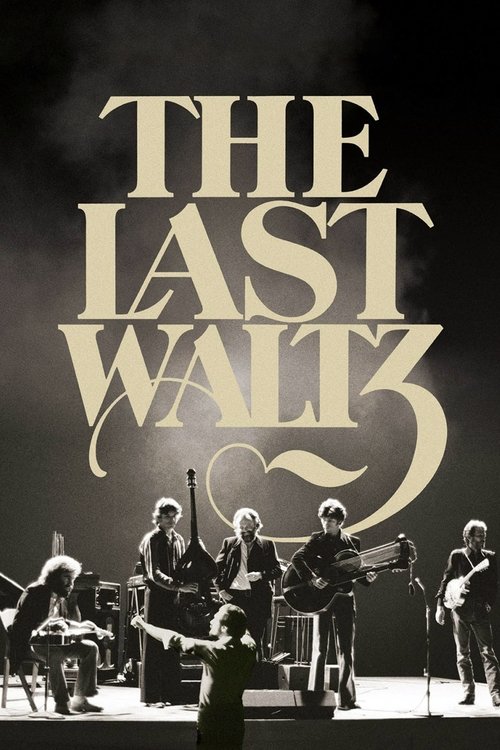
The Last Waltz
1978 · Martin Scorsese
For a night when you want to turn the lights down, the volume up, and feel music instead of just hearing it — equally right for die-hard fans and people who couldn't name a single Band song. Comfort viewing with soul.
What it's about
On Thanksgiving 1976, The Band played their farewell concert at San Francisco's Winterland Ballroom, and half of rock royalty — Bob Dylan, Joni Mitchell, Van Morrison, Eric Clapton, Neil Young — showed up to send them off. Martin Scorsese filmed the night like a feature, then wove in backstage interviews where the musicians, tired and funny and a little haunted, look back on sixteen years of the road.
The experience
It feels like being at the best wake ever thrown — joyous on stage, wistful in the interviews, with performances that keep hitting sudden peaks of pure electricity. You come out elated and a little melancholy at once.
Performances
Not acting, but presence: Robbie Robertson's road-weary storytelling, Levon Helm singing from somewhere deep in the chest, and guest turns — Van Morrison and Bob Dylan among them — where you watch performers catch fire in real time.
The craft
Scorsese scripted camera moves to the actual song lyrics and put feature-film cinematographers on the floor, so every number is shot with the care of a drama scene — warm light, faces, hands on strings — instead of concert-video chaos. It's the rare music film that demands good speakers and rewards them on every song.
Why it matters
Widely called the greatest concert film ever made, it set the standard for how music could be filmed with narrative craft and marked Scorsese's lifelong second career as rock's house documentarian.
Snapshot
The Last Waltz documents the farewell concert of The Band, staged at Bill Graham's Winterland Ballroom in San Francisco on Thanksgiving Day, November 25, 1976, and supplements that performance with studio-shot numbers and Martin Scorsese's interviews with the group. It is routinely cited as one of the finest concert films ever made, and its reputation rests less on novelty of subject than on the rigor of its execution: Scorsese approached a rock concert with the planning discipline of a narrative feature, scripting camera moves to a marked-up shooting script of the song lyrics and deploying a roster of feature-film cinematographers. The result fuses the loose, valedictory mood of a band dissolving with an unusually controlled visual style. Released in 1978 by United Artists, the film arrived as Scorsese was consolidating his reputation after Mean Streets (1973) and Taxi Driver (1976), and it stands at the intersection of his New Hollywood authorship and his lifelong devotion to popular music. Its guest list — Bob Dylan, Eric Clapton, Joni Mitchell, Van Morrison, Muddy Waters, Neil Young, Joni Mitchell, Emmylou Harris, Dr. John, Neil Diamond, and others — frames the event as a summing-up of a particular strand of American and Anglo-American roots rock at the moment of its passing.
Industry & production
The concert was conceived and produced by The Band's manager and the group itself, with Bill Graham mounting the live event; concert promoter Graham's organization handled the Winterland staging, including a rented set drawn from the San Francisco Opera's production of La Traviata and a Thanksgiving dinner served to the audience. Scorsese came aboard to film it, and the production unusually straddled the worlds of the music business and feature filmmaking. The shoot was financed and ultimately distributed through United Artists, with Robbie Robertson of The Band serving as the film's producer and a central creative partner to Scorsese — a collaboration that would extend across decades of subsequent Scorsese projects on which Robertson supervised music.
The production's defining industrial fact is the gap between the concert's single-night spontaneity and the film's protracted, expensive post-production. The live event was captured in one evening; the studio-recorded sequences (notably the numbers with Emmylou Harris and The Staple Singers) were filmed afterward on a Metro-Goldwyn-Mayer soundstage, and editing and sound work stretched over a long period. The film overran its original budget, and the post-production coincided with the troubled, drug-shadowed making and aftermath of Scorsese's New York, New York (1977); Scorsese has spoken candidly in later years about the personal disorder of this period. The Last Waltz thus belongs to the New Hollywood economy in which auteur directors, flush with creative latitude after the early-1970s successes, commanded resources that could turn even a concert documentary into a major production undertaking.
Technology
The film was shot on 35mm — a deliberate and consequential choice, since concert documentaries of the era were frequently shot on 16mm for mobility and cost. The 35mm format gave the images the resolution and tonal depth of a studio feature, and the production lit Winterland accordingly, with controlled stage lighting designed to be photographed rather than merely to serve the live audience. Multiple cameras covered the concert simultaneously, allowing coverage of soloists and ensemble in a single performance without restaging.
On the audio side, the concert was multi-track recorded, enabling a detailed mix that could isolate and balance instruments and voices in post — essential to the film's clarity, given the number of guest performers cycling through the stage. The combination of 35mm capture and multitrack sound positioned the film at the higher-craft end of concert documentation, closer to the production values of a fiction feature than to the run-and-gun verité aesthetic of Woodstock (1970), the landmark on which Scorsese himself had worked as an editor and assistant director.
Technique
Cinematography
The cinematography is the film's signature achievement and the clearest evidence of its feature-film ambitions. Rather than entrust the concert to documentary operators improvising in the dark, Scorsese assembled an extraordinary team of cinematographers — among them Michael Chapman (his collaborator on Taxi Driver) as director of photography, with camera operators and additional cinematographers including figures of the stature of Vilmos Zsigmond, László Kovács, and others associated with New Hollywood's visual renaissance. Scorsese famously prepared a 200-plus-page shooting script keyed to the songs, so operators knew which performer to favor and when, turning improvisatory stage action into something approaching choreographed coverage.
The visual style favors warm, saturated stage color, deep blacks, and a stately camera that glides and reframes rather than jerks. Slow push-ins on soloists, elegant pans across the ensemble, and a general preference for composed, legible framing distinguish it from the kinetic, zoom-driven look of contemporaneous concert films. The studio-shot numbers, lit with even more control, extend this polish.
Editing
Edited by Yeu-Bun Yee and Jan Roblee, the film organizes a sprawling concert and a stack of interviews into a rhythm that alternates performance and reflection. The cutting within songs is musically motivated — edits land on beats and phrase boundaries, and the coverage is deep enough that the editors can follow a guitar solo to its source or cut to a harmony singer exactly as a voice enters. Crucially, the film resists the temptation to dice every number into rapid montage; many performances are allowed long takes and sustained two-shots, trusting the musicianship to hold attention. The interleaving of backstage interviews between songs gives the film its essayistic, elegiac structure, framing the concert as a retrospective meditation rather than a straight chronological document of the evening.
Mise-en-scène / staging
The staging is unusually theatrical for a concert film. The borrowed La Traviata opera set — chandeliers and drapery — lends Winterland a faded-grandeur opulence that visually underwrites the film's themes of farewell and the end of an era. Scorsese and his team treated the stage as a designed space, and the interview segments were composed with care, the musicians often arranged in informal groupings against neutral or darkened backgrounds. The studio numbers were staged on a soundstage with a clean, controlled look that sets them apart from the concert proper without breaking the film's tonal unity.
Sound
Sound is foundational. The multitrack recording was mixed to render dozens of performers across many songs with clarity and presence, and the film's reputation as a listening experience is nearly as strong as its standing as a viewing one. The mix balances The Band's intricate ensemble interplay — the interlocking of Robertson's guitar, Garth Hudson's keyboards and saxophone, Rick Danko's bass, Levon Helm's drums and vocals, and Richard Manuel's piano and voice — with the contributions of the guests. The spoken interviews are recorded intimately, their relaxed, sometimes elliptical quality contributing to the film's confessional register.
Performance
The "performances" here are musical and conversational rather than dramatic, but the film is acutely attentive to both. On stage it captures distinct artistic personae — Van Morrison's explosive physicality, Dylan's guarded charisma, Muddy Waters' commanding authority on "Mannish Boy," Joni Mitchell's harmonic sophistication. Off stage, the interviews present The Band, and Robertson in particular, as articulate, weary chroniclers of life on the road. The film's framing has been read, then and since, as privileging Robertson's perspective and screen time — a point of lasting contention, given Levon Helm's later public objections to how the film and the larger Band narrative apportioned credit. That tension is part of the historical record around the film and worth naming plainly rather than smoothing over.
Narrative & dramatic mode
Though a documentary, The Last Waltz is structured with a clear dramatic arc: the end of a sixteen-year journey "on the road," as Robertson puts it in the film's framing conceit. The interviews supply exposition and theme — stories of the early years, the toll of touring, the meaning of the dissolution — while the performances function as set pieces that both celebrate and eulogize. The mode is elegiac and retrospective; the film opens with the concert's finale and the title card "This Film Should Be Played Loud," then circles back, organizing time thematically rather than strictly chronologically. It is less reportage than valediction, a film consciously about endings.
Genre & cycle
The film belongs to the concert-film and rockumentary genres that crystallized in the late 1960s and early 1970s — Monterey Pop (1968), Woodstock (1970), Gimme Shelter (1970). Within that cycle, The Last Waltz marks a turn toward higher craft and authorial control, away from the verité, festival-as-social-event template toward the concert film as a designed, single-artist (or single-event) cinematic statement. It also participates in a thematic sub-current of the mid-1970s: the sense of a counterculture-era musical moment reaching its close, captured just as punk was beginning to redraw the landscape.
Authorship & method
The Last Waltz is unmistakably a Scorsese film, bearing the stamp of his obsessive musicality and his belief that a camera should be as choreographed to music as a dancer. His method — the lyric-keyed shooting script, the marshalling of A-list cinematographers, the insistence on 35mm — imported feature-film discipline into documentary. His key collaborators were central: Michael Chapman as director of photography translated Scorsese's plans into the film's controlled, warm-hued look; the editors Yeu-Bun Yee and Jan Roblee shaped the elegiac structure; and Robbie Robertson, as producer, musical architect, and the film's most prominent on-screen voice, was effectively a co-author, beginning a creative partnership with Scorsese that would run through the director's later career as a music supervisor and collaborator. There is no conventional screenwriter; the "writing" lives in the structuring of interviews and song order. The film should also be read alongside Scorsese's formative work as an editor on Woodstock, which gave him a direct grounding in the concert-film form he would later refine.
Movement / national cinema
The film sits squarely within American New Hollywood, the movement of director-driven, auteur-empowered filmmaking that flourished in the United States from the late 1960s into the late 1970s. Its very production conditions — a major director and a cohort of celebrated cinematographers turning their attention to a concert — reflect the latitude New Hollywood afforded its leading figures. Culturally, the film is a document of a specifically North American roots-music sensibility (The Band straddled Canadian and American identities, with four Canadian members and the Arkansan Levon Helm), filtered through the Anglo-American rock world that Dylan, Clapton, and Morrison represented.
Era / period
1978 was a hinge moment. New Hollywood's auteur ascendancy was beginning to give way to the blockbuster era inaugurated by Jaws (1975) and Star Wars (1977); in music, the rock culture The Band embodied was being challenged by punk and disco. The Last Waltz registers this turn implicitly — its mood of exhaustion and finality reads, in retrospect, as the close of an era. For Scorsese personally, the film belongs to the difficult stretch around New York, New York, after which he would regroup and emerge with Raging Bull (1980). The documentary thus occupies a transitional pocket in both the director's career and the broader cultural calendar.
Themes
The film's governing theme is the end of the road — the physical and spiritual cost of perpetual touring, and the decision to stop before the life destroyed the men living it. Robertson's interview refrain about the road being "a goddamn impossible way of life" supplies the thesis. Surrounding it are themes of brotherhood and its fraying, of musical lineage and inheritance (the guest performers function as a family tree of influences and peers), and of mortality and dissolution — the elegiac sense that something irrecoverable is passing. The borrowed opera set materializes another theme: the mythologizing of rock, its aspiration to grandeur and permanence set against the impermanence the film documents. Beneath these runs the unresolved theme of authorship and credit within a collective — whose story is this, and who gets to tell it — a question the film's framing raises and that subsequent accounts, especially Helm's, have contested.
Reception, canon & influence
The Last Waltz was warmly received on release and its critical standing has only risen; it is now widely regarded as the benchmark concert film, frequently named at or near the top of critics' lists of the form. Its reputation rests on the marriage of musical content and cinematic craft — the sense that, almost uniquely among concert films, it was directed rather than merely captured.
Influences on the film (backward): Scorsese's editing apprenticeship on Woodstock gave him direct experience of the concert-film genre's possibilities and limits, and the verité concert documentaries of the era — Monterey Pop, Gimme Shelter — formed the tradition against which he defined a more composed approach. His feature work with cinematographer Michael Chapman fed the visual method directly. The film also draws on the deep well of American roots music — blues, R&B, country, gospel, folk-rock — embodied by its performers, a lineage The Band had spent its career synthesizing.
Legacy (forward): The film established a higher craft standard for the concert documentary and demonstrated that a major narrative director could bring feature-film discipline to live music, an example visible in later director-driven concert films and in Scorsese's own continued music documentaries (his work on Dylan, George Harrison, and the Rolling Stones among them). It cemented the Scorsese–Robertson partnership that shaped the music of Scorsese's subsequent features. It also entered the culture as a reference point and occasional object of affectionate parody (its earnest backstage interviews are part of the DNA that This Is Spinal Tap would later send up). Finally, the film's contested authorship became a lasting case study in how documentaries frame and apportion a collective's story — Levon Helm's published objections ensuring that the film is discussed not only as a triumph of craft but as a text whose point of view is itself a subject of debate. On the historical specifics of the film's grosses and exact budget figures, the public record is uneven, and precise numbers should be treated with caution rather than asserted here.
A Deleuzian reading
The chandeliers don't belong there.
The full Deleuzian reading of The Last Waltz →
Reception
Hailed on release as the concert film raised to art — and it's only climbed since, routinely topping 'greatest concert film ever' lists. The one real revision: Levon Helm's bitter 1993 memoir recast it for many as Robbie Robertson's self-mythologizing project rather than The Band's true farewell.
How The Last Waltz was received, from release to now →
Influences: the films it descends from and the films it influenced
- Woodstock (1970) — Scorsese's hands-on editing apprenticeship here taught him to cut image to musical phrase and sync multi-camera coverage to the beat — the technical grammar he later disciplined into The Last Waltz.
- Monterey Pop (1968) — Established the direct-cinema concert template of handheld capture and available light that Scorsese deliberately defined himself against by storyboarding shots to lyrics.
- Gimme Shelter (1970) — Pioneered the verité concert documentary's reactive, on-the-fly camera and edit-room-as-authorship structure — the unscripted tradition Scorsese refined into composed choreography.
- Jazz on a Summer's Day (1959) — The first concert film to treat live performance with lush, deliberately composed color cinematography rather than newsreel reportage, prefiguring the warm-hued 35mm 'directed' look.
- Don't Look Back (1967) — Codified the backstage rock interview and the musician-in-private-moment that The Last Waltz formalizes into its scripted couch conversations between songs.
- Taxi Driver (1976) — Scorsese's feature with DP Michael Chapman developed the controlled slow push-in and choreographed camera move that were imported wholesale onto the Winterland stage.
- Mean Streets (1973) — Established Scorsese's signature of cutting and staging action to pre-existing rock records, the musically-motivated editing logic that governs the concert's song-to-image rhythm.
- Stop Making Sense (1984) — Extended the director-driven concert film by pre-planning every shot and lighting cue as a designed theatrical build, inheriting the idea that a major narrative director could choreograph a show rather than merely document it.
- This Is Spinal Tap (1984) — Parodies the earnest backstage-interview-plus-performance structure of the prestige rockumentary, lampooning exactly the reflective musician confessionals The Last Waltz had elevated.
- Shine a Light (2008) — Scorsese's own return to the form, marshalling a battalion of A-list cinematographers (Richardson and others) on a scripted camera plan — the same auteur-marshals-DPs method scaled up.
- No Direction Home (2005) — Continues the Scorsese music documentary built from structured interview and archival song-order, the 'writing-lives-in-the-edit' authorship pioneered when scripting The Last Waltz's between-song talk.
- George Harrison: Living in the Material World (2011) — Applies the same elegiac-retrospective structure — a career told through performance and reminiscence — that gave The Last Waltz its 'end of the road' shape.
- Rattle and Hum (1988) — Aspires to Last Waltz prestige by shooting concert footage on cinematic 35mm black-and-white with composed framing, explicitly chasing the 'directed not captured' standard.
- The Blues Brothers (1980) — Elevated the concert-film-hybrid into prestige cinema by staging A-list musicians within a loose narrative frame and prioritizing live-performance fidelity over studio polish; Blues Brothers adopts the same reverential approach to the session-musician world and applies it to a comedy chassis.
- Almost Famous (2000) — Multi-camera backstage concert film—the band's off-stage spaces treated as primary subjects rather than interstitial material—that established the formal template for treating the rock backstage as a space worthy of sustained cinematic attention; cited by Crowe and Toll as a visual reference in production.
- The Doors (1991) — Scorsese's methodology of treating the rock concert as a controlled multi-camera cinematic spectacle — choreographed stage lighting, planned camera positions, the performance space redesigned for film — established the template for staged concert reconstruction that Stone's team followed, moving the rock biopic away from documentary capture toward theatrical set-piece construction.
- When We Were Kings (1996) — Scorsese's hybrid of high-quality multi-camera concert footage with retrospective interview commentary — musicians reflecting on history in the wake of a performance — establishes the concert-documentary-plus-analytical-overlay structure that Gast uses to elevate the Zaire '74 festival material beyond a music film into cultural history.
- Bohemian Rhapsody (2018) — Scorsese's multi-camera documentary grammar for widescreen concert cinematography — direct-address performance, isolating close-ups cut against wide stage tableaux — is the formal ancestor of the biopic concert sequence that Bohemian Rhapsody's Live Aid recreation emulates.
- A Complete Unknown (2024) — Scorsese's multi-camera concert grammar — extreme close-ups of hands and faces during solos, editing locked to the musical phrase rather than the dramatic beat — is the formal template for ACU's performance sequences.
- Rust Never Sleeps (1979) — A contemporaneous artist-directed concert film that, like Scorsese's, treats staging and theatrical set design as authored cinema rather than neutral coverage of a gig.
- Sign o' the Times (1987) — Builds its concert film around designed staging and scripted performance blocking shot for the camera, extending the borrowed-set, theatrically-framed approach over pure live capture.
- The Song Remains the Same (1976) — A contemporary attempt to elevate the concert film with staged, restaged and supplementary footage, sharing The Last Waltz's impulse to construct rather than merely record the live event.
Similar films
- Gimme Shelter (1970) — influence & lineage
- Mean Streets (1973) — influence & lineage
- This Is Spinal Tap (1984) — influence & lineage
- Taxi Driver (1976) — influence & lineage
- Moonage Daydream (2022) — shared sensibility
- The Last Temptation of Christ (1988) — shared sensibility
- A Complete Unknown (2024) — shared sensibility
- The Doors (1991) — shared sensibility
All the films related to The Last Waltz →