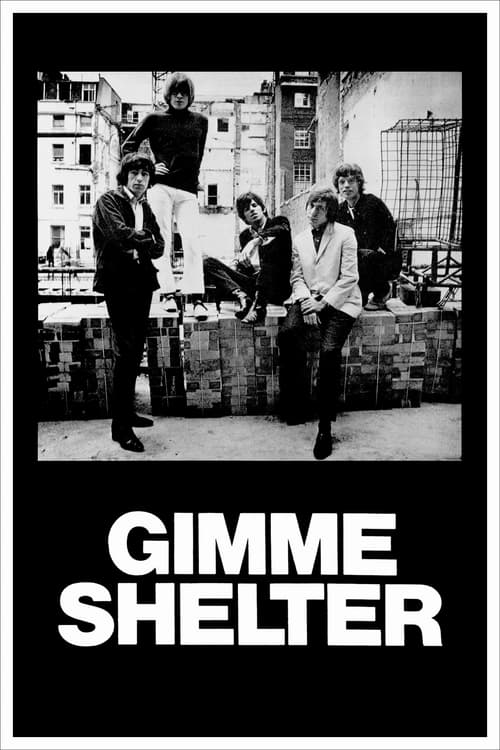
Gimme Shelter
1970 · Charlotte Zwerin
For when you want a documentary that hits like a thriller — real events with real stakes, the death of an era caught on film. Not comfort viewing; it's the kind of true story that leaves you a little shaken.
What it's about
The Rolling Stones cross America in late 1969, playing to enormous crowds at the peak of their powers, and the cameras go everywhere with them — onstage, backstage, into lawyers' offices where a free concert is being hastily negotiated. That concert, at the Altamont Speedway in California, draws hundreds of thousands and goes horribly wrong, with Hells Angels working security and violence breaking out feet from the stage. The film follows the band watching this footage back on an editing table, trying to understand what they were part of.
The experience
It starts as an electric concert film and slowly turns into a slow-motion catastrophe you can see coming and can't stop. The dread builds all day at Altamont — bad vibes in the crowd, the music straining against the chaos — and by the end you feel like a witness rather than a spectator.
The craft
Shot in the fly-on-the-wall style where nothing is staged and no narrator tells you what to think — the cameras simply catch what happens, including the moment everything breaks. The editing-room framing, with the Stones watching their own footage, gives it a haunted, self-questioning structure rare in any concert film. The live performances sound raw and ferocious; play it loud.
Why it matters
It became the standing document of the moment the sixties counterculture collapsed, the dark twin to the era's festival films, and a landmark of American observational documentary.
Snapshot
Gimme Shelter is the definitive document of the moment the 1960s counterculture curdled into something it could not control. Built around the Rolling Stones' 1969 American tour and its catastrophic free concert at the Altamont Speedway near Tracy, California, on December 6, 1969, the film records — and then re-examines, on an editing table, in front of the musicians themselves — the day a young man named Meredith Hunter was stabbed to death a few yards from the stage as the band played. Made in the American direct-cinema tradition by Maysles Films, it is at once a concert movie, a tour diary, a true-crime artifact, and a reflexive meditation on what a camera can and cannot redeem. Though TMDB and many sources foreground a single director, the film is properly credited to three: Albert Maysles, David Maysles, and Charlotte Zwerin. It remains one of the most studied nonfiction films of its era precisely because it refuses the consolation that its medium might otherwise offer.
Industry & production
The film was produced by Maysles Films, the New York company run by brothers Albert and David Maysles, who by 1969 were established figures in observational documentary following Salesman (1969). The Rolling Stones and their organization cooperated with the production, and the project began as a relatively conventional record of a triumphant North American tour — the band's first in three years — including a celebrated run at Madison Square Garden in late November 1969. The plan to film a culminating free concert, conceived in part as a West Coast "Woodstock," transformed the production midstream when the event collapsed into violence.
The Altamont concert itself was assembled hastily after the intended San Francisco-area venues fell through; the film shows the Stones' organization and the celebrity attorney Melvin Belli negotiating logistics by telephone. The decision to use members of the Hells Angels in a security or crowd-control capacity near the stage — an arrangement widely reported to have involved payment in beer — became the production's central tragedy, though the film presents the chain of decisions without supplying a tidy account of culpability. Because the cameras captured Hunter's killing, the footage took on documentary and quasi-legal significance; it figured in the public understanding of the death of Hunter, who was stabbed by Hells Angel Alan Passaro. Passaro was later tried and acquitted on grounds of self-defense, the film having shown Hunter drawing a revolver. Specific budget and box-office figures are not something I can state reliably here; the record I can vouch for concerns the film's making and meaning rather than its ledger.
Technology
Gimme Shelter is a product of the lightweight 16mm synchronous-sound technology that made American direct cinema possible in the 1960s. Portable cameras and the development of practical sync-sound recording allowed small, mobile crews to follow events without the tripods, cabling, and lighting of studio documentary. For Altamont, the production deployed a large camera team — by most accounts well over a dozen operators — fanned across the stage, the scaffolding, and the crowd, a scale of coverage that proved essential: the killing was caught almost by accident by one camera among many. Among the crew of operators was the young George Lucas, then near the start of his career, a frequently cited piece of the film's lore. The concert performances were captured with multitrack-era live recording, later mixed for the film, and the picture was assembled and reviewed on flatbed editing tables — equipment that becomes, unusually, visible within the film itself.
Technique
Cinematography
The shooting style is handheld, reactive, and close. Albert Maysles, one of the great American direct-cinema camera operators, sought intimacy with subjects rather than composed distance, and the Madison Square Garden sequences have the sweaty proximity that became a template for concert cinematography: the camera at the lip of the stage, swinging with Mick Jagger, catching Charlie Watts in profile, Keith Richards half in shadow. At Altamont the visual language shifts from celebration to dread. With many operators covering the chaos, the footage is fragmentary, jostled, and sometimes obstructed — qualities the film embraces as testimony rather than smoothing away. The cameraman generally credited with capturing the fatal stabbing is Baird Bryant, whose shot, buried in hours of material, had to be located in the cutting room. The cinematography's authority comes from its limitations: it sees, but from a single vantage, in a crowd, in failing light.
Editing
Editing is the film's true authorship, and the contribution most associated with Charlotte Zwerin. Faced with an overwhelming mass of tour and concert footage and a single horrifying event embedded within it, Zwerin devised the structural device that defines the film: a framing in which the Stones — principally Jagger and Watts — sit at a flatbed editing console and watch the footage of their own tour, culminating in the Altamont material. The film thus moves between past event and present reckoning, between the concert as it happened and the musicians' silent, stricken review of it. The celebrated culminating gesture is the editor rolling the footage of the stabbing back and forth, freezing and replaying it, as Jagger watches — an act that makes the audience complicit in the same forensic looking. This reflexive architecture transforms a concert film into an inquiry, and it is the single most influential formal decision in the picture.
Mise-en-scène / staging
As an observational documentary, Gimme Shelter does not stage its world, but it is acutely attentive to the staging within events. The literal stage at Altamont — low, crowded, encircled by Hells Angels and pressing fans, offering the band no buffer — becomes the film's central, fatal geography. The collapse of distance between performer and crowd, the absence of the security architecture a concert normally provides, is something the film registers spatially: there is nowhere for the violence to be kept out. Counterposed is the controlled, fluorescent calm of the editing suite, the one "set" the film effectively composes, where the same faces appear contemplative rather than exposed.
Sound
Sound is foundational. The live performances — "Jumpin' Jack Flash," "Sympathy for the Devil," "Under My Thumb," among others — are rendered with the immediacy of synchronous concert recording, and the film also documents performances and incidents involving other acts on the bill, including the Flying Burrito Brothers and Jefferson Airplane, whose singer Marty Balin was knocked unconscious during their set. The title derives from the Stones' own "Gimme Shelter," from Let It Bleed (1969), whose ominous opening became shorthand for the era's darkening mood. Equally important is the film's use of ambient sound and, crucially, silence and spoken hesitation in the editing-room scenes, where the absence of music throws the act of watching into relief.
Performance
The "performances" are real people being themselves. Jagger is the film's magnetic and ambiguous center: charismatic and commanding onstage, then visibly powerless at Altamont as he pleads for calm ("Brothers and sisters... why are we fighting?"), and finally quiet and unreadable in the editing room. The film's refusal to resolve his interiority — is he grieving, performing grief, or genuinely numb? — is one of its richest effects. Charlie Watts's understated reactions, and the contributions of figures like the attorney Belli and the various promoters, round out a human field in which no one is quite in command of the events they set in motion.
Narrative & dramatic mode
The film operates in an observational, non-narrated mode, withholding voice-of-God commentary in favor of unfolding event and reflexive review. Yet it is far from formless: Zwerin's structure imposes a tragic shape, moving from the buoyancy of the tour toward a known catastrophe, with the editing-room frame functioning as a kind of chorus that already knows the ending. This gives the film an unusual temporal doubling — we watch events both as they happened and as they are being mourned — and lends it the gravity of tragedy rather than the open-endedness typical of pure vérité.
Genre & cycle
Gimme Shelter belongs to the concert/rock documentary, a cycle that crested around 1970 with films like Woodstock and Monterey Pop. Within that cycle it is the dark twin, the anti-Woodstock: where those films celebrate communal euphoria, Gimme Shelter records communal breakdown. It also overlaps the true-crime documentary and the reflexive essay film, and its hybridity — concert movie crossed with inquest — is part of what has kept it canonical while many pure concert films date.
Authorship & method
The film is the work of three credited directors, and the discrepancy with single-director listings is worth stating plainly. Albert Maysles and David Maysles were the principals of Maysles Films and the leading American practitioners of direct cinema, committed to observation without narration or overt manipulation; Albert was the company's master cameraman. Charlotte Zwerin, a gifted editor and filmmaker who worked closely with the brothers (she had collaborated on Salesman), is widely credited with shaping Gimme Shelter's structure in the cutting room, including the decisive reflexive frame; her role exemplifies how, in observational documentary, authorship often resides in editing as much as shooting. The camera team was unusually large and collaborative, with Baird Bryant generally credited for the footage of the killing and a roster of operators that included, notably, George Lucas. There is no composer in the conventional sense — the music is the performers' own — and no screenwriter, the "writing" being the work of selection and arrangement. I am confident of these core attributions; the full editing roster beyond Zwerin's guiding role is something I would not want to specify without overstating the record.
Movement / national cinema
The film is a landmark of American direct cinema, the observational documentary movement associated with Robert Drew, D. A. Pennebaker, Richard Leacock, and the Maysles brothers, which prized portable sync-sound technology and the ideal of the unobtrusive camera. Gimme Shelter both epitomizes and complicates that ethos: it is rigorously observational in its concert and tour footage, yet its reflexive editing-room device acknowledges the constructedness and the moral weight of the documentary act, pushing direct cinema toward self-awareness.
Era / period
Released in December 1970, the film is inseparable from its historical hinge. Altamont, occurring just months after Woodstock and within the same year as the Manson murders and the deepening of the Vietnam War, was almost immediately read as the symbolic end of the 1960s — the point at which the decade's utopian self-image failed. The film both records and helped crystallize that reading, becoming the visual shorthand for a generational disillusionment.
Themes
At its center is the fragility of the counterculture's ideals — the gap between the rhetoric of peace and love and the reality of a crowd that could not protect one of its own. The film meditates on spectatorship and complicity: by placing the musicians (and us) in the position of replaying a death, it asks what looking accomplishes, whether the camera bears witness or merely consumes. It explores charisma and powerlessness, embodied in Jagger's inability to control the energies he summons. It is preoccupied with violence and its representation — the ethics of having the footage at all. And running beneath everything is the theme of disillusionment, the loss of an era's faith in itself, registered not as argument but as the silence of people watching what they cannot undo.
Reception, canon & influence
Critically, Gimme Shelter was recognized early as a major and unsettling work, though it also provoked debate — most pointedly the charge, associated with critic Pauline Kael, that the filmmakers and the Stones had in some sense profited from or aestheticized a real death, and questions about whether the camera's presence shaped the events it recorded. That very controversy testifies to the film's seriousness: it forced audiences to confront the ethics of documentary looking rather than letting the concert wash over them.
Looking backward, the film draws on the direct-cinema methods the Maysles brothers had refined through the 1960s — the handheld camera, sync sound, the absence of narration — and on the concert-film impulse of Monterey Pop and the era's appetite for filming rock culture. Its reflexive turn extends a self-questioning strand already latent in nonfiction film.
Looking forward, its influence is broad and durable. It set a standard for concert cinematography's intimacy and remains the genre's essential counter-text — the film invoked whenever the rock documentary's celebratory mode needs puncturing. Its reflexive editing-room frame, in which subjects review their own footage, anticipated decades of self-aware documentary practice. As a cultural artifact it became the primary visual source for the "death of the sixties" narrative, cited endlessly in histories of the counterculture, of the Rolling Stones, and of Altamont itself. It is preserved and studied as a canonical American documentary, and its standing has, if anything, grown: a film that began as a tour movie endures as one of cinema's most searching examinations of what it means to have it all on film, and to be unable to change a frame of it.
A Deleuzian reading
Start with the face.
The full Deleuzian reading of Gimme Shelter →
Reception
It landed in 1970 under a cloud of controversy — Pauline Kael's New Yorker takedown accused the filmmakers of complicity in the very tragedy they filmed, and the Maysles had to publish a rebuttal. Half a century later it's a Criterion cornerstone, routinely ranked among the greatest documentaries ever made.
How Gimme Shelter was received, from release to now →
Influences: the films it descends from and the films it influenced
- Primary (1960) — Pioneered the lightweight 16mm sync-sound handheld rig (Albert Maysles among the camera team) that let operators follow subjects unobtrusively in real time — the exact technical apparatus Gimme Shelter's coverage depends on.
- Chronicle of a Summer (1961) — Introduced the reflexive feedback loop of subjects watching and reacting to footage of themselves in a screening room — the direct formal ancestor of Gimme Shelter's editing-room frame where Jagger reviews Altamont on the flatbed.
- Lonely Boy (1962) — Observational pop-idol portrait (Paul Anka) that exposes the manufacture of celebrity and breaks frame to show its own crew — model for the study of star charisma shadowed by powerlessness.
- What's Happening! The Beatles in the USA (1964) — The same direct-cinema team first embedded handheld observational cameras inside a touring rock act's entourage, establishing the access method later turned on the Stones.
- Dont Look Back (1967) — Unnarrated handheld vérité of a rock star (Dylan) capturing unguarded backstage and hotel-room moments — the template for Gimme Shelter's offstage texture and deflating intimacy.
- Monterey Pop (1968) — Established multi-camera sync-sound concert filming with intimate performer framing; its celebratory rock-festival mode is the template Gimme Shelter consciously inverts (dossier-cited).
- Salesman (1969) — The immediately prior Maysles/Zwerin film where Zwerin built dramatic structure out of shapeless observational footage in the cutting room — the editing authorship she carries directly into Gimme Shelter.
- A Hard Day's Night (1964) — Deploys the handheld telephoto crowd documentation and performer/audience intercutting grammar AHDN institutionalized, but reframes the identical syntax: what coded collective joy in AHDN codes menace and evidence here, demonstrating how completely the visual grammar had become the rock-event documentary standard.
- Grey Gardens (1975) — The same authorship team foregrounds subjects' explicit awareness of and performance for the lens, advancing the reflexive complicity between camera and subject Gimme Shelter made central.
- The Last Waltz (1978) — Raised concert cinematography's intimate multi-camera performer-framing to a deliberate craft standard, descending from the close, sync-recorded stage coverage Gimme Shelter set as the genre benchmark.
- Stop Making Sense (1984) — Extends the discipline of synchronous concert recording and unbroken performer attention into a fully composed stage film, inheriting the genre's intimacy standard without the celebratory looseness.
- The Thin Blue Line (1988) — True-crime documentary that interrogates the unreliability of recorded evidence and the ethics of looking at a death — descendant of Gimme Shelter's fusion of concert film with true-crime investigation and spectator complicity.
- Capturing the Friedmans (2003) — Structured around subjects reviewing home-movie footage of themselves on screen — a direct descendant of the editing-room replay frame and temporal doubling that organizes Gimme Shelter.
- The Act of Killing (2012) — Weaponizes the reflexive feedback loop — subjects watching footage of their own reenacted killings — turning Gimme Shelter's screening-room device and spectatorship-complicity into the film's entire moral engine.
- Amy (2015) — Assembles a pop star's rise and destruction from accumulated performance and private footage, replaying the charisma-to-powerlessness arc and the reckoning of having a death effectively captured on film.
- Almost Famous (2000) — The grainy, available-light, multi-camera direct-cinema aesthetic for documenting a rock tour—human texture over spectacle, the unglamorous backstage as primary subject—that Toll and Crowe explicitly studied when calibrating their photochemical 35mm period-documentary visual reference.
- Nashville (1975) — The Maysles deploy multiple cameras with zoom lenses holding on individual faces within the Altamont crowd rather than the performers, modeling Nashville's acoustic-democratic observation strategy where the audience carries as much visual weight as the stage and entertainment-event footage transforms without warning into evidence of catastrophe.
- The Doors (1991) — The Maysles' orbiting handheld camera grammar in the Altamont concert footage — the lens circling the performer as the event escalates toward violence and chaos — is the direct formal model for Richardson's concert cinematography throughout The Doors, establishing the rock concert as a site of uncontrollable Dionysian energy captured in unstable handheld movement.
- When We Were Kings (1996) — The Maysles-Zwerin structure of intercutting concert footage with retrospective framing testimony — the editing-suite replay of the Altamont murder imposing legal and moral hindsight onto celebratory material — is the template Gast adopts when he uses 1990s interview commentary to impose dramatic narrative retrospectively onto 1974 concert and fight footage shot without that narrative intent.
- This Is Spinal Tap (1984) — Establishes the verite convention of the band reviewing its own footage on-camera and the tour-spiraling-out-of-control arc that Spinal Tap satirizes beat for beat.
- Titicut Follies (1967) — Demonstrated narration-free observational form whose entire meaning is constructed through editing juxtaposition rather than commentary — the same 'authorship resides in the cut' principle Zwerin applies.
- Woodstock (1970) — Same-year multi-camera festival film (split-screen, Scorsese among editors) whose utopian counterculture vision makes Gimme Shelter its deliberate dark counter-text within the identical concert-doc toolkit.
- Cocksucker Blues (1972) — The very next Stones tour film, extending the same vérité offstage access to the band's private chaos — sibling work in the Stones-on-film intimacy Gimme Shelter opened up.
Similar films
- The Last Waltz (1978) — influence & lineage
- Chronicle of a Summer (1961) — influence & lineage
- Primary (1960) — influence & lineage
- A Hard Day's Night (1964) — shared sensibility
- The Doors (1991) — shared sensibility
- Performance (1970) — shared sensibility
- Punishment Park (1971) — shared sensibility
- The Motorcycle Diaries (2004) — shared sensibility
All the films related to Gimme Shelter →