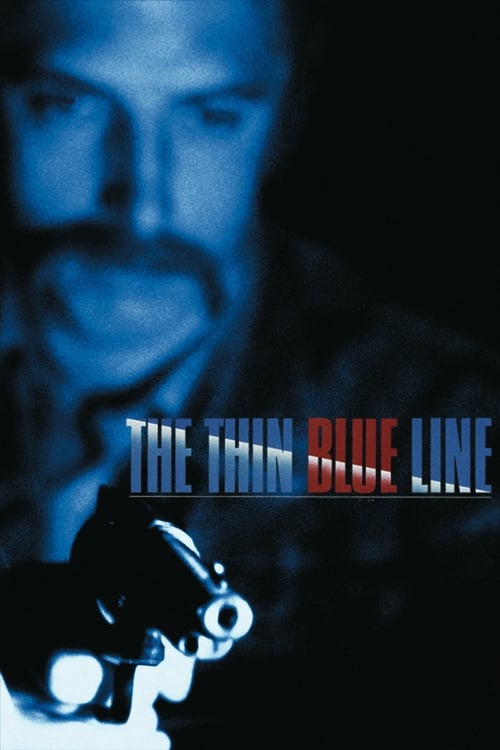
The Thin Blue Line
1988 · Errol Morris
For when you want true crime with real stakes and a film to chew on for days — gripping, but it will leave you angry at the machinery of justice. Choose it when you're up for engagement, not escape.
What it's about
In 1976 a Dallas police officer was shot dead during a routine traffic stop, and a drifter named Randall Dale Adams was convicted and sentenced to death for it. Errol Morris re-opens the case on film — interviewing witnesses, lawyers, and the teenager who was in the car that night — and methodically pulls the official story apart thread by thread.
The experience
Hypnotic and quietly infuriating — it plays less like a lecture than like a noir you can't look away from, replaying the same night from shifting angles as your certainty erodes. By the end the outrage has crept up on you.
The craft
Morris broke documentary's rules on purpose: moody staged reenactments of the shooting, interviews shot with eerie stillness, and a circling Philip Glass score that turns testimony into something trance-like. The style isn't decoration — the repetitions and restagings are how the argument is made.
Why it matters
It did what almost no film has done: within a year of release Adams's conviction was overturned and he walked free. It also rewired documentary itself, making reenactment and stylized subjectivity legitimate tools — the modern true-crime boom descends from it.
Snapshot
The Thin Blue Line is Errol Morris's investigation into the 1976 murder of Dallas police officer Robert Wood, a killing for which a drifter named Randall Dale Adams was convicted and sentenced to death. Across roughly 100 minutes, Morris assembles interviews, stylized reenactments, and a hypnotic Philip Glass score to argue that Adams was innocent and that the actual gunman was almost certainly David Harris, the teenager who had been driving with Adams the night of the shooting. The film is famous on two counts: as a formal landmark that rewired the grammar of documentary by embracing dramatization, subjectivity, and an almost noir-ish artifice; and as a rare instance of a movie that demonstrably changed the world it depicted — Adams's conviction was overturned within a year of its release, and he was freed in 1989. The title comes from a prosecutor's courtroom invocation of police as "the thin blue line" separating society from anarchy, a phrase Morris turns ironic by showing how the machinery built to protect order can manufacture a lethal falsehood. It is at once a true-crime procedural, an epistemological essay about the unreliability of memory and testimony, and a cold, beautiful object.
Industry & production
The film emerged from a project that began as something else entirely. Morris had traveled to Texas to research a different subject — Dr. James Grigson, the forensic psychiatrist nicknamed "Dr. Death" for his courtroom willingness to predict that defendants would kill again, testimony that helped send men to death row. In interviewing Grigson's cases, Morris encountered Randall Adams and became convinced both of the man's innocence and that the real story lay in the case itself. The production was independent and comparatively modest, made outside the studio system in the tradition of American nonfiction filmmaking, with backing associated with public-television and independent-financing channels of the period; the precise budget and financing structure are not something I can state with confidence beyond that it was a low-budget independent feature.
Industrially, the film's reception exposed a fault line in how the establishment classified documentary. The Thin Blue Line was widely expected to figure in the Academy's documentary category but was not nominated, an omission frequently attributed to its use of reenactment and stylization, which some gatekeepers felt disqualified it as "true" documentary. That snub became part of the film's lore and a catalyst for debate about what documentary could legitimately be. Whatever the exact internal reasoning of the Academy's documentary branch, the controversy itself is well documented and helped, paradoxically, to amplify the film's reputation and its formal argument.
Technology
The film was shot and finished on 35mm in the late 1980s, before digital nonlinear editing or digital cinematography were available to a project of this scale. Its technological signature is not novel hardware but the deliberate, almost fetishistic treatment of conventional tools: precise studio lighting, slow-motion inserts, macro close-ups of objects (a spinning police-car light, a thrown milkshake, a falling clock), and an interview apparatus that placed subjects in controlled, theatrical setups rather than vérité environments. Morris would later become identified with the "Interrotron," a teleprompter-based rig that lets subjects look directly into the lens while making eye contact with him, but that device postdates The Thin Blue Line; here the direct, fixed, frontal interview style is achieved through more conventional means. The film's innovation is conceptual — using the full artificial toolkit of fiction filmmaking in service of nonfiction — rather than technological per se.
Technique
Cinematography
The cinematography, with camera work credited to Stefan Czapsky and Robert Chappell, is the film's most immediately startling quality: this is a documentary that looks like a film noir. Reenactments are lit with high contrast, saturated color, and a nocturnal palette of asphalt black, neon, and the rotating red of squad-car lights. Compositions are formal and frequently symmetrical; the camera is patient and often static. Morris repeatedly cuts to extreme close-ups of physical details — the murder weapon, a police report, the swinging of feet — that abstract the case into a series of fetish objects. The visual approach refuses the handheld immediacy associated with cinéma vérité; instead it announces its own constructedness, signaling that what we see is a representation, an interpretation, never raw truth.
Editing
Editing, credited to Paul Barnes, is structurally the spine of the film's argument. Morris organizes the material not chronologically but as an accumulating case, returning again and again to the night of the murder and re-staging it differently as each witness's account is introduced. The repeated reenactments do not converge on a single authoritative version; they contradict one another, dramatizing the central thesis that testimony is unstable and that the "truth" assembled by the justice system was a construction. The cutting rhythms are deliberate and incantatory, locked to Glass's looping score, building less toward a revelation than toward an overwhelming sense of doubt — and then, in the famous final passage, toward something close to confession.
Mise-en-scène / staging
Morris's staging treats the reenactment as openly theatrical. Faces of actors are often withheld or fragmented; we see hands, headlights, a tossed cup, the geometry of a roadside rather than fully dramatized human encounters. The recurring image of the milkshake arcing through the air — tied to a witness's account — becomes an emblem of how absurd, partial details get elevated into evidence. Interview subjects are placed against plain or darkened backgrounds, isolated and frontal, so that the human face becomes its own kind of staged landscape. The whole mise-en-scène insists on artifice as a route to truth rather than a betrayal of it.
Sound
Sound design is sparse, controlled, and married to Philip Glass's score. Diegetic ambience is frequently stripped away in favor of the music's hypnotic arpeggios, which lend even mundane testimony an air of fatefulness. The most celebrated use of sound is the film's ending: a small audio cassette recorder, photographed in close-up, plays Morris's taped interview with David Harris, whose oblique, drawling near-admission of guilt the film lets us hear directly. After a feature built on images that cannot be trusted, the resolution arrives as pure sound — a voice on tape — which is itself a pointed commentary on the hierarchy of evidence.
Performance
Two registers of performance coexist. The reenactment actors are anonymous, deliberately depersonalized figures whose function is illustrative rather than dramatic; we are never asked to identify with them as characters. The real performances are the interviews. Randall Adams is measured, weary, and lucid; the supporting witnesses — including the eyewitness Emily Miller — reveal themselves through inconsistency and self-regard; and David Harris, charming and chilling, dominates the film's conclusion. Morris's method coaxes subjects into talking past their own guardedness, so that the "performances" are really self-revelations, the camera holding long enough for evasions and tells to surface.
Narrative & dramatic mode
The film operates as a detective story in which the detective is the film itself. It withholds and reorders information, plants doubt, and stages competing versions of a single event so that the viewer is recruited into the work of adjudication. This is documentary as inquiry rather than exposition — closer to Rashomon than to journalism, in that it foregrounds the irreducibility of conflicting accounts. Yet unlike a relativist fable, The Thin Blue Line does ultimately assert a truth: it believes Adams is innocent and Harris is guilty, and it marshals its destabilizing techniques precisely to dismantle the false certainty of the original verdict before delivering its own. The dramatic mode is therefore double — radically skeptical about testimony in general, and morally certain about this case in particular.
Genre & cycle
The film sits at the intersection of the crime film and the documentary, and it effectively inaugurated the modern stylized true-crime mode. It draws on the iconography of film noir — the doomed drifter, the corrupt machinery of justice, the nocturnal city — and grafts it onto nonfiction. Within documentary history it belongs to a turn away from the observational orthodoxy of direct cinema and toward a reflexive, essayistic, and openly constructed practice. Its progeny is enormous: the contemporary explosion of investigative true-crime across film and serialized television — works that re-examine contested convictions through reenactment, interview, and atmospheric scoring — descends in large part from the template Morris built here.
Authorship & method
The Thin Blue Line is a definitive auteur documentary, and Morris's method is its meaning. A former graduate student in the history of science and philosophy and a sometime private investigator, Morris brought to the project an investigator's patience and a philosopher's preoccupation with the gap between truth and the representations we mistake for it. His authorial signature includes the frontal, confessional interview; the stylized reenactment; the refusal of voiceover narration in favor of letting subjects condemn or exonerate themselves; and the use of repetition to corrode certainty. Key collaborators shape that signature: composer Philip Glass, whose minimalist score is inseparable from the film's hypnotic gravity; cinematographers Stefan Czapsky and Robert Chappell, who supplied its noir surface; and editor Paul Barnes, who built its recursive structure. Morris is credited as director and as the investigative author of the project; he conducted the interviews whose accumulation constitutes the film's case. The collaboration with Glass in particular established a director-composer pairing that would recur in Morris's later work.
Movement / national cinema
The film is a product of American independent nonfiction filmmaking, and it marks a decisive break within that tradition. The dominant mode of serious American documentary in the preceding decades had been direct cinema — the observational, fly-on-the-wall practice associated with the Maysles brothers, D.A. Pennebaker, and Frederick Wiseman, which prized the appearance of unmediated reality and treated reenactment and stylization as taboo. Morris's film is, in part, a deliberate repudiation of that orthodoxy. It belongs to a broader reflexive turn in 1980s documentary that admitted subjectivity, authorship, and construction back into the form, aligning it intellectually with contemporary debates about representation and the limits of objectivity. Within American cinema it stands as one of the founding works of the artful, theatrically released documentary that would flourish in subsequent decades.
Era / period
Released in 1988, the film is very much of the late-Reagan-era United States, with the death penalty and the conduct of the criminal-justice system as live national concerns. Its Texas setting — Dallas, its police, its courts, its capital-punishment apparatus — grounds it in a specific regional culture of law and order. The case it reopens dates from 1976, so the film also functions as a period reconstruction of the mid-1970s, an era it renders through the muscle cars, roadside drive-ins, and drive-in movies that figure in the witnesses' accounts. The film's release coincided with, and helped accelerate, a growing public skepticism about wrongful convictions that would later crystallize in the innocence-project movement of the 1990s.
Themes
At its core the film is about the unreliability of memory and testimony, and about how institutions transmute uncertain human recollection into the hard currency of "evidence." It is preoccupied with the seductive power of narrative — the way a coherent story, once adopted by police and prosecutors, becomes self-reinforcing and resistant to contradiction. It interrogates the death penalty and the casual machinery, embodied by the "Dr. Death" psychiatrist, that lubricates it. It dwells on the figure of the scapegoat: Adams, an adult outsider, was a more convenient culprit than Harris, a local juvenile. And running beneath all of this is an epistemological theme that links the film to Morris's lifelong project — the conviction that truth exists but is perpetually obscured by the representations, performances, and self-deceptions through which people relate it. The title phrase, drawn from the prosecution's rhetoric, becomes the film's central irony: the thin blue line meant to hold back chaos here produces an injustice indistinguishable from it.
Reception, canon & influence
Critically, the film was met with strong acclaim and quickly recognized as a watershed, even as its formal choices provoked argument about the boundaries of documentary; the Academy's failure to nominate it became a widely discussed scandal that itself testified to how disruptive the film was. Its most extraordinary reception, however, was juridical rather than critical: the film's evidence and the renewed attention it brought contributed directly to the reopening of Randall Adams's case, the overturning of his conviction, and his release from prison in 1989. (Adams subsequently entered into a public dispute with Morris over the rights to his own life story, a coda that complicated the film's triumphant narrative and raised real questions about authorship and the ethics of documentary subjects.) David Harris, the film's likely true killer, was later executed in Texas for a different murder.
Looking backward, the film's influences are eclectic: film noir's visual and moral universe; the reflexive documentary theory of its moment; Rashomon's structure of competing testimonies; and the minimalist musical aesthetics that Morris found in Glass. Looking forward, its legacy is difficult to overstate. It legitimized reenactment and stylization as serious documentary tools and effectively created the modern investigative true-crime genre; the wave of acclaimed nonfiction films and serialized true-crime television that reopen contested cases through atmospheric reconstruction and patient interview owes a direct debt to its template. It also cemented Errol Morris as one of the essential nonfiction filmmakers of his generation and inaugurated the methods — the frontal interview, the philosophical skepticism, the collaboration with Philip Glass — that would define his subsequent career. The Thin Blue Line endures as both a canonical work of cinema and a rare proof that a film can not only represent reality but intervene in it.
A Deleuzian reading
Start with the milkshake.
The full Deleuzian reading of The Thin Blue Line →
Reception
Critics raved in 1988 but documentary purists balked at its stylized reenactments — and the Academy infamously refused it even a nomination. Now it sits near the top of every greatest-documentaries list, and the techniques that once got it disqualified are the genre's default settings.
How The Thin Blue Line was received, from release to now →
Influences: the films it descends from and the films it influenced
- Rashomon (1950) — Supplies the core formal engine Morris adopts wholesale: the same event reenacted multiple times from mutually contradictory testimonies so that repetition corrodes rather than confirms the truth.
- Citizen Kane (1941) — Models the investigative-portrait structure of assembling a person and an event out of successive witness interviews, plus the deep-focus, low-key noir compositions Morris's reenactments echo.
- The Killers (1946) — Provides the noir template of reconstructing a single murder through conflicting flashback accounts lit in hard chiaroscuro — the visual and structural grammar of Morris's nighttime crime restagings.
- In Cold Blood (1967) — Pioneers the true-crime reconstruction shot in stark monochrome noir (Conrad Hall) that dramatizes a real murder and its testimony, the docudrama surface Morris stylizes further.
- Gates of Heaven (1978) — Establishes Morris's own signature method — the static, frontal, deadpan interview in which subjects damn or reveal themselves with no voiceover guiding the viewer.
- Vernon, Florida (1981) — Extends Morris's frontal-interview-as-portrait technique, letting eccentric monologue accumulate into meaning, the interviewing discipline he weaponizes for the Adams case.
- Koyaanisqatsi (1982) — Demonstrates the hypnotic Philip Glass minimalist score driving image as pulse and dread — the exact compositional aesthetic Morris recruits Glass to bring to the film.
- F for Fake (1973) — Morris's use of stylized dramatic reconstructions intercut with contradictory witness interviews—where no reconstruction is authoritative and each retelling exposes the previous one as unreliable—operationalizes Welles's unreliable-narrator grammar in the context of factual criminal investigation.
- Gimme Shelter (1970) — True-crime documentary that interrogates the unreliability of recorded evidence and the ethics of looking at a death — descendant of Gimme Shelter's fusion of concert film with true-crime investigation and spectator complicity.
- The Onion Field (1979) — The documentary apotheosis of the same subject and ethic — a cop killing prosecuted through years of legal failure, fidelity to the record over closure, justice as attrition rather than catharsis.
- My American Uncle (1980) — A fiction/documentary hybrid that uses stylized reenactment and expository architecture to build an argument, formalizing the same porous border between document and staged illustration.
- The Fog of War (2003) — Carries the method forward by formalizing the frontal interview into the Interrotron (direct eye-line to camera) while continuing the Morris–Glass scoring partnership the film inaugurated.
- Mr. Death (1999) — Reuses the stylized, repeated reenactment and the strategy of letting a self-justifying subject indict himself on camera without authorial narration.
- Standard Operating Procedure (2008) — Pushes the contested-event reenactment to a baroque extreme, restaging Abu Ghraib in slow-motion macro detail to interrogate what photographic 'evidence' actually proves.
- Wormwood (2017) — Builds an entire serialized work around the recursive reenactment of one disputed death, fragmenting and repeating the fall from the window exactly as the milkshake-and-cruiser sequence is cycled here.
- Paradise Lost: The Child Murders at Robin Hood Hills (1996) — Directly inherits the template of an atmospheric investigative documentary that reopens a contested conviction and materially affects the legal outcome.
- Capturing the Friedmans (2003) — Adopts the Rashomon-via-Morris structure of competing testimonies about a single alleged crime, engineered so that accumulating accounts dissolve certainty rather than resolve it.
- The Act of Killing (2012) — Radicalizes Morris's legitimization of reenactment by having perpetrators theatrically restage their own murders, turning stylized reconstruction into a confessional instrument.
- Making a Murderer (2015) — Serializes the exact Thin Blue Line project — patient interviews and reconstruction reopening a wrongful-conviction case to intervene in reality, the TV form Morris's template spawned.
- The Jinx (2015) — Marries glossy noir-lit reenactment to a climactic recorded confession, explicitly reprising the taped-admission ending that closes Morris's film.
- One Day in September (1999) — Established the sustained single-subject interview with a participant in criminal violence as the primary dramatic engine of a feature-length theatrical documentary, a structural model Macdonald directly inherits and cites.
- Little Dieter Needs to Fly (1997) — Morris established reenactment as a constitutive formal device — stylized, non-transparent, aesthetically autonomous — rather than mere illustration, creating the enabling precedent Herzog cites implicitly when he insists Dengler physically perform his own captivity rather than simply describe it.
- Grizzly Man (2005) — Pioneers the authored, openly argumentative documentary in which the filmmaker contends with and re-stages his subject's material rather than effacing himself behind observational neutrality.
- The Staircase (2004) — Shares the investigative true-crime DNA of building a long-form case around the unreliability of testimony and the gap between forensic narrative and truth.
- JFK (1991) — Repeats and varies stylized reenactments of a killing to interrogate contradictory testimony, treating reconstruction as evidentiary argument.
- The Look of Silence (2014) — Source of the frontal, direct-address interview framing (Morris's Interrotron logic) used to elicit self-incriminating account by locking the subject's gaze to the lens.
- The Wrong Man (1956) — Nonfiction heir to the eyewitness-unreliability thesis — dramatizing how a mistaken identification and institutional momentum convict an innocent man, the documentary form fulfilling the 'this is true' promise of Hitchcock's prologue.
- 4 Little Girls (1997) — Documentary engineered to reopen a closed case and re-establish it as a live moral and legal question, prefiguring how 4 Little Girls is credited with returning the bombing to national attention before the reopened prosecutions.
- Let's Get Lost (1988) — Same-year rejection of vérité: interviews treated as unreliable contradictory testimony and expressive stylized staging replacing observational neutrality.
Similar films
- In Cold Blood (1967) — influence & lineage
- JFK (1991) — shared sensibility
- Where the Sidewalk Ends (1950) — shared sensibility
- Memento (2000) — shared sensibility
- L.A. Confidential (1997) — shared sensibility
- Mississippi Burning (1988) — shared sensibility
- Colors (1988) — shared sensibility
- Midnight Express (1978) — shared sensibility
All the films related to The Thin Blue Line →