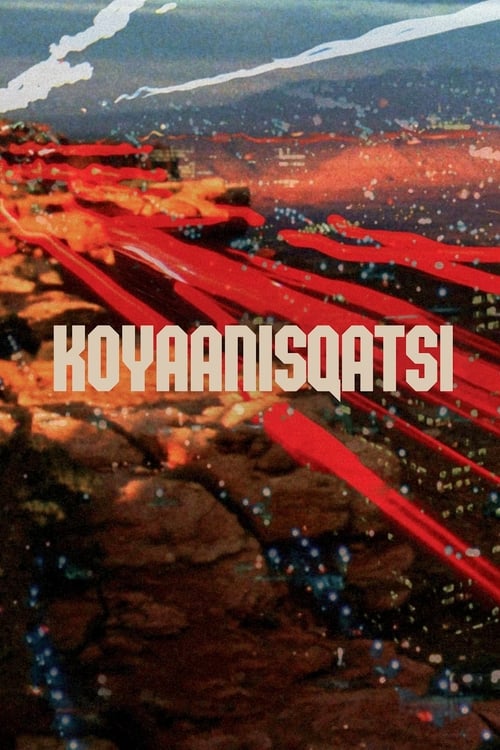
Koyaanisqatsi
1983 · Godfrey Reggio
For when you want to turn your brain sideways rather than follow a plot — a late-night, lights-off, sound-up experience. It's a challenge in the best sense: less a movie you watch than a state you enter.
What it's about
No story, no dialogue, no narrator — just images of America set to music. Cameras drift over deserts, canyons, and clouds, then plunge into power plants, freeways, factory floors, and city crowds moving at inhuman speed. The film builds a wordless argument about what industrial life is doing to the planet and to us, letting the collision of pictures and Philip Glass's relentless score say everything.
The experience
Hypnotic is the honest word — it starts serene and slowly cranks into something overwhelming, almost trance-like, as the time-lapse rhythms and the pulsing music sync up. You come out of it seeing your own commute, your own city, a little differently.
The craft
Ron Fricke's cinematography is the star: years of patient shooting, time-lapse that turns traffic into rivers of light and clouds into crashing waves, all cut to Philip Glass's churning, repeating score — one of the most famous marriages of image and music in cinema. This absolutely demands the biggest screen and best speakers you can find; on a phone it evaporates.
Why it matters
It invented a genre — the non-narrative 'visual tone poem' — spawning direct sequels and decades of imitators in documentaries, music videos, and commercials, and it made time-lapse a mainstream cinematic language.
Snapshot
Koyaanisqatsi is a feature-length, non-narrative documentary that dispenses with dialogue, intertitles, and spoken commentary, building its argument instead from photographed images and Philip Glass's continuous score. The title is a Hopi word that the film glosses, in a closing card, as "life out of balance" — and the film functions as an extended visual essay on the collision between the natural world, the built environment, and the accelerating rhythms of industrial modernity. Conceived and directed by Godfrey Reggio, a former member of a Catholic religious order with no prior filmmaking career, and shot over several years by cinematographer Ron Fricke, it moves from geological landscapes and desert vistas through power plants, freeways, factories, and the crowded streets of American cities, organizing this material by tempo and visual rhyme rather than by story. It is the first installment of what became the Qatsi trilogy (followed by Powaqqatsi, 1988, and Naqoyqatsi, 2002). Though commercially marginal on release, it has become one of the most widely cited and imitated works of experimental documentary, a touchstone for the time-lapse-and-score aesthetic that later saturated advertising, music video, and nature television.
Industry & production
Koyaanisqatsi originated outside the conventional film industry, and its production history is unusually protracted and improvisational. Reggio came to filmmaking after fourteen years in the Christian Brothers, a Catholic teaching order, and after community-organizing and media-education work in New Mexico, including a public-awareness campaign about privacy and behavioral technology. The project grew out of that activist sensibility rather than out of a studio development process. Financing was assembled piecemeal over the latter half of the 1970s, and the film was produced under the banner of the Institute for Regional Education, a nonprofit Reggio was associated with in Santa Fe. Shooting and assembly extended over roughly six years, an unusually long gestation made possible precisely because the film was not beholden to a studio release calendar.
The decisive industrial intervention came at the distribution stage: Francis Ford Coppola lent his name as a presenter, and the film was subsequently handled in association with his Zoetrope orbit, with later distribution through Island Alive / New Cinema. Coppola's imprimatur gave a difficult, unclassifiable object access to art-house exhibition it would not otherwise have reached. The film premiered in 1982 (festival and special screenings) and entered wider release in 1983. Precise budget and box-office figures circulate in various forms but are not consistently documented; given the film's nonprofit origins and staggered financing, I treat specific dollar figures as uncertain rather than assert them. What is clear is that the film operated entirely outside the economics of narrative features, recouping over a long tail of repertory bookings, festival play, and eventually home video.
Technology
The film is fundamentally a showcase for the expressive possibilities of photographic time manipulation. Its two signature techniques — time-lapse and slow motion — both depend on controlling the relationship between the camera's capture rate and the projector's playback rate. For time-lapse, frames are exposed at long intervals so that hours of clock time compress into seconds of screen time; clouds pour over mountains, shadows sweep across buildings, and freeway traffic becomes luminous rivers of light. For slow motion, the opposite: scenes are over-cranked so that pedestrians and faces unfold with a contemplative heaviness. The production used 35mm motion-picture cameras, and the imagery includes substantial aerial cinematography, which required helicopter mounts and stabilization to achieve the gliding, dreamlike passages over landscapes and industrial sites.
The film also draws, in places, on existing or archival material — most famously imagery associated with rocket launch and explosion — integrated with the original photography. Because so much of the film's effect depends on the marriage of image and music, the post-production technology of synchronization mattered greatly: editor and composer worked toward a structure in which visual rhythm and musical phrase reinforce one another. It is worth being precise here: the much-imitated "digital" look later associated with this style postdates the film. Koyaanisqatsi is a wholly photochemical, analog work; its innovations are optical and temporal rather than electronic.
Technique
Cinematography
Ron Fricke's cinematography is the film's visual signature and arguably its authorial center alongside Reggio's concept. Fricke favored long lenses that compress depth, flattening freeways, crowds, and skylines into dense graphic fields; this telephoto compression is essential to the film's vision of modernity as a teeming, stacked mass. The time-lapse sequences are exposed and composed with great care so that motion within the frame — clouds, traffic, shadows — describes legible curves and vectors. The aerial work establishes the natural world in long, unhurried movements, while the urban material grows progressively more frantic. The palette runs from the warm earth tones of the Southwest to the cold sodium-and-neon spectrum of the night city, a chromatic argument embedded in the photography itself.
Editing
Editing is where Koyaanisqatsi makes its meaning, since it has no script to carry argument. The cutting is organized around tempo, graphic match, and thematic juxtaposition: a sequence of manufactured goods on an assembly line is intercut so that the production of sausages, cars, and television sets rhymes with the flow of commuters through subways and escalators — the famous implication that human movement through the city mirrors industrial processing. The film builds in long crescendos, accumulating speed until urban life appears as pure mechanized flow, then releasing into stillness. The edit is fundamentally musical in conception, phrased to Glass's score so that cuts land on rhythmic and harmonic events.
Mise-en-scène / staging
Because the film is documentary, there is no staging in the fictional sense — no sets, actors, or blocking. The "mise-en-scène" is instead a matter of selection and framing: what slice of the real world is chosen, from what angle, at what tempo. Reggio and Fricke composed found reality into graphic order, isolating the geometry of housing projects, the lattices of power pylons, the grids of parking lots and freeway interchanges. The recurring human element is the face caught unawares in slow motion — anonymous pedestrians whose individuality registers precisely because the surrounding film treats people, elsewhere, as flow.
Sound
There is no dialogue and no narration; Glass's score is, in effect, the soundtrack. The most prominent vocal element is the chanted incantation of the title word and of Hopi prophecies, delivered in a deep choral register, which bookends the film and lends it a liturgical gravity. The translated prophecies appear only as end cards. The decision to let music wholly displace speech is the film's defining formal gesture — it converts documentary from an explanatory mode into an immersive, affective one.
Performance
There are no performers in the conventional sense. The "performances" are the unscripted gestures of ordinary people photographed in public space, rendered expressive by slow motion. The closest thing to a star presence is the score and the landscape itself.
Narrative & dramatic mode
Koyaanisqatsi is resolutely non-narrative: it has no characters, no plot, no causal chain of events. Its dramatic mode is closer to the symphony, the tone poem, or the essay than to story. Yet it is not formless. It is structured as an arc — from the geological and natural, through the constructed and industrial, to the human and urban, building toward a vision of acceleration and crisis, and closing with a return to the originary (a launch and a fall) that frames the whole as cautionary. The film's "argument" is delivered entirely through montage and music, asking the viewer to feel a thesis rather than follow one. This places it in the lineage of the "city symphony" and the lyrical documentary rather than of expository nonfiction.
Genre & cycle
The film sits at the intersection of documentary, experimental/avant-garde cinema, and the concert or music film. It belongs most clearly to the tradition of the non-narrative "city symphony" — Walter Ruttmann's Berlin: Symphony of a Great City (1927) and Dziga Vertov's Man with a Movie Camera (1929) are its obvious ancestors — and to the lyrical, observational strand of American avant-garde film. Within Reggio's own work it inaugurates a cycle, the Qatsi trilogy, unified by the Hopi-derived titles, the Glass scores, and the wordless meditation on civilization. It also helped crystallize a broader cycle of image-and-music nonfiction, sometimes called the "Qatsi" or "tone-poem documentary" mode, that Fricke himself extended in Chronos (1985), Baraka (1992), and Samsara (2011).
Authorship & method
Authorship of Koyaanisqatsi is genuinely collaborative, though Reggio is its conceptual author. Reggio supplied the governing idea — a wordless critique of technological modernity rooted in his activist concern with how technology reshapes human life — and the philosophical and titular framework drawn from Hopi language and prophecy. Ron Fricke, as cinematographer (and a credited collaborator on the film's conception and editing), supplied much of its visual method; the time-lapse and telephoto aesthetic is so identified with him that his later directorial work (Baraka, Samsara) is in effect a continuation of this film's grammar. Philip Glass composed the score, and his minimalist idiom — repetitive cellular structures, slow harmonic change, hypnotic momentum — is so integral that image and music are difficult to separate; the film is frequently performed live with Glass's ensemble. Editing credit is shared in the film's collaborative working method, with Fricke central to the assembly. There is no screenwriter, by design. The method was iterative and long: shoot widely over years, then discover the film's structure in the editing room in dialogue with the developing score.
Movement / national cinema
The film is an American work, but one defined against the dominant currents of American cinema. It draws on the American avant-garde and structural-film traditions and on the international heritage of the 1920s city symphony, while its musical language belongs to American minimalism (Glass, alongside Reich and Riley), one of the most consequential currents in late-twentieth-century American art music. It is best understood not within Hollywood but within a transnational experimental-documentary lineage, even as its subject — the American landscape and the American city — is emphatically national.
Era / period
Koyaanisqatsi is a product of the late 1970s and early 1980s, and it bears the marks of that moment: post-1960s environmental consciousness, anxiety about technology and energy, and the maturation of minimalist music into a public-facing style. Its long production (mid-1970s into the early 1980s) straddles the transition from the New Hollywood era — whose presiding figure, Coppola, lent the film his name — into the blockbuster 1980s. It arrived just before the digital and music-video revolutions whose aesthetics it uncannily anticipated; MTV launched in 1981, and the film's time-lapse-and-score style would soon become a commercial lingua franca.
Themes
The film's central theme is announced by its title: imbalance — koyaanisqatsi, life out of balance, a state of being that "calls for another way of living." From this flow its principal concerns. First, the relationship between nature and technology, staged as a progression from untouched landscape to a built environment that increasingly resembles a self-running machine. Second, the dehumanizing rhythm of industrial life: the editing's central conceit equates the processing of goods with the movement of people, suggesting that modern systems treat human beings as throughput. Third, scale and speed — the film uses time manipulation to make visible rhythms normally beyond human perception, revealing the city as a single organism and arguing that we live inside processes we cannot see or control. Fourth, a quasi-religious or prophetic register, drawn from the Hopi material, that frames technological civilization as a transgression with foretold consequences. Critics have noted a productive ambiguity here: the film's images of industry and the city are often beautiful, even seductive, which complicates its apparent condemnation — the spectacle indicts and entrances at once.
Reception, canon & influence
Koyaanisqatsi was a difficult sell on first release — an 86-minute film without words or story — and its initial reception was divided between viewers who found it hypnotic and profound and those who found it portentous or one-note. But it found a durable audience through repertory and festival exhibition, live Glass-ensemble performances, and home video, growing steadily in stature until it was widely regarded as a landmark of experimental cinema. In 2000 it was selected for preservation in the United States National Film Registry by the Library of Congress as a culturally and aesthetically significant work — a notable canonization for a non-narrative documentary.
Influences on the film (backward): its deepest debts are to the silent city symphony — Ruttmann's Berlin and Vertov's Man with a Movie Camera — and to the American avant-garde tradition of lyrical, camera-driven filmmaking. Its musical lineage runs through American minimalism. Its intellectual framework owes much to mid-century critiques of technological society; Reggio has cited the influence of thinkers concerned with technology's autonomy and its reshaping of human experience (the broad current associated with figures like Jacques Ellul and Ivan Illich), though one should attribute specific philosophical debts cautiously rather than overstate them.
Legacy (forward): the film's influence is vast and somewhat double-edged. It defined the "tone-poem documentary," directly seeding Ron Fricke's Baraka and Samsara and a whole genre of wordless, globe-spanning image-and-music features. Its time-lapse vocabulary — city lights streaming, clouds racing, crowds flowing — passed almost immediately into advertising, music video, title sequences, and nature documentary, to the point that the style became a cliché and the film's name became shorthand for it. Philip Glass's score helped bring minimalism to a mass audience and remains among his most performed film works. The film also established Reggio's career and the Qatsi trilogy as a singular project in nonfiction cinema. Few experimental films have so thoroughly colonized the mainstream visual language while remaining, themselves, uncompromisingly outside it.
A Deleuzian reading
A river of light.
The full Deleuzian reading of Koyaanisqatsi →
Reception
Dismissed by some 1983 critics as a gorgeous but empty 'coffee-table movie', it steadily climbed to landmark status — inducted into the National Film Registry in 2000 and now treated as the definitive work of non-narrative cinema.
How Koyaanisqatsi was received, from release to now →
Influences: the films it descends from and the films it influenced
- Berlin: Symphony of a Great City (1927) — Furnishes the city-symphony template Koyaanisqatsi rebuilds: a wordless day-cycle structured into rhythmic movements via graphic matches between machine motion and human motion.
- Man with a Movie Camera (1929) — Pioneers the speed-manipulated, camera-driven montage — fast-motion and freeze of urban crowds, editing rhythm itself as argument — that Reggio and Fricke convert into time-lapse poetics.
- Rien que les heures (1926) — Early city-symphony cross-section that organizes a metropolis by social strata and hours rather than plot, modeling the non-narrative urban survey.
- Regen (Rain) (1929) — Lyrical single-phenomenon study that treats a weather event as visual music through patient camera observation, a direct precedent for Koyaanisqatsi's cloud and water passages.
- N.Y., N.Y. (1957) — Uses anamorphic and prismatic optical distortion to abstract the city into kaleidoscopic pattern, anticipating Fricke's reading of urban grids as moving graphic design.
- Pacific 231 (1949) — Cuts locomotive imagery in precise synchronization to Honegger's score, an early model of the image-edited-to-music method Koyaanisqatsi systematizes with Glass.
- 2001: A Space Odyssey (1968) — Demonstrates wordless, music-driven long-form awe and Trumbull's slit-scan abstraction of motion, proving an audience could sustain non-narrative image-and-score spectacle.
- Powers of Ten (1977) — Builds a continuous scalar zoom that reframes humanity against cosmic and microscopic scale, a graphic-scaling rhetoric Koyaanisqatsi echoes in its macro/aerial juxtapositions.
- Metropolis (1927) — Reggio and cinematographer Ron Fricke extend Metropolis's percussive industrial editing — the proposition that human movement synchronized with mechanical tempo creates simultaneous aesthetic pleasure and existential dread — into feature-length non-narrative form, with Philip Glass's score functioning as a contemporary leitmotif structure that assigns recurring musical phrases to recurring images of mass human-mechanical integration.
- Fata Morgana (1972) — Extends Fata Morgana's processional editing tempo and music/image disjunction into feature length — Ron Fricke's cinematography adapts the available-light landscape-first method to time-lapse and slow-motion while Philip Glass supplies the same cosmological scoring function.
- Fantasia (1940) — A feature with no story, dialogue or characters whose cutting rate is governed by Philip Glass's score in a reciprocal picture-to-music, music-to-picture pass — the same non-narrative wager Disney made, with the sync relation as the film's only architecture.
- Chronos (1985) — Fricke's first solo film, where he engineers a computer-controlled time-lapse camera to extend the very telephoto/time-lapse grammar he developed shooting Koyaanisqatsi, now in 70mm.
- Baraka (1992) — A direct continuation of Koyaanisqatsi's method — telephoto crowds, time-lapse skies, graphic-match editing — globe-spanning and shot in 70mm Todd-AO by the original cinematographer.
- Samsara (2011) — Fricke's 65mm refinement of the same wordless image-and-music architecture, pairing ultra-high-resolution time-lapse with graphic matches across cultures and industry.
- Home (2009) — Carries the nature-vs-technology thesis into globe-spanning aerial cinematography set to a continuous minimalist-leaning score, the aerial-survey strand of Koyaanisqatsi's legacy.
- Manufactured Landscapes (2006) — Extends the wordless contemplation of industrial scale, using long held shots of factories and waste to deliver a 'life out of balance' argument through observation rather than narration.
- Microcosmos (1996) — Adopts the wordless, music-scored observational mode for insect life, scoring magnified natural motion as composition in the tone-poem-documentary lineage Koyaanisqatsi seeded.
- Requiem for a Dream (2000) — Reggio and Philip Glass established the neo-minimalist score as a structural montage driver — repetitive, accumulating, doom-inflected — that Clint Mansell's Requiem score inherits directly, using minimal string cells that accelerate in lockstep with the editing to render compulsive repetition as musical inevitability.
- For All Mankind (1989) — Reggio proved non-narrative documentary could sustain feature length through image-score density alone — Philip Glass's minimalist score functioning as environmental ground, not punctuation — the direct formal model for Reinert's decision to let Eno's Apollo album carry the film's phenomenological argument.
- Lessons of Darkness (1992) — Immediate precedent for sustained aerial photography of industrial civilization stripped of narrative context, with music as the primary structural logic — though Philip Glass's score is original rather than pre-existing, the equivalence between aerial image and musical phrase is a device Lessons of Darkness inherits directly.
- The Tree of Life (2011) — A wordless montage juxtaposing the natural and human worlds, carried entirely by a continuous musical score — the precedent for sustaining meaning through image-to-music association without dialogue or plot.
- The Truman Show (1998) — The benchmark use of Philip Glass's pulsing minimalist cells as structural narration rather than underscore — the doubly-authored, score-as-commentary approach the Glass/Dallwitz music extends.
- Hukkle (2002) — Demonstrates that a wordless feature can sustain meaning through pure image-and-music montage texture, the proof-of-concept for Hukkle's dialogue-free storytelling.
- Powaqqatsi (1988) — The trilogy's second panel: applies slow-motion telephoto compression to Global South manual labor with a Glass score, inverting the first film's machine-flow into human-flow.
- Naqoyqatsi (2002) — Closes the Qatsi trilogy by porting the montage-argument and Glass-score structure into digitally manipulated and archival imagery, extending the technology-critique into the image itself.
- Visitors (2013) — Reggio and Glass distill the method to black-and-white slow-motion human and lunar portraiture, the score-driven gaze of Koyaanisqatsi stripped to faces and stillness.
- The Hours (2002) — Establishes the Glass idiom of minimalist, arpeggiated cyclic figures as a register of inexorable emotional flow over montage — the template Glass returns to for The Hours' connective scoring.
- Mishima: A Life in Four Chapters (1985) — Immediately preceding Mishima, it made Philip Glass's arpeggiated, additive minimalism the structural engine driving the image rather than mere accompaniment — the co-equal scoring role Glass reprises here.
Similar films
- Samsara (2011) — influence & lineage · same viewing thread · often watched together
- Man with a Movie Camera (1929) — influence & lineage · same viewing thread · often watched together
- Baraka (1992) — influence & lineage · same viewing thread
- Microcosmos (1996) — influence & lineage
- 2001: A Space Odyssey (1968) — influence & lineage
- The Color of Pomegranates (1969) — often watched together
- Wavelength (1967) — often watched together
- Synecdoche, New York (2008) — often watched together
All the films related to Koyaanisqatsi →
Watch it with: curated runs of related films
- Cinema Without Words — Watch these as one run of pure image and music — the city symphony reborn, from Vertov's roaming cameras to 70mm temples, disaster zones, and Apollo footage, each the whole world edited into rhythm without a line of dialogue.