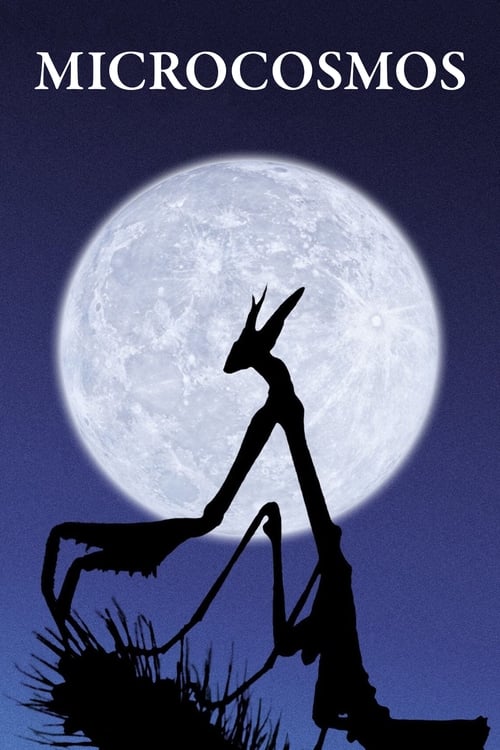
Microcosmos
1996 · Marie Pérennou
For when you want pure wonder with zero talking — a reset for a frazzled brain, and magic with kids or anyone who's forgotten how strange the world is. Total comfort, endlessly rewatchable.
What it's about
One French meadow and its pond, seen from the ground up. Extreme close-up photography turns insects and other tiny creatures into the cast of an epic: a dung beetle wrestling its ball uphill, snails entwining in slow motion, an underwater spider building itself a diving bell of air, ants, caterpillars, a mosquito being born on the water's surface — and a rainstorm that, at this scale, is an apocalypse.
The experience
Wordless, hypnotic, and frequently jaw-dropping — you keep asking how they filmed this. It plays like a silent adventure movie with a full emotional range: comedy, tenderness, menace, all inside a square meter of grass.
The craft
Claude Nuridsany and Marie Pérennou spent years developing macro lenses and techniques to shoot the meadow at insect scale, and the results — rain hitting leaves like bombardment, wingbeats slowed to visibility — remain astonishing. With almost no narration, sound design and music do the storytelling, so good speakers matter as much as a big screen.
Why it matters
A landmark that proved nature filmmaking could be cinema rather than television — an international hit that opened the door for a wave of theatrical, dialogue-free wildlife spectacles.
Snapshot
Microcosmos: Le peuple de l'herbe ("The People of the Grass") is a French nature documentary that spends roughly seventy-five minutes at ground level in a single French meadow and its adjoining pond, observing insects and other small invertebrates through extreme macro cinematography. It has no conventional narration to speak of, no scientific voice-of-God cataloging species, and almost no human presence; instead it presents a sequence of encounters — a dung beetle laboring to roll its ball uphill and snagging it on a thorn, snails coupling in slow glistening embrace, a mosquito emerging from its pupal case on the water's surface, an underwater spider spinning a diving bell of air, ants milking aphids, a sudden rainstorm that becomes an apocalypse at this scale. The film was directed by Claude Nuridsany and Marie Pérennou, two French biologists-turned-filmmakers who worked as a lifelong creative partnership; single-director credits circulate, but the historical record is unambiguous that it is a co-directed work. Produced under the wing of Jacques Perrin's Galatée Films, it premiered at the 1996 Cannes Film Festival and became one of the most commercially and critically successful theatrical nature documentaries of its era, a touchstone for the "cinematic," image-first strand of wildlife filmmaking that would flower over the following decade.
Industry & production
Microcosmos was produced by Galatée Films, the company of actor-producer Jacques Perrin, in co-production with France 2 Cinéma, Bac Films, and Swiss and Italian partners, with participation from Canal+ and support from the CNC — a fairly typical European art-house financing mosaic of the mid-1990s. Perrin's involvement is significant: he was building a body of large-scale, theatrically ambitious natural-world films, and Microcosmos stands as the first major entry in a loose trilogy of Galatée nature spectaculars that would continue with Winged Migration (Le Peuple migrateur, 2001) and Oceans (2009). The production was extraordinarily long-gestating. Nuridsany and Pérennou had spent years as still photographers and popular-science authors specializing in the miniature world before the film, and the shoot itself is generally described as spanning roughly two to three years of principal photography preceded by a long period of technical development. The film reached theaters in France in 1996 and was distributed internationally with a light English-language framing; the English narration is commonly attributed to Kristin Scott Thomas, though the film remains overwhelmingly wordless in any version. Precise budget and box-office figures I will not assert here, but the film is securely documented as a substantial art-house success, unusually so for a feature-length insect documentary, and its Cannes and César recognition cemented its commercial legs.
Technology
The film's existence is fundamentally a technology story, and this is the area where its makers' claims are best documented in the general record without needing invention. To film insects at the scale and image quality of a theatrical feature, Nuridsany and Pérennou could not rely on off-the-shelf macro gear, which at this magnification suffers from vanishingly shallow depth of field, crippling light loss, and the physical impossibility of moving a normal camera through a stem of grass. Over years of preparation they and their technical collaborators developed bespoke apparatus: specially adapted macro lenses, motion-control and micro-crane rigs allowing the camera to track and glide within the miniature landscape, and lighting solutions engineered to illuminate subjects a few millimeters across without cooking them. Contemporary accounts also credit periscope-style and endoscopic optical relays that let the lens penetrate spaces a camera body never could. The film combines several temporal technologies — real-time observation, slow motion for events like flight and droplet impact, and time-lapse for growth and blooming — so that the meadow is rendered across multiple simultaneous timescales. This engineering-first approach is the film's true innovation; the imagery that audiences found revelatory was inseparable from hardware that largely did not exist before the production built it.
Technique
Cinematography
The cinematography is the film's signal achievement and was honored as such. Shooting on film at extreme magnification, the filmmakers achieve a painterly image: shallow planes of focus isolate a single beetle or dewdrop against luminous, dissolved backgrounds, and the light is frequently warm, low, and golden, treating the meadow like a landscape at magic hour. Crucially, the camera moves. Rather than the locked-off scientific shot, Microcosmos dollies, tracks, and cranes through its miniature world, adopting the grammar of narrative cinema — establishing shots of the meadow at dawn, then a descent into the grass, then intimate close-ups — so that scale itself becomes a dramatic instrument. Water is a recurring subject and a technical showpiece: surface tension, the meniscus a water-strider dimples, a raindrop striking like a bomb, the silver skin of the underwater spider's air bubble. The film's cinematography was recognized at the Césars, and its look established a template — insects photographed with the reverence and compositional care usually reserved for human faces or grand vistas.
Editing
The editing organizes what could have been a mere reel of spectacle into an emotional and structural arc. The film is broadly shaped as a single day-into-night cycle in the meadow — dawn mist, midday activity, an afternoon storm, dusk, night — which gives the loose anthology of encounters an underlying diurnal rhythm. Within that frame, individual "scenes" are cut as small dramas with beginnings, complications, and resolutions: the dung beetle sequence is edited for comic suspense and persistence; the storm is cut for genuine peril and release. The pacing alternates contemplative long takes with brisker montage, and the editing controls the film's tonal swings between wonder, humor, tension, and tenderness. This dramaturgical cutting — treating tiny biological events as narrative beats — is central to why the film reads as cinema rather than as an educational reel, and its editing was among the craft categories recognized in awards.
Mise-en-scène / staging
"Staging" is a delicate term for a documentary, and Microcosmos sits in an honest gray zone that its makers never fully disguised. Much of the film is genuine observation in the field, but the practicalities of macro cinematography — controlled light, stability, the ability to move a camera through vegetation — mean a great deal was necessarily filmed in prepared conditions, effectively a naturalistic studio-meadow, with subjects and environments arranged to be filmable. This is standard for the invertebrate genre and not a scandal, but it is fair to describe the film's mise-en-scène as composed: backgrounds chosen for their painterly dissolution, light shaped for warmth and modeling, action framed to read legibly at unfamiliar scale. The result is a designed miniature world that feels like discovered nature — the artifice serving verisimilitude rather than undermining it.
Sound
Sound is one of the film's most inventive and least remarked dimensions. At true scale, an insect meadow is nearly silent or produces sounds too faint and too high-pitched for cinema; the film's sound design therefore reconstructs an entire sonic world in post-production, building foley for footsteps of beetles, the creak of chitinous armor, the wet articulation of snails, the whir of wings, so that the audience "hears" a scale it could never actually hear. This designed soundscape, working in concert with the score, is what gives the images their tactile, almost tact furry intimacy. The film's sound work was among the elements recognized at the Césars, and it is arguably as responsible as the cinematography for the sense of being shrunk down into the grass.
Performance
There are no human performers in any conventional sense; the "cast" is entirely invertebrate, plus the occasional bird, frog, or pheasant. The relevant human "performance" is Kristin Scott Thomas's spare English narration and, in the original, the equally sparse French framing — deliberately minimal, present mainly as a light introductory touch rather than an explanatory track. The film's refusal of a talking guide is itself a performative choice: it asks the animals' behavior to carry the drama without a mediating human voice interpreting it.
Narrative & dramatic mode
Microcosmos operates in an observational, poetic-documentary mode rather than an expository one. It is closer to the "city symphony" tradition and to pure cinema than to the lecture-illustrated wildlife film: it withholds names, taxonomies, and statistics, and instead invites the viewer to read behavior as story. Yet it is far from plotless. Its dramatic method is anthropomorphic in the gentlest register — not by assigning insects speech or personalities in voice-over, but by editing and scoring their behavior so that we perceive effort, appetite, courtship, danger, and triumph. The dung beetle's Sisyphean struggle plays as slapstick heroism; the snails' mating plays as erotic tenderness; the rainstorm plays as catastrophe and survival. The overarching dramatic frame is the single day, a structure as old as the diurnal cycle itself, lending a subtle sense of completeness and mortality to what is otherwise an anthology.
Genre & cycle
The film belongs to the nature/wildlife documentary genre, and specifically to its "blue-chip," theatrical, spectacle-driven subgenre — but it helped inaugurate a distinct cycle within that: the cinematic natural-history feature designed for the big screen and the art-house rather than for television. Its most direct lineage is the Galatée cycle it began, continued by Winged Migration and Oceans, all sharing the house signature of immersive, near-wordless, image-and-music-forward natural spectacle with high technical ambition. More broadly it sits within the francophone tradition of the poetic science film and prefigures the later wave of theatrically released nature documentaries — including much of the Disneynature slate — that prioritize awe and narrative shaping over pedagogy.
Authorship & method
The authorship is genuinely a shared, two-person auteurism. Claude Nuridsany and Marie Pérennou trained in biology and came to filmmaking through still photography and popular science writing about the miniature world; Microcosmos is the fullest expression of a decades-long obsession that they pursued as co-directors, co-writers, and, in the field, co-cinematographers and technical inventors. Their method fused naturalist patience — the years of observation needed to know where and when a behavior would occur — with a filmmaker's dramaturgy and an engineer's problem-solving. The key collaborators complete the picture. Jacques Perrin, as producer, provided the platform and the theatrical ambition that lifted the project out of the television-science ghetto. The composer Bruno Coulais wrote the score, which mixes orchestral color with wordless vocal textures and functions almost operatically, and whose work here was award-recognized; Coulais's association with Perrin's nature films would continue. Additional cinematographers and technicians contributed to the field photography and the custom rigs, and the sound and editing teams — likewise honored at the Césars — were essential authors of the film's constructed intimacy. The result is a work whose "auteur" is really a small, specialized collective organized around two naturalist-directors.
Movement / national cinema
Microcosmos is firmly a French film, produced within the French national cinema's ecosystem of CNC support, public-broadcaster co-financing, and Canal+ participation, and it draws on a specifically French vein of the film scientifique and poetic documentary — a tradition that runs from Jean Painlevé's surreal-scientific aquatic films of the early twentieth century through to the popular-science culture the directors themselves came from. It is not part of any narrative "movement" in the New Wave sense, but it can be placed within a distinctly French confidence that natural-science subjects can be treated as high cinematic art. Its international success also marked a moment when French producers, Perrin foremost, positioned the nature spectacular as an exportable art-house product.
Era / period
The film arrives in the mid-1990s, a hinge moment for the documentary's technological and commercial possibilities. It is a late-celluloid achievement — shot on film with mechanical and optical ingenuity rather than digital sensors or CGI — made just before digital tools would transform both capture and, more insidiously, the ethics of what nature imagery could fabricate. Coming in 1996, it also predates the broadcast-driven revival of blue-chip natural history (the BBC's The Blue Planet and Planet Earth landmarks lay ahead), and it helped demonstrate a theatrical appetite that those later productions and the Disneynature label would exploit. It belongs, in short, to the last great pre-digital moment of the nature film and to the beginning of the genre's modern theatrical resurgence.
Themes
Beneath its surface delight, the film advances a coherent set of themes. The first is scale and defamiliarization: by shrinking the viewer to the size of an insect, it makes the ordinary meadow strange, vast, and sublime, arguing that wonder is a matter of attention rather than of exotic locations. The second is the universality of life's drives — the insects' labor, hunger, courtship, and struggle are staged to rhyme with human experience, quietly proposing continuity between the smallest creatures and ourselves without ever stating it. A third is time, rendered literally through slow motion and time-lapse: the film insists that events invisible to us because they are too fast or too slow are dramas in their own right. A fourth is indifferent nature, most sharply in the storm sequence, where beauty and violence are inseparable. And running through all of it is an ecological and almost devotional reverence: an implicit argument that this teeming, overlooked world is worthy of the same awe we grant mountains and oceans.
Reception, canon & influence
Critically, Microcosmos was received as a revelation and quickly entered the small canon of great theatrical nature documentaries. At the 1996 Cannes Film Festival it was awarded the Technical Grand Prize, a fitting recognition of a film whose art was inseparable from its engineering, and at the following year's César Awards it won multiple prizes across the technical crafts — cinematography, editing, sound, and Bruno Coulais's music among them, along with recognition for its producer — an unusually strong showing for a documentary. Critics abroad, including in the English-language press, praised its beauty and its refusal of pedantry, though some noted the anthropomorphic shaping and the constructed nature of certain sequences; these remain the standard critical reservations.
Its influences backward reach to the French scientific-poetic film tradition — Painlevé's precedent for treating small aquatic and invertebrate life as cinematic and even surreal subject matter — and to the long history of macro nature photography from which its directors emerged. Forward, its influence is substantial and specific. It established, together with its Galatée successors Winged Migration and Oceans, a durable model for the theatrically released, immersive, near-wordless nature feature, and it demonstrated a mainstream audience for such films that the subsequent wave of big-screen wildlife cinema — including the Disneynature releases and the theatrical ambitions of the BBC's landmark series — would build upon. Perhaps most lastingly, it changed expectations for how insects and the miniature world could be photographed, normalizing the idea that a beetle deserves the same lens, light, and dramatic care as a movie star. Its combination of technical invention, dramaturgical editing, and near-total faith in the image over the word remains a reference point whenever filmmakers attempt to make the unnoticed world feel vast.
Reception
A surprise sensation in 1996 — a bug documentary that drew huge crowds in France, screened at Cannes and swept up five César Awards — and it's since settled in as the arthouse ancestor of the whole prestige nature-doc boom that followed.
How Microcosmos was received, from release to now →
How to watch Microcosmos: what to notice on a first viewing
- Notice how close the camera gets to a single beetle. Shallow focus isolates one insect or dewdrop against a dissolved, glowing background, turning ordinary grass into something closer to a portrait studio. Scale itself becomes the drama. You are made to see a beetle the way a film usually frames a face.
- Watch the camera glide through the grass like a dolly shot. Rather than a locked-off scientific shot, the camera tracks, cranes, and descends into the meadow, borrowing the moves of narrative cinema rather than nature television. The insects get treated with the same visual grammar a feature film gives its characters.
- Listen for footsteps and creaks no insect could really make. The sound design rebuilds an entire sonic world in post-production, foley for beetle steps and chitinous creaks that no camera could have actually recorded. What you hear is built, not captured, and it's what makes the scale feel touchable.
- Track the light from dawn haze to evening gold. The film is shaped as one day in the meadow, dawn to night, giving the loose run of encounters an underlying rhythm you can feel. A single day's arc holds together what could otherwise be just a reel of pretty images.
- Watch the water strider dimple the pond's surface tension. Water recurs throughout as both subject and showpiece, from the strider's dimpled surface to a raindrop landing like a small bomb. The film keeps finding an entire physics lesson in a single drop of water.
The whole guide to watching Microcosmos, with the keys for a rewatch →
Influences: the films it descends from and the films it influenced
- Koyaanisqatsi (1982) — Established the near-wordless theatrical feature whose entire dramaturgy is carried by image cut to a wall-to-wall score (Glass), the image-over-word faith Coulais and the editors operationalize almost operatically.
- A Bug's Life (1998) — Modeled the immersive macro worm's-eye photography of an insect world as epic landscape, with backlit foliage and dew-scale detail rendered as a grand environment.
- Hukkle (2002) — Builds a feature entirely from macrophotographic attention to insect and non-human life, the creaturely extreme-close-up scale Hukkle braids directly into its murder narrative.
- The Velvet Queen (2021) — French nature doc built almost wordlessly on patient long/macro-lens observation and painterly held frames, letting score and silence rather than commentary carry the contemplative register.
- The Birth of a Flower (1910) — Pioneered the time-lapse and microcinematography that Microcosmos inherits in its 'mixed-timescales' technique — speeding botanical growth and slowing insect motion so biological time becomes dramatic time.
- L'Hippocampe (The Seahorse) (1934) — Founding gesture of the French film scientifique that treats tiny invertebrate life as a lyrical, near-surreal cinematic protagonist scored with music rather than lectured over — the exact register Nuridsany and Pérennou adopt.
- The Living Desert (1953) — Codified the dramaturgical editing of raw behavioral footage into character-driven 'scenes' with gentle anthropomorphism and a diurnal-cycle spine, the constructed-intimacy method Microcosmos applies to a meadow.
- The Hellstrom Chronicle (1971) — Ken Middleham's dramatized macro insect cinematography here first framed the beetle and mantis as movie-star close-ups with staged menace, the 'a bug deserves the same lens and light' ethos Microcosmos normalized.
- Phase IV (1974) — Middleham again shoots extreme-macro insect life with shallow focus and studio-controlled staging, turning ant colonies into blocked, characterized protagonists — the naturalistic-studio approach Microcosmos refined into custom rigs.
- Baraka (1992) — Sibling in the wordless immersive nature feature, using 70mm image and continuous music instead of narration to make the observed world feel vast — the same rhetoric of awe without explanation.
- Winged Migration (2001) — Direct Galatée successor produced by Perrin and scored by Coulais: extends the custom-rig engineering (ultralight flight platforms in place of macro optics) and the near-wordless immersive model to a new scale of animal proximity.
- Bugs! A Rainforest Adventure (2003) — Ported Microcosmos's beetle-as-protagonist macro dramaturgy to giant-screen IMAX 3D, using purpose-built close-focus optics to stage a mantis-and-caterpillar 'plot' for a mass theatrical audience.
- Genesis (2004) — The directors' own follow-up, extending their extreme-macro, custom-optics photography of miniature and cellular life within a poetic cosmological frame — the same naturalist-inventor method scaled to origins-of-life storytelling.
- Life in the Undergrowth (2005) — Attenborough's BBC series built directly on Microcosmos's proof that invertebrate behavior warrants cinematic macro treatment, adopting motorized probe/endoscopic macro lenses to enter the miniature world at its own scale.
- Oceans (2009) — Galatée's later immersive feature, again produced by Perrin with a Coulais score, continuing the near-wordless, custom-rig, dramatically edited nature spectacle template Microcosmos launched — this time underwater.
- Wings of Life (Pollen) (2011) — Disneynature descendant whose extreme-macro plus time-lapse photography of pollinators literalizes Microcosmos's mixed-timescale intercutting of flower and insect, wedded to a wordless music-led theatrical cut.
Similar films
- Baraka (1992) — influence & lineage
- The Velvet Queen (2021) — shared sensibility
- The Metamorphosis of Birds (2021) — shared sensibility
- Dry Leaf (2026) — shared sensibility
- Silent Light (2007) — shared sensibility
- Silent Friend (2026) — shared sensibility
- The Summit of the Gods (2021) — shared sensibility
- Memoir of a Snail (2024) — shared sensibility