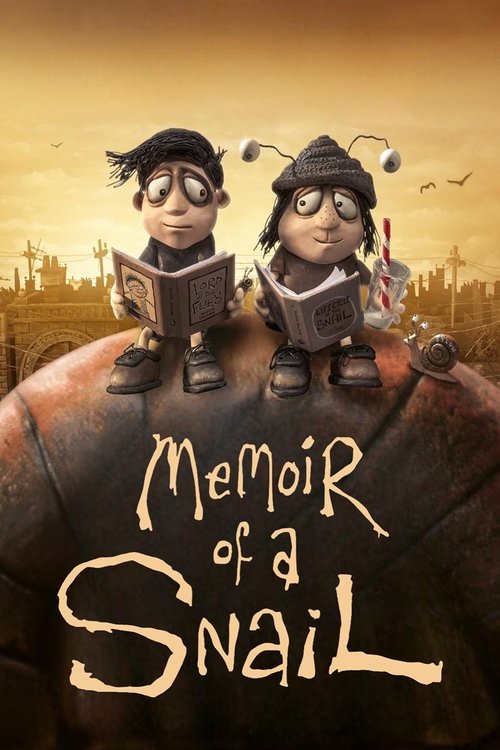
Memoir of a Snail
2024 · Adam Elliot
For when you want a good cry that leaves you lighter, not heavier — a sad-funny film about loneliness that ends up feeling like a hug. Comfort viewing for grown-ups, even at its darkest.
What it's about
Grace Pudel — orphan, misfit, hoarder of snail figurines — narrates her own life story: torn from her twin brother by the foster system as a child, she grows up collecting things against the loneliness, slowly burying herself in clutter and small catastrophes. It's a stop-motion biography told in plasticine, following her from a broken childhood in Australia toward the hard-won question of whether she can crawl out of her shell.
The experience
It swings between deadpan comedy and real grief, often in the same shot — you laugh at a sight gag and then feel a lump in your throat ten seconds later. Melancholy but never miserable, it moves at the patient, hand-crafted pace of its snails and earns every tear it asks for.
Performances
Sarah Snook narrates Grace with a wounded, wry tenderness that carries the whole film, and Jacki Weaver is pure warmth as the eccentric old woman who befriends her.
The craft
Adam Elliot sculpts everything by hand and leaves the evidence in frame — visible thumbprints in the clay, a slight wobble he embraces as style rather than corrects. Every cluttered set is dense with handmade detail, so the closer you look the more it gives; it rewards a screen big enough to see the fingerprints.
Why it matters
It won the Cristal at Annecy — the top prize in world animation — and earned an Oscar nomination, cementing Elliot as the rare animator making entirely adult, autobiographical work in clay.
Grace Pudel — hoarder of snail figurines, wearer of a knitted beanie with eye-stalks — narrates her own scrapheap of a life: orphaned young, wrenched apart from her twin brother by the foster system, and slowly buried under the clutter she gathers against loneliness. Adam Elliot, the Melbourne clay animator behind Mary and Max and the Oscar-winning short Harvie Krumpet, calls his films 'clayographies': biographies in plasticine, drawn from people he has known, where grief and deadpan comedy share every frame. His handmade ethic is absolute — thumbprints are left visible in the clay, and the wobble of his own hereditary tremor is embraced as style rather than corrected. The result took the Cristal at Annecy, the top prize in world animation, and an Academy Award nomination, confirming Elliot as the rare animator working an entirely adult register: mortality, abuse, desire and hope, molded one fingertip-dented frame at a time.
Reception
Premiered at Annecy 2024 and took the Cristal, then rode a slow-burn arthouse rollout all the way to a Best Animated Feature Oscar nomination — by awards night it had become animation Twitter's scrappy favorite in the year of Flow.
How Memoir of a Snail was received, from release to now →
Influences: the films it descends from and the films it influenced
- Uncle (1996) — The first of Elliot's autobiographical 'Trilogy' shorts, establishing the lumpy fingerprinted clay figure and the tender, deadpan narrated portrait of a solitary eccentric that Memoir scales up to feature length.
- Harvie Krumpet (2003) — Elliot's Oscar-winning prototype of 'clayography' — a single-subject clay biography structured as a rolling catalog of afflictions and small mercies, narrated in flat wry voiceover, whose exact grammar Memoir reprises.
- Mary and Max (2009) — Elliot's first feature carried clayography to feature scale with a near-monochrome palette accented by single spot colors, epistolary/first-person narration, and pathos delivered through inventory of misfortune — the direct template for Memoir.
- Creature Comforts (1989) — Aardman's pioneering marriage of documentary-style vox-pop voiceover to clay figures, and its deliberate refusal to smooth away tool-marks and fingerprints, is the source of Elliot's 'visible thumbprints' as a deadpan aesthetic.
- Alice (1988) — Švankmajer's insistence on the tactile materiality of hand-manipulated objects and obsessively accumulated bric-a-brac feeds both Memoir's hoarding motif and its ethic that the handmade surface should remain palpably present.
- The Nightmare Before Christmas (1993) — Established the feature-length stop-motion built around a melancholic outsider protagonist, proving armatured puppets could sustain adult-adjacent tonal registers rather than only slapstick.
- Robot Dreams (2023) — Contemporary adult animation that mines loneliness, loss, and separation as its core subject with the same unsentimental melancholy, extending the 'animation as grown-up grief' lane Robot Dreams occupies.
- I Lost My Body (2019) — An adult stop-motion feature built on grief, bodily damage, and recurring object motifs across a fractured life-story timeline, extending the serious-drama-as-animation frontier the film benchmarked.
- Marcel the Shell with Shoes On (2021) — Extends Elliot's first-person-voiceover life-story craft directly: a diminutive handmade creature narrates its own aching, deadpan philosophy of loss and family in confessional monologue over stop-motion.
- Wendell & Wild (2022) — Continues the LAIKA-lineage of stop-motion carrying trauma, guilt and grief with a handmade grotesquerie, extending the medium's claim on heavy adult emotional material.
- Coraline (2009) — LAIKA's handcrafted-sets-and-puppets approach pushed stop-motion into a darker, tactile, faintly unsettling register aimed above the nursery — kin to Elliot's insistence on an adult performance register.
- Fantastic Mr Fox (2009) — Anderson embraced the shimmer of hand-touched fur and visible puppet imperfection as deliberate style rather than error — the same 'tremor-as-style' logic that lets Elliot leave thumbprints in frame.
- Anomalisa (2015) — The nearest sibling: an adult-register stop-motion feature about loneliness that leaves the puppets' face-plate seam lines deliberately unconcealed, treating the visible join as an honesty-of-the-handmade device exactly as Elliot treats thumbprints.
- My Life as a Zucchini (2016) — A stop-motion feature built on childhood grief, orphanhood and institutional loneliness, delivered with tender restraint — the same melancholy-clay register Elliot works, minus the comedy floor.
- Guillermo del Toro's Pinocchio (2022) — Foregrounds mortality and grief for an adult audience through stop-motion, keeping a hand-carved wood-grain tactility on the puppets so the making stays visible — sibling in the 'mortality via tactile puppet' vein.
- Persepolis (2007) — A sibling in the animated-biography genre: a first-person life-story arc narrated in dry, deadpan retrospect, proving animation can carry a full melancholic autobiography — the same narrative form Elliot builds in clay.
- Waltz with Bashir (2008) — An animated first-person memoir organized as recovered life-narrative through voiceover testimony — sibling in the animated-biography lineage that legitimizes animation as a vehicle for a single narrator's remembered grief.
- $9.99 (2008) — An Australian adult-themed stop-motion feature (written by Etgar Keret) about lonely apartment-dwellers seeking meaning — a regional sibling to Elliot's melancholy, deadpan adult claymation.
Similar films
- Mary and Max (2009) — influence & lineage · same viewing thread
- My Life as a Zucchini (2016) — influence & lineage
- Guillermo del Toro's Pinocchio (2022) — influence & lineage
- Alice (1988) — influence & lineage
- Coraline (2009) — influence & lineage
- Marcel the Shell with Shoes On (2022) — same viewing thread
- Flow (2024) — same viewing thread
- Robot Dreams (2023) — same viewing thread
All the films related to Memoir of a Snail →
Watch it with: curated runs of related films
- Animation That Aches — A run of animated films that take loneliness, grief, and memory as seriously as any live-action drama — watch them in a row and the cartoon surface stops mattering.