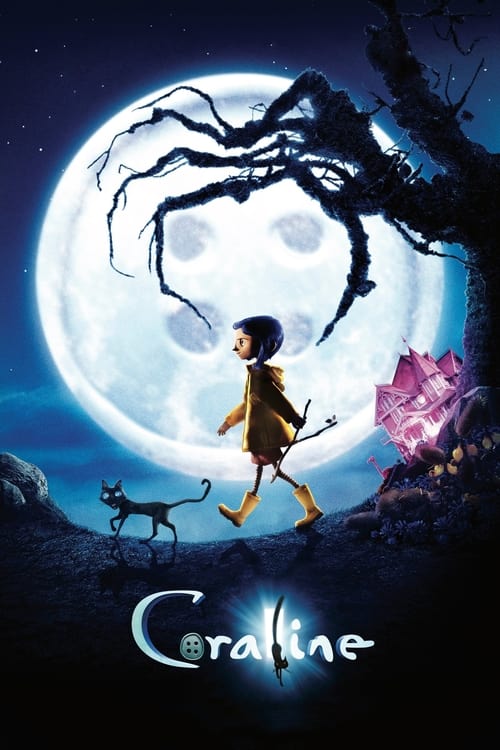
Coraline
2009 · Henry Selick
For a stormy-night watch when you want wonder with teeth — a family movie that actually unsettles you, or a gateway scare for a kid who's ready. Cozy on the surface, but don't expect it to stay that way.
What it's about
Eleven-year-old Coraline, bored and overlooked in her family's creaky new house in rain-gray Oregon, finds a small hidden door that opens onto a parallel version of her life — one where the food is delicious, the garden blooms just for her, and her Other Mother dotes on her endlessly. Everyone there has buttons for eyes, and the invitation to stay comes with a price.
The experience
Enchanting and genuinely creepy in equal measure — it starts as a cozy fantasy and tightens, scene by scene, into real dread. It's scary in the way the best old fairy tales are: thrilling rather than traumatizing, with fear served in doses a brave kid can handle.
The craft
Handmade stop-motion at its most staggering: the film pioneered 3D-printed replacement faces that gave its puppets unprecedented expressiveness, while details like Coraline's miniature knitted star sweater keep everything tactile and intimate. The two worlds are designed as mirror images — drab and saturated — and the contrast pays off gorgeously on a big screen.
Why it matters
The film that launched the stop-motion studio Laika and became a generation's gateway horror, with the Other Mother earning a place among the great modern movie monsters.
Henry Selick, the stop-motion master behind The Nightmare Before Christmas, inaugurated the Laika studio with this adaptation of Neil Gaiman's novella — a fairy tale in the old, unsoftened sense, where a door in the wall opens onto a world that loves you a little too eagerly. A bored girl in a rain-gray Oregon house finds a parallel home where the food is better, the garden blooms for her, and everyone has buttons for eyes; the price of staying is the story's cold engine. Selick understands that children crave fear in controlled doses, and the film became a generation's gateway horror, its Other Mother among the great modern movie monsters. The craft remains staggering: Coraline pioneered 3D-printed replacement faces, giving puppets an unprecedented expressive range, while retaining a handmade intimacy — her miniature star sweater was knitted with needles as fine as human hair. Every frame carries the fingerprint smudge of actual touch, which is exactly what makes its uncanny world so hard to shake.
A Deleuzian reading
Someone knitted the sweater.
The full Deleuzian reading of Coraline →
Reception
A modest hit and well-reviewed on release in 2009, Coraline has since snowballed into a generational touchstone — annual theatrical re-releases keep selling out, and its 15th-anniversary run in 2024 topped $30M worldwide, remarkable for a re-issue.
How Coraline was received, from release to now →
Influences: the films it descends from and the films it influenced
- The Nightmare Before Christmas (1993) — Selick's own directorial debut established the rig-and-replacement puppet performance system and the practice of swapping sculpted faces frame-by-frame that Coraline later industrialized as 3D-printed replacement faces.
- James and the Giant Peach (1996) — Selick refined his literary-adaptation-to-stop-motion pipeline and hand-built miniature worlds here, the workflow he stripped down to a fully-puppet register for Coraline.
- King Kong (1933) — Willis O'Brien's armature-based, single-frame model animation is the foundational technique on which all subsequent character stop-motion, including Laika's, is built.
- Jason and the Argonauts (1963) — Ray Harryhausen's Dynamation pushed frame-by-frame puppet acting toward genuine expressive performance, the tradition Coraline's puppeteers extend with facial-replacement nuance.
- Alice (Něco z Alenky) (1988) — Švankmajer's tactile stop-motion of a girl drifting through a menacing domestic dreamworld of animated household objects is the direct template for Coraline's handmade domestic menace and uncanny register.
- Street of Crocodiles (1986) — The Quays' decayed-puppet uncanny and obsessive miniature set-craft, where texture and grime carry dread, feeds Coraline's staging of tactility as unease.
- Return to Oz (1985) — A dark portal-fantasy that fuses claymation antagonists with a childhood-fear tonality, modeling the 'seductive other world turns menacing' structure Coraline inherits.
- Beetlejuice (1988) — Stop-motion gothic-cute uncanny-parallel-world craft that carries the handmade Selick/Burton macabre forward a generation.
- Corpse Bride (2005) — Laika industrialized Corpse Bride's proof that stop-motion could be shot frame-by-frame on digital stills, adding rapid-prototyped 3D-printed replacement faces where Corpse Bride used internal gears.
- The Secret of NIMH (1982) — Extends NIMH's conviction that unsettling children is a legitimate aim, wedding meticulous hand-craft (stop-motion here) with mystery-structure dread and a maternal-peril fable.
- The Pied Piper (1986) — Demonstrates handmade stop-motion sustaining genuine dread and moral weight at feature length, the very proof-of-concept Krysař offered two decades earlier.
- Wallace & Gromit: The Curse of the Were-Rabbit (2005) — Laika industrialized Aardman's replacement-part principle, substituting rapid-prototyped 3D-printed replacement faces for hand-sculpted replacement mouths — the same discrete-performance logic at a scale only made financeable by Chicken Run and Were-Rabbit proving the feature market.
- ParaNorman (2012) — Laika's follow-up took Coraline's rapid-prototyped replacement-face system into full color 3D printing, multiplying the expression library Coraline pioneered.
- The Boxtrolls (2014) — Extends Coraline's dense miniature-craft and 3D-printed facial-animation workflow to a grimy, hand-built Victorian world.
- Kubo and the Two Strings (2016) — Scaled Coraline's 3D-printed face library into tens of thousands of interchangeable parts and giant rig-supported puppets, the technique's fullest expansion.
- Anomalisa (2015) — Deliberately preserves the visible seam line across the 3D-printed replacement faces Coraline introduced, turning that uncanny fault-line into the film's central formal device.
- Guillermo del Toro's Pinocchio (2022) — A feature stop-motion dark fairy tale that extends Coraline's model of emotionally realistic puppet performance and its willingness to face death and menace in a children's story.
- My Life as a Zucchini (2016) — Established the modern articulated-puppet feature pipeline built around a child navigating loss, which Zucchini scales down to deliberately handmade, imperfect intimacy.
- Marcel the Shell with Shoes On (2022) — Laika's rigged stop-motion of characters navigating built miniature domestic sets establishes the physical-scale world-building — kitchens, stairs, household objects at doll scale — that Marcel restages in a real house.
- The Little Prince (2015) — Runs a hybrid pipeline that fuses stop-motion puppets with CG support and stages a drab-real vs. vivid-other two-world contrast, prefiguring the film's dual-register palette.
- Masters of the Universe (2026) — Knight's formation as an animator on this film instilled the LAIKA doctrine he brings to live action — that a physically built object photographs differently from a simulated one, and that a performance beat should be held rather than cut around — alongside its central staging of a monster who is revealed to be family.
- Rise of the Guardians (2012) — The precedent for shooting stereo natively as dramaturgy rather than depth-as-spectacle: convergence and depth budget scripted per sequence so the shift between worlds is felt as a change in spatial pressure — the same discipline behind Guardians' tunnel and globe-room staging.
- Chicken Run (2000) — Aardman's contemporary feature-scale stop-motion with sculpted replacement mouths proved character animation at length, the industrial bar Laika met and then advanced with printed faces.
- Fantastic Mr. Fox (2009) — Released the same year, it revived literary-adaptation stop-motion while deliberately keeping handmade tactility visible (fur ripple, fingerprints), the same embrace of the medium's seams Coraline shares.
- Pan's Labyrinth (2006) — A dark fairy tale whose lonely child crosses into a beguiling-then-predatory other world governed by a binding bargain — the Faustian parallel-world grammar Coraline deploys.
- Frankenweenie (2012) — Burton's return to black-and-white replacement-animation stop-motion horror-for-children works the same gateway-horror puppet register as Coraline.
- Spirited Away (2001) — A near-parallel craft object: a girl crosses a threshold into an inverted parental world of seductive food and hidden menace, weaponizing hospitality and appetite exactly as the bathhouse feast turns Chihiro's parents to pigs.
- Scooby-Doo on Zombie Island (1998) — Commits to real, un-defanged horror and creeping melancholy in a children's frame, extending the same premise Zombie Island proved — that a young audience can be trusted with authentic fear rather than a safe fake-out.
- Mary and Max (2009) — Selick's stop-motion contrasts a drab, desaturated 'real' world against a heightened 'other' world — the same dual-worlds staging with divergent palettes that separates Mary's ochre Australia from Max's gray New York.
- Isle of Dogs (2018) — Laika's rapid-prototyped, 3D-printed replacement faces represent the parallel technical frontier of the same craft — a sibling solution to animating nuanced puppet emotion at feature length.
- Memoir of a Snail (2024) — LAIKA's handcrafted-sets-and-puppets approach pushed stop-motion into a darker, tactile, faintly unsettling register aimed above the nursery — kin to Elliot's insistence on an adult performance register.
- Miss Peregrine's Home for Peculiar Children (2016) — A portal into an uncanny alternate home ruled by a beautiful child-devouring caretaker, executed in the same macabre-cute stop-motion register Peregrine reveres.
- Mad God (2021) — Laika's feature-scale built-miniature and replacement animation is the studio-era counterpart to Mad God's proof that handmade world-building can sustain a feature.
- Beetlejuice Beetlejuice (2024) — Stop-motion Other-world built from tactile, handmade uncanny interiors, extending the Selick/Burton puppet lineage the sequel draws on for its underworld inhabitants.
Similar films
- The Nightmare Before Christmas (1993) — influence & lineage
- Kubo and the Two Strings (2016) — influence & lineage
- Pan's Labyrinth (2006) — influence & lineage
- Little Amélie or the Character of Rain (2025) — same viewing thread
- Alice (1988) — shared sensibility
- The Wolf House (2018) — shared sensibility
- Hereditary (2018) — shared sensibility
- My Neighbor Totoro (1988) — shared sensibility
All the films related to Coraline →
Watch it with: curated runs of related films
- Handmade Animation's Dark Wonder — A run of painstakingly handcrafted animation — painted, stop-motion, watercolor — where childhood wonder keeps brushing up against loss and the adult dark.