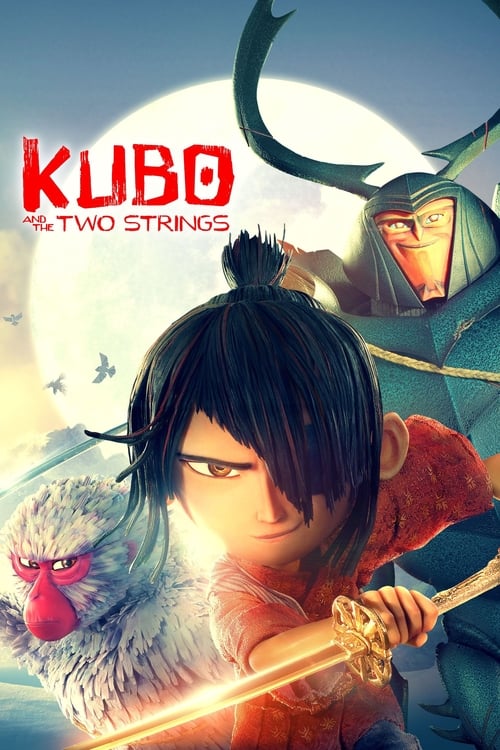
Kubo and the Two Strings
2016 · Travis Knight
For when you want wonder with substance — a family movie night that adults will feel as deeply as kids, or a solo evening when you want beauty and a lump in your throat. Comforting in tone, but emotionally honest about loss.
What it's about
In a mythic feudal Japan, a one-eyed boy named Kubo scrapes by telling stories in a village square, spinning sheets of paper into living origami with the music of his two-stringed shamisen. He cares for his ailing mother and guards one rule: never stay out after dark. When the rule breaks and a vengeful spirit from his family's past finds him, Kubo is thrown into a quest for the armor of his fallen samurai father — and into the mystery of who his family really is.
The experience
An adventure with real weight under it — funny and thrilling in the moment, but shot through with grief and memory, so it lands harder than most family films. It builds to a finale that goes quiet where other films go loud, and it may leave you wiping your eyes.
Performances
Charlize Theron gives the stern, secretly tender Monkey a dry warmth that anchors the whole quest, and Matthew McConaughey has loose, goofy fun as the amnesiac Beetle.
The craft
This is stop-motion pushed to a scale the medium had rarely attempted — hand-animated puppets, colossal creatures, storms and seas built with physical craft and seamlessly extended effects, all styled after Japanese woodblock prints and origami. Every frame is dense with handmade texture, and the score weaves the shamisen through it. It rewards the biggest, sharpest screen you can find.
Why it matters
Widely regarded as the high-water mark of Laika's run, it earned Oscar nominations for both animated feature and — almost unheard of for animation — visual effects, and won the BAFTA for animated film. It proved stop-motion could carry epic scale and adult emotional seriousness at once.
Snapshot
Kubo and the Two Strings is the fourth feature from Laika, the Portland, Oregon stop-motion studio, and the directorial debut of the studio's president and CEO, Travis Knight. A mythic-Japan fantasy about a one-eyed boy whose magic lives in his shamisen and his origami, it braids a hero's quest with a meditation on grief, memory, and the act of storytelling itself. Critically it stands as the most ambitious and, for many reviewers, the most fully realized of Laika's films to that point — a work that pushed the physical craft of stop-motion to a new scale while wrapping it in an unusually somber, adult emotional register for a "family" release. It earned Academy Award nominations for Best Animated Feature and, unusually for an animated title, Best Visual Effects, and won the BAFTA for Best Animated Film. Commercially it disappointed, a recurring fate for Laika's handcrafted, mid-budget productions in a marketplace dominated by computer-animated studio tentpoles.
Industry & production
The film was produced by Laika and distributed by Focus Features, the specialty arm of Universal, continuing the distribution relationship Laika had built across Coraline (2009), ParaNorman (2012), and The Boxtrolls (2014). Laika occupies a singular industrial position: a boutique, artisan-scale studio underwritten in significant part by Travis Knight's father, Nike co-founder Phil Knight, which allows it to pursue labor-intensive stop-motion at a moment when the technique is otherwise largely confined to shorts, television, and Aardman's comedic output.
Knight, a career animator who had served as lead animator on Laika's earlier features, took the director's chair for the first time here. The screenplay is credited to Marc Haimes and Chris Butler, from a story by Shannon Tindle and Haimes; Tindle, an artist who had worked in television animation, originated the concept and the central character design. The voice cast paired marquee names with the craft: Art Parkinson as Kubo, Charlize Theron as Monkey, Matthew McConaughey as Beetle, Rooney Mara as the twin Sisters, and Ralph Fiennes as the Moon King, with George Takei, Cary-Hiroyuki Tagawa, and Brenda Vaccaro in supporting roles.
Production reportedly ran across several years of design, fabrication, and shooting, in keeping with the extraordinarily slow cadence of stop-motion, where a few seconds of finished footage represent a week's work per animator. On the film's commercial performance the reliable public record is that it underperformed relative to its budget and was widely characterized as a box-office disappointment; I will not attach specific gross or budget figures here, as I cannot verify exact numbers with confidence. The film also drew criticism, part of a broader industry conversation, over the casting of predominantly non-Japanese actors in a story steeped in Japanese culture and folklore.
Technology
Technologically, Kubo is the clearest statement of Laika's hybrid philosophy: stop-motion as the animating soul, with digital and additive-manufacturing tools deployed in service of the handmade rather than as replacements for it. Laika had pioneered the use of 3D-printed replacement faces on Coraline and industrialized it thereafter; on Kubo the studio's rapid-prototyping pipeline produced vast libraries of printed facial components, enabling nuanced, frame-by-frame expression changes on the puppets. The studio has publicly discussed the enormous combinatorial range of expressions this system made available for its lead characters, a scale that would be impractical with hand-sculpted clay faces.
The production's signature technical feat was scale. Its climactic Hall of Bones sequence required what the studio described as the largest stop-motion puppet it had ever built — a towering skeleton several times human height, rigged and animated as a practical object. At the same time, the film leans on digital visual effects, supervised by Steve Emerson, to a degree that earned it that rare Best Visual Effects Oscar nomination: water, weather, the vast "ocean of eyes," and the seamless integration and cleanup of rigs and set extensions were handled with CGI compositing layered over the practical photography. The film thus sits at a deliberate seam between the tactile and the computational — a hybrid whose aesthetic argument is that the handmade should remain legible even when digitally augmented.
Technique
Cinematography
Frank Passingham, a longtime Laika collaborator, served as director of photography. The film's visual language is built on painterly, high-contrast lighting and a controlled, often widescreen sense of composition that lends the miniature sets an epic scale. Passingham's lighting frequently isolates figures against expanses of sky, snow, or water, using silhouette and rim-light to evoke the flatness and negative space of Japanese woodblock printmaking while retaining the volumetric depth that stop-motion's real, physical sets naturally provide. Camera movement is used sparingly and purposefully, so that the many static and near-static framings register as compositions rather than mere coverage.
Editing
Christopher Murrie edited the film. Cutting a stop-motion feature is a distinctive discipline, because performance is committed frame by frame long before assembly and cannot be reshot casually; the edit shapes rhythm across sequences that were painstakingly pre-visualized. Murrie's cutting modulates between the film's contemplative, breathing passages — the storytelling in the village, the quiet grief between Kubo and Monkey — and its kinetic action set pieces, notably the underwater Garden of Eyes and the skeleton battle, where the editing has to sustain momentum without betraying the labor-bound nature of the imagery.
Mise-en-scène / staging
Production design by Nelson Lowry gives the film its coherent visual world: a stylized, mythic feudal Japan rendered in handbuilt sets, textiles, and props whose material reality is central to the film's beauty. Origami is both plot device and design motif — Kubo's paper figures, especially the tiny samurai "Little Hanzo," fold and unfold as living objects, a self-reflexive emblem for the studio's own art of animating physical matter. The staging repeatedly foregrounds craft: paper, cloth, hair, and bone are photographed to emphasize texture, so that the audience feels the handmade surface of the world.
Sound
Dario Marianelli composed the score, drawing on Japanese instrumentation — the shamisen above all, the film's central instrument — woven into an orchestral idiom. Music is diegetically bound to the story, since Kubo's power flows through his playing, collapsing the usual distinction between score and plot. The end-credits feature a cover of the Beatles' "While My Guitar Gently Weeps" performed by Regina Spektor, a choice that literalizes the film's guitar-as-instrument-of-feeling motif. Sound design elsewhere reinforces the tactility of the world — paper, wind, water — though detailed accounts of the sound team's work are thinner in the public record than those of the visual crafts.
Performance
The vocal performances anchor the film's emotional weight. Art Parkinson gives Kubo a mixture of resilience and vulnerability; Charlize Theron's Monkey is stern, protective, and quietly sorrowful; Matthew McConaughey brings comic warmth and amnesiac melancholy to Beetle; and Ralph Fiennes lends the Moon King a chilling, otherworldly serenity. Rooney Mara's dual Sisters are among the film's most memorable creations, their masked, gliding menace a product of voice, puppet design, and animation in concert. Crucially, "performance" here is doubly authored — the vocal actors and the puppet animators together produce each character, with the animators translating breath and hesitation into physical gesture.
Narrative & dramatic mode
The film operates in the register of the mythic quest and the folktale, framed explicitly as a told story: it opens with direct address to the audience ("If you must blink, do it now") and returns throughout to storytelling as its organizing act. Kubo, who spins tales for his village by day and cares for his ailing mother, is forced into a literal quest — to recover three pieces of his fallen father's armor — after he inadvertently draws the attention of vengeful supernatural kin. The dramatic mode fuses the archetypal structure of the hero's journey with a genuinely tragic emotional undertow: this is a children's adventure that is fundamentally about loss, mourning, and the way memory and story keep the dead present. The late revelations about the identities of Kubo's companions turn the quest inward, reframing an external adventure as a family's reckoning with grief.
Genre & cycle
Kubo belongs to the animated fantasy-adventure genre but stands apart within the mid-2010s American animation cycle for its tonal seriousness and its embrace of stop-motion at a time of near-total CGI dominance. It is legible as part of Laika's own auteur cycle — a run of features (Coraline, ParaNorman, The Boxtrolls, then Kubo) unified by handcrafted technique, darker-than-usual themes for family films, and an interest in outsider children confronting mortality and the uncanny. It also participates in a longer tradition of Western animation drawing on Japanese aesthetics, positioning itself in dialogue with, rather than imitation of, that lineage.
Authorship & method
The film is best understood as the convergence of a studio method and a first-time director's sensibility. Travis Knight, steeped in Laika's animation floor, directs with a hands-on animator's understanding of the medium's physical constraints and expressive possibilities; his authorship is inseparable from the collaborative, craft-intensive process the studio has refined. Shannon Tindle's originating vision supplies the concept, characters, and cultural framework; Marc Haimes and Chris Butler shape the screenplay. Among key collaborators, cinematographer Frank Passingham and production designer Nelson Lowry define the look, composer Dario Marianelli the sonic identity, editor Christopher Murrie the rhythm, and visual-effects supervisor Steve Emerson the hybrid pipeline. "Method" here is the true author: the film's meaning — that beauty is made by patient hands and that stories outlast their tellers — is enacted by the very labor that produced it.
Movement / national cinema
This is an American independent-inflected studio production, made by an Oregon studio outside the Los Angeles majors, and it is not a product of any national film movement in the strict sense. Its most important cinematic conversation is transnational: it is an American film that reverently draws on Japanese visual and narrative traditions — folklore, woodblock aesthetics, and the melancholy sensibility often glossed as mono no aware. That cross-cultural borrowing is central to both its beauty and the criticism it attracted; it is homage from outside rather than an expression from within Japanese cinema.
Era / period
Kubo arrives at a specific industrial moment — the mid-2010s, when computer animation had become the overwhelming default and stop-motion survived chiefly through Laika and Aardman. It is thus both contemporary and deliberately anachronistic, a defense of an older craft mounted with cutting-edge tools. Its diegetic setting is a timeless, mythic feudal Japan, unmoored from precise historical dating; the film treats period as legend rather than as reconstruction, consistent with its folktale mode.
Themes
The film's governing themes are memory, mortality, and storytelling as an act of love and survival. Kubo's magic — animating paper through music and narration — is a figure for art itself, and the film argues that stories are how the living hold onto the dead. Grief runs throughout: the loss of a father, the fading of a mother, and finally a confrontation with a grandfather figure who offers a cold immortality in place of mortal feeling. The "two strings" motif, tied to the shamisen and to the bonds of family, insists that love is made of connection and that memory is a form of continued presence. Sight and blindness — Kubo's single eye, the Moon King's aversion to human sight and feeling — thread a further meditation on what it means to truly see and be seen.
Reception, canon & influence
Critically, the film was received as a triumph of craft and one of the finest American animated features of its year, widely praised for its visual beauty, emotional depth, and thematic ambition; a common note in reviews was surprise at how dark and moving a "family" film had allowed itself to be. It earned Academy Award nominations for Best Animated Feature and Best Visual Effects — the latter a notable rarity for an animated film and a recognition of its hybrid technical achievement — and won the BAFTA for Best Animated Film, alongside recognition at the Annie Awards. It did not win its Oscar categories. Its commercial underperformance, however, made it emblematic of the economic precariousness of handcrafted animation.
The influences on the film run backward into a deep well: Japanese woodblock printmaking (ukiyo-e) and folklore; the cinema of Akira Kurosawa and the animation of Hayao Miyazaki and Studio Ghibli; traditions of Japanese puppetry; and the long lineage of stop-motion craft that Laika itself extends. Its forward legacy is twofold. Within Laika, it consolidated the studio's identity as the guardian of feature stop-motion and confirmed Travis Knight as a director. More broadly, it stands as a touchstone in ongoing arguments for the artistic viability of practical, handmade animation against an all-digital tide — cited as evidence that the technique can achieve epic scale and adult emotional seriousness. Its longer-term influence on the field is still being written, and any claim beyond this would be speculation; what is certain is its standing as a high-water mark of twenty-first-century stop-motion.
A Deleuzian reading
A boy sits down in front of his village, tilts a shamisen across his lap, and plucks one string.
The full Deleuzian reading of Kubo and the Two Strings →
Reception
Rapturous reviews in 2016 couldn't save it from underperforming at the box office, kicking off the perennial 'audiences don't show up for Laika' lament. It's since settled in as the studio's crown jewel — the go-to example when animation fans argue stop-motion deserves more love.
How Kubo and the Two Strings was received, from release to now →
How to watch Kubo and the Two Strings: what to notice on a first viewing
- Watch how figures are lit against sky, snow, or water. Passingham repeatedly isolates characters in silhouette and rim-light against wide, empty fields, from the village square to the snowfield. This drains the landscape into pure feeling instead of action.
- Listen for the shamisen driving the origami's movement. Marianelli ties his score so closely to Kubo's playing that the music becomes the action, not just its backdrop. Score and story fuse into one act instead of remaining separate.
- Notice how still Monkey holds her body between lines. Charlize Theron's Monkey moves rarely and precisely; her stillness reads as restraint and sorrow rather than blankness. Stillness carries feeling because a real puppet, not a drawing, holds the pose.
- Listen to the opening line spoken straight to you. The film opens with direct address and returns often to storytelling itself as its organizing act. It marks the whole quest as a told tale, not a report of fact.
The whole guide to watching Kubo and the Two Strings, with the keys for a rewatch →
Influences: the films it descends from and the films it influenced
- Coraline (2009) — Laika's founding feature debuted the rapid-prototyped 3D-printed replacement-face system that Kubo scaled up, swapping machined faceplates frame-by-frame instead of hand-sculpting expressions.
- ParaNorman (2012) — First to use full-color 3D printing for replacement faces, generating a vast library of finely graded expressions — the exact pipeline (and screenwriter Chris Butler) Kubo inherited and pushed toward subtler emotional acting.
- The Boxtrolls (2014) — Consolidated Laika's hybrid method of shooting practical puppets on physical sets and seamlessly extending them with CG environments and rig-removal, the invisible-seam approach VFX supervisor Steve Emerson brought to Kubo.
- The Nightmare Before Christmas (1993) — Established that armature-based stop-motion could sustain a feature-length narrative at studio scale, the production model Laika institutionalized.
- Jason and the Argonauts (1963) — Ray Harryhausen's sword-fighting skeleton, animated on ball-jointed armatures, is directly echoed by Kubo's giant skeleton warrior — a lineage of hand-articulated bone creatures menacing live-action-scaled heroes.
- The 7th Voyage of Sinbad (1958) — Harryhausen's Dynamation — compositing a hand-animated giant creature against action at human scale — is the ancestor of Kubo's record-breaking practical giant-puppet composited into the frame.
- King Kong (1933) — Willis O'Brien's armature-driven stop-motion gave a giant creature genuine pathos, founding the tradition of using painstaking frame-by-frame puppetry to make monsters emotionally legible.
- Rashomon (1950) — Kurosawa's nested, narrator-mediated storytelling — a tale whose telling is itself the subject — is the structural model for Kubo's framed 'if you must blink' oral-storyteller device.
- Ran (1985) — Kurosawa's widescreen composition of samurai figures dwarfed by weather, banners, and sky supplies Kubo's high-contrast, wind-driven anamorphic staging of its epic landscapes.
- Princess Mononoke (1997) — Miyazaki's design of monumental nature-spirit deities and his fusion of folkloric awe with mortal grief shape Kubo's spirit-creatures and its refusal to soften death for a family audience.
- Corpse Bride (2005) — Extends Corpse Bride's marriage of physical armature craft with digital capture, compositing hand-animated puppets into large-scale digital environments.
- Missing Link (2019) — Laika's immediate follow-up scaled the 3D-printed-face and hybrid-CG pipeline further, building the most facial-expression-rich puppets yet on the technical foundation Kubo advanced.
- Guillermo del Toro's Pinocchio (2022) — Extends stop-motion's claim to adult emotional seriousness — mortality, loss, and grief handled without consolation — carrying forward Kubo's proof that handmade puppetry can bear tragic weight.
- Wendell & Wild (2022) — Selick returns to feature stop-motion with contemporary 3D-printed-face and hybrid-CG tools, continuing the handcrafted-against-the-digital-tide argument Kubo became the touchstone for.
- Masters of the Universe (2026) — Knight's own first feature establishes his authorial grammar wholesale: a child sundered from a parent, an inherited instrument that is also an obligation, sound events keyed to discrete physical transformations, and action staged in readable full-figure wides because stop-motion cannot hide incoherence behind shutter blur.
- The Tale of the Princess Kaguya (2013) — Takahata renders a Japanese folktale in the sparse, brush-and-negative-space sumi-e/ukiyo-e idiom that Kubo translates into physical sets and origami — a parallel modern homage to woodblock-print flatness and folklore.
- Fantastic Mr. Fox (2009) — Revived meticulously hand-crafted, natural-fiber puppet stop-motion as a director-driven art form, the auteur-plus-craft footing on which Kubo's animator-director Travis Knight stands.
- Isle of Dogs (2018) — A near-contemporaneous stop-motion feature built as an explicit transnational homage to Japanese cinema and woodblock aesthetics, extending the same ukiyo-e-and-Kurosawa lineage in puppet form.
- Song of the Sea (2014) — Cartoon Saloon's hand-drawn film mines national folklore through a flat, ornamental folk-art graphic design — the 2D counterpart to Kubo's case that handmade craft and myth can stand against all-digital spectacle.
- My Life as a Zucchini (2016) — A same-year stop-motion feature about a bereaved child whose maximalist scale throws Zucchini's deliberately small, quiet, handmade counter-approach into relief.
- How to Train Your Dragon 2 (2014) — Extends the mythic coming-of-age epic on a grand landscape scale, pairing a young hero's journey with the loss of parents and a somber, elegiac tone rare in family animation.
- The Little Prince (2015) — Laika hybrid of stop-motion and CG organized around paper/origami as an on-screen craft object, making the handmade medium the story's own subject as the paper unit does here.
- Wallace & Gromit: Vengeance Most Fowl (2024) — Pushed the fusion of miniature stop-motion puppets with digital compositing and 3D-printed replacement faces, advancing the craft of blending physical animation with invisible CG extension that Aardman also employs.
- Anomalisa (2015) — Scales the same 3D-printed replacement-faceplate system to a library of tens of millions of expressions with every seam erased — the maximal-polish version of the pipeline Anomalisa deliberately de-polished.
Similar films
- ParaNorman (2012) — influence & lineage · often watched together
- Guillermo del Toro's Pinocchio (2022) — influence & lineage
- The Tale of The Princess Kaguya (2013) — influence & lineage
- Coraline (2009) — influence & lineage
- Princess Mononoke (1997) — influence & lineage
- Isle of Dogs (2018) — influence & lineage
- The Boy and the Beast (2015) — same viewing thread
- Violet Evergarden: The Movie (2020) — same viewing thread
All the films related to Kubo and the Two Strings →
Watch it with: curated runs of related films
- Anime's Dreaming Adolescents — Watch these together for the ache of being young — first crushes, imaginary worlds, and the small transformations that feel enormous when you're inside them.