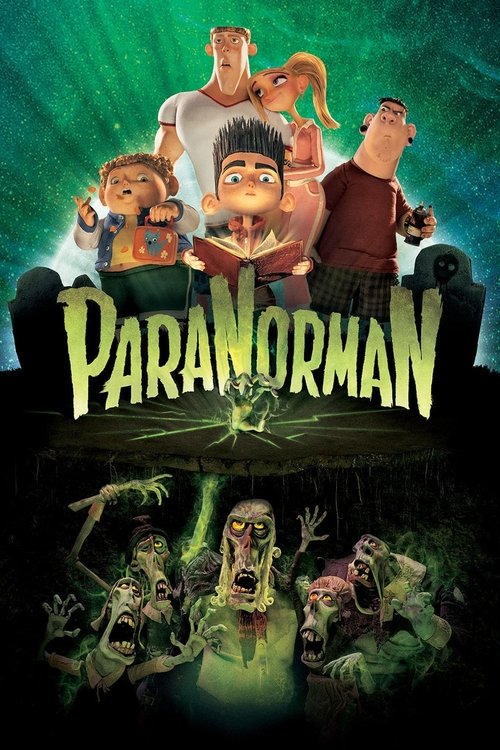
ParaNorman
2012 · Sam Fell
The perfect family Halloween pick: when you want something spooky you can watch with kids that won't insult the adults in the room. Comforting on the surface, with enough substance to chew on after.
What it's about
In the New England town of Blithe Hollow, eleven-year-old Norman can see and speak with the dead — a gift that makes him an outcast at school and an embarrassment at home. The town has built its whole tourist identity on a witch executed three centuries ago, and when her curse stirs back to life, Norman is the only one who can perform the ritual to stop it. What begins as a kids-versus-zombies romp turns into a story about mob fear and the people a town chooses to cast out.
The experience
Funny, spooky, and surprisingly moving — it plays like a Halloween adventure for the first half, then sneaks up on you with real emotional weight. The scares are kid-calibrated but the themes land hard at any age, and it earns a lump in the throat by the end.
The craft
Laika's stop-motion is extraordinary — hand-built sets, puppets with 3D-printed faces allowing thousands of expressions, and a tactile, handmade texture no computer animation replicates. The design lovingly channels 1970s–80s horror, from grindhouse zombies to synth-flavored atmosphere, and the detail genuinely rewards a big screen where you can see every fingerprint-level choice.
Why it matters
It cemented Laika as the studio proving stop-motion could carry serious themes in family entertainment, and it's become a modern Halloween perennial praised for treating young audiences as capable of handling darkness and empathy.
Snapshot
ParaNorman is a stop-motion feature from the Oregon studio Laika. It is a children's horror-comedy with an unusually serious moral core. Sam Fell and Chris Butler co-directed it, and Butler wrote the screenplay. Norman Babcock is an eleven-year-old outcast in the New England town of Blithe Hollow who can see and talk to the dead. The town has built its tourist identity on the story of a witch executed three centuries earlier. When her curse returns, Norman finds that both the "monsters" and the town's version of its own history are not what they seem. The film starts as an affectionate homage to 1970s and 1980s horror: grindhouse zombie pictures, John Carpenter, and the Amblin-style kids'-gang adventure. It then turns into a story about persecution, mob fear, and empathy for the person who has been cast out.
It was Laika's second feature after Coraline (2009). Technically it is a landmark because it was the first stop-motion feature to make its replacement faces with full-colour 3D printing. It was nominated for the Academy Award for Best Animated Feature. It is often remembered for a late, casual line that reveals a supporting character is gay, which was rare for a mainstream American family animation at the time.
Industry & production
Laika grew out of Will Vinton Studios in Portland, Oregon, after Nike co-founder Phil Knight acquired the company in the early 2000s. His son Travis Knight became the creative and later corporate leader of the studio's animation division. Laika's feature strategy was built around stop-motion, a costly, slow, artisanal medium that few American studios still used. Its first feature, Henry Selick's Coraline, showed the studio could make prestige stop-motion with commercial reach. ParaNorman was the test of whether Laika could keep going as a feature studio without Selick.
The project began with Chris Butler, a British storyboard artist who had worked on Corpse Bride (2005) and Coraline. He developed the story over a long period. Sam Fell joined as co-director. He brought feature-directing experience from Flushed Away (2006, Aardman/DreamWorks, co-directed with David Bowers) and The Tale of Despereaux (2008, co-directed with Robert Stevenhagen). Arianne Sutner and Travis Knight produced, and Focus Features distributed in the United States, as it had Coraline. The film opened in August 2012.
Production took place on Laika's stages in Hillsboro, Oregon. As usual in stop-motion, many animators worked at once on dozens of separate sets, each producing only a few seconds of finished footage per week. The film did reasonable business against a competitive slate but was not a breakout hit. That pattern of critical esteem, awards attention, and modest theatrical returns has defined Laika's reputation ever since.
Technology
ParaNorman's main technical contribution is in replacement animation for faces. Stop-motion studios have long animated faces by swapping in sculpted heads or mouths. Coraline had used 3D-printed replacement faces, but they were printed in monochrome resin and painted by hand. For ParaNorman, Laika's rapid-prototyping department adopted colour powder-based 3D printers. Faces could now be designed digitally, including skin tones, blush, and freckles, and printed in colour. That meant facial performances could be planned in software and then made physical as thousands of individual pieces. The result was a range of subtle expression, especially for Norman, that earlier stop-motion could not easily achieve. Contemporary coverage reported very large numbers of possible facial combinations for the lead. I won't cite exact figures here because they vary between sources.
The printed parts had real drawbacks. Colour-powder prints were fragile and had to be infused with a hardening agent. Consistency between print batches was a constant problem, and the faces showed visible seam lines where upper and lower halves met, which had to be painted out digitally. Laika kept refining the process in later films, and its rapid-prototyping work became part of its public identity. The studio's work in this area was later recognised with a Scientific and Engineering Academy Award.
The film was shot in stereoscopic 3D on digital still cameras mounted on motion-control rigs. Most sources name Canon DSLR bodies. Digital compositing was used heavily: to remove rigs and seam lines, extend sets, multiply crowds, and add effects such as the supernatural storm in the climax. ParaNorman is therefore a hybrid. It is physical stop-motion at its core, with substantial digital work around it. Laika has consistently defended this approach as an extension of the craft rather than a dilution of it.
Technique
Cinematography
Tristan Oliver was director of photography. He had shot Aardman's Wallace & Gromit features and Wes Anderson's Fantastic Mr. Fox (2009), so he was one of the most experienced cinematographers in miniature photography. ParaNorman has a warm, autumnal palette of rusts, ochres, and sickly greens, set against the cold blues and violets of night scenes. The film borrows freely from live-action horror. It uses low-angle wide shots, ominous push-ins, and silhouettes against moonlit skies. The opening is a pastiche of a scratched, colour-shifted grindhouse print, and it establishes the film's fondness for the textures of exploitation cinema.
The climax changes visual register completely. Norman enters a storm-world where Aggie's rage makes the forest and sky tear apart. The image becomes abstract and luminous, built from crackling light, swirling vortices, and a giant, flickering face of the witch. This is the most digitally augmented passage in the film, and it is deliberately unlike the tactile world before it.
Editing
Christopher Murrie edited the film. In stop-motion most editorial decisions are made at the storyboard and animatic stage, before animation begins, because reshooting is so expensive. The cutting here follows the rhythm of the genre it is quoting. There are comic deflations after jump scares and fast cross-cutting in the zombie chase and town-hall siege. The pacing slows notably in the final confrontation, where the film gives long, unhurried beats to dialogue between Norman and Aggie. That slowing is a structural choice that marks the move from comedy to tragedy.
Mise-en-scène / staging
Blithe Hollow is designed as a caricature of New England heritage tourism. Its shops, statues, and pageants commercialise the town's witch legend, much as Salem, Massachusetts, has done with its own history. The production design is deliberately lopsided and imperfect. Buildings sag, and characters have exaggerated bodies, uneven teeth, and blemished skin, all of which the colour-printed faces could render precisely. Heidi Smith's character designs move away from conventional attractiveness on purpose. Norman's tall, spiky hair, a silhouette that recalls an exclamation mark or a fright-wig, is the defining image of the character.
The staging also uses its genre references directly. Norman's bedroom is full of horror merchandise, his ringtone quotes the Halloween theme, and the zombie siege of the town hall echoes the barricade scenes of George A. Romero.
Sound
Jon Brion composed the score. He is best known for his work with Paul Thomas Anderson and Michel Gondry, and ParaNorman was a rare animated assignment for him. The score mixes orchestral writing with analogue synthesiser textures that recall 1970s–80s horror scoring, especially Carpenter's minimalist synth themes and Italian horror's prog-rock influences, along with choral passages for the supernatural material. In the climax, the music becomes more elegiac. The sound design has to cover both the comic and the frightening registers, and it supplies most of the scale in the storm sequence.
Performance
The voice cast was assembled with an ear for naturalism rather than celebrity personality. Kodi Smit-McPhee voices Norman with a restrained, slightly withdrawn delivery. Tucker Albrizzi plays Neil, Norman's guileless and bullied friend. The supporting cast includes Anna Kendrick (Norman's sister Courtney), Casey Affleck (Neil's brother Mitch), Christopher Mintz-Plasse (the bully Alvin), Leslie Mann and Jeff Garlin (Norman's parents), Elaine Stritch (Norman's ghostly grandmother), John Goodman (Uncle Prenderghast), Bernard Hill (Judge Hopkins), and Jodelle Ferland (Aggie).
Much of the performance credit belongs to the animators. The film's acting is notable for small gestures: shrugs, hesitations, sidelong glances, which the replacement-face system made possible. Ferland's performance as Aggie is central to the film's tonal shift. The voice of the dreaded witch turns out to be a frightened, furious child.
Narrative & dramatic mode
Structurally the film follows the outsider-child adventure. A misunderstood hero inherits a supernatural duty, gathers an unlikely team (sister, best friend, jock, and bully), and faces a threat the adults cannot see. Its dramatic interest lies in a series of reversals. The zombies who rise from the graveyard turn out to be the Puritan elders who condemned Aggie. They are not predators. They are guilt-ridden ghosts who want to make amends, and the modern townsfolk, turned into a torch-carrying mob, become the real threat. The witch herself turns out to be a little girl executed for having the same gift as Norman.
The film moves from parody to sincerity. It opens in a register of genre jokes and gradually takes away their protection, ending with a quiet, sad climax in which Norman does not defeat Aggie but comforts her. Monster-hunting turns into bearing witness. This turn from spectacle to compassion is the film's most discussed narrative choice.
Genre & cycle
ParaNorman combines several traditions:
- The children's horror film and the "kids on bikes" adventure, in the line of The Monster Squad (1987), The Goonies (1985), and Amblin productions generally. Butler cited John Hughes and the Amblin cycle as touchstones in interviews.
- The zombie film, especially Romero's Night of the Living Dead (1968) and its siege structure, as well as the cheap, lurid Italian and American zombie films of the 1970s and 80s that the opening parodies.
- Witch-trial and folk-horror narratives, bringing in the cultural memory of Salem.
- Gothic stop-motion, the tradition of Tim Burton–produced work (The Nightmare Before Christmas, Corpse Bride) and Selick's Coraline, which Laika had inherited.
The film also belongs to a notable cluster of 2012 monster-themed animated releases, alongside Burton's Frankenweenie (stop-motion, Disney) and Sony's Hotel Transylvania (CG). Critics often discussed the three together. ParaNorman was generally seen as the darkest and most morally serious of them.
Authorship & method
Authorship is shared. Sam Fell brought experience in managing large animated productions and comic timing developed at Aardman. Chris Butler wrote the screenplay, and the film's thematic concerns are generally attributed to his long development of the story: bullying, the scapegoated outsider, and the town's self-mythologising. Butler later wrote and directed Laika's Missing Link (2019) alone, which won the Golden Globe for Best Animated Feature. That has encouraged critics to read ParaNorman partly as an early statement of his sensibility.
Key collaborators:
- Tristan Oliver (director of photography): miniature cinematography with a live-action horror vocabulary.
- Jon Brion (composer): a synth-and-orchestra score that recalls genre history.
- Christopher Murrie (editor): comic and suspense pacing within stop-motion's pre-planned editorial process.
- Travis Knight and Arianne Sutner (producers): Knight also worked as a lead animator, as he had on Coraline, and later directed Kubo and the Two Strings (2016).
- Heidi Smith (character designer) and Laika's art department led by production designer Nelson Lowry. Their deliberately "ugly" designs are a signature of the film.
Laika's method combines handmade puppetry with industrial-scale digital fabrication. That mix of artisanal labour and technological R&D is as much part of the film's authorship as any individual credit.
Movement / national cinema
ParaNorman is an American studio film, but it sits in an international stop-motion tradition. Its lineage includes Ray Harryhausen and the Rankin/Bass specials on one side, and British studio stop-motion on the other. The latter influence comes through Aardman, Fell, and Oliver, and through the British crew members who have long been central to the craft. Laika itself positioned itself as an independent alternative to the dominant CG studios (Pixar, DreamWorks, Blue Sky, Illumination). It was privately funded and committed to a medium those studios had largely left behind. Its location in the Pacific Northwest, away from Los Angeles, was part of its identity as an outsider studio, which matches the film's own outsider sympathies.
Era / period
The film came out at the height of digital 3D theatrical exhibition after Avatar (2009) and was released in stereoscopic 3D. Animation in this period was dominated by CG features aimed at the widest possible family audience. ParaNorman's mix of real scares, profanity-adjacent humour, and dark subject matter earned a PG rating and some debate about its suitability for young children. It was also part of a wider early-2010s revival of 1980s genre nostalgia that would later appear in Super 8 (2011) and, above all, the television series Stranger Things (2016–).
Culturally, the film appeared during increased public attention to anti-bullying campaigns. Its revelation that Mitch has a boyfriend came at a moment when LGBTQ representation in children's media was being actively argued over. The moment was praised by advocacy groups and drew some complaints from conservative commentators. It is frequently cited as one of the first explicitly gay characters in a wide-release American animated feature.
Themes
- Fear of the other and the scapegoat. The film's central argument is that communities create monsters out of what they fear and do not understand. Aggie was killed for being different, Norman is ostracised for the same reason, and the modern mob repeats the Puritan crime.
- Bullying and cycles of cruelty. Bullying occurs at every level, from schoolyard torment to judicial murder. The film treats them as versions of the same impulse, and it rejects revenge as a response, including Aggie's revenge.
- Memory, history, and heritage. Blithe Hollow profits from a sanitised witch legend, turning an atrocity into kitsch. The film criticises the commercialisation of historical violence and argues for honest remembrance.
- Death and grief. Norman's easy conversations with his dead grandmother present the dead as part of everyday life. The film treats mourning and letting go with unusual gentleness for the genre.
- Empathy as heroism. The resolution is not a battle but an act of listening. Norman wins by recognising himself in his enemy.
- Genre love as identity. Norman's horror fandom is both a sign of his isolation and the source of his ability to cope. The film affirms the outsider value of genre culture.
Reception, canon & influence
Critical reception. Reviews were broadly positive. Critics praised the craftsmanship, the expressive faces, the affectionate genre parody, and particularly the emotional seriousness of the final act. Some reviewers found the middle stretch busy or the tone uneven, and others questioned whether the scares and themes were too intense for younger children. The film was nominated for the Academy Award for Best Animated Feature (lost to Pixar's Brave) and received multiple Annie Award nominations and BAFTA recognition. Its box office was respectable rather than spectacular. Over time its reputation has grown, and it is now regularly included in lists of essential Halloween family viewing and in discussions of modern horror for children.
Influences on the film (backward). These include Romero's zombie films and the siege structure of Night of the Living Dead; John Carpenter, quoted directly through the Halloween theme and echoed in the score; 1970s–80s grindhouse and Italian horror, parodied in the opening; Amblin and John Hughes youth films and The Monster Squad; Scooby-Doo-style mystery-gang conventions; the history and legend of the Salem witch trials; and the gothic stop-motion tradition of Burton and Selick, especially Coraline.
Legacy (forward). Industrially, ParaNorman established Laika as a continuing feature studio rather than a one-film company. Its colour 3D-printing pipeline became the basis for the studio's later films: The Boxtrolls (2014), Kubo and the Two Strings (2016), Missing Link (2019), and Wildwood. Each extended the fusion of physical puppetry and digital fabrication, and the technique has influenced stop-motion production more widely. Thematically, the film helped show that family animation could handle persecution, death, and moral complexity without a reassuring villain. Its sympathetic recasting of the monster as a victim anticipates later family films and series about misunderstood outsiders. Its 1980s-horror nostalgia was an early example of a sensibility that became mainstream with Stranger Things. The Mitch reveal is a standard reference point in histories of LGBTQ representation in American animation. Direct lines of influence on specific later works are harder to document, and claims beyond Laika's own output should be treated as affinities rather than established lineage.
Influences: the films it descends from and the films it influenced
- Night of the Living Dead (1968) — ParaNorman's third act copies Romero's siege setup: a mixed group is trapped in a public building while the dead close in. It then reverses Romero's anti-mob ending, so the townspeople outside become the real threat.
- Halloween (1978) — The film quotes Carpenter's 5/4 piano motif outright, and Jon Brion's pulsing analog-synth beds over orchestra are built on Carpenter's self-scored minimalism.
- Witchfinder General (1968) — The Aggie flashback uses the folk-horror witch-trial scene of Reeves's film, where Puritan elders condemn a victim in a rural court, and makes that persecution the film's real source of horror.
- Gremlins (1984) — Dante's Amblin model of horror pitched at children, with real scares and gore played as slapstick in a satirised small town, sets ParaNorman's tone of comic menace.
- The Goonies (1985) — ParaNorman takes its bickering mismatched kid-and-sibling ensemble from Donner's Amblin film, with overlapping dialogue and a misfit gang drawn into a local legend's buried history.
- The Monster Squad (1987) — Dekker's horror-literate kids'-gang film, in which children armed with genre knowledge face monsters the adults won't believe in, is the template for Norman's crew and its knowing in-jokes.
- The Nightmare Before Christmas (1993) — Selick's hand-sculpted library of hundreds of swappable heads for Jack Skellington set up the replacement-face system that Laika later industrialised with 3D printing.
- Wallace & Gromit: The Curse of the Were-Rabbit (2005) — Tristan Oliver's cinematography here first put a Hammer and Universal horror lighting vocabulary (fog, moonlit silhouettes, monster-reveal compositions) into miniature, the approach he took to ParaNorman.
- Monster House (2006) — This Amblin-produced animated suburban horror film had a trio of kids uncover a monster that turns out to be a grieving victim, the same switch from parody to sympathy that ParaNorman's climax makes.
- Coraline (2009) — Laika's first feature pioneered rapid-prototyped replacement faces, printed in monochrome and hand-painted, with Travis Knight as lead animator. ParaNorman extended the pipeline to full-colour printed faces.
- Fantastic Mr. Fox (2009) — Tristan Oliver shot this film frame by frame on digital SLR stills cameras under motion control, a workflow he carried straight into ParaNorman's stereoscopic DSLR rigs.
- Beetlejuice (1988) — Laika stop-motion that fuses kid-protagonist ghost comedy with affectionate horror pastiche, a direct heir to the morbid-whimsical template.
- The Boxtrolls (2014) — Laika scaled up ParaNorman's colour 3D-printed face pipeline and its deliberately grotesque, asymmetric character design for an ensemble of misunderstood 'monsters' persecuted by the townspeople.
- Kubo and the Two Strings (2016) — ParaNorman's producer and lead animator made his directing debut here, pushing its mix of stop-motion and digital work to giant practical puppets with CG extensions and finer printed-face micro-expressions.
- Isle of Dogs (2018) — Tristan Oliver again shot puppet animation on stills-camera motion-control rigs, refining the single-frame DSLR lighting control he developed on ParaNorman.
- Missing Link (2019) — ParaNorman's writer and co-director returned to the sympathetic outsider-creature and carried the colour-printed face libraries to Laika's largest scale yet, more than 100,000 faces in total.
- Wendell & Wild (2022) — Selick's stop-motion horror-comedy uses split replacement faces in the line ParaNorman established, alongside a satire of a decaying town's institutions and undead raised from a cemetery.
- Nimona (2023) — Templated the monster-as-misunderstood-outsider plot driven by mob/institutional persecution, and slipped in mainstream animation's first openly gay character — the queer-coded othering Nimona makes central.
- Frankenweenie (2012) — Released the same autumn, this black-and-white stop-motion pastiche of Universal and Hammer horror also builds to a climax where the frightened townsfolk, not the reanimated creature, become the danger.
- Scooby-Doo on Zombie Island (1998) — Aims kids' comedy-horror at genuinely melancholic, sympathetic zombies who are wronged victims rather than villains — the same pathos-for-the-undead move Zombie Island makes with its cursed cat-cult harvest.
- Guillermo del Toro's Pinocchio (2022) — Advanced the full-color 3D-printed replacement-face system for stop-motion, a direct sibling in the printed-facial-library technical lineage.
Similar films
- Kubo and the Two Strings (2016) — influence & lineage · often watched together
- Coraline (2009) — influence & lineage
- The Nightmare Before Christmas (1993) — influence & lineage
- Halloween (1978) — influence & lineage
- Wallace & Gromit: The Curse of the Were-Rabbit (2005) — influence & lineage
- Cobweb (2023) — shared sensibility
- Guillermo del Toro's Pinocchio (2022) — shared sensibility
- Trick 'r Treat (2007) — shared sensibility