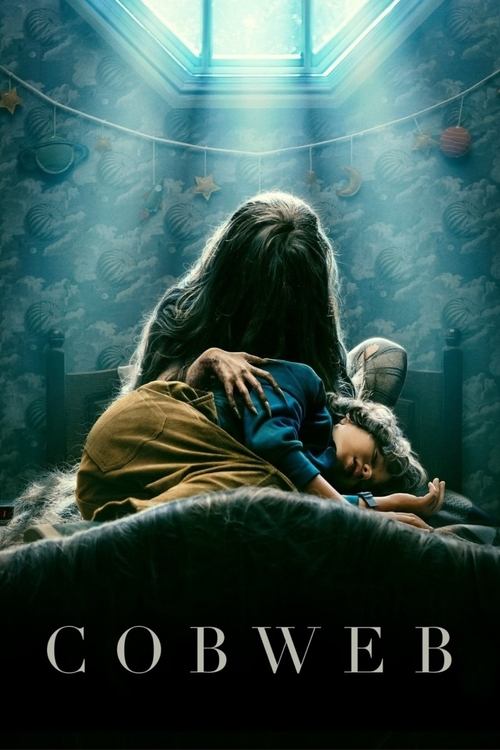
Cobweb
2023 · Samuel Bodin
For a Halloween night when you want something wicked and fast — ninety minutes of storybook creepiness that turns savage. More fun-scary than traumatizing, ideal with the lights off and candy in reach.
What it's about
Eight-year-old Peter lives in a decaying farmhouse where a tapping has started inside his bedroom wall — then the tapping becomes a voice. His parents insist it's his imagination, but the voice offers him company, advice, even help with the bullies at school, and Peter begins to wonder whether the real danger is the thing in the wall or the people tucking him in at night. It all comes to a head in the days before Halloween.
The experience
A dread-soaked dark fairy tale that keeps you guessing who to trust, then drops the floor out and becomes a full-throttle creature horror in its final stretch. Short, nasty, and efficient — it doesn't overstay its welcome.
Performances
Lizzy Caplan and Antony Starr are superbly unnerving as the parents, pitching every smile just wrong enough that you can't tell protective from sinister, while young Woody Norman holds the center with a believable, frightened stillness.
The craft
French director Samuel Bodin, making his feature debut after the series Marianne, shoots the house like a Grimm illustration — rotting wallpaper, pumpkin light, shadows with too much depth. The sound design of the tapping and whispering is the engine of the film and rewards good speakers.
Why it matters
A compact calling card that announced Bodin as a horror stylist to watch and found an appreciative audience among fans of mean little Halloween-set chillers.
Snapshot
Cobweb is a compact American horror film, roughly ninety minutes long, about Peter (Woody Norman), an eight-year-old boy in a decaying farmhouse on the edge of a small town. He hears tapping, and then a voice, coming from inside his bedroom wall. His parents, Carol (Lizzy Caplan) and Mark (Antony Starr), insist it is his imagination. Over the days before Halloween, the voice offers Peter companionship and advice, including about the bullies at school. Peter's new substitute teacher, Miss Devine (Cleopatra Coleman), begins to suspect the home is not safe. The film moves from a dread-filled domestic fairy tale to an explicit creature-and-siege horror film in its last act. It was the feature debut of French director Samuel Bodin, best known for the Netflix series Marianne (2019). It was written by Chris Thomas Devlin and released by Lionsgate in July 2023. It is a modest, uneven, often striking film. Its main interest for an atlas of influence lies in how openly it reworks earlier "secret in the house" horror, especially Wes Craven's The People Under the Stairs (1991), through a European art-horror eye for texture and framing.
Industry & production
Cobweb came out of the mid-budget American genre system that grew up around studio-adjacent producers in the 2010s. The producers were Seth Rogen, Evan Goldberg and James Weaver of Point Grey Pictures, together with Roy Lee's Vertigo Entertainment. Lee had a long record in horror from the American remakes of The Ring and The Grudge through the two It films. Lionsgate distributed the film in the United States. Point Grey is chiefly a comedy company, and its move into straight horror was part of a wider pattern of comedy-rooted producers backing the genre after the success of Get Out (2017). The available record does not document how far the producers shaped the film creatively.
Chris Thomas Devlin's script had circulated as a spec project before it went into production. Devlin's other produced credit is the Netflix legacy sequel Texas Chainsaw Massacre (2022). Hiring Bodin followed a familiar industry route: a European director with a successful genre series or feature is recruited for an English-language studio project. Reports indicate the film was shot largely in Bulgaria, a common low-cost base for American genre production. Detailed production documentation is thin, however, and that location should be treated as reported rather than fully confirmed.
Lionsgate released Cobweb theatrically on 21 July 2023, the same weekend as Barbie and Oppenheimer. That placement nearly guaranteed it would draw little attention. It moved quickly to premium video-on-demand, and like many mid-budget horror films of its period it found most of its audience in home viewing and later streaming. Reliable box-office figures are not something this dossier can confirm, so none are given.
Technology
Nothing about the film's technology is new. It is a digitally shot, digitally finished production of its time. The relevant points are craft decisions. The film relies on practical sets for the house's interiors and crawlspaces, with dark, low-key lighting that depends on modern digital sensors performing well in low light. The creature in the final act combines a physical performer, prosthetics and makeup with digital augmentation. That hybrid approach was standard practice in early-2020s horror, and Cobweb stands with films like Barbarian (2022) in keeping its monster mostly hidden until late, when the effects work has to carry the reveal. The available record does not say much about cameras, lenses or effects vendors.
Technique
Cinematography
The cinematographer is Philip Lozano, who also shot Marianne. The lighting is a palette of sickly ambers, deep browns and bruise-like shadow. The house looks as if it is slowly decomposing. Peter's room is often lit by a single warm source that leaves the corners and the wall itself in darkness, so the wall becomes the frame's centre of attention even when nothing is moving. Exteriors are full of Halloween iconography: a field of rotting pumpkins, overcast autumn skies and a cut-out, storybook flatness. Bodin and Lozano often frame Peter small within doorways and corridors, which makes the adults and the architecture loom over him. This child's-eye scale owes something to Spielbergian suburban fantasy, and more to the deliberately artificial fairy-tale compositions of European genre cinema.
Editing
Credits for the film's editing are not well documented in the sources available here, so the editor is not named. In the first two acts the cutting is patient. Scenes are allowed to settle into silence before the tapping returns, and the shock moments are rationed. Bodin's skill in Marianne at the timed jump scare carries over. The last act speeds up sharply into crosscutting violence. Many reviewers felt that change in tempo as a break in the film's texture, rather than a gradual build.
Mise-en-scène / staging
The house is the film's most developed character. Its peeling wallpaper, warped floors, a locked basement and a hatch into the walls make up a Gothic geography of hidden spaces. The wall is staged as a membrane between the official family and the hidden one. The film keeps returning to Peter lying in bed with his ear pressed to the plaster, a striking image of a child listening for the truth his parents deny. The Halloween setting is not just decoration. Pumpkins, costumes and the town's memory of children who vanished on a past Halloween tie the domestic horror to communal ritual and a buried local crime. The parents' staging is significant too. Caplan and Starr are often blocked as a unit, standing in doorways or at the end of the dinner table, which presents them as a single wall of authority.
Sound
Sound is the film's central dramatic tool. The plot begins with an acoustic event, a tapping, and the first half is built on the ambiguity of noises heard through walls. The score is by Drum & Lace, the composer Sofia Hultquist, whose other work includes Ghosts of War (2020). It favours textures and drones over melodic themes and leaves space for the diegetic creaks and knocks. The voice in the wall begins as a whisper and slowly gains character, and its sound mixing is designed to sit uneasily between inside and outside Peter's head, at least until the film settles the question.
Performance
Woody Norman, praised for C'mon C'mon (2021), plays Peter with a watchful restraint that avoids precociousness. Lizzy Caplan is the film's most discussed performer. Her Carol is brittle and smiling, and her mothering is hard to tell apart from captivity. Reviewers repeatedly singled out the performance for its unsettling falseness. Antony Starr, widely known as Homelander in The Boys, plays Mark as quietly menacing, with a coiled physical threat behind a mild surface. Cleopatra Coleman's Miss Devine is the film's outside conscience. The part is largely functional in the script, but she gives it warmth.
Narrative & dramatic mode
Cobweb is built as a two-part fable. The first and longer movement is an epistemological horror story. Is the voice real? Are the parents protecting Peter or hiding something? Can a child's perception be trusted against adult denial? This mode descends from The Turn of the Screw and from the "gaslit child" strand of horror. The second movement resolves the uncertainty into literal fact. The thing in the walls is real, it is connected to the parents' secret and to the town's past, and its release turns the climax into a home-invasion-in-reverse: the danger comes out of the house rather than into it.
The script's fairy-tale logic is explicit. There are monstrous parents, a sealed-off child, a good stranger who sees what others won't, and a child hero who has to pass through terror. Hansel and Gretel and Bluebeard's forbidden room are the obvious archetypes. The film's critical fault line is how cleanly it gives up ambiguity for spectacle. Defenders read the turn as the fable's necessary payoff. Detractors saw a promising psychological film collapsing into a routine creature film.
Genre & cycle
The film sits where several strands meet:
- The Halloween-set horror film, from Halloween (1978) to Trick 'r Treat (2007). The holiday setting supplies both iconography and a backstory of children who disappeared.
- The "hidden family member" Gothic, with roots in Jane Eyre's attic. In film this runs through The People Under the Stairs (1991), in which monstrous guardians hold children captive within the walls of a house, and through Mama (2013).
- The early-2020s cycle of "something in the house's hidden spaces" films, notably Barbarian (2022), with its hidden tunnels beneath a rental house, and Skinamarink (2022/23), the experimental film about children and a house that is reshaping itself. Cobweb arrived in the same commercial year as The Boogeyman (2023), another child-centred, studio-distributed horror film about a monster in a child's dark spaces.
- The child-in-peril / unreliable-parents film, with Run (2020) and the broader post-Hereditary (2018) wave of horror about family as a site of inherited trauma.
Authorship & method
Samuel Bodin (director) is a French filmmaker. His reputation came from Marianne, a Netflix horror series that drew a strong following for its frightening set pieces and its grotesque possessed-old-woman performance. Cobweb shows the same signatures: an interest in childhood fears turned into folklore, a liking for grotesque faces and bodies used sparingly, and a tightly controlled jump-scare grammar. It is a work-for-hire on someone else's script, and how far Bodin shaped the final cut is not well documented. The film's visual coherence nonetheless points to a strong directorial hand.
Chris Thomas Devlin (writer) wrote a script that strips the setting down to a single house, a schoolroom and a town, and gives the central mystery a stark premise. Its turn into slasher-style violence in the last act is consistent with his work on Texas Chainsaw Massacre (2022).
Philip Lozano (cinematographer) carried over his partnership with Bodin from Marianne, and the decaying, amber-dark look of the film is the most consistent link between the two works.
Drum & Lace / Sofia Hultquist (composer) supplies a texture-based score in line with contemporary horror's turn from orchestral stingers toward ambient electronic and processed-acoustic sound design.
Producers: Point Grey (Rogen, Goldberg, Weaver) and Vertigo (Roy Lee). Lee's involvement places the film within a producer lineage that has shaped mainstream American horror for two decades.
Movement / national cinema
Cobweb is an American studio-distributed film, but its authorship belongs to a recognisable route by which French genre directors have moved into English-language horror. Before Bodin, the route was taken by Alexandre Aja (Haute Tension to The Hills Have Eyes and Crawl), Pascal Laugier (Martyrs to The Tall Man and Incident in a Ghost Land), and Julien Maury and Alexandre Bustillo (À l'intérieur to Leatherface). Those directors arrived after the "New French Extremity" in feature film. Bodin's route came instead through the streaming-era series, which reflects how Netflix's international originals became a talent pipeline in the late 2010s. The film's look, with its fairy-tale artificiality, painterly decay and grotesque bodies, reads as European, while its plot mechanics and third-act payoff are recognisably American.
Era / period
The film belongs to the post-pandemic horror market of 2021–2023. Horror was one of the few genres that reliably drew theatrical audiences, but mid-budget films faced short theatrical windows and a quick move to PVOD and streaming. Its release against Barbie and Oppenheimer is a small case study in how such films were scheduled as counter-programming and then absorbed into home viewing. Thematically, it shares the period's concern with the family as a container of secret trauma. That preoccupation runs through the "elevated horror" discourse of Hereditary, The Babadook (2014) and Relic (2020), although Cobweb ultimately resolves into a more traditional genre entertainment.
Themes
- Parental gaslighting and the child's perception. The core drama is a child told that what he hears is not real. The film dramatises the vulnerability of children whose reality is defined by adults, and the moral weight of believing them.
- The family secret as architecture. The literal hidden space in the walls makes concrete the idea that families build structures to contain what they cannot acknowledge.
- Captivity disguised as care. Carol and Mark's protectiveness can't be told apart from imprisonment, and the film keeps blurring nurture and control.
- Monstrous kinship. The voice in the wall is a companion, a tempter and a mirror. It speaks to Peter's anger at bullies and his isolation, and raises the question of what is inherited and what is chosen.
- Communal memory and ritual. Halloween links the house's secret to the town's history of children who vanished, suggesting that private horrors have public consequences.
Reception, canon & influence
Critical reception. Reviews were mixed to moderately positive. Critics generally praised Bodin's atmosphere and visual design, Lozano's cinematography, and especially Lizzy Caplan's unnerving performance, along with Norman's and Starr's. The most common objection was the third act. Many reviewers felt the move to an explicit monster and widespread carnage threw away the ambiguity and slow-burn tension of the first hour. Others accepted it as a gleefully nasty fairy-tale climax. The film was not treated as a major release. Its theatrical run was short and drew little notice, and its reputation was formed mainly through home viewing and genre-press coverage. This dossier does not cite specific aggregate scores or grosses, because the figures cannot be verified here.
Influences on the film (backward).
- The People Under the Stairs (Wes Craven, 1991) is the clearest ancestor. It has monstrous guardians, children hidden inside a house's walls, and a child hero who learns the domestic order is a prison.
- The Turn of the Screw and its film adaptation The Innocents (Jack Clayton, 1961) supply the template of the uncertain presence perceived through a child.
- Halloween (John Carpenter, 1978) and Trick 'r Treat (Michael Dougherty, 2007) supply the small-town holiday setting and its buried history of violence against or by children.
- Mama (Andrés Muschietti, 2013) and Lights Out (David F. Sandberg, 2016), both of which also came from producer-driven studio horror, share the model of a feral or spectral being tied to a family's hidden history, revealed through a child's fear.
- The Night of the Hunter (Charles Laughton, 1955) is a more distant influence on its storybook style and its image of the threatening parent.
- Bodin's own Marianne (2019) is the immediate stylistic source.
Legacy (forward). The record is genuinely thin on any measurable influence, as is usual for a modestly released film only a few years old. Cobweb has not become a canonical title or launched a cycle of its own. Its significance is mostly as a representative work. It documents the 2022–23 wave of "hidden spaces in the house" horror alongside Barbarian and Skinamarink. It also documents the streaming-series-to-studio-feature route for European genre directors, and it is a reference point in Lizzy Caplan's turn toward darker roles (she went on to star in the series Fatal Attraction, released in spring 2023 before the film). Among horror audiences it has a modest following as a seasonal Halloween watch, valued for its atmosphere and imagery more than its resolution. Whether it gains a cult reputation, as Trick 'r Treat did after its own neglected release, cannot yet be judged.
Influences: the films it descends from and the films it influenced
- The People Under the Stairs (1991) — Gives Cobweb its main structure: a house whose walls hide imprisoned children, guarded by monstrous 'parents', and a child hero who finds his way through the hidden spaces between the rooms.
- The Innocents (1961) — Its method of making a presence uncertain by filtering it through a child's perception, with offscreen whispers and voices that cannot be placed, is what Cobweb uses for the voice in Peter's wall during its first hour.
- The Night of the Hunter (1955) — Its storybook expressionism, with stylized silhouettes and a child's-eye frame, sets a smiling parent-figure as the predator, the same fairy-tale grammar Cobweb uses to frame its mother and father.
- Halloween (1978) — Established the small-town Halloween setting, with its pumpkin-lit suburban streets and a buried act of violence by a child against his family, which Cobweb borrows wholesale for its town's history of a missing girl.
- Trick 'r Treat (2007) — Its Halloween as a punitive folk ritual, with children as victims and avengers and a candy-colored but nasty tone, anticipates Cobweb's gleefully cruel climax on the night itself.
- Flowers in the Attic (1987) — The gothic premise of children shut away inside the family home by adults who lie about their existence is the secret Cobweb's parents keep.
- Coraline (2009) — Its hidden passage in the wall leads to the realization that the child's parents are false and predatory; Cobweb stages the same dark-fairy-tale reversal in live action.
- Mama (2013) — The model for a feral, spider-limbed being tied to a family's hidden past and revealed in full only late, which is how Cobweb handles its crawling sister in the third act.
- Lights Out (2016) — Studio horror built on one simple rule and a creature bound to a mother's secret, and on a child's fear that adults dismiss, the model Cobweb follows.
- The Boy (2016) — An apparently supernatural presence turns out to be a real person who has lived inside the walls, and the film switches abruptly from slow ambiguity to physical violence; Cobweb copies the reveal and the change of pace.
- The Babadook (2014) — Its brittle, unravelling mother, its storybook visual design and a creature that may or may not be in the boy's head set the performance register Lizzy Caplan builds her character on.
- High Tension (2003) — The calling card that began the move of French genre directors into Hollywood, with its abrupt third-act turn into gory spectacle, the path and structural gamble Bodin's Cobweb follows.
- Bring Her Back (2025) — Builds on the gaslighting parent as the real horror: a foster mother hides a monstrous child in the house and controls what the children are allowed to believe.
- Weapons (2025) — Carries forward small-town horror centered on children in which adults' household authority becomes literal captivity, and a slow mystery breaks into gleeful, fairy-tale-grotesque violence.
- Barbarian (2022) — From the same 2022–23 cycle of horror about hidden spaces in a house: a hidden basement holds a captive, inbred 'mother' figure, and a deliberate break in pace upends the film's tone partway through.
- Skinamarink (2022) — From the same cycle: child's-eye framing at floor height and a voice without a visible source coming from the house's walls and dark doorways, pushed to an experimental extreme.
- The Boogeyman (2023) — A 2023 studio release that, like Cobweb, sets a child's terror of something in the dark of the house against adults who dismiss it, and ends by showing a fully embodied creature.
Similar films
- Coraline (2009) — influence & lineage
- Trick 'r Treat (2007) — influence & lineage
- The Babadook (2014) — influence & lineage
- Halloween (1978) — influence & lineage
- ParaNorman (2012) — shared sensibility
- Skinamarink (2023) — shared sensibility
- Hokum (2026) — shared sensibility
- Ghost Stories (2018) — shared sensibility