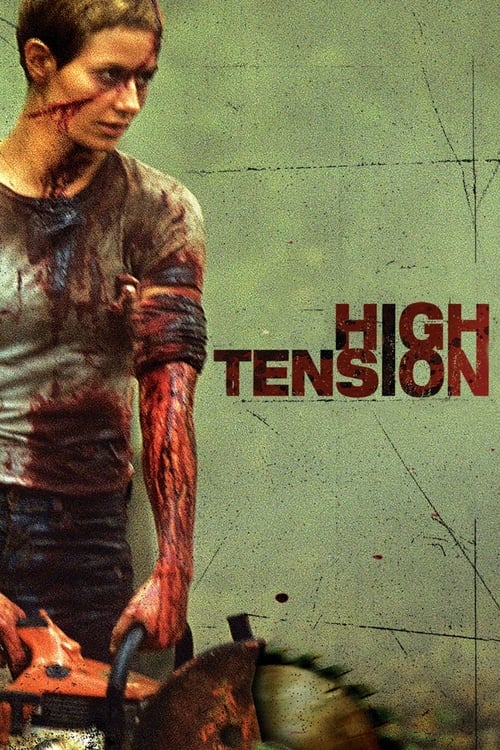
High Tension
2003 · Alexandre Aja
When you're craving pure adrenaline — a short, savage ride that keeps your pulse up the entire runtime. Strictly for strong stomachs; this is horror as endurance test, not atmosphere.
What it's about
University friends Marie and Alex drive out to Alex's family farmhouse in the French countryside for a quiet weekend of studying. On their first night, a hulking stranger arrives at the door, tears through the household with horrifying efficiency, and drives off with Alex captive in his van. Marie, unseen, stows away — and spends the rest of the night trying to free her friend without being found.
The experience
Almost unbearably tense from the first night onward — long stretches of held-breath hiding punctuated by some of the most ferocious practical gore of its era. It's lean, fast, and physical, with a final turn that flips everything and splits every audience that sees it.
Performances
Cécile de France is a powerhouse — wiry, watchful, and credible in every desperate physical beat — and Philippe Nahon makes the killer a wall of banal, grunting menace.
The craft
Alexandre Aja strips the film down to stalking, hiding, and pursuit, and sustains suspense with almost no dialogue for long passages. The practical effects are brutally tactile, the sound design makes every creak and engine idle a threat, and the whole thing is built to be watched loud, in the dark.
Why it matters
One of the founding films of the twenty-first-century French horror wave, it launched Aja to Hollywood and set the bar for how far mainstream-adjacent horror could push physical brutality.
Snapshot
Haute Tension (released in English-speaking markets as High Tension, and in the UK as Switchblade Romance) is a compact, brutal home-invasion and pursuit thriller. Its stripped-down narrative and the force of its practical gore made it one of the founding works of the twenty-first-century French horror revival. Two university friends, Marie (Cécile de France) and Alex (Maïwenn), travel to Alex's family farmhouse in the countryside to study. On their first night a hulking, unnamed killer (Philippe Nahon) arrives, slaughters Alex's family, and abducts Alex in his rusted delivery van. Marie, hidden and unseen, follows. Most of the film is an extended exercise in sustained suspense: hiding under beds, a stalking sequence in a gas station, and a chase through woods and along a highway. It then delivers a final-act twist, revealing that the killer and Marie are one and the same, a dissociated projection of her obsessive desire for Alex. That twist made the film notorious. Admirers read it as a daring reframing of what came before; detractors, most prominently Roger Ebert, took it as a logical cheat that undoes the narrative. Either way, the film announced Alexandre Aja and his co-writer Grégory Levasseur as major genre talents, gave Hollywood a ready template for "French horror," and became the usual starting point for the critical category later loosely called the New French Extremity.
Industry & production
The film was produced by Alexandre Films, the company of Aja's father, the director-producer Alexandre Arcady, with Robert Benmussa. EuropaCorp, Luc Besson's company, handled French distribution, and its involvement marked a moment when Besson's operation was actively backing commercially minded genre product aimed beyond the domestic market. Aja (born Alexandre Jouan-Arcady) had made one previous feature, the futuristic drama Furia (1999). He and Levasseur wrote Haute Tension as a deliberately lean, contained project that could be made on a modest budget. The precise figure is reported variously in secondary sources and is not reliably documented, so it is not given here.
Although the story is set in rural France, the film was shot largely in Romania. At the time Romania was an attractive, low-cost production base for European and American genre films, and the choice reflects the economics of mid-budget European horror in the early 2000s. The farmhouse, the cornfields and forest, and the gas station were assembled from Romanian locations and sets, dressed to read as provincial France.
The film premiered internationally in the Midnight Madness section of the Toronto International Film Festival in 2003, a showcase that was becoming a key launch pad for international horror. It was released in France that year. Its North American release came later, in 2005, through Lions Gate Films (with Maple Pictures in Canada). For that release the film was trimmed to earn an R rating rather than NC-17, and parts of it were redubbed so that some dialogue, especially in the opening and closing frame, played in English. The R-rated cut and the partial dubbing are frequently cited as examples of how foreign horror was reshaped for the American multiplex in that period. The unrated version later circulated on home video.
Technology
Haute Tension is a celluloid production of the last years before digital capture became routine in European genre filmmaking. Its most significant technological signature is its reliance on practical, prosthetic and mechanical makeup effects rather than digital augmentation. The effects were supervised by Giannetto De Rossi, the Italian makeup veteran best known for his work with Lucio Fulci, notably Zombi 2 (1979) and The Beyond (1981). Hiring De Rossi was an explicit act of genealogy: it tied the film's carnage to the handmade gore tradition of Italian horror in the late 1970s and early 1980s rather than to the CGI-enhanced American studio horror of the turn of the millennium. The decapitation, the slashing, and the climactic circular-saw violence were achieved with physical appliances, blood rigs and dummies, which gives the violence a tactile weight that became central to the film's reputation.
The image was graded toward a cold, desaturated palette of steely blues, greys and sickly greens, with deep, often crushed blacks. Commentators describe the effect as close to a bleach-bypass look, though the specific lab or grading process used is not well documented in accessible sources.
Technique
Cinematography
Maxime Alexandre, who became Aja's regular cinematographer, shoots the farmhouse nocturne with a disciplined economy. Much of the suspense in the central section depends on restricted sightlines: low angles from under a bed, partial views through slatted doors and banisters, shallow-focus close-ups of Marie's face while offscreen sound carries the threat. The camera often hugs Marie's position, aligning the viewer with her perceptual field. This choice is crucial to the twist, because the film has trained us to accept her vantage as objective. The farmhouse is lit in pools of low-key light against large areas of darkness. The exterior sequences, particularly the highway and forest chase, move to a greyer, washed-out daylight that keeps the film's chill. The killer is often framed in fragments (hands, boots, the van's interior, a silhouette) before he is shown whole, a strategy that both builds menace and, in retrospect, preserves the possibility of his unreality.
Editing
The film was edited by Baxter. Its rhythm alternates long stretches of near-silent, real-time suspense with abrupt bursts of violence, and the cutting is generally patient during the hide-and-seek passages, letting duration do the work. The opening and closing scenes frame the story: Marie appears in a clinical setting, observed through surveillance video, and this establishes a frame whose meaning is only clarified at the end. The final act re-presents earlier events, showing Marie in the killer's actions. The film's critics argue that this is where the editing cannot reconcile what we saw with what the twist claims. The most frequently cited inconsistencies involve scenes in which Marie and the killer appear simultaneously, and events (such as the van and the gas-station sequence) whose physical logic the revelation does not fully account for. Whether these are flaws or deliberate markers of subjective unreliability has been the central interpretive argument around the film.
Mise-en-scène / staging
The staging follows the long tradition of the farmhouse siege: an isolated home, a dark landscape, a single vehicle on a deserted road. Aja uses domestic space as a field of concealment. Beds, closets, bathrooms and staircases become hiding places and kill sites. The killer's van, filthy and cluttered, is a second, mobile interior, and the film's middle section turns it into a claustrophobic cell. The production design emphasizes rural grime: oil-stained floors, a weathered barn, the anonymous fluorescent interior of a gas station. The violence is staged in a frontal, unhurried way. The killings of Alex's father, mother and young brother are prolonged and specific, and the camera rarely cuts away at the moment of impact. The climactic confrontation, with Marie wielding a barbed-wire-wrapped fence post and the killer (or Marie-as-killer) wielding a concrete saw, reaches for the sheer physical excess of the American slasher and Italian splatter traditions.
Sound
François Eudes composed the score. It mixes pulsing electronic textures and drones with more conventional suspense cues, and it often recedes so that diegetic sound can carry the tension: creaking floors, breathing, the dull mechanical noise of the van, the hum of rural night. The soundtrack makes heavy use of pop music as diegetic or quasi-diegetic texture, including music heard through the killer's van stereo and through Marie's headphones. These moments are often noted for producing an ironic, unsettling counterpoint to the violence. The sound design is also strategic in the hiding scenes. The audience is placed in Marie's acoustic position, so that the killer's movements are known chiefly through what she hears.
Performance
Cécile de France, a Belgian actress who was then rising in French cinema (she won the César for Most Promising Actress for L'Auberge espagnole around this time), gives Marie a taut, physically committed intensity. She carries most of the film largely in silence, through watchfulness and exertion. Her cropped hair and androgynous presentation set Marie apart from Alex, and the film codes Marie's desire for her friend as queer from the opening scenes. This coding has been heavily criticized, because the twist pathologizes that desire. Maïwenn plays Alex, who spends much of the film bound and gagged. The role is necessarily limited, but she does register terror and, at the end, horror at Marie. Philippe Nahon, whose association with Gaspar Noé's Carne (1991) and I Stand Alone (Seul contre tous, 1998) had made him an emblem of bleak French cinematic abjection, plays the killer as a near-wordless physical mass, slovenly and implacable. His casting carried an intertextual charge for French audiences, linking the film's monster to a figure of social and sexual menace from art-house extremity.
Narrative & dramatic mode
Structurally, the film is a pursuit thriller enclosed within a psychological frame. The first act sets up the women's friendship and the farmhouse. The second is an extended siege and abduction. The third is a pursuit and confrontation. All of it is then reframed by the revelation that the killer was Marie's dissociated alter ego, and that the "rescue" she has been staging is in fact the abduction itself. The dramatic mode moves from naturalistic suspense to an overtly subjective, unreliable mode in which the film retroactively claims that much of what we saw was filtered through Marie's psychosis.
The twist belongs to a lineage of "unreliable focalizer" narratives that runs from The Cabinet of Dr. Caligari (1920) through Psycho (1960) to late-1990s and early-2000s twist cinema (Fight Club, The Sixth Sense). Its execution is unusually blunt, and it does not fully reconcile objective and subjective registers. Critics who defend the film argue that its logic is dreamlike or expressionistic rather than forensic. Detractors argue that the film plays fair with neither its audience nor its own premises. There is a broad consensus that the first two-thirds work as pure suspense craft whatever one thinks of the ending.
Genre & cycle
Haute Tension is a slasher and home-invasion film with a road-pursuit midsection and a psychological-thriller frame. Its genre DNA is overtly American and Italian rather than French. It draws on the backwoods horror of The Texas Chain Saw Massacre (1974) and The Hills Have Eyes (1977), the isolated-house slasher of the Halloween tradition, and the visceral splatter of Italian horror, which De Rossi's involvement made concrete. Many commentators have noted strong resemblances to Dean Koontz's 1995 novel Intensity, in which a young woman visiting a friend's rural family home witnesses the family's slaughter and pursues the killer who has taken her friend. The parallels in premise and structure are widely discussed, but the extent of any acknowledged borrowing is not clearly documented, and the twist marks a decisive departure from Koontz.
The film helped launch a cycle of French horror films in the 2000s that were notably violent, technically polished, and often centred on women in extremity. The cycle includes Them (Ils, 2006, David Moreau and Xavier Palud), Inside (À l'intérieur, 2007, Julien Maury and Alexandre Bustillo), Frontier(s) (Frontière(s), 2007, Xavier Gens), and Martyrs (2008, Pascal Laugier). Haute Tension is widely credited with showing that such films could find international audiences and distribution.
Authorship & method
Alexandre Aja (director, co-writer) emerged from a family steeped in French commercial cinema and was openly a cinephile of American and Italian genre film. His method, already evident here, combines meticulous craft in staging suspense with an unapologetic commitment to practical gore and a pared-down narrative engine. Haute Tension functioned as a calling card. On its strength Aja and Levasseur were hired for the remake of Wes Craven's The Hills Have Eyes (2006), produced by Craven, and Aja went on to Mirrors (2008), Piranha 3D (2010), Horns (2013), The 9th Life of Louis Drax (2016), Crawl (2019) and Oxygen (2021), among others. He also produced and co-wrote Maniac (2012), directed by Franck Khalfoun.
Grégory Levasseur (co-writer) was Aja's long-standing writing partner. The two co-wrote most of Aja's early features, and Levasseur also directed The Pyramid (2014).
Maxime Alexandre (cinematographer) became Aja's regular director of photography across several subsequent films, including The Hills Have Eyes, Mirrors and Maniac. The cold, controlled look of Haute Tension established their working relationship.
François Eudes (composer) provided the electronic-inflected score. Eudes is chiefly known for this film and its circle of French genre work.
Baxter (editor) cut the film. Detailed accounts of the editorial process are limited in the published record.
Giannetto De Rossi (special makeup effects) brought the practical-gore idiom of Italian horror into the production and is central to the film's physical impact.
Movement / national cinema
The film is now habitually grouped under the New French Extremity, a label derived from the critic James Quandt's 2004 Artforum essay. Quandt used it to characterize, largely critically, a strain of transgressive French cinema built on sexual and physical violence, citing art-house directors such as Gaspar Noé, Catherine Breillat, Bruno Dumont, Claire Denis and François Ozon. Quandt's essay was not primarily about genre horror. The term was later extended, especially in English-language fan and academic writing, to the wave of French horror films that followed Haute Tension.
This positioning is significant. Haute Tension stands at the hinge between the art-house extremity Quandt described (the casting of Nahon makes the link explicit) and an export-oriented French genre industry modelled on Hollywood and Italian forms. The traditional French critical establishment had long held domestic horror in low regard, and Haute Tension was, unusually, a French horror film with international commercial reach. Its success abroad, particularly in the Anglophone horror market, helped legitimize horror as a viable French production genre and open pathways for young French directors into American studio work.
Era / period
The film belongs to the early 2000s, a moment of renewed global appetite for harder, more graphic horror after the self-referential, teen-oriented slashers of the late 1990s (Scream and its successors). It arrived just before the American "torture porn" cycle associated with Saw (2004) and Hostel (2005), and its US release in 2005 placed it squarely within that wave. Commentators frequently grouped it with that cycle, though its origins and aesthetic differ.
Internationally, the period also saw the success of Japanese and Korean horror and the growth of genre film festivals and boutique DVD labels. These created a distribution circuit through which non-English horror could build cult audiences. Haute Tension's movement from the Toronto Midnight Madness programme to a wide US release by Lions Gate exemplifies that circuit. The film also reflects early-2000s twist-ending culture, in which surprise reversals had become an expected and marketable feature of the thriller.
Themes
Obsessive desire and its disavowal. The core of the film, as the twist reframes it, is Marie's possessive love for Alex. The killer is the externalized form of her rage at anything that comes between them: Alex's family, the men in Alex's life, Alex's own autonomy. Read this way, the film is a psychodrama of jealousy and possession.
Queerness and pathology. The film codes Marie's desire as lesbian and then makes that desire the source of monstrous violence. Critics and scholars have widely attacked this as a regression to the old trope of the homicidal lesbian (a line running through films such as Basic Instinct), arguing that the film's formal daring is bought with a reactionary sexual politics. Some readings argue that the film dramatizes repression rather than desire itself, since Marie's violence follows from her inability to acknowledge her feelings. The debate remains active.
The final girl inverted. Marie is introduced as the classic final girl described by Carol J. Clover: resourceful, gender-ambiguous, the survivor with whom the audience identifies. The twist collapses the final girl and the killer into a single figure, a provocative reworking of slasher conventions. It literalizes the identificatory structures Clover analysed.
Rural space and abjection. The killer's figuration (dirty, sexually degraded, associated with the countryside, a van and severed heads) draws on the backwoods-horror construction of the rural as threat, filtered through Nahon's established persona of abject masculinity. Since the killer is ultimately Marie's projection, this imagery can be read as her fantasy of male monstrosity.
Perception and spectatorship. By aligning the camera with Marie and then revoking that alignment, the film interrogates the audience's trust in point of view. It also implicates the viewer's desire to see the violence that Marie, in her fantasy, both commits and witnesses.
Reception, canon & influence
Critical reception. In France and on the international festival circuit, the film was greeted as a striking display of genre craft, and Toronto established its cult reputation. Anglophone critical response at the 2005 US release was sharply divided. Roger Ebert's one-star review became the best-known dismissal: he objected to the twist as rendering the plot incoherent and to the film's gore as gratuitous. Other critics praised its relentless suspense and its virtuoso staging while also expressing reservations about the ending. Horror-specialist press and fan communities were far more enthusiastic, and the film quickly acquired cult status. The unrated home-video version strengthened its reputation among genre audiences. Box-office figures are not given here, as reliable consolidated numbers are not readily verifiable, but the film was widely regarded as a commercial success relative to its scale and as an export breakthrough for French horror.
Influences on the film (backward). The clearest ancestors are The Texas Chain Saw Massacre (1974), The Hills Have Eyes (1977), John Carpenter's Halloween (1978), and the Italian splatter of Lucio Fulci, which De Rossi's makeup work invokes directly. The twist structure belongs to the lineage of Psycho (1960) and the late-1990s twist thriller. Dean Koontz's Intensity (1995) is widely noted as a close narrative analogue. The casting of Philippe Nahon brings in the French art-house abjection of Gaspar Noé's Carne and I Stand Alone.
Legacy (forward). Haute Tension's influence operated on several levels:
- The French horror wave. It is widely credited as the breakthrough that made the cycle of Them, Inside, Frontier(s) and Martyrs commercially conceivable and internationally visible. That cycle became one of the most discussed bodies of horror filmmaking of the decade.
- Hollywood recruitment of European genre talent. Aja and Levasseur's move to The Hills Have Eyes (2006) is an early and influential instance of a pattern by which American studios hired directors from the European horror wave, often to make remakes. Several directors associated with the French cycle later followed comparable paths.
- Practical gore in the 2000s. Alongside contemporaries such as Rob Zombie's films and the Saw franchise, it contributed to the revival of graphic practical effects as a selling point in mainstream horror.
- The twist-ending debate. The film remains a standard reference point in discussions of the "cheating" twist and unreliable focalization in horror, and it is often cited, both admiringly and critically, in writing about how subjective narration can be reconciled with objective imagery.
- Queer horror criticism. It has become a recurring case study in scholarship and criticism on lesbian representation in horror and on the figure of the monstrous queer woman, usually as a cautionary example.
Two decades on, Haute Tension occupies an ambivalent but secure place in the horror canon. It is widely admired for the bravura suspense of its first two acts and the force of its practical effects, endlessly argued over for its ending and its sexual politics, and recognized as a turning point that put contemporary French horror on the international map.
Influences: the films it descends from and the films it influenced
- The Texas Chain Saw Massacre (1974) — The rural-maniac setup, the killer's grimy delivery truck and the long final-girl chase through scrub and along roadside are Hooper's template, which Aja restages almost beat for beat in the gas-station and woodland pursuits.
- The Hills Have Eyes (1977) — Craven's siege of civilians by a predatory outsider, shot in grainy, sun-bleached naturalism, shapes Aja's backwoods home-invasion structure, which is why Craven later hired Aja and Levasseur to remake the film.
- Halloween (1978) — Carpenter's widescreen frame, with off-centre space where the killer may appear and the camera prowling a house through doorways and windows, is the basis for Aja's restricted-sightline staging during the farmhouse concealment sequence.
- Psycho (1960) — The dissociative-identity reveal recasts the earlier 'objective' images as a split self's crime, and Aja borrows that move, including its problem of having shown the 'other' killer as an independent body.
- The Beyond (1981) — Giannetto De Rossi's lingering close-up prosthetic violence for Fulci, with flesh opened slowly and held on screen, comes back directly through De Rossi's own effects work on the decapitation and razor kills in High Tension.
- Zombi 2 (1979) — De Rossi's appliance work for Fulci set the Italian splatter rule that a practical gore effect should play in an unbroken insert rather than be cut around, which is the method he brings to Aja's film.
- I Stand Alone (1998) — Philippe Nahon's grunting, sweat-sheened physical menace and Noé's abject French realism come into Aja's film through casting: Nahon's killer carries the Butcher's misanthropic charge as ready-made intertextual dread.
- The Sixth Sense (1999) — The late-90s twist thriller made a final reveal that reorganizes the protagonist's point of view a commercial selling point, and Aja adapts that structure to the slasher, though without Shyamalan's care to keep the clues consistent.
- Fight Club (1999) — The hidden-alter-ego reveal, in which a second character turns out to be the focalizer's projection staged as a separate physical body, is the device Aja uses with Marie and the trucker, along with its debate over continuity contradictions.
- Them (Ils) (2006) — An isolated-house siege played mostly in darkness, with sightlines kept from both victims and audience and the assailants half-glimpsed, carries Aja's farmhouse concealment set-pieces into the French wave that his film made bankable.
- Inside (À l'intérieur) (2007) — A one-location home invasion in a desaturated, steely palette with escalating practical blade gore pushes High Tension's bleach-bypass look and close-quarters prosthetic violence even further.
- Frontier(s) (2007) — Gens grafts the Texas Chain Saw backwoods-family template onto French extremity with graphic practical carnage, the same Franco-American hybrid Aja's film first proved could sell internationally.
- Martyrs (2008) — An opening home-invasion massacre that turns out to be partly a traumatized woman's hallucination, with the 'creature' a projection of her guilt, reworks Aja's split-focalizer device and stays more consistent about it.
- The Hills Have Eyes (2006) — Aja and Levasseur take High Tension's bleached, high-contrast palette, close-up prosthetic gore by KNB, and set-pieces of hiding while the killer searches into the Craven remake that served as their studio calling card.
- Mirrors (2008) — Aja's Hollywood follow-up reuses his reflective and surveillance framing, with mirrors and monitors as frames-within-frames that hide or reveal threat, alongside a showcase practical gore effect: the jaw-tearing bathtub death.
- Crawl (2019) — A heroine trapped in a single house, crawling through cramped spaces while a predator circles out of view, is the mature form of High Tension's concealment staging, built on edited sightlines and near misses.
- Cobweb (2023) — The calling card that began the move of French genre directors into Hollywood, with its abrupt third-act turn into gory spectacle, the path and structural gamble Bodin's Cobweb follows.
- The Devil's Rejects (2005) — A contemporary of Aja's film, it shares the grimy, desaturated 70s-backwoods palette and the revival of practical gore as a selling point, a mid-2000s turn in American horror that High Tension helped drive.
- Switchblade Romance-era peer: Calvaire (2004) — This Francophone backwoods nightmare, with a stranded traveler, a rural predator and the Texas Chain Saw farmhouse imprisonment transposed to the Ardennes, came out alongside High Tension and is its art-house twin within the extremity cycle; both are photographed in drained, wintry tones.
- Identity (2003) — Released the same year, it runs the identical split-personality slasher trick — killer and victim revealed as one person — exposing how both films weaponize point-of-view to hide a single fractured mind.
Similar films
- Martyrs (2008) — influence & lineage
- The Texas Chain Saw Massacre (1974) — influence & lineage
- Them (2006) — shared sensibility
- Trouble Every Day (2001) — shared sensibility
- Climax (2018) — shared sensibility
- Titane (2021) — shared sensibility
- Irreversible (2002) — shared sensibility
- Possession (1981) — shared sensibility