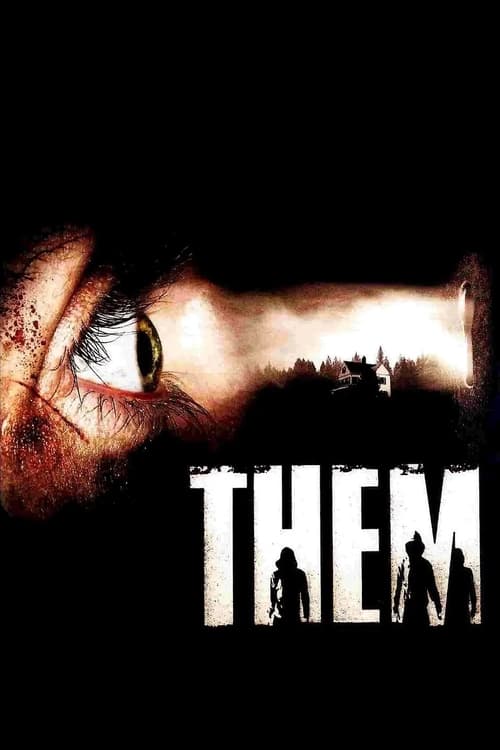
Them
2006 · Xavier Palud
When you want a short, sharp scare you can finish in one sitting — lights off, phone away, no bathroom breaks. Intense but not gruesome, which makes it a great gateway for someone who wants terror without torture.
What it's about
Clémentine and Lucas, a young French couple, live in a big, isolated country house outside Bucharest — she teaches French in the city, he's a writer. One night they wake to strange noises outside; their car is gone, the phone line goes strange, and hooded figures they can barely see begin hunting them through the house, the woods, and the tunnels beyond. The film gives them, and you, no explanation until the very end.
The experience
A tight, stripped-to-the-bone exercise in fear of the dark — under ninety minutes, almost all of it one long night of creaks, flashlights, and half-glimpsed movement. It trades gore for pure nerve-shredding suspense, and the final reveal reframes the whole ordeal with a cold shudder.
The craft
Directors David Moreau and Xavier Palud build the whole film from sound and sightlines: rustles in another room, shapes at the edge of a beam of light, a house that becomes a maze. The restraint is the craft — almost nothing is shown, so everything is frightening. Good speakers matter more here than a big screen.
Why it matters
A key entry in the mid-2000s French horror surge, its claim of being based on real events and its faceless-intruder premise fed directly into the home-invasion boom that followed on both sides of the Atlantic.
Snapshot
Them (original title Ils) is a short, tightly built French home-invasion horror film. It was co-written and co-directed by Xavier Palud and David Moreau, who are almost always credited together, so the attribution to Palud alone in the brief is incomplete. A young French couple lives in an isolated country house outside Bucharest. Clémentine (Olivia Bonamy) teaches French in the city and Lucas (Michaël Cohen) is a writer. One night they wake to noises, find their car taken, and are hunted through the house, the surrounding woods and a network of underground tunnels by hooded figures they can barely see. The film runs well under ninety minutes and holds back almost all explanation until the end. A closing title card claims the story is based on real events and names the attackers as children and adolescents. That turn, together with the film's restraint, made Them a frequently cited reference point for the late-2000s home-invasion cycle. Bryan Bertino's The Strangers (2008) is the film most often set beside it.
Industry & production
Them was a French production shot in Romania. That arrangement was typical of mid-2000s European genre filmmaking, when Romanian locations and crews offered lower costs. The production is generally associated with the producer Richard Grandpierre and his company Eskwad. The detailed financing and distribution record is thin in widely available sources, and this dossier does not give budget or box-office figures.
The production context still matters. In the mid-2000s, French producers briefly saw horror as a viable export genre. Alexandre Aja's Haute Tension (2003) had found international distribution, and a cluster of French horror features followed. Them was cheap, compact and built around a single location and two principal actors, which suited that commercial window. Its length and simplicity made it easy to sell abroad, and it reached English-speaking audiences under the translated title Them.
Technology
Nothing in the film's technology is exceptional. The approach is economical: available-light aesthetics, practical light sources inside the story (flashlights, torches, car headlights, a flickering television), and portable camera equipment suited to moving through corridors, attics and tunnels. The specific capture format and post-production pipeline are not well documented in accessible sources. The film's look is best described in terms of technique rather than equipment.
Technique
Cinematography
The cinematography is credited to Axel Cosnefroy. Its central strategy is to withhold. The attackers are seen in fragments: a shape behind frosted glass, a hood at the edge of a beam of light, figures in silhouette against fog. Much of the film is lit as if by the characters' own torches, so the frame contains small zones of visibility surrounded by unreadable black. The audience shares the couple's perceptual limits. Handheld camerawork follows Clémentine closely as she moves through the house, and the slightly unstable framing keeps the viewer at body height inside the space instead of above it. In the forest and tunnel sequences, compositions narrow to tight corridors of space. The dark and enclosed space of the house turns into something close to underground horror.
Editing
The editing favours duration over shock. Scenes of listening, waiting and hesitant movement are allowed to run long, so tension comes from anticipation rather than from rapid cutting. When cuts do accelerate, during chases and struggles, they are kept short and disorienting. Structurally the film is lean. After a brief prologue there is a short domestic setup, and then the siege takes up most of the running time with little ellipsis. The film plays out almost as one continuous night.
Mise-en-scène / staging
The house is the film's main instrument. It is large, old, partly renovated and full of half-finished spaces: an attic hung with plastic sheeting, stairwells, doors that do not lock reliably. It is a modern couple's project imposed on an older rural building, and its weak points become the attackers' routes in. Staging uses depth and off-screen space throughout. Threats are placed behind characters, beyond doors, or audible above and below them. The final act moves outside and then underground into drainage or sewer tunnels. This shift from domestic interior to hostile landscape to subterranean maze widens the threat from one house to a whole territory the attackers seem to know intimately.
Sound
Sound may be the film's most effective tool. Long stretches have little or no score, and fear comes from diegetic noise: thumps, footsteps, a television giving off static, the shrill and inhuman-seeming calls the attackers use to signal to each other, a mobile phone ringing in the dark. Because the attackers are rarely seen clearly, sound stands in for their presence and shows how many and how organised they are. Music, where it appears, mostly sustains atmosphere rather than driving stingers. The composer credit is not something this dossier can confirm confidently from the accessible record, so it is left unattributed.
Performance
The film rests largely on Olivia Bonamy, who is on screen for nearly all of it. Clémentine is not a stylised final girl but an ordinary person reacting physically: breathing, hiding, freezing, improvising. Michaël Cohen's Lucas is written to be injured and weakened early, which shifts the burden of action to Clémentine. The film thus quietly rejects the convention of male protection without making a statement of it. The attackers barely perform as characters at all. Their anonymity and near-silence are the point, and the final revelation depends on the audience never having read them as individuals.
Narrative & dramatic mode
The narrative is minimal and linear. A cold-open prologue shows a mother and daughter whose car breaks down on a dark road, ending in violence from an unseen assailant. It establishes both the threat and the setting before the protagonists appear. The main story then gives a short portrait of the couple's routine before compressing everything into a single night of siege and pursuit.
The dramatic mode is survival suspense rather than mystery. The film never gives the couple, or the audience, the chance to understand the attackers' motives while events unfold. Knowledge is held back until the closing moments, when the attackers are seen clearly as young people and a title card supplies the frame. It presents the film as based on real events and reports the attackers' supposed explanation, usually quoted as that their victims "wouldn't play with them." The effect is retroactive: the meaningless violence is re-coded as child cruelty, and the night is cast as a game played by others.
The "true events" claim deserves caution. It is widely discussed as a framing device, and no well-documented real case has been reliably shown to match the film's events. The claim belongs to the film's rhetoric, a tactic with a long horror lineage running back through The Texas Chain Saw Massacre (1974). It should not be treated as historical fact.
Genre & cycle
Them belongs to the home-invasion or siege thriller, a subgenre with roots in Straw Dogs (1971), Michael Haneke's Funny Games (1997) and, more broadly, the rural-threat cinema of the 1970s. It also draws on the "killer children" tradition, whose key reference is Narciso Ibáñez Serrador's Who Can Kill a Child? (¿Quién puede matar a un niño?, 1976).
Within mid-2000s horror, the film sits at the start of a wave of home-invasion and youth-menace films. These include The Strangers (2008), the British Eden Lake (2008), and later titles such as Kidnapped (Secuestrados, Spain, 2010) and The Children (UK, 2008). The cycle shared anonymous, often masked or hooded attackers; isolated or affluent homes; and refusal of motive as a source of dread.
Authorship & method
Xavier Palud and David Moreau worked as a directing duo on Them, their feature debut. They are credited together as writers and directors, and it makes more sense to treat them as a single authorial unit than to assign the film to either alone. Their method here is reductive: one setting, two characters, an invisible threat, and almost no exposition. It shows a clear grasp of how much horror can be built from point of view and sound alone.
The film's international reception led directly to Hollywood work. Moreau and Palud co-directed The Eye (2008), the American remake of the Pang brothers' Hong Kong horror film. That production did not carry over the distinctive austerity of Them, and the pair's later careers went separate ways in French cinema. Palud's later work includes the thriller À l'aveugle (2012). Moreau's work in the years that followed included the comedy 20 ans d'écart (2013). Them therefore stands as the clearest expression of their joint sensibility.
Among the collaborators, cinematographer Axel Cosnefroy is responsible for the film's defining low-light, handheld look. Credits for editing and music are not reliably recoverable from the accessible record, so they are not named here.
Movement / national cinema
Them is usually grouped with the "New French Extremity," a label critics (notably James Quandt, who coined the term in a critical 2004 Artforum essay) used for French films of bodily violence and transgression. The horror wing of that tendency includes Haute Tension (2003), À l'intérieur (Inside, 2007), Frontière(s) (2007) and Martyrs (2008).
Them sits uneasily in that grouping. It is far less graphic than its peers and depends on suggestion, darkness and suspense rather than prolonged gore or bodily violation. It is better described as part of the broader mid-2000s revival of French genre horror than as an exemplar of extremity. It shared the movement's industrial moment and some of its pessimism, but not its aesthetic of excess. Its Romanian setting also marks it as a transnational European film. The French protagonists are expatriates, and the foreign, rural landscape around them adds to their isolation.
Era / period
The film appeared in the mid-2000s, as several trends converged in horror. American horror was dominated by remakes and by the so-called "torture porn" cycle of Saw (2004) and Hostel (2005). European genre production, especially French and Spanish, was gaining international visibility. Low-budget horror built on a single location and a single night was proving commercially viable.
Socially, the film's anxieties fit wider European fears of the period. In France especially, public debate in the mid-2000s gave a lot of attention to youth violence and disaffected adolescents, intensified by the 2005 unrest in French banlieues. Them does not stage a political argument, and its attackers are not given a social identity. Still, reading the film's feral, unaccountable youth in the light of these contemporary anxieties is a common critical move, and the British Eden Lake made such concerns explicit two years later.
Themes
- The fragility of domestic security. The house is a project of comfort and settlement, half-renovated and full of plans. It turns out to be porous and indefensible, and the couple's private life is exposed as provisional.
- Isolation and foreignness. The protagonists are outsiders in a landscape they do not know, while the attackers move through it with total fluency, including through tunnels beneath it. Territory and belonging favour the hunters.
- The opacity of violence. For most of the film the threat has no face, voice or reason. Even when a reason is offered, it is trivial. The film's disturbing core is that the cause is incommensurate with the horror.
- Childhood and cruelty. The final reveal turns the innocence normally attached to children into its opposite and connects the film to Who Can Kill a Child?. The attackers' "game" suggests a world of children operating beyond adult moral reach.
- Perception and its limits. Formally and thematically, the film is about not being able to see, hear clearly or know. The audience's experience mirrors the victims'.
Reception, canon & influence
Critical reception. On its release Them was generally received well within genre criticism. It was praised for its efficiency, atmosphere and restraint, especially compared with the more explicit horror of the period. Common criticisms were that its brevity and thin characterisation made it slight, and that the final explanation and "true story" frame were either chilling or gimmicky depending on the viewer. It is not usually ranked among the defining masterpieces of the French horror wave, but it is regularly cited as one of the period's most effective pure suspense exercises.
Influences on the film (backward). Its clearest ancestors are the siege thriller (Straw Dogs; John Carpenter's Assault on Precinct 13, 1976), Haneke's Funny Games, the "killer children" film (Who Can Kill a Child?, and more distantly Village of the Damned, 1960), and the "based on true events" framing of 1970s American horror such as The Texas Chain Saw Massacre. Its stress on darkness, unseen threat and sound continues a long tradition of suggestive horror running back to the Val Lewton productions of the 1940s. That last connection is a stylistic affinity, not a documented influence.
Legacy (forward). The film most often linked to Them is Bryan Bertino's The Strangers (2008). It shares the isolated house, the young couple, the anonymous attackers who refuse explanation, and a claim to real-life inspiration. Critics and viewers have commonly noted the resemblance. Bertino has cited other inspirations, including a childhood memory of strangers knocking at the door and real crimes, so the relationship is best described as a widely noted similarity rather than a confirmed borrowing. Eden Lake (2008) and The Children (2008) developed the youth-menace strand further. The broader home-invasion revival of the following decade also follows the template Them helped to clarify: the threat stays faceless, the motive is withheld, and the home becomes a trap. In the atlas's terms, Them is a node where the 1970s siege film and the killer-children film meet the 2000s European horror revival, with a line running directly into American home-invasion cinema of the late 2000s and 2010s.
Influences: the films it descends from and the films it influenced
- Cat People (1942) — The Lewton–Tourneur 'bus' principle of building terror from darkness and off-screen sound, never the visible monster, is the grammar *Them* uses for its unseen hooded attackers. This is a stylistic affinity, not a documented borrowing.
- Village of the Damned (1960) — It set the convention that a group of children acting as one, with no readable inner life, is more frightening than any single adult killer, and *Them* reduces its youths to that same faceless pack.
- Night of the Living Dead (1968) — Its one-location siege of a barricaded house, where doors and windows are the only lines of defence and the attackers are an undifferentiated mass, is the spatial blueprint for the couple's night at the Romanian villa.
- Straw Dogs (1971) — Peckinpah's foreign couple besieged in a remote house by locals who resent them supplies *Them*'s expatriate-outsider premise and its night-long, room-by-room defence of a domestic space.
- The Texas Chain Saw Massacre (1974) — *Them* copies Hooper's 'based on true events' opening and closing text cards, which give a pure genre exercise the false weight of reportage.
- Assault on Precinct 13 (1976) — Carpenter's attackers are anonymous, nearly silent and given no motive, and they surround a building in real-time darkness, the same withheld-antagonist siege structure Palud and Moreau use.
- Who Can Kill a Child? (1976) — Serrador showed foreign tourists hunted by children whose violence is never explained, and *Them* repeats both the outsiders-abroad setup and the late, flat revelation that the killers are kids.
- Halloween (1978) — Carpenter's widescreen use of doorways and dark backgrounds, where the threat waits at the edge of the frame or behind the viewer, underlies *Them*'s handling of off-screen space inside the villa.
- Funny Games (1997) — Haneke's polite young invaders who will not justify themselves taught *Them* that the bleakest move a home-invasion film can make is to withhold motive entirely, a refusal the European home-invasion films of the 2000s took up.
- The Blair Witch Project (1999) — Its handheld camera, lit only by a torch the characters carry and surrounded by noises in the dark that never resolve into an image, is the low-light verité method Axel Cosnefroy's photography adapts for the chase through the attic and tunnels.
- Haute Tension (2003) — Aja's isolated-farmhouse night siege, built around a lone woman's physical endurance against a near-faceless intruder, set the French-extremity model of a long survival sequence that Olivia Bonamy's performance follows.
- The Strangers (2008) — It reproduces *Them*'s couple in an isolated house at night, masked attackers who withhold their motive, long silent stretches broken by knocks and footsteps, and a true-events framing card. Critics widely noted the resemblance; Bertino has not confirmed it as a borrowing.
- Eden Lake (2008) — It extends the strand of a young couple hunted by a feral teenage gang and moves *Them*'s handheld, body-height pursuit and female physical-survival arc into British woodland.
- The Children (2008) — It pushes the killer-children reveal further, staging an isolated snowbound house as a trap in which adults cannot bring themselves to believe or fight back against children until too late.
- Kidnapped (Secuestrados) (2010) — It carries the European home-invasion's duration-over-shock approach to an extreme, unfolding a single family's invasion in a dozen long handheld takes so that real time is never cut away from.
- Citadel (2012) — Its hooded, near-silent feral children, kept at the edges of the frame and in the dark, revive *Them*'s faceless youth pack and its hoodie iconography in an urban siege.
- You're Next (2013) — Its handheld, near-darkness digital photography of an isolated house besieged by unseen attackers sets the low-light visual grammar Wingard and Palermo use for the night-time invasion.
- The Descent (2005) — Made a year earlier, it lit claustrophobic underground passages with only the light sources the characters carry, the method *Them* uses for its climax in the sewers and tunnels.
- Inside (À l'intérieur) (2007) — Another French directing duo's debut, it confines a single night's invasion to one house and one besieged woman, which with *Them* defines how the mid-2000s French wave staged violation of the home.
Similar films
- High Tension (2003) — influence & lineage
- Funny Games (1997) — influence & lineage
- Don't Breathe (2016) — shared sensibility
- Skinamarink (2023) — shared sensibility
- Insidious (2011) — shared sensibility
- The Strange Ones (1950) — shared sensibility
- Cobweb (2023) — shared sensibility
- Barbarian (2022) — shared sensibility