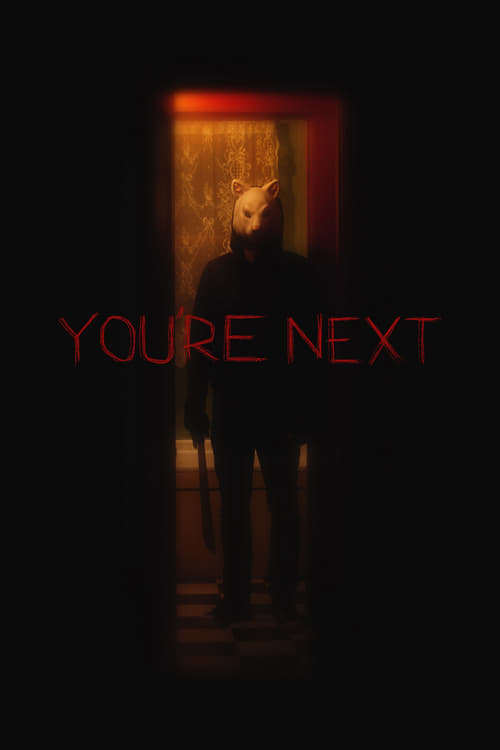
You're Next
2013 · Adam Wingard
When you want a scary movie that flips into a fist-pump — something tense enough to grip you and clever enough to make you grin at how it plays with the rules.
What it's about
A wealthy, quietly resentful family reunites at a remote country estate for the parents' wedding anniversary — old grudges simmering over dinner — when crossbow bolts start coming through the windows. Killers in animal masks have the house surrounded. But one guest, a son's unassuming Australian girlfriend, turns out to have grown up in a way that makes her very, very bad news for home invaders.
The experience
Tense, nasty, and sneakily hilarious — the siege is genuinely frightening, but the film keeps tipping into deadpan comedy as the tables turn. Once the heroine gets going, the dread turns into vicious, crowd-cheering fun.
Performances
Sharni Vinson is the film's secret weapon as Erin — calm, capable, and completely believable as she converts a dinner party into a kill zone.
The craft
Simon Barrett's script runs like a trap-building machine: every setup pays off, and the family's petty bickering keeps the comedy alive mid-massacre. Wingard shoots the house geography cleanly so you always know where the danger is, and a pulsing synth score drives the siege.
Why it matters
A festival sensation that sat on a shelf for two years, then became a flagship of the 2010s indie horror wave and a defining entry in the self-aware home-invasion cycle — with a heroine regularly cited among the genre's best.
Snapshot
You're Next is a home-invasion horror film that turns into something else partway through. A wealthy, bickering family gathers at a remote country house for the parents' wedding anniversary. Killers in animal masks lay siege to them. Then the genre's usual victim turns out to be the most capable person in the house. Erin (Sharni Vinson), the Australian girlfriend of one of the sons, grew up on a survivalist compound. She meets the attack with improvised traps, kitchen tools and tactical calm, and the slaughter gradually becomes a contest she is winning.
The film was directed by Adam Wingard and written by Simon Barrett. Both came out of the American micro-budget scene of the late 2000s, and many of the cast are fellow filmmakers from that circle. The result is a lean, darkly comic genre exercise that sits between the low-budget indie world and mainstream studio horror. It premiered at the Toronto International Film Festival in 2011 and was bought by Lionsgate, but was not released until August 2013. During that gap it built a reputation as a festival favourite. It is now usually remembered as a key text in the 2010s rethinking of the "final girl" and as the film that launched Wingard and Barrett's commercial careers.
Industry & production
You're Next was a small independent production made outside the studio system. It was produced through Snoot Entertainment, the company associated with producers Keith Calder and Jessica Wu, which had backed earlier genre projects. The film was shot in 2011 in and around Columbia, Missouri, where a large rural house stood in for the Davison family's vacation home. Shooting mostly in one location suited a modest budget. The production's exact cost is not reliably documented in sources I can confirm, but it is generally described as low-budget.
The film's path to release is a revealing industry story. It premiered in the Midnight Madness section at TIFF in September 2011, where the audience response was strongly positive. Lionsgate acquired worldwide rights soon afterwards. The studio then held the film for almost two years and released it in late August 2013, a slot traditionally used for genre titles. Public explanations for the delay were thin. The usual reading is that Lionsgate was choosing a release window rather than changing the film. Meanwhile Wingard and Barrett had become better known through the anthology films V/H/S (2012) and The ABCs of Death (2012). By the time You're Next opened, its makers were recognised figures in genre circles.
Commercially it was a modest theatrical performer and a solid result for its cost. Its larger value proved to be in reputation and in afterlife on home video and streaming.
Technology
The film was shot digitally. That was standard for American independent features by 2011, and it allowed the long night shoots and limited lighting that a siege story in one house needs. Published detail about the specific camera package is thin, and I won't name a model.
What matters stylistically is that the film embraces the look of low-light digital capture. Interiors are lit at night from practical sources: lamps, a few lit rooms, and darkness at the windows. The image tolerates noise and deep shadow, which keeps the house's geography uncertain and the threat from outside hard to see. Effects are largely practical. The kills use prosthetics, blood rigs and physical props (a crossbow, a machete, a meat tenderiser, and most memorably a kitchen blender) rather than digital enhancement. This hands-on approach fits the film's interest in improvised violence with household objects.
Technique
Cinematography
The cinematographer was Andrew Droz Palermo, who later worked with Wingard again and shot other independent features. The camera is mostly handheld and close to the actors. That reflects the filmmakers' roots in naturalistic micro-budget drama, where a loose, reactive camera was standard. In the early dinner sequences this style gives the family's arguments an uncomfortable intimacy.
Once the siege begins, the same mobility turns into disorientation. Characters run through unlit halls and the frame struggles to keep up. The film also uses the house's windows as a recurring visual device. Glass panes are frames in which masked figures appear, or through which the first crossbow bolts arrive. The tension between inside and outside, lit and dark, is built largely through how windows are placed in the image.
Editing
Wingard edited the film himself, as he did on several of his early projects. The cutting is brisk and often abrupt, with deliberately jarring transitions out of moments of shock. The editing also controls the comedy. Many scenes depend on timing, especially the reveal of an ambush or a sudden death in the middle of a sentence, and Wingard frequently cuts on a beat that makes the brutality both startling and darkly funny.
The film's structure, a slow-burning family drama followed by a sustained siege, also relies on editorial pacing. The first act is allowed to drag with awkward small talk, so that the eruption feels like a release.
Mise-en-scène / staging
The central design element is the masks: plain white animal faces, notably a lamb, a tiger and a fox, worn by killers in dark clothing. They are deliberately simple and a little absurd. Their blankness follows The Strangers (2008) and a longer tradition of masked slashers, while their animal theme hints at predation and a strange playfulness. The killers' calling card, "YOU'RE NEXT" painted in blood on the walls, adds theatrical cruelty.
The house is staged as a maze of rooms, staircases, a basement and exits. Erin's arc is expressed through her growing command of that space. She barricades, sets traps and turns furniture and fixtures into weapons. Booby traps assembled from domestic objects are the film's signature, and they place it in a lineage that critics have compared, sometimes half-jokingly, to Home Alone (1990).
Sound
The score is credited to a group of composers including Wingard, Jasper Justice Lee, Kyle McKinnon and Mads Heldtberg. It leans on analogue-style synthesizer textures that recall John Carpenter's self-composed scores and Italian horror music of the 1970s and 80s. This was part of a broader retro-synth revival in genre film at the time, and it became more central in Wingard and Barrett's The Guest (2014).
The most distinctive sound choice is a recurring pop song, Dwight Twilley's "Looking for the Magic". Its bright power-pop clashes with the carnage around it. It is first heard in the opening killing, then returns in the story as a playlist loop on a stereo. The repetition becomes an ironic motif and shows the film's tonal method: horror played straight, with a wink underneath.
Performance
The cast mixes professional actors with filmmakers from the same independent circle as Wingard and Barrett. Sharni Vinson, previously known for the dance film Step Up 3D (2010), carries the film as Erin. She plays the part with a matter-of-fact physical confidence that avoids both hysteria and swagger. Erin's competence is presented as practical knowledge rather than superhero ability, and Vinson's restraint makes this convincing.
Barbara Crampton plays the matriarch Aubrey. The casting was widely read as a deliberate tribute to her 1980s work with Stuart Gordon (Re-Animator, From Beyond), and it helped spark a late-career revival in independent horror. AJ Bowen, a regular in Wingard's films, plays Crispian, a resentful, self-pitying academic. The supporting cast includes Joe Swanberg, Amy Seimetz and Ti West, all directors in their own right, and Larry Fessenden, an independent horror producer-director, in the opening scene. Their casual, somewhat improvisational style gives the family scenes a realistic awkwardness that makes the later violence land harder.
Narrative & dramatic mode
The narrative has three clear parts. First comes a prologue in which a neighbouring couple is murdered, which shows the killers' methods. Next is the family reunion. Paul and Aubrey Davison gather their adult children and partners at their country home, and old resentments surface quickly over dinner. Then a crossbow bolt fired through a window starts the siege. The family is picked off, and Erin takes charge of the defence.
The third movement is a mystery reveal. The attack was not random. Some members of the family hired the killers to murder the parents and siblings and collect the inheritance. This changes the film's meaning in hindsight: the home invasion was an inside job. Much of the climax is driven by the conspirators' shock that their plan has been wrecked by an outsider they never expected.
The tone is a mixture of horror, black comedy and thriller. The film keeps the threat real while undercutting the genre's conventions. Killers are inept, the conspirators bicker among themselves, and the final girl turns out to be the most dangerous person present. The ending is abrupt and ironic, with one last fatal accident caused by one of Erin's traps. It refuses the cathartic rescue and makes a closing joke about the arbitrariness of violence.
Genre & cycle
You're Next belongs to the home-invasion cycle that ran through the late 2000s and early 2010s. Notable titles include the French film Ils (Them, 2006), Michael Haneke's US remake of Funny Games (2007), Bryan Bertino's The Strangers (2008), and in the year of its release The Purge (2013). Most of these films stress the victims' helplessness. You're Next deliberately reverses that.
It also draws on the slasher, especially the "final girl" figure described by Carol J. Clover in Men, Women, and Chain Saws (1992). In the classic slasher, the final girl becomes capable only through suffering. Erin is capable from the start. The film keeps the structure of the final-girl narrative while removing its slow arc of transformation.
It also has a family-satire element, with its greedy heirs and an inheritance plot. That links it to the "old dark house" mystery and to class satire, a strand that became prominent in later horror.
Authorship & method
Wingard and Barrett had been collaborating since A Horrible Way to Die (2010), a low-budget serial-killer drama that also featured AJ Bowen and Amy Seimetz. Their partnership is central to the film's identity. Barrett, as writer, provided the plot mechanics, the twist structure and much of the dark humour. Wingard, as director and editor, shaped the rhythm and tone. Barrett also appears on screen as one of the masked killers.
Both came from the overlap between "mumblecore", the naturalistic micro-budget dramas associated with Joe Swanberg and others, and independent horror. Critics sometimes jokingly called this overlap "mumblegore". The method was collaborative and close-knit: friends acting in each other's films, small crews, and dialogue that left room for improvisation.
Andrew Droz Palermo (cinematography), the composing collective around Wingard, and producers Keith Calder and Jessica Wu completed the core team. Wingard and Barrett's next feature, The Guest (2014), took the same approach further, with synth music and genre pastiche. Wingard later moved into larger studio work: Blair Witch (2016, again written by Barrett), Death Note (2017), and then the MonsterVerse films Godzilla vs. Kong (2021) and Godzilla x Kong: The New Empire (2024).
Movement / national cinema
The film is a product of American independent cinema at a specific moment: when the micro-budget, digitally shot, friends-and-collaborators scene of the late 2000s began crossing into commercial genre filmmaking. The casting of Swanberg, West, Seimetz, Kate Lyn Sheil and Fessenden makes the film a kind of group portrait of that community.
That network also overlapped with the horror anthology wave of the period (V/H/S, The ABCs of Death), in which many of the same names took part. You're Next is one of the clearest examples of how this scene became a pipeline into mainstream horror in the following decade.
The Australian background of the protagonist is a narrative detail rather than a sign of transnational production. The film is an American independent production.
Era / period
The film was made in 2011 and released in 2013, so it falls in the period when low-cost horror was becoming a strong commercial category. Blumhouse's micro-budget model (Paranormal Activity, Insidious, The Purge) was changing studio thinking about genre, and festival midnight sections had become important markets for horror. Digital cinematography had lowered the barrier to feature filmmaking.
The two-year delay put the film's release among a growing wave of 1980s-nostalgic genre cinema, reflected in its synth score and its Crampton casting. It was also released into a horror culture increasingly interested in self-aware, deconstructive play with conventions, a trend associated with the Scream films and The Cabin in the Woods (made in 2009, released 2012).
Themes
Family as threat. The film's central irony is that the danger comes from within. The masked killers are hired help, and the true villains are the children who want the inheritance. The bourgeois family gathering, already full of resentment, is revealed as a site of violence driven by greed.
Competence and the final girl. Erin's skill, explained as the product of a survivalist upbringing, inverts the genre's victim structure. The film is interested in the gap between how people are perceived (an outsider, a girlfriend, someone the conspirators did not take seriously) and what they can actually do.
Class and inheritance. The Davisons' wealth and the children's dependence on it give the violence a material motive. The film anticipates the class-satire strand that later drove horror-comedies of the rich.
Domestic objects as weapons. The house's ordinary tools become instruments of survival and murder. This turns the safety of the home into a site of improvised combat.
Violence and absurdity. The deaths, from bumbling killers to the final irony, emphasise how arbitrary and comic violence can be, without fully cancelling its horror.
Reception, canon & influence
Critical reception. At its TIFF premiere the film drew a strongly enthusiastic midnight-audience response, and genre critics picked it up as a discovery. When it was released in 2013 the reception was generally positive but more divided. Admirers praised the tonal control, the twist on the final girl and Vinson's performance. Detractors found the family drama thin, the comedy uneven, or the reversal of convention less fresh after two years of festival hype. It has since settled into a secure place in the canon of 2010s American horror and is often listed among the decade's notable genre films.
Influences on the film. The clearest predecessors are the home-invasion films The Strangers (masked, silent attackers in a remote house), Ils, and Funny Games, along with older siege narratives such as Straw Dogs (1971). The final-girl structure descends from the 1970s–80s slasher, notably Halloween and The Texas Chain Saw Massacre, as theorised by Clover. The score points to John Carpenter and Italian horror music. The Crampton casting nods to Stuart Gordon's 1980s Lovecraft adaptations. The trap-setting has drawn frequent comparisons to Home Alone, and the inheritance plot draws on the old-dark-house mystery.
Legacy. The film's influence works in several directions:
- The competent final girl. Erin became a frequently cited model for a protagonist who is capable from the start. The film is often discussed alongside later films that put a resourceful woman at the centre of a deadly family or household setting.
- The "deadly family gathering" subgenre. Ready or Not (2019) is most often compared to it, with its wedding-night siege, wealthy family and resourceful bride. Others in that strand of class-conscious horror-comedy include The Hunt (2020) and later house-party thrillers.
- Careers. It launched Wingard's commercial career and made the Wingard–Barrett partnership a recognised force, leading directly to The Guest and Blair Witch. It also revived Barbara Crampton's career in independent horror, with roles in We Are Still Here (2015), Beyond the Gates (2016) and others.
- The mumblegore pipeline. The film demonstrated that the micro-budget indie community could produce commercial genre films. It became a reference point for the movement of that generation of filmmakers into mainstream horror.
- Retro-synth aesthetics. Together with The Guest, it helped popularise the analogue-synth score in 2010s genre cinema, a style that spread through film and television in the following years.
The most recent claims of direct influence on later films come mainly from critical comparison. Documented statements from later filmmakers about a direct debt to You're Next are sparser, and the lineage is best understood as kinship within a cycle rather than proven borrowing.
Influences: the films it descends from and the films it influenced
- The Cat and the Canary (1927) — Sets the old-dark-house template that You're Next updates: heirs gathered in a remote mansion are picked off by a disguised killer who turns out to be a family insider after the inheritance.
- Wait Until Dark (1967) — A woman trapped inside a home turns its layout and its fixtures, especially the lighting, into tactical weapons against intruders, the model for Erin's methodical use of the house as a battlefield.
- Straw Dogs (1971) — Its climactic siege of a farmhouse, where the defender improvises lethal traps (the mantrap, boiling liquid) from domestic objects, is the blueprint for Erin's household arsenal.
- The Last House on the Left (1972) — Craven's grindhouse reversal, where the people in the house booby-trap it and slaughter the invaders, gives You're Next its pattern of victims who become ingeniously sadistic hunters.
- Black Christmas (1974) — Builds terror in a single house through prowling POV and window-framed menace, with the killer's identity unresolved inside the household, an early form of You're Next's threat that is already inside.
- Halloween (1978) — Carpenter's self-composed minimalist synth ostinato and his masked figures standing silently in window and doorway frames are quoted directly in You're Next's homemade synth score and its window-framing compositions.
- From Beyond (1986) — Barbara Crampton's genre persona in Gordon's Lovecraft cycle is what the film's casting deliberately calls on, turning her into a knowing meta-presence who is dispatched early as the matriarch.
- Home Alone (1990) — Its slapstick room-by-room booby-trapping (tripwires, nails, objects rigged on doors) is remade with lethal intent in Erin's blender, nail-board and doorway traps, which keep the cartoon timing of the original.
- Funny Games (1997) — Its polite, emotionless invaders who make a game of killing the family supply the motive-withholding quality of the animal-masked killers, which the film then debunks as a commercial job.
- Ils (Them) (2006) — Its handheld, near-darkness digital photography of an isolated house besieged by unseen attackers sets the low-light visual grammar Wingard and Palermo use for the night-time invasion.
- The Strangers (2008) — The direct model for the silent masked trio in a remote holiday house, including the slow-reveal shot of a mask in the background of the frame and the ironic music from a domestic record player that You're Next turns into its looping Dwight Twilley motif.
- The Guest (2014) — Wingard and Barrett push You're Next's retro-synth sound and tonal swing between deadpan comedy and violence into a full Carpenter-style pastiche (Steve Moore's score, a family invaded from within), ending in another set-dressed household showdown.
- We Are Still Here (2015) — The most direct use of the Crampton revival that You're Next started: it casts her as the lead in an old-dark-house siege that, like You're Next, builds its violent climax around townsfolk with hidden motives who converge on a family home.
- Hush (2016) — Extends the competent-final-girl model inside a home-invasion film: a heroine who reads the house tactically, sets her own traps and outthinks a masked intruder in a single night-time location.
- Ready or Not (2019) — Made by Radio Silence, Wingard's V/H/S collaborators, it rebuilds the You're Next formula of a newcomer bride against a wealthy family killing for its fortune in a mansion, with the same comic timing in its cuts on botched kills and a gore-drenched finale.
- Abigail (2024) — A single-house siege in which the victim turns the tables, played with deadpan comic timing, helped form the mumblegore-to-mainstream horror-comedy register Radio Silence works in.
- The House of the Devil (2009) — West, who plays Tariq in You're Next, came from the same mumblegore circle and pioneered its retro-genre pastiche: an analogue period look and slow-burn suspense applied to a micro-budget house-siege plot.
- A Horrible Way to Die (2010) — The first Wingard–Barrett feature, made with the same ensemble of filmmaker-actors (AJ Bowen, Amy Seimetz, Joe Swanberg) and the same improvisation-friendly handheld naturalism laid over a genre killing plot.
- V/H/S (2012) — An anthology made by the same micro-budget collective, with Wingard, Barrett, Swanberg and West all acting in or directing segments, which consolidated the friends-casting-friends model of production that You're Next carried into wide release.
- Scream 4 (2011) — A same-year self-aware suburban-siege slasher whose resourceful final girl and inside-job killer conspiracy run the exact home-invasion-whodunit machinery Scream 4 deploys.
- Evil Dead (2013) — Part of the same early-2010s hard-R revival that recommitted to practical, tactile siege violence over glossy PG-13 supernatural horror.
- Scream VI (2023) — Its home-invasion whodunit reveals the masked attackers as intimates and family, marrying mumblegore dark comedy to slasher mechanics the way Radio Silence balances dread and jokes.
- Green Room (2016) — Runs the same scarce-prop economy — the besieged house is inventoried as usable objects (blender, meat tenderizer, nail board) and the film's turns come from who reads that inventory first.
Similar films
- Ready or Not (2019) — influence & lineage
- Funny Games (1997) — influence & lineage
- The Cabin in the Woods (2012) — shared sensibility
- Funny Games (2008) — shared sensibility
- Barbarian (2022) — shared sensibility
- Scream 4 (2011) — shared sensibility
- Abigail (2024) — shared sensibility
- The Invitation (2016) — shared sensibility