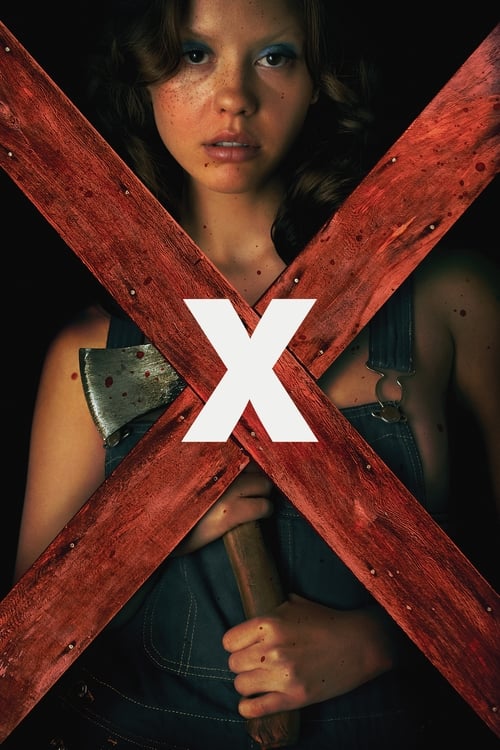
X
2022 · Ti West
For a late night when you're craving a real scare with some grindhouse swagger — horror that's both a party and a slow tightening of the throat. A challenge for the squeamish, a treat for anyone who loves the genre.
What it's about
Texas, 1979. A small crew of young filmmakers — an ambitious producer, his starlet girlfriend, a director with art-house dreams — rent a bunkhouse on a remote farm to shoot an adult film on the sly. Their hosts are a reclusive elderly couple, and when the old woman discovers what the visitors are really doing, her loneliness and longing twist into something murderous, and the night turns into a fight to survive.
The experience
It's a slow-burn that luxuriates in dread — long, patient stretches where you know something terrible is coming but not from where — before erupting into gleefully nasty violence. Sleazy, funny, and genuinely unnerving, often in the same scene.
Performances
Mia Goth is the reason to watch: fearless, strange, and heartbreaking, she gives what should be a straightforward scream-queen role real hunger and sadness, and carries the film's whole idea about youth, desire, and being looked at.
The craft
Ti West shoots it like a lost artifact of 1979 — sun-bleached grain, split screens, ominous overhead shots of the farm — with editing that keeps cutting between the film-within-the-film and the horror gathering outside it. The sound design makes every creaking floorboard and distant screen door count. It rewards a dark room and good speakers.
Why it matters
It revived the fortunes of the theatrical slasher, launched a whole trilogy shot around Mia Goth, and confirmed Ti West as one of the sharpest genre stylists working.
Snapshot
X is Ti West's lurid, formally controlled return to feature horror after a years-long detour into television and short-form work, and it functions simultaneously as a backwoods slasher and an essay about looking. In 1979, a small crew drives a van into rural Texas to shoot an adult film called The Farmer's Daughters on a property they have rented from an elderly couple; the wife's frustrated, predatory desire curdles into a night of killing. West uses that premise to braid two cycles of disreputable cinema — the 1970s rural-horror picture and the golden-age pornographic feature — into a single object, arguing that both are forms of image-making organized around the body. The film is also the keystone of a larger structure: West and star Mia Goth secretly shot a companion film, Pearl, back-to-back on the same New Zealand location, and would later complete the arc with MaXXXine (2024). X is thus best understood not as a standalone shocker but as the opening movement of an authored trilogy about desire, aging, and the will to be seen.
Industry & production
X was produced and distributed by A24, the company whose name had by the early 2020s become shorthand for a certain kind of prestige-adjacent, director-driven horror (Hereditary, The Witch, Midsommar). West had a long history in low-budget independent horror — The House of the Devil (2009), The Innkeepers (2011), The Sacrament (2013) — before stepping back from features to direct episodic television. X marks both his comeback and his entry into a better-resourced studio ecosystem.
The production's most consequential decision was logistical and creative at once: though set in Texas, the film was shot in rural New Zealand, on a farm property dressed to read as 1979 East Texas. The remote, contained location allowed West and his collaborators to mount a second, clandestine production. With shooting disrupted by COVID-era constraints and the cast and crew effectively sequestered, West and Goth developed and filmed Pearl — an origin story for the elderly antagonist — on the same set immediately afterward, keeping the project quiet until X was nearly in release. This back-to-back model recalls older exploitation and studio practices of squeezing two pictures from one standing set, but here it was redeployed as an authorial gambit, doubling West's output and deepening X retroactively.
The ensemble was compact and pointedly cast. Mia Goth plays Maxine Minx, the ambitious young performer, and — under heavy prosthetics — also plays Pearl, the aged hostess, so that victim and killer are literally the same body across time. The crew-within-the-film includes Martin Henderson as the producer-boyfriend Wayne, Brittany Snow as the seasoned adult performer Bobby-Lynne, Scott Mescudi (Kid Cudi) as the male lead Jackson Hole, and Owen Campbell and Jenna Ortega as the earnest director RJ and his reluctant sound girlfriend Lorraine. Ortega's casting proved well-timed, arriving just before her broader breakout. I do not have reliable, citable budget or box-office figures to quote here, and so will not invent them; what is clear from the production's scale and reception is that X performed strongly enough relative to its modest means to greenlight the rest of the trilogy.
Technology
X is, in part, a film about film technology, and West foregrounds the apparatus of 1979 image-making within the fiction: the crew's 16mm camera, the boom and reel-to-reel sound gear, the clapperboard, the dailies. The diegetic pornographers are shooting on film, and West repeatedly cuts to their viewfinder framings and grainy footage, so the movie stages a continuous dialogue between its own slick capture and the rougher analog image it depicts.
For the actual production, X was shot digitally, but its entire visual program is bent toward emulating the texture and grammar of the period — the warm, slightly degraded palette and grain structure of 1970s American genre filmmaking. The most visible technological feature is in fact a makeup and performance technology rather than a camera one: the extensive aging prosthetics that transform Goth into Pearl. That transformation is the hinge of the whole conceit, and its success — the audience's inability, on first viewing, to read the two characters as one actor — is what permits West's argument about youth and age to land as a formal shock rather than a printed trivia note.
Technique
Cinematography
West's longtime director of photography Eliot Rockett shot X, and the collaboration shows in the film's disciplined retro grammar. The look is keyed to late-1970s rural Americana: golden, dusty exteriors; deep, lamp-lit interiors; compositions that favor the wide, patient framing and slow zooms of the era rather than contemporary handheld coverage. Rockett and West deploy a recurring visual rhyme of doubling and reflection — split compositions, mirrored framings, parallel staging — that quietly insists on the equivalence between Maxine and Pearl, and between the "legitimate" and "illicit" images the film contains. Several set pieces are organized around water and the pond on the property, and around the alligator that lurks there, with overhead and surface-level framings that turn the landscape itself into a predator. The camera's frequent restraint — holding on a porch, a doorway, a sleeping figure — generates dread through duration, a hallmark of West's earlier slow-burn horror that survives into this faster, bloodier register.
Editing
West edited X himself, as he characteristically does, and the cutting is one of the film's chief authorial signatures. The editing builds the central thesis through montage juxtaposition: West cross-cuts between the porn shoot and other activity on the farm, between youthful bodies and aged ones, between sex and death, so that the parallel between the two productions — the film-within-the-film and the killings — is made structurally rather than stated. The first half is deliberately patient, establishing geography and character with a slow-burn rhythm; the second accelerates into slasher tempo. A celebrated formal move is the use of match cuts and graphic rhymes that bridge bodies and acts across the cut, collapsing eros and violence into a single visual logic.
Mise-en-scène / staging
The production design commits totally to 1979: the van, the wood-paneled farmhouse, the costuming and hair, the gear, the country-and-gospel sonic furniture. The farm is staged as a closed system — house, barn, pond, cellar — that the film maps carefully so that later violence reads spatially. Staging repeatedly pairs the visiting young people with their aged hosts in the same frame, and West choreographs Pearl's intrusions into scenes of youth and desire as both pathetic and menacing. The mise-en-scène is saturated with the iconography of rural American horror — isolation, religion, decaying domesticity — while the porn shoot imports the brighter, performed glamour of a different disreputable genre into the same rooms.
Sound
Sound is thematized within the story through Lorraine's role as the boom operator and RJ's insistence on craft, and the film attends to the textures of its period: scratchy radio, gospel and televangelism bleeding from the farmhouse set, country music, the mechanical noises of analog gear. The score, by Tyler Bates and Chelsea Wolfe, leans into a brooding Americana that supports the regional setting rather than fighting it, and the film also makes pointed use of period-appropriate source music. The interplay of diegetic and non-diegetic sound reinforces the larger doubling: the sounds the crew is professionally capturing and the sounds of the horror engulfing them occupy the same sonic world.
Performance
The performances are calibrated to the dual register of the project — knowing and earnest at once. Mia Goth's twin turn is the film's center of gravity: Maxine is hungry, guarded, and self-possessed, while Pearl, beneath the prosthetics, is rendered with a startling pathos that the companion film would later expand. Brittany Snow's Bobby-Lynne is warm and unashamed, the film's most generous figure; Scott Mescudi and Martin Henderson supply swagger and pragmatism; Owen Campbell's RJ embodies the pretensions of the would-be auteur; Jenna Ortega's Lorraine charts the arc from prudish reluctance to participation that the film treats as its sly moral provocation. Stephen Ure plays the elderly Howard. The ensemble's commitment keeps the film's archness from curdling into mere pastiche.
Narrative & dramatic mode
X operates in a hybrid dramatic mode: it is a slasher, structured around the gradual elimination of a group of isolated young people, but its first act plays as an ensemble hangout comedy-drama about scrappy filmmakers. West withholds the violence, investing instead in character and theme, so that when the killing begins it arrives as the eruption of a tension the film has been building thematically — the resentment of age toward youth, of the unseen toward the desired. The narrative is organized around dramatic irony and parallelism: the crew makes one kind of film while West makes another around them; the old couple's repressed longing mirrors the young performers' frank sexuality. The structure is essentially classical slasher architecture — isolation, transgression, punishment — but inflected by an authorial interest in interiority, especially the killer's, that points directly toward Pearl's character-study form.
Genre & cycle
X sits at the convergence of two cycles. The first is the 1970s American rural horror picture — the Texas backwoods, the decaying farmhouse, the menacing elders — descending most obviously from The Texas Chain Saw Massacre (1974), with debts to the broader hagsploitation and "old dark house" traditions. The second is the golden-age theatrical pornography of the same decade, the Deep Throat / Boogie Nights milieu of crews who believed, however naively, that they were making real movies. X belongs as well to the 2010s–20s wave of elevated, knowingly retro genre cinema, and specifically to A24's horror line. By making the porn shoot's auteurist ambitions explicit through RJ's dialogue about creating a "good" dirty movie, West folds a genre-commentary layer into the slasher itself, so the film is at once a competent example of the cycle and a critique of the hierarchies that separate respectable from disreputable cinema.
Authorship & method
X is a strong auteur statement: West wrote, directed, and edited it, controlling the three levels — script, staging, and cut — at which his thesis operates. His method here extends the patient, period-fetishizing craft of The House of the Devil and The Innkeepers (films set in or evoking earlier decades, built on slow accumulation of dread) but marries it to a new conceptual ambition and a new productivity, embodied in the secret back-to-back shoot of Pearl. The key collaborators are central to the achievement: cinematographer Eliot Rockett, West's recurring DP, who supplies the period image; composers Tyler Bates and Chelsea Wolfe, whose score grounds the film in brooding Americana; and Mia Goth, who is less a hired lead than a creative partner — she co-developed and co-wrote Pearl with West, making her authorship of the trilogy's emotional architecture explicit. The producing apparatus at A24 enabled the model. The result is a body of work in which director and star function as co-authors of an interlinked cycle.
Movement / national cinema
X is an American film in subject, idiom, and tradition — a deliberate exercise in a national horror lineage rooted in 1970s regional independent filmmaking. Its actual production in New Zealand is a logistical fact rather than an aesthetic one; the film makes no claim on New Zealand cinema and instead labors to erase any trace of its shooting location in favor of an imagined Texas. If it belongs to a "movement," it is the loosely defined contemporary American art-horror tendency associated with A24 and with directors who treat genre as a vehicle for formal and thematic seriousness, rather than any geographically bounded national school.
Era / period
The film is doubly periodized. It was made and released in 2022, in the immediate aftermath of pandemic disruption that shaped its isolated, contained production. But it is set with great specificity in 1979, at the tail end of the brief window when theatrical pornography still imagined itself as a legitimate, even artful, commercial cinema before home video collapsed that ambition. West chooses that hinge moment deliberately: RJ's dream of a porn film that could "play in real theaters" is historically poignant precisely because the audience knows the form is about to be relegated to private consumption. The 1979 setting also situates the film at the height of the rural-slasher cycle it is pastiching, so the period choice is simultaneously a citation of horror history and of pornography's lost respectability.
Themes
The film's governing theme is desire across the life span, and specifically the horror and pathos of aging into invisibility. Pearl kills because she can no longer be the object of the gaze that the young performers command effortlessly; her violence is the rage of the no-longer-desired. Maxine's ambition — her refusal to accept "a life I don't deserve" — is the mirror image of that fear, youth's terror of obscurity projected forward. Around this core, West develops a sustained meditation on the equivalence of sex and death, eros and mortality, staged through the film's relentless cross-cutting. A second major theme is the legitimacy of disreputable art: the porn crew's belief in their craft, and West's implicit defense of horror and pornography as forms of real cinema, collapses the hierarchy between high and low. Religion, repression, and the puritanical underbelly of American sexuality run throughout, embodied in the televangelism bleeding through the farmhouse and in Lorraine's arc from judgment to appetite.
Reception, canon & influence
X was warmly received by critics, who singled out West's formal control, the film's wit about its own genre lineage, and especially Mia Goth's dual performance, which became the focus of much of the conversation around the film and, subsequently, around her career. The picture was widely read as both an effective slasher and a genuine piece of film commentary, and its strong showing relative to its scale made it a notable success within A24's horror line. (I do not have citable box-office or budget figures and decline to invent them.)
Its influences run backward to a clear set of touchstones. Tobe Hooper's The Texas Chain Saw Massacre (1974) is the foundational reference for the setting, the menacing family, and the rural-Texas dread; Alfred Hitchcock's Psycho lineage and the broader hagsploitation tradition inform the figure of the murderous elder; and Paul Thomas Anderson's Boogie Nights (1997), along with the actual history of Deep Throat-era theatrical pornography, supplies the affectionate portrait of the porn crew's doomed ambitions. West's own earlier period horror is the immediate stylistic ancestor.
Forward, X's legacy is most concretely the trilogy it launched. Pearl (2022), shot in secret alongside it, reframed the antagonist as a tragic protagonist and demonstrated the conceptual richness of the doubling at X's core; MaXXXine (2024) carried Maxine into 1980s Los Angeles, completing an arc about American desire and self-invention across decades. More broadly, the film consolidated a model of authored, retro-literate, star-collaborative horror, helped cement Mia Goth's status as a defining genre performer of her generation, and stands as a prominent example of the early-2020s tendency to treat the slasher as a vehicle for serious formal and thematic work. Its longer-term canonical standing will depend on how the complete trilogy is assessed, but X is already established as the entry point to one of the more ambitious horror projects of its decade.
A Deleuzian reading
Pearl stands at the edge of a doorway, watching the young people laugh, and the camera holds a beat too long.
The full Deleuzian reading of X →
Reception
A festival-buzz hit out of SXSW 2022 that was liked immediately, but its stature grew retroactively once it became the opening chapter of a whole trilogy — plenty of fans now rank it against Pearl and MaXXXine rather than on its own.
How X was received, from release to now →
Influences: the films it descends from and the films it influenced
- The Texas Chain Saw Massacre (1974) — Supplies the sun-baked 16mm grain, the isolated farmhouse, and the predatory rural household whose unseen elder rules the property — West reproduces its documentary-grit texture as a deliberate period skin.
- Psycho (1960) — Models the decaying house presided over by a murderous parental figure and the voyeur-punished structure, plus the trick of staging an aged killer as a withheld reveal.
- Boogie Nights (1997) — Gives West the affectionate ensemble treatment of a porn crew chasing legitimacy, and the dense wall-to-wall period-source-music scoring that grounds the era diegetically.
- The House of the Devil (2009) — West's own director-edited slow-burn method: total period emulation (here late-'70s/'80s) built on patient accumulation of dread before a late eruption of violence.
- The Innkeepers (2011) — Establishes West's naturalistic, low-key ensemble hang-out rhythm — characters idling in a confined location — that he carries directly into X's farmhouse first act.
- What Ever Happened to Baby Jane? (1962) — The foundational hagsploitation text X draws Pearl from: the aged woman rendered grotesque, performance built on decay, frustrated stardom, and murderous envy of youth.
- Persona (1966) — Source for the dual-performance grammar — one actress as two women framed in mirrored, overlapping compositions so youth and age read as a single divided face.
- Halloween (1978) — Provides the slasher's patient slow-zoom suspense and POV stalking grammar, plus the synth-anchored mood West and Bates/Wolfe echo in their brooding score.
- Friday the 13th (1980) — The lakeside-cabin template with cross-cut kill set-pieces and the transgressive-sex-then-death structure that X knowingly inhabits and comments upon.
- The Shining (1980) — The Room 237 bathtub crone — aging prosthetics converting eros into mortal revulsion — is the direct precedent for X's old-woman seduction-horror and its match-cut formalism.
- Last Night in Soho (2021) — Uses a lovingly reconstructed period aesthetic to interrogate stardom, desire and looking rather than merely indulge nostalgia — squarely the nostalgia-horror conversation Soho helped foreground.
- Fear Street: 1994 (2021) — Post-Fear-Street period-slasher that likewise reconstructs a specific year (1979) with fetishistic texture and needle-drops, treating the retro slasher as a deliberate craft object and vehicle for foregrounded sexuality rather than pastiche alone.
- MaXXXine (2024) — Carries Maxine into 1980s Los Angeles, swapping rural-16mm grain for De Palma/giallo neon-and-split-diopter pastiche while continuing the trilogy's period-emulation-as-method.
- In a Violent Nature (2024) — Extends the early-2020s impulse to treat the slasher as a formal experiment, foregrounding rural landscape, real-time pacing, and authored craft over body-count mechanics.
- Pearl (2022) — Shot in secret back-to-back with X using the same locations; inverts the doubling into saturated two-strip-Technicolor melodrama emulation (Wizard of Oz / golden-age Hollywood look).
- Grindhouse (2007) — Shares the strategy of faux-degraded film-stock texture and retro-literate exploitation homage — treating the period image itself as the film's primary special effect.
- Once Upon a Time in Hollywood (2019) — Parallel project in meticulous period-industry emulation: an affectionate portrait of show-business dreamers in a precisely reconstructed era, ruptured by a sudden burst of brutality.
- It Follows (2014) — Reactivates the same Carpenter inheritance — slow lateral zooms, widescreen suburban dread, and a synth score — as a contemporary auteur revival of patient slasher grammar.
- Strange Darling (2024) — Revives the slasher as elevated horror with celluloid-conscious cinematography and a dual-faced lead performance (Mia Goth), the same craft-forward retro-genre register.
- Scream (2022) — A same-year self-aware slasher revival trading gritty grain for period-precise, meta-literate craft, extending the subgenre's glossy-reflexive turn in the identical cultural moment.
- Barbarian (2022) — American-horror-renaissance contemporary whose antagonist is a decrepit figure staged to elicit pathos rather than pure menace, and who structures terror around a rural property's hidden spaces.
- Teenage Sex and Death at Camp Miasma (2026) — The crew shooting a movie on the property that kills them, cross-cut so that setups from the film-within rhyme frame-for-frame with the murders happening outside it.
Similar films
- MaXXXine (2024) — influence & lineage · same viewing thread
- Pearl (2022) — influence & lineage
- The Texas Chain Saw Massacre (1974) — influence & lineage
- Halloween (1978) — influence & lineage
- Saw X (2023) — same viewing thread
- Five Nights at Freddy's (2023) — same viewing thread
- Sinners (2025) — same viewing thread
- Terrifier 3 (2024) — same viewing thread
Watch it with: curated runs of related films
- Fresh Blood: 2020s Studio Horror — A run of the decade's mainstream fright machine — abduction shockers, franchise revivals, and one arthouse throwback — best watched back-to-back to feel how modern horror hunts its prey.