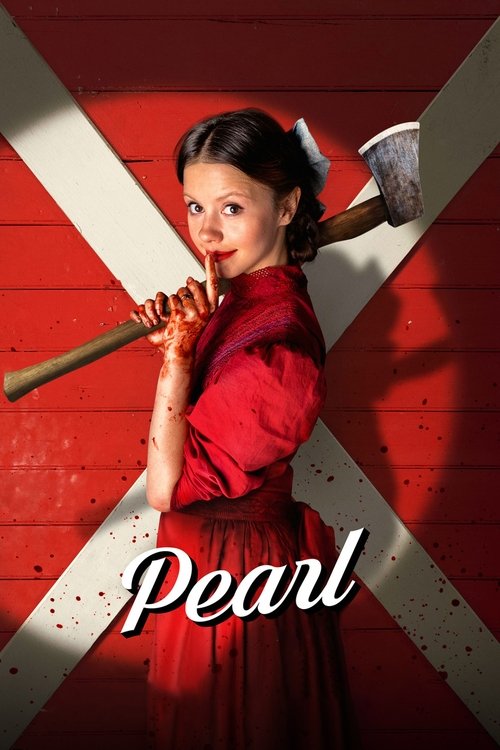
Pearl
2022 · Ti West
For when you're craving horror with a brain — something stylish and psychologically nasty to chew on, not comfort viewing. Best when you're up for spending two hours very close to an unraveling mind.
What it's about
Texas, 1918. Pearl is a young farm wife stranded at home while her husband is off at war, tending a paralyzed father under the cold eye of a rigidly devout mother. She dreams of the dancing-girl stardom she's seen at the picture show, and the gap between that dream and her locked-down life keeps widening — until something in her starts to give. It's the origin story of a monster, told with total sympathy from inside her head.
The experience
Deeply unsettling in a way that sneaks up on you: it looks like a candy-colored old Hollywood fairy tale and plays like a slow-building nightmare. Less about jump scares than about watching a person come apart — funny, sad, and genuinely disturbing, sometimes in the same scene.
Performances
Mia Goth is the whole show — a ferocious, swing-for-the-fences performance capped by an extended unbroken monologue that's already legendary among horror fans. She co-wrote the film, and it plays like a role built to test everything she can do.
The craft
Ti West shoots repression and rot in the saturated colors and swelling strings of a Golden Age studio picture, and the clash between that storybook surface and what's actually happening is the film's engine. It's gorgeous to look at, precisely paced, and all the more disturbing for how pretty it is.
Why it matters
Shot in secret back-to-back with X, it turned a slasher throwback into a genuine trilogy, cemented Mia Goth as a horror icon, and became a flagship for the wave of elevated, director-driven horror.
Horror · Psychological horror · Slasher. A sunlit Technicolor farm fairy tale curdles into a slow-burn nightmare inside a lonely young woman's cracking mind.
Snapshot
Pearl is an origin story disguised as a Technicolor fairy tale: a psychological horror melodrama that traces the young womanhood of the murderous farm widow first glimpsed, buried under old-age prosthetics, in Ti West's X (2022). Shot in secret in New Zealand back-to-back with that film, and co-written by its star Mia Goth, Pearl rewinds from 1979 to 1918 to ask how a girl becomes the monster. Set on a rural Texas farm during the closing months of the First World War and the Spanish influenza pandemic, it follows Pearl as she nurses her paralyzed father, chafes under her rigid immigrant mother, and dreams of the dancing-girl stardom she has seen flickering on movie screens. The film's signal achievement is tonal: it renders the visual grammar of Golden Age Hollywood — saturated color, swelling strings, storybook framing — as a container for matricide, delusion, and the slow curdling of thwarted desire. It is at once a genuine character study and a knowing pastiche, anchored by a Goth performance that became one of the most discussed of the decade.
Industry & production
Pearl was produced and distributed by A24, extending the studio's investment in West as a house auteur of elevated, cinephilic horror. Its production circumstances are the defining industrial fact about it: the film was conceived and shot clandestinely alongside X, using the same New Zealand locations, crew, and lead actress, during a period shaped by pandemic-era travel restrictions and quarantine. West and Goth used the enforced downtime and isolation of the X shoot to write Pearl's screenplay, and the second film was photographed on the same farm sets before the productions wrapped — a strategy that let A24 amortize a single logistical footprint across two features. The existence of Pearl was kept quiet and revealed as a surprise, most famously teased in a trailer attached to X itself. This tandem model, closer to episodic-television economics than to conventional feature sequencing, is unusual for theatrical horror and became central to the film's marketing story. Pearl premiered on the 2022 festival circuit, including Venice and Toronto, before its theatrical release later that year. Precise budget and box-office figures are best left to primary trade reporting rather than asserted here; the salient point is that the picture was made lean, fast, and in the shadow of its predecessor, and that A24 subsequently completed the arc with MaXXXine (2024).
Technology
The film is a conventional digital production dressed in the clothes of an older photochemical era. Its most conspicuous technological gesture is aesthetic rather than mechanical: cinematographer Eliot Rockett and West engineer a palette that evokes three-strip Technicolor and mid-century Hollywood color processes — impossibly green lawns, blood-red dresses, gold-hour skies — achieved through lighting, art direction, and digital color grading rather than any vintage capture format. Where X aped the grubby 16mm grindhouse look of 1970s exploitation, Pearl reaches back further to the glossy studio artifice of the 1930s and 40s, and the technology serves that pastiche. Optical devices of the period appear within the story world as well — the movie projector and the flickering nickelodeon-style films Pearl watches are the machines that seed her fantasies, making cinema's own apparatus a thematic engine. Beyond this the production relied on standard contemporary tools; the film's ambition is one of style and control, not technical novelty.
Technique
Cinematography
Eliot Rockett, West's long-standing director of photography, is the crucial technical collaborator. His images consciously quote the vocabulary of classic Hollywood: symmetrical, frontal compositions; luminous key light; skies and fields pushed toward the artificial vividness of a hand-tinted postcard. The camera favors stately, deliberate movement — slow pushes, graceful pans — over the handheld immediacy of much modern horror. Two sequences showcase the approach. Pearl's dance audition and her fantasy interludes are staged with the flat, presentational clarity of a studio musical, while the film's longest sustained passage, her confessional monologue on the porch, is held in an extended near-unbroken take that dares the viewer to sit inside her unraveling without the relief of a cut. The color scheme is dramaturgical: red recurs as the film's blood-and-desire signature, set against the wholesome greens and blues of the storybook farm.
Editing
West characteristically cuts his own films, and Pearl bears the marks of a director-editor's control — patient scene lengths, a willingness to let performance run, and a rhythmic contrast between placid, becalmed tableaux and sudden eruptions of violence. The editing withholds the fast cross-cutting of conventional slashers; horror arrives inside long, composed takes rather than through montage. The choice to sustain shots well past comfort — the porch speech, the notorious final image — makes duration itself an instrument of dread.
Mise-en-scène / staging
The film's design is its argument. Period costume, the clapboard farmhouse, the barn, the scarecrow, and the recurring farm animals are arranged into a deliberately artificial, almost soundstage-clean world that recalls The Wizard of Oz and the Disney fairy tale as much as any horror antecedent. Props carry weight: the pitchfork and axe as agrarian tools turned lethal, the roast goose, the movie posters, the alligator in the lake that Pearl feeds. West stages Pearl's fantasies of stardom against this pastoral backdrop so that the gap between her Technicolor dreams and her drab reality is always visible in the frame.
Sound
The score, credited to Tyler Bates with Timothy Williams, is a lush, string-forward orchestral pastiche of Golden Age film music — sweeping, romantic, and ironically at odds with the horror it accompanies. This deliberate mismatch between sumptuous scoring and grotesque event is one of the film's defining tonal devices, framing atrocity as though it were a MGM romance. Sound design otherwise favors the naturalistic hum of the farm punctuated by sharp violent accents.
Performance
Pearl is, finally, a performance film, and Mia Goth's turn in the title role is its reason for being. She modulates between childlike yearning, coquettish charm, and abrupt, affectless brutality, often within a single scene. Two set pieces made the performance a talking point: the lengthy porch monologue delivered to her sister-in-law Mitsy — a confession that shifts from self-pity to menace to breakdown in one continuous emotional arc — and the film's closing shot, in which Goth holds a rictus smile, tears and terror flickering beneath it, across the entire end-credit crawl. The supporting cast, including Tandi Wright as Pearl's severe mother and David Corenswet as the movie projectionist who becomes an object of her fantasy, is staged to orbit Goth's escalating derangement.
Narrative & dramatic mode
Structurally, Pearl is a prequel and an origin story, but its dramatic mode is melodrama pushed to horror. It borrows the shape of the classical woman's picture — the frustrated heroine, the absent husband at war, the domineering parent, the dream of escape — and follows it to a monstrous conclusion. The narrative is tightly confined to the farm and a nearby town over a short span of days, giving it the chamber-drama intimacy of a stage play. Its engine is not mystery (we already know, from X, what Pearl becomes) but inevitability: the pleasure and horror lie in watching the machinery of repression and delusion close around her. The porch monologue functions as the film's dramatic keystone, a near-theatrical soliloquy that lays bare Pearl's psychology and converts the audience from spectators into her reluctant confessors.
Genre & cycle
Pearl sits inside the recent cycle of "elevated" or auteur-driven horror associated with A24, and more specifically within the origin-story and character-study wing of that movement, where the monster's interiority is the subject. It belongs, too, to a longer lineage of horror that locates terror in the repressed woman and the poisoned family — a tradition running through Psycho, Carrie, and the domestic gothic. As the middle panel of West's trilogy (X, Pearl, MaXXXine), it participates in a self-conscious game of genre pastiche: where X channeled 1970s slasher exploitation, Pearl channels the studio melodrama and fairy tale, and the trilogy as a whole becomes a history of American screen fantasy told through one bloodline. It is a slasher origin film that mostly withholds slasher form, substituting the rhythms of prestige period drama.
Authorship & method
West directs, co-writes, and edits, making Pearl a strong expression of his authorship — his patience, his cinephilia, his fondness for slow-building dread and precise period recreation, all evident in earlier work like The House of the Devil and The Innkeepers. The decisive collaboration, however, is with Mia Goth, who receives her first screenwriting credit alongside West and whose performance the film is engineered to display. The partnership is genuinely co-authorial: the character, the monologue's cadences, and the film's emotional extremity are inseparable from Goth's contribution. Eliot Rockett's cinematography supplies the Technicolor grammar; the Bates-and-Williams score supplies the ironic romantic sweep; and West's own editing binds performance and image into long, unbroken units. Together they practice a method of tonal counterfeiting — deploying the sincere visual and musical language of vintage Hollywood to smuggle in horror — that defines the film's originality.
Movement / national cinema
Pearl is an American independent horror film in the A24 mode, though its production geography is notably transnational: an American story of rural Texas realized on New Zealand locations, made under global pandemic conditions. It draws on classical Hollywood as an aesthetic homeland rather than any contemporary national school. Within American cinema it belongs to the twenty-first-century independent horror renaissance — filmmakers working in genre with art-cinema craft and studio backing — and to that movement's characteristic dialogue with film history itself.
Era / period
The film is set in 1918, and its period is not incidental but thematic. The First World War removes Pearl's husband Howard and darkens the horizon; the Spanish influenza pandemic enforces isolation, masking, and dread, giving the farm its quarantined, hermetic quality. Made and released in the wake of the COVID-19 pandemic, Pearl's period setting reads as a deliberate mirror — its images of infection, confinement, and stir-crazy longing carrying an unmistakable contemporary charge. The dawning age of cinema is equally central: 1918 places Pearl at the birth of the movies as mass fantasy, and her worship of the screen is the worship of a brand-new machine for manufacturing desire.
Themes
The film's governing theme is thwarted ambition — the collision between a woman's hunger for a "glamorous life like she's seen in the movies" and the narrow rural, familial, and gendered world that denies it. From this flow its other concerns: repression and its violent return; the family as a site of duty, resentment, and murder; and cinema itself as both salvation and poison, the source of Pearl's dreams and the measure of her failure. Motherhood and daughterhood are figured as inheritance and entrapment, and stardom as a fantasy of being seen that curdles into a rage at being ordinary. The pandemic backdrop deepens these into a study of isolation and the derangement it breeds. Underneath runs a bleak meditation on the American promise of self-invention: Pearl wants to be special, is told she is not, and answers with slaughter.
Reception, canon & influence
Critically, Pearl was received strongly, widely regarded as equal to or better than X, with near-universal praise concentrated on Mia Goth's performance; the porch monologue and the end-credit smile became emblematic, frequently cited moments, and fueled conversation — largely from critics rather than from the industry's awards bodies — about recognition for genre acting. The specific contours of that reception are best confirmed against the critical record, but the consensus that the film was a showcase for Goth and a confirmation of West's control is well established.
Looking backward, the influences on the film are worn openly. The Wizard of Oz is the presiding spirit, from the Technicolor farm to the yearning for a world "over the rainbow"; the studio melodramas of the Douglas Sirk tradition supply the ironic gloss on domestic misery; silent-era stardom and the birth of the movies furnish Pearl's aspirations; and the poisoned-family horror of Psycho and Carrie underwrites her psychology. The scarecrow, the fairy tale, and the Disney storybook are all knowingly invoked.
Looking forward, Pearl's most immediate legacy is structural: it completed the middle of West's trilogy and set up MaXXXine (2024), and it demonstrated the commercial and creative viability of the secret tandem-shoot model and of the horror origin story as prestige character study. More diffusely, it strengthened the standing of pastiche horror that reanimates a specific bygone film style, and it made a strong case — echoing across subsequent commentary on genre performance — for the horror lead as a vehicle for major dramatic acting. Its full downstream influence remains to be seen, but within its own trilogy and the A24 horror project it is already a keystone.
A Deleuzian reading
She takes scraps down to the lake and feeds the alligator.
The full Deleuzian reading of Pearl →
Reception
Premiered at Venice just six months after X — the surprise prequel nobody knew existed — and almost immediately overtook its parent film in fan affection; by the time MaXXXine landed to shrugs, Pearl had been settled on as the trilogy's crown jewel.
How Pearl was received, from release to now →
How to watch Pearl: what to notice on a first viewing
- Watch Pearl carry scraps down to the lake. The alligator is on the property, a short walk from the porch. Feeding it is a chore, filmed like a chore, between the roast goose and the tended animals and the impossibly green grass. The farm and the swamp are the same place. Nothing monstrous has to arrive from outside, because it is already part of the daily round.
- Notice how often people are framed dead center and frontal. Rockett shoots in symmetrical storybook compositions with luminous key light, moving in slow pushes and graceful pans. It looks like a studio picture rather than like 1918. You are seeing her world the way the movies she watches in town have taught her to see it. The style belongs to her wanting.
- Look for red against the green fields and blue sky. The palette quotes three-strip Technicolor, with wholesome pastoral color everywhere and red rationed. When red shows up, in a dress or on a blade, it takes the whole frame's temperature with it. One color carries both blood and wanting. Tracking where it appears tells you what Pearl is feeling before she says anything.
- Listen to the strings swell over things they should not. Bates and Williams write a lush Golden Age orchestral pastiche and play it straight. Sweeping romantic scoring covers events no romance would cover, without once breaking character. The mismatch is the whole tonal device. Sincerity, not irony, is what makes the beautiful surface so unpleasant to sit inside.
- Count the cuts during the violent moments. West cuts his own film and declines the fast cross-cutting a slasher would use. Horror arrives inside long composed takes, and afterward the movie returns to the chores. Without montage to hurry you past it, violence sits in the frame at the same pace as everything else on the farm.
The whole guide to watching Pearl, with the keys for a rewatch →
Influences: the films it descends from and the films it influenced
- The Wizard of Oz (1939) — Supplies the three-strip Technicolor farm-and-rainbow grammar Rockett counterfeits — the yearning heroine, the scarecrow, and the storybook barnyard staged as a saturated soundstage idyll.
- All That Heaven Allows (1955) — Establishes the ironic Technicolor melodrama register — lush studio artifice deployed to gild domestic entrapment — that Pearl weaponizes to smuggle horror under sincere-looking gloss.
- Psycho (1960) — Bequeaths both the poisoned mother-child psychology of a homebound killer and the Herrmann-style stabbing/swooning strings that West's Bates-and-Williams score pastiches ironically.
- Carrie (1976) — Models the operatic melodrama-to-horror pivot built around a repressed young woman under a tyrannical mother, curdling sympathetic character study into slaughter.
- Sunset Boulevard (1950) — Prototypes the delusional faded-stardom arc capped by a mad face-to-camera close-up, the template for Pearl's audition rejection and held end-credit smile.
- The Bad Seed (1956) — Pioneers the angelic-faced sociopath performed in a full studio-melodrama key, the tonal counterfeit of innocence masking a serene killer that Goth extends.
- Meet Me in St. Louis (1944) — Provides the MGM Technicolor Americana of picture-book period framing and warm domestic tableaux that Pearl adopts sincerely before violating.
- Suspiria (1977) — Demonstrates horror built from hyper-saturated primary color design and frontal, storybook-artificial set staging rather than realism.
- The House of the Devil (2009) — West's own foundational method — patient duration-as-dread and meticulous single-era pastiche (there '80s) with long unbroken takes — carried directly into Pearl's 1918 recreation.
- The Innkeepers (2011) — Refines West's slow-build, empty-frame anticipation and director-as-editor control of held duration that underlies Pearl's dread pacing.
- Midsommar (2019) — Shares the daylight-lit, symmetrical, storybook-bright staging that stages a woman's psychological rupture as showcase performance rather than shadowed genre exercise.
- May (2003) — West pairs a lonely woman's murderous breakdown with saturated, storybook-bright lighting and lets Mia Goth's performance run in long, uncomfortable takes, a near-match for May's bright look and the way Bettis's performance carries the film.
- MaXXXine (2024) — Completes the trilogy by porting the same period-pastiche-as-horror model forward to a neon 1980s Hollywood, extending Pearl's thwarted-stardom throughline.
- X (2022) — The secret tandem-shoot companion, made back-to-back with the same crew and Goth in dual roles, pastiching 1970s grindhouse where Pearl pastiches 1910s melodrama.
- Hereditary (2018) — Advances the A24 model of horror as prestige character study engineered around a single virtuoso female breakdown (Collette), the mode Pearl builds around Goth.
- The Lighthouse (2019) — Practices the same fastidious archival counterfeiting — period aspect ratio and vintage optics as the medium of horror — anchored to a sustained, extreme two-hander performance.
- Blonde (2022) — Reanimates specific classic-Hollywood film styles to render thwarted stardom as psychological horror, the same tonal-counterfeit approach to the birth-of-the-movies dream.
- Smile 2 (2024) — Weaponizes the held, forced smile as a sustained horror image (the closing rictus over the credits) while charting a performer's showbiz aspiration curdling into violence — a direct sibling to the maintained-smile motif.
- Infinity Pool (2023) — Pearl developed Mia Goth's register of manic, wheedling menace that swings from pleading to screaming in a single take, the performance mode she pushes further as Gabi.
Similar films
- X (2022) — influence & lineage · same viewing thread
- MaXXXine (2024) — influence & lineage · same viewing thread
- Midsommar (2019) — influence & lineage
- Hereditary (2018) — influence & lineage
- Suspiria (1977) — influence & lineage
- Carrie (1976) — influence & lineage · often watched together
- Malignant (2021) — shared sensibility
- Mārama (2026) — shared sensibility
All the films related to Pearl →
Watch it with: curated runs of related films
- The Killer You Can't Look Away From — A run of murder mysteries where obsession — the witness's, the investigator's, the killer's own — curdles into pure style, from the gloved-hand giallo that invented the look to the modern heirs still working the vein.
- Slashers That Know the Rules — A run of body-count films that know their own genre: requels, camp-slasher love letters, Ti West's X trilogy and outright parodies, all reworking the masked killer, the final girl and the cursed summer camp, so each one sharpens the jokes and scares in the next.