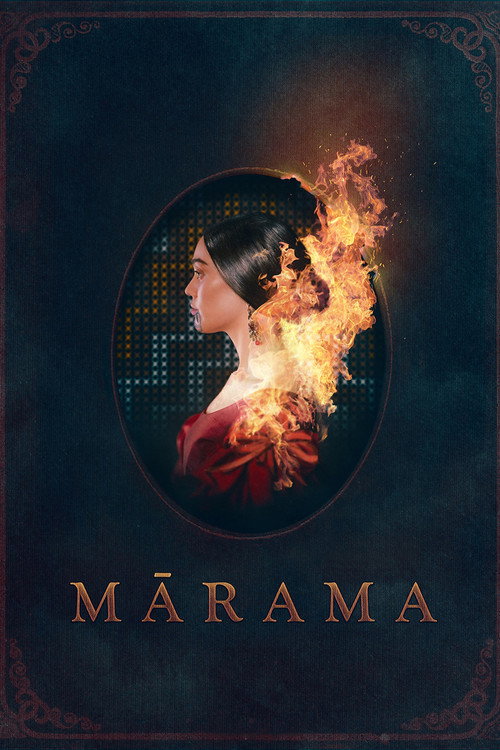
Mārama
2026 · Taratoa Stappard
For when you want horror with real weight behind it — a film that unsettles you and gives you something to sit with after. More a brooding, deliberate chill than a fun fright night; reach for it when you're up for a challenge.
What it's about
In 1859, a young Māori woman raised under the English name Mary Stevens sails from New Zealand to North Yorkshire after a stranger writes claiming to know the truth about her parents. The trail leads to a remote manor whose titled owner hires her as a governess — and whose hallways, unnervingly, are lined with Māori treasures an ocean from home. As she pieces together what her family suffered and who is responsible, a slow gothic mystery hardens into a story of reckoning and revenge.
The experience
A slow-burn that trades jump scares for mounting dread — the wrongness of hearing her own language in an English mouth, of sacred objects displayed as trophies. It simmers with grief and anger before turning sharp and violent, and the unease is as much historical as supernatural.
Performances
Ariāna Osborne carries the film as Mary, holding composure over a slow build of recognition and fury, while Toby Stephens brings a genteel menace to the manor's owner.
The craft
Writer-director Taratoa Stappard, in his feature debut, pours his own Māori and English heritage into the material, folding te reo Māori, taonga and Māori art into the visual fabric of an English gothic manor so the house itself becomes an argument. The period atmosphere is thick and tactile — candlelit interiors, moorland gloom — and it rewards a dark room and patience.
Why it matters
An announcement of a new voice in Indigenous horror — a Māori filmmaker seizing the gothic, the empire's own haunted-house tradition, and aiming it back at the empire.
Snapshot
Mārama is a Māori gothic horror film and the feature debut of writer-director Taratoa Stappard, who was born in Aotearoa New Zealand to a Māori mother and an English father. It is set in 1859. Mary Stevens (Ariāna Osborne), a young Māori woman raised under an English name, travels from New Zealand to North Yorkshire after a man writes to her claiming to know the truth about her parents. The trail leads to Hawkser Manor, where the owner, Nathaniel Cole (Toby Stephens), hires her as a governess. Inside the house she finds Māori taonga (treasured objects) and toi Māori (Māori art) lining the hallways. She hears te reo Māori, the Māori language, spoken in an English accent. Slowly she learns what her family suffered and who is responsible. The film moves from a slow-burn gothic mystery to a violent revenge story, and it reclaims her name, Mārama, as it goes.
The film premiered at the Toronto International Film Festival on 5 September 2025. It then played the genre circuit, including Sitges, Fantastic Fest, AFI Fest's After Dark section and Grimmfest, and in 2026 it screened at the Seattle International Film Festival and the Calgary Underground Film Festival. It opened in New Zealand cinemas on 12 February 2026 and in the United States on 17 April 2026. Critics were broadly enthusiastic. They praised its atmosphere, its production design and Osborne's lead performance, and they read it as a deliberate turning of the English gothic against the empire that produced it.
Industry & production
Sweetshop Entertainment produced the film. Sweetshop has long worked in international commercials and has more recently moved into features. The producers were Sharlene George, Rickylee Russell-Waipuka and Rouzie Hassanova. Paraone Gloyne served as Māori language and culture producer, which signals that cultural authority was built into the production rather than added as consultation afterwards. The executive producers were Victoria Dabbs and Gal Greenspan for Sweetshop, Jill Macnab and Phil Bremner for Vendetta Films, and Badie Ali, Hamza Ali and Greg Newman for MPI Media.
The project went through an unusually wide set of international development programmes. It had support from Te Tumu Whakaata Taonga (the New Zealand Film Commission), imagineNATIVE, The Black List, TIFF, the Zurich Film Festival and the Berlinale Co-Production Market. It was made in association with the NZFC, NZ On Air, Whakaata Māori and Images & Sound. That mix is typical of current Indigenous-authored genre cinema: public money at home, international development labs, and a festival launch aimed at genre-specialist distributors.
The film was shot in late 2024 in Auckland and the Otago region, so New Zealand stands in for North Yorkshire. This inverts the usual colonial direction of the period picture. Here the former colony's landscape doubles for the imperial centre.
Vendetta Films handled the New Zealand release. In North America the film was released by Dark Sky Films, a long-standing independent horror label, together with Watermelon Pictures, a distributor associated with politically engaged and anti-colonial titles. A video-on-demand release followed on 25 May 2026 through the Letterboxd Video Store. Reported box-office figures are modest, in the low six figures in US dollars, which is consistent with a limited arthouse and genre release.
Technology
The public record says little about the film's technical specifications, including capture format, lenses and post-production pipeline, so nothing is claimed here. As far as the record shows, it was made with ordinary contemporary digital production methods at a mid-budget independent scale. Its technical ambitions show mainly in production design, location doubling and sound, not in any new process.
Technique
Cinematography
Gin Loane shot the film. Reviews describe a controlled, atmospheric register suited to the country-house gothic: candlelit interiors, a manor whose rooms work as both museum and trap, and moorland exteriors filmed in southern New Zealand to read as Yorkshire. Critics most often praised the beauty of the frames and the house. Some noted that this composure makes the film slow, "lull[ing] more than it unsettles" in its early stretches. Detailed accounts of shot design are not yet in the critical record.
Editing
Dan Kircher edited the film. Reviewers describe a deliberate slow burn. Long passages of mystery and quiet discovery build to a final movement of sudden, graphic violence, and several critics felt the late violence lands harder because of the restraint before it. Some critics also describe ancestral visions whose supernatural status stays uncertain. Editing these passages into Mary's experience keeps open whether they are memory, haunting or inheritance.
Mise-en-scène / staging
Production design is the film's main argument. Hawkser Manor is filled with Māori taonga and toi Māori displayed as trophies. In The Spinoff, Lyric Waiwiri-Smith noted that these objects "adorn the hallways" as signs of colonial theft. The house is the classic gothic container of buried family secrets, but here it is also a private ethnographic collection, the kind of colonial archive built from objects taken out of context. The staging of a Māori cultural "celebration" inside the manor is the film's key setpiece. Several reviewers saw it as the point where the film shows that the collector's appreciation is desecration.
Sound
The score is by Karl Sölve Steven and Rob Thorne. Thorne is known as a practitioner of taonga pūoro, traditional Māori instruments. Pairing a composer of screen music with a taonga pūoro specialist suggests an Indigenous sonic layer running against the European gothic setting. Detailed analysis of the score is not yet available in published criticism. The script also uses language as sound: Cole's accented te reo Māori marks possession and mimicry, and Mary's own command of the language becomes a form of reclamation.
Performance
Ariāna Osborne plays both Mary/Mārama and a figure from the past, Emilia/Te Haeata. The dual role links the protagonist to her lost ancestor, and Osborne is at the centre of nearly all the praise. Waiwiri-Smith wrote that "the mana that comes through in Osborne's performance almost takes your breath away." In The Movie Waffler, Eric Hillis described her haka in the climax as the moment she "transform[s] before our eyes into a proud warrior." Toby Stephens, an experienced player of period drama, gives Cole an obsessive, proprietorial charm rather than open villainy. Reviewers also singled out Erroll Shand as the menacing Jack Fenton. Umi Myers, Evelyn Towersey, Jordan Mooney and Mihi Te Rauhi Daniels complete an ensemble split between the manor's English household and the Māori past.
Narrative & dramatic mode
The story is an investigation that turns into a reckoning. It starts with a letter promising the truth about the heroine's origins. That device is common in Victorian sensation fiction and gothic fiction, which often turn on orphaned heroines, hidden parentage and a summons to a remote house. The governess premise points directly to Jane Eyre and The Turn of the Screw, and Hillis names The Turn of the Screw and Dracula among the film's literary models. Dracula fits especially well: Stoker set much of his novel at Whitby on the North Yorkshire coast, and the film sends its colonised heroine into the same landscape.
The film's dramatic structure reverses its sources. In the Victorian gothic, the outsider or colonial "other" is often the threat that enters the English home. In Mārama, the English home holds the horror, and the colonial subject arrives as investigator and then avenger. Critics described a slow-burn first half that changes in the last act into a revenge narrative with sharp violence. That change splits opinion on pacing, but most reviewers judged the payoff earned.
Genre & cycle
The film belongs to several current cycles at once.
1. Period gothic revival. Films and series since the 2010s, such as Crimson Peak and the many Jane Eyre/Rebecca variants, have used the country house and its secrets as a horror engine. Mārama uses that grammar but changes whose secrets they are. 2. Indigenous horror and genre cinema. A growing body of work uses genre to stage colonial history, including Jeff Barnaby's Rhymes for Young Ghouls (2013) and Blood Quantum (2019) and Danis Goulet's Night Raiders (2021). In Aotearoa there are Māori-led genre and action films such as Toa Fraser's The Dead Lands (2014). 3. *"Social horror" after Get Out. Hillis makes the comparison directly, writing that Stappard "does for British colonialists here as Jordan Peele did for white American liberals." The shared structure is a guest in a grand house discovering that their hosts' admiration is predation. 4. Colonial revenge narrative. The film belongs alongside Jennifer Kent's The Nightingale (2018), set in colonial Tasmania, and, within New Zealand cinema, Geoff Murphy's Utu* (1983), the landmark revenge film of the New Zealand Wars. 5. Inverted folk horror. Hillis's reading recasts the folk-horror model, in which an outsider is consumed by a community's rites, as a story in which Indigenous ritual becomes the protagonist's source of power.
Authorship & method
Taratoa Stappard (writer-director). Stappard has a Māori mother and an English father, and the film's premise mirrors that dual heritage: a Māori woman with an English name sent "home" to an England that holds her family's ruin. Its long development, through imagineNATIVE, The Black List, the TIFF and Zurich programmes and the Berlinale Co-Production Market, suggests a carefully built debut. The record on his earlier short-form or screen work is not covered in sources consulted here and is left out.
Key collaborators:
- Gin Loane (cinematographer): a New Zealand cinematographer who shapes the film's atmospheric period look.
- Dan Kircher (editor): shapes the slow-burn rhythm and the late shift into violence.
- Karl Sölve Steven and Rob Thorne (composers): a score that brings taonga pūoro into a European gothic setting.
- Paraone Gloyne (Māori language and culture producer): responsible for the integrity of te reo and tikanga (Māori custom) on screen. This role is now standard practice in Māori-led productions and is central to how the film's cultural material works.
The authorial method is to write from inside a cultural and linguistic position the gothic usually treats as exotic. The fetishised objects and borrowed language are things the film critiques, not decoration.
Movement / national cinema
Mārama belongs to the tradition of Māori filmmaking that runs from Barry Barclay's Ngati (1987) and Merata Mita's Mauri (1988), the first dramatic features directed by Māori, through Once Were Warriors (1994), Taika Waititi's films, Cousins (2021) and Tearepa Kahi's Muru (2022). Barclay's idea of "Fourth Cinema," an Indigenous cinema made from within Indigenous ways of seeing, is the obvious lens. The film's use of te reo, taonga and haka as structural elements rather than ethnographic colour fits that framework.
It also continues New Zealand's strong genre-film tradition, from Peter Jackson's early splatter films to Housebound (2014), What We Do in the Shadows (2014) and Coming Home in the Dark (2021). It adds an explicitly decolonial Māori voice to that genre lineage. The co-financing of NZFC, NZ On Air and Whakaata Māori reflects the public-funding structure behind much of recent Māori screen production.
Era / period
The story is set in 1859, a pointed choice. It falls between the Treaty of Waitangi (1840) and the outbreak of the Taranaki War in 1860, a period of growing settler land pressure in New Zealand. In Britain it was the height of Victorian collecting, when Māori artefacts and human remains entered British museums and private houses. The manor's "collection" invokes that history, which also bears on present-day repatriation campaigns.
As a 2025–26 production, the film reflects its own moment: museum restitution debates, wider recognition of Indigenous screen sovereignty, and, as The Spinoff noted, its New Zealand release amid ongoing political argument there over the legacy of colonisation and the place of the Treaty.
Themes
- Colonial collecting as horror. The manor is a cabinet of stolen taonga, and the horror is the realisation that one's culture, and one's kin, have been made into property.
- Fetishisation and the sexualised Māori woman. Waiwiri-Smith singles out the film's critique of how colonial desire reduced Māori women to caricature and object.
- Language and mimicry. Cole's accented te reo shows that knowing a culture is not the same as respecting it. Mary's reclaimed fluency and her reclaimed name are acts of sovereignty.
- Inheritance and ancestry. The dual casting of Osborne, together with visions that stay supernaturally ambiguous, makes the ancestors present. The past is a living claim, not just a ghost.
- Mana and the haka. The climax turns a performance once staged for colonial spectators into an assertion of power and retribution.
- Reversing the gothic. England, not the colonial "periphery," is the dark heart. The film uses the empire's own literary form to tell the history the empire left out.
Reception, canon & influence
Critical reception. Reviews have been strongly positive across New Zealand, British and North American outlets. Rotten Tomatoes recorded a uniformly positive aggregate at the time of writing, with a consensus calling it "thoughtfully informed by Māori culture and the legacy of colonialism" and told "with invigorating flair." Waiwiri-Smith called it "a masterclass in modern Māori storytelling," noting that it builds dread without relying on "gore, bloodshed or cheap thrills" in its early stretches. Hillis placed it in the line of Dracula, The Turn of the Screw and Get Out. The main reservation, voiced in some reviews, is a slow pace that can blunt the tension before the final act. A few reports say the film won a top prize at SIFF 2026, but the sources consulted here do not settle which award, so this should be checked before it is cited.
Influences on the film (backward). These include the Victorian gothic and sensation novel (Jane Eyre, The Turn of the Screw, Dracula and its Whitby setting), the country-house horror tradition, Peele's social horror, the folk-horror form it inverts, colonial revenge films such as Utu and The Nightingale, and Māori cinema from Barclay and Mita onward.
Legacy (forward). As a 2025–26 release, the film's influence cannot yet be measured, and claims of lasting impact would be premature. For now its significance lies in demonstrating three things: a Māori-authored film can take on the English gothic on its own ground; Indigenous cultural production roles can shape genre filmmaking; and a decolonial horror film can travel the international festival and genre-distribution circuit. Whether it starts a wider cycle of Indigenous period gothic, or proves a strong standalone debut, is a question for later film history.
Influences: the films it descends from and the films it influenced
- The Innocents (1961) — Freddie Francis's deep-focus CinemaScope frames and apparitions placed at the edge of the frame (Miss Jessel across the lake) set the model for withholding ghosts. Mārama's 'ambiguous ancestral visions' build the same doubt about whether the heroine is seeing things or the house is haunted.
- Jane Eyre (2011) — Adriano Goldman shot interiors by real candle and firelight with minimal fill, so faces sink into the dark of the English country house. Mārama uses the same naturalistic light for the governess-style arrival of a young woman into a manor that hides a secret.
- Barry Lyndon (1975) — Kubrick shot by pure candlelight on ultra-fast f/0.7 lenses, which made period interiors look painted. Every candlelit country-house gothic since, Mārama included, works from this image of how a pre-electric estate looks at night.
- Bram Stoker's Dracula (1992) — Coppola treats Stoker's Whitby and his foreign aristocrat as a story of contagion moving into England. Mārama inverts that: the 'foreign' visitor arriving in Yorkshire is the one who has been preyed upon, and the English house is the vampire.
- The Wicker Man (1973) — An outsider walks into a closed community's festivities, and a celebration grows sinister in stages before a ritual climax. Mārama takes this folk-horror structure and inverts it, so the 'pagan' ritual violence belongs to the English hosts.
- Utu (1983) — Murphy staged the NZ Wars as a utu (revenge) narrative that mixes period genre action with grim irony and shifts sharply into graphic violence. Mārama's colonial-revenge escalation follows this template, set in the same nineteenth-century conflict.
- Ngati (1987) — The first feature written and directed by a Māori filmmaker. Barclay's 'Fourth Cinema' method (camera placed inside the community, cultural protocol governing what is filmed) is the basis for Mārama's Māori language and culture producer role.
- Mauri (1988) — Mita built a Māori narrative around mauri (life force), visions of ancestors and the living presence of the dead, framed by colonial land loss. This is the source of Mārama's treatment of ancestral presence as real, not just symbolic.
- The Others (2001) — A light-starved house justified in the story (no electricity, curtains always drawn) and a late twist that reverses who is haunting whom. Mārama makes the same reversal: the English inhabitants become the ghosts of colonial history.
- Get Out (2017) — Peele's garden-party sequence, with polite white hosts examining a Black guest as a commodity, is the direct model for Mārama's desecrating celebration set piece. The same polite-but-predatory staging escalates into a violent breakout.
- The Nightingale (2018) — Kent kept Palawa kani and Irish dialogue unsubtitled or minimally subtitled and refused to aestheticise colonial violence. Mārama's political use of language (te reo against accented, mimicked English) and its brutal colonial-revenge register come from this approach.
- Crimson Peak (2015) — Del Toro built a decaying English gothic manor on Canadian soundstages to stand in for northern England. Mārama uses the same production approach, with New Zealand doubling for Yorkshire, and both treat the house as a predatory collection of the family's sins.
- The Dead Lands (2014) — A te reo Māori genre film whose fight choreography was built on mau rākau (traditional weaponry) under cultural advisors. It is the precedent for Mārama's climactic haka being staged as authentic martial and ceremonial performance rather than spectacle.
- Night Raiders (2021) — A Cree–Māori co-production (with Ainsley Gardiner) that used the same imagineNATIVE-to-international-market route as Mārama. Both show Indigenous cultural production roles shaping a genre film made for the festival circuit.
- His House (2020) — A British-made horror film in which the haunting of an English house comes from the protagonists' own ancestral and colonial history. Like Mārama, it uses dream-logic visions that can be read as either supernatural or traumatic memory.
- Nosferatu (2024) — Jarin Blaschke's near-monochrome candle and moonlight photography and Eggers's period-researched dialogue. Mārama shares this commitment to historically exact speech and lighting inside a reworked Victorian Dracula story.
- Sinners (2025) — A period genre film in which ancestral music (Ludwig Göransson's blues score) summons the dead at a communal celebration that turns into a massacre. It parallels Mārama's taonga pūoro score as an ancestral force and its desecrated-celebration climax.
- Midsommar (2019) — Aster stretches a festive gathering through a long slow burn and then breaks into sudden, explicit graphic violence. Mārama's editing follows the same deliberate pattern of patient dread followed by sudden gore, which reviewers both praised and criticised.
Similar films
- Nosferatu (2024) — influence & lineage
- The Nightingale (2018) — influence & lineage
- Crimson Peak (2015) — influence & lineage
- Bring Her Back (2025) — shared sensibility
- Impetigore (2019) — shared sensibility
- Grave Torture (2024) — shared sensibility
- Enys Men (2023) — shared sensibility
- Hokum (2026) — shared sensibility