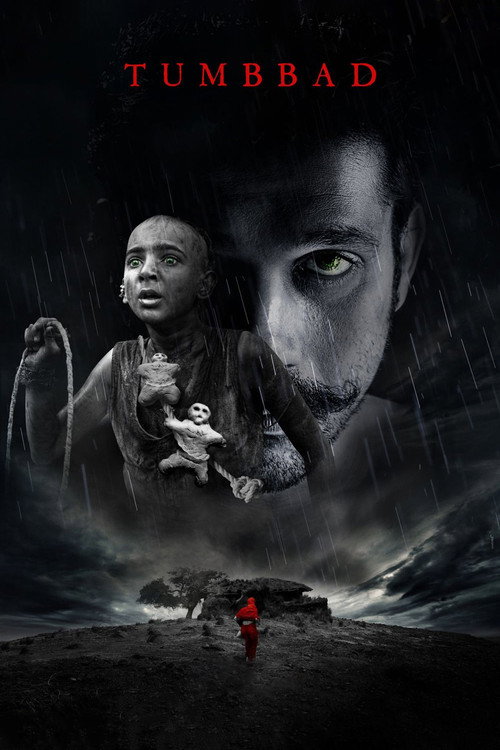
Tumbbad
2018 · Rahi Anil Barve
For when you want horror with weight — a dark fable to sink into on a stormy night, something that unsettles you and gives you an idea to chew on afterward. Challenge more than comfort, but gorgeous enough to go down easy.
What it's about
India, 1918. In a cursed village where the rain never stops, a boy named Vinayak becomes obsessed with an ancestral treasure guarded by a monstrous old woman his family keeps in a locked room. Told in three chapters spanning 1918 to 1947, it follows him into adulthood as he keeps returning to Tumbbad — and passes the obsession down — in a fable where greed isn't a moral failing but a machine that runs across generations.
The experience
Sumptuous and dread-soaked, more fairy tale than jump-scare horror — it builds unease through atmosphere, ritual, and the queasy logic of a bargain that keeps paying out. Slow-burning but never slack, and genuinely frightening when it wants to be.
Performances
Sohum Shah, who also produced the film through its long gestation, plays Vinayak across decades with a greedy, magnetic swagger that curdles slowly — you watch appetite become a way of life.
The craft
Fourteen years in the making, it looks like nothing else in Indian horror: perpetual rain, oil-lamp interiors, a red womb-like underworld, all rendered with painterly period detail. The sound design and score do heavy lifting, and the visuals genuinely reward the biggest, darkest screen you can find.
Why it matters
A slow-building word-of-mouth phenomenon that became a modern landmark for Indian genre cinema, proving mythological folk horror could be both artful and commercial.
Snapshot
A Hindi-language period horror-fantasy set in the Konkan hinterland of colonial Maharashtra, Tumbbad traces three generations of a family bound to a buried god of gold. It is a fable about extraction — of wealth, of inheritance, of the body — told in three chapters dated 1918, 1933 and 1947, so that the protagonist's private career of accumulation runs precisely alongside the last three decades of the Raj. The film opens with an epigraph attributed to Gandhi ("The world has enough for everyone's need, but not for everyone's greed"), then spends 104 minutes demonstrating that the maxim is not a moral but a mechanism.
Its production history is inseparable from its reputation: director Rahi Anil Barve began writing in the 1990s, completed a first draft at eighteen, drew a 700-page storyboard, saw the project collapse and restart repeatedly, and finished it only after a full re-write and re-shoot. Premiered in Critics' Week at the 75th Venice Film Festival — the first Indian film selected for that sidebar — it opened in India in October 2018 to strong reviews and modest business, accumulated a cult following on streaming, and in September 2024 returned to theaters and outgrossed its entire original run within roughly a week. That second life is now the standard example cited in Indian exhibition for the viability of re-releases.
Industry & production
Tumbbad is an unusual object in Hindi-cinema industrial terms: an art-horror film financed as an international co-production. The credited production companies include Sohum Shah Films, Aanand L. Rai's Colour Yellow Productions, Eros International (also distributor), and — decisively — the Swedish outfits Filmgate Films and the regional fund Film i Väst. Producers are listed as Sohum Shah, Aanand L. Rai, Anand Gandhi, Mukesh Shah and Amita Shah. The Gothenburg connection is not cosmetic: Filmgate handled the visual effects, and Swedish co-financing is what allowed a first-time director's creature picture to be made at a reported budget of roughly ₹15 crore without being pushed toward star casting or item numbers.
The road there was long. Barve has said the project entered production as early as 2008, with Nawazuddin Siddiqui attached, before the financier withdrew; by his account it went through three separate starts and was passed on by seven companies, the recurring objection being that the film had no "frame of reference" — nothing in the market resembled it. Principal photography finally began in 2012, during monsoon, after Sohum Shah (who also plays the lead) and Anand Gandhi came aboard. Barve and Shah judged the assembled result a failure, and the film was substantially rewritten and reshot, with photography completed in May 2015 and post-production running roughly two and a half more years. Shah gained about eight kilograms for the role and held the weight across the six-year span so that footage would cut together.
The economics are worth stating plainly. The 2018 theatrical run, on fewer than 600 screens, returned roughly ₹15 crore net in India — recovery, not profit at scale. The 2024 re-release, in a restored presentation, took approximately ₹38 crore, more than doubling the original. Combined, the two runs total around ₹53 crore. A sequel, confirmed during the re-release with a teaser in September 2024, is reported to center on Vinayak's son Pandurang and the theme of immortality.
Technology
The film was shot digitally on RED cameras. Pankaj Kumar's stated constraint was absolute: no sunlight anywhere in the film. Production waited on cloud cover, sometimes for hours, to hold a uniform overcast gray, and shot across two monsoon seasons rather than scheduling around cast availability — with artificial rain supplementing natural rainfall when the weather failed to cooperate. The long production timeline was in part a consequence of this: the film's texture required weather that arrives only a few months a year.
Location technology was, inversely, a matter of avoidance. The production could not afford to paint out mobile towers, power lines and modern construction, so scouting ran for years in search of landscapes without contemporary intrusion — Saswad, villages in Satara district, Mahabaleshwar, and the Purandare Wada near Pune, which supplied cave interiors. The underground chamber that houses the god was built in Mumbai and shot over roughly fifteen to twenty days with, by Kumar's account, minimal visual effects; the climactic descent was lit by a single oil lamp.
Hastar, the creature, is a hybrid of prosthetic makeup (by Gurpreet Singh Dhuri, requiring six to seven hours in the chair) and digital augmentation from Filmgate. The choice to build the monster physically and extend it digitally, rather than the reverse, is the film's central technical wager and the main reason its creature has aged better than most contemporaneous Indian VFX work. Filmgate's contribution won Best Special Effects at the IIFA Awards and Best Visual Effects at Screamfest.
Technique
Cinematography
Pankaj Kumar — who had already shot Anand Gandhi's Ship of Theseus (2012) and Vishal Bhardwaj's Haider (2014) — organized Tumbbad around four color schemes: blue, cold gray, red and gold. The exteriors live in the first two; the interiors of the ancestral mansion, and above all the subterranean womb, in the last two. Roughly fifty lanterns and oil lamps served as practical sources, both for period plausibility and to produce a falloff that modern instruments smooth out. The result is a controlled underexposure: faces surface out of ochre darkness and sink back, and the frame frequently withholds more than it shows.
The film's compositional habit is to place small figures against large, wet, ruined space — the crumbling wada under sheeting rain, the road out of the village, the temple mound. Critics reached repeatedly for painterly analogies, and the comparison to nineteenth-century Indian oleograph traditions is apt in palette if not in iconography. Kumar's work took Best Cinematography at the Filmfare Awards, the Screen Awards, Sitges and the Critics Choice Film Awards, India — an unusually clean sweep.
Editing
Sanyukta Kaza's contribution is the least visible and among the most consequential. Reports of the cut describe an assembly of roughly 200 minutes reduced to a 104-minute release version, with Kaza requesting dialogue rewrites during post — that is, the editor functioning as a late-stage writer. The compression shows in the film's most distinctive structural feature: the elisions between chapters. Fifteen years pass between the first and second parts and fourteen more before the third, and the film simply steps across them, trusting the audience to reconstruct the intervening career from its residue — a house, a wife, a mistress, a son, a habit. Within scenes the cutting is patient and often holds on Vinayak's face after the information has landed, letting appetite register as duration.
Mise-en-scène / staging
Nitin Zihani Choudhary and Rakesh Yadav's production design (Filmfare, Zee Cine and Critics Choice awards for art direction) builds the film's argument into its spaces. Everything above ground is decaying, waterlogged, overgrown — a feudal order visibly dissolving. Everything below ground is organic, red, warm and enclosed: the treasure chamber is explicitly a womb, entered by a descent down a rope through a fleshy aperture, and Hastar sleeps in it as a fetus. The film thus stages accumulation as a return to the maternal body and theft from it, which is the source of its unusual charge.
Staging is repetitive by design. The dough-doll ritual — bait thrown to distract the god long enough to snatch a single coin — is executed several times with escalating variation, so that the audience learns the rules and then watches greed break them. The film's horror is procedural rather than sudden: it depends on our knowing exactly how much is enough.
Sound
Kunal Sharma's sound design won at Filmfare and IIFA (the latter for sound recording), and the film's soundscape is built on a near-continuous bed of rain — falling, dripping, pooling — against which any silence reads as threat. Hastar registers acoustically before he registers visually: breath, chain, a low wet articulation.
The score is by Jesper Kyd, the Danish composer best known for the Hitman and Assassin's Creed games; Ajay–Atul are credited for songs. Kyd's hire is the film's most legible international gesture, and his idiom — sustained drone, textural rather than thematic writing, restraint about melody — keeps the film away from the emphatic sting-based scoring conventional in Hindi horror. The score was nominated at Filmfare and won at the Critics Choice Film Awards, India.
Performance
Sohum Shah's Vinayak is the film's spine and a deliberately unlikeable creation: sullen as a boy, curdled as a young man, imperious and frightened in middle age. Shah, a Rajasthani actor, worked extensively on Marathi-inflected diction, and wore gray contact lenses throughout — a small choice that drains warmth from the performance's center. Jyoti Malshe as the mother carries the first chapter's moral weight; Anita Date-Kelkar plays the wife with a watchful, unsentimental practicality; Mohammad Samad, as the son Pandurang, gives the third chapter its horror by reproducing his father's appetite without any of his caution. The Screen Awards recognized Samad and Dhundiraj Prabhakar Jogalekar (young Vinayak) jointly for child performance.
Narrative & dramatic mode
Tumbbad is a fable with a prologue, not a mystery. A narrated creation story establishes the cosmology up front: a goddess of prosperity, mother of all gods; her first-born Hastar, who seized all the gold and reached for the food; his mutilation by the other gods; his mother's intervention on condition that he never be worshipped. The village of Tumbbad breaks that condition, and is cursed with perpetual rain.
The three-chapter structure — Barve has described it as a metaphor for India's own trajectory — is generational rather than escalatory in the usual horror sense. Chapter one is a child's story about a monstrous ancestor kept chained and sleeping. Chapter two is a heist told as a trade. Chapter three is a transmission: the father teaching the son. The film's dramatic mode is closer to the frame-tale traditions of Vikram–Betal and the Panchatantra than to the Anglo-American haunted-house plot; a moral is stated at the outset and then dramatized without irony but also without mercy. There is no redemption arc and no investigative structure. Vinayak learns nothing, and the film's final movement is about whether the curse can be refused rather than solved.
Genre & cycle
Hindi horror had for decades occupied a low-prestige exhibition niche, defined commercially by the Ramsay Brothers' 1970s–80s cycle (Purana Mandir, Veerana) and, at the classier end, by the gothic melodrama descending from Mahal (1949) and later Ram Gopal Varma's Bhoot (2003). Tumbbad arrived in a remarkable single year — 2018 also produced Prosit Roy's Pari and Amar Kaushik's Stree — that collectively re-legitimised the genre for mainstream Indian audiences by attaching it to, respectively, art-horror craft, folk myth and comedy.
Within that cluster Tumbbad is the folk-horror pole: place-bound, mythologically self-authored, indifferent to jump scares. Its clearest successors are Anvita Dutt's Bulbbul (2020), which similarly fuses period gothic with a feminist reading of feudal violence, and Rishab Shetty's Kannada Kantara (2022), which shares its structure of a local deity, contested land and a body possessed by inheritance. The Maddock horror-comedy line (Bhediya, Munjya, Stree 2) took the other fork, but the commercial permission for both was granted in 2018.
Authorship & method
Barve is the film's originating consciousness and its method is unusually documented for a debut. He began writing in the early 1990s, inspired by the Marathi horror writer Narayan Dharap — specifically the story "Aaji," with elements from "Bali" — and finished a first draft in 1997 at eighteen. Between 2009 and 2010 he spent roughly eight months producing a 700-page storyboard that he has called the anchor for everything that followed. The title itself is borrowed from Shripad Narayan Pendse's Marathi novel Tumbadche Khot.
Authorship is nonetheless genuinely distributed here, and the record is thin on exactly how. Adesh Prasad is credited as co-director; Anand Gandhi, director of Ship of Theseus, is credited as creative director and producer and is widely understood to have shaped the film's conceptual architecture and its second, successful pass. Screenplay credits are shared between Gandhi, Barve, Mitesh Shah and Prasad, with story credited to Dharap. How much of the released film derives from the 2012 shoot versus the post-2013 reconstruction has never been publicly itemized, and claims about who authored which element should be treated with caution. What is documented is that the key collaborators — Kumar, Kaza, Choudhary and Yadav, Kyd, Sharma, Dhuri — each produced award-recognised work, and that Sohum Shah's dual role as producer and lead is what kept the project alive through a decade of collapses.
Movement / national cinema
Tumbbad sits at a junction of three currents. The first is the independent Hindi cinema of the 2010s — Gangs of Wasseypur, Ship of Theseus, Masaan, Newton — which established that formally ambitious work could find theatrical distribution through hybrid financing; Aanand L. Rai's Colour Yellow functioned as the bridge to mainstream release. The second is the Marathi new wave (Fandry, Court, Sairat), whose interest in caste, rural land and vernacular texture the film shares even while working in Hindi: the milieu, the diction, the wada architecture and the deity are all Maharashtrian. The third is transnational genre co-production, via Film i Väst and Filmgate — the Scandinavian public-funding model applied to an Indian creature feature.
Era / period
The period settings are load-bearing. 1918 places the first chapter at the end of the Great War, in a countryside still organized around the sarkar — the local landholder whose illegitimate son Vinayak is, and whose death sets the family adrift. 1933 finds Vinayak in a colonial-era market economy where his gold must be laundered into respectability. 1947 sets the last chapter at Independence, with a British sergeant on screen and the currency about to change: the film's most quietly devastating idea is that the transfer of power threatens Vinayak's business model, and that his response is not political but purely proprietary. The wealth extracted from beneath Tumbbad is thus mapped onto the whole arc of late colonial India and, by implication, onto what came after.
Themes
Greed is the announced theme, but the film's more specific subject is inheritance — wealth and curse as the same transmitted object. The god is reached through a womb; the coin is taken from a body; the trade is taught from father to son. Reproduction and accumulation are made structurally identical, which is why the film's women (a mother who exacts a promise, a wife who wants a normal life, a mistress who is kept) function as the sites where the cost is paid.
A second strand, developed at length in Indian criticism, concerns caste and Brahminical privilege: Vinayak is a Brahmin, the illegitimate heir to a feudal position, and the film is precise about how ritual authority, land and access to the sacred are inherited together and defended jealously. A third is ecological and cosmological: Tumbbad's endless rain is punishment for worshipping a god the pantheon forbade, and the film's world is one where the earth withholds and the underground holds only appetite.
Notably, the mythology is invented rather than scriptural. Hastar has no place in Hindu canon; the name derives, through Dharap's engagement with Lovecraftian material, from Hastur — a figure originating with Ambrose Bierce, elaborated by Robert W. Chambers and absorbed into the Cthulhu Mythos. Tumbbad thus fabricates a folk religion in the register of one, which is both its most audacious move and the reason its cosmology feels older than it is.
Reception, canon & influence
Indian reviews in October 2018 were strong and unusually focused on craft. Baradwaj Rangan wrote that it had been a while since something genre-based turned out so rich and mysterious, so defiantly its own thing; Shubhra Gupta in The Indian Express called it highly unusual and visually stunning; Sanjukta Sharma in Scroll.in praised its subversion of genre without gimmickry and its fidelity to an Indian setting; Namrata Joshi identified the Gothic dread in its landscape; Anna M. M. Vetticad valued its refusal to explain itself. Internationally, Deborah Young in The Hollywood Reporter called it atmospheric, heavy on mythology and scary as hell, while Screen International's Lee Marshall dissented, finding the film let down by thin characterization and a long stretch of fright-free period drama — a criticism echoed by some genre outlets about the second half's pacing. The film holds a strong aggregate critical standing in Anglophone tallies.
Awards followed the craft: three Filmfare wins (cinematography, art direction, sound design) from eight nominations; Best Film in Sitges' Focus Àsia strand plus cinematography; Best Picture and Best Visual Effects at Screamfest; special effects and sound at the IIFAs; cinematography, production design and background score at the Critics Choice Film Awards, India. Barve's nomination for Best Director at the latter is one of the few nods the direction itself received, which is itself telling about how the film was initially read.
Backward, its lines of influence are legible: Narayan Dharap's Marathi horror fiction (itself a conduit for Stephen King's "Gramma" and Lovecraft); Pendse's novel for the name; and, in critical reception if not in demonstrated citation, Guillermo del Toro's Cronos, The Devil's Backbone and Pan's Labyrinth, whose model of the historical fable told through a child and a monster Tumbbad clearly shares. Reviewers also reached for Eraserhead and for Tarsem Singh. To these one might add, as affinity rather than claimed source, Satyajit Ray's Jalsaghar (1958) — the same crumbling mansion, the same landlord ruined by an appetite he mistakes for a birthright.
Forward, the film's influence has grown rather than faded. It supplied the template for prestige Indian folk horror that Bulbbul and Kantara extended; it demonstrated that a Hindi genre film could open a Venice sidebar; and its 2024 re-release — surpassing its entire 2018 gross in about eight days, and ranking among the highest-grossing Indian re-releases on record — became the proof case that catalog titles could be re-monetised theatrically in India, prompting a wave of imitators. A sequel centered on Pandurang was confirmed alongside that re-release. Eight years on, Tumbbad occupies a position few debut genre films reach: a commercial disappointment that became a canon entry by attrition, and then, unusually, became a hit.
A Deleuzian reading
A man lowers himself on a rope into a hole in the ground.
The full Deleuzian reading of Tumbbad →
Reception
Barely made a ripple in Indian cinemas in 2018, then streaming word-of-mouth turned it into a phenomenon — so much so that its 2024 theatrical re-release out-grossed the original run, a genuine flop-to-classic arc completed in six years.
How Tumbbad was received, from release to now →
How to watch Tumbbad: what to notice on a first viewing
- Count the coins Vinayak takes on each descent. The dough-doll ritual repeats with escalating variation, teaching you its exact rule before greed breaks it. The horror is procedural: you know precisely how much is enough, then watch a man decide it isn't.
- Notice that no shot ever shows direct sunlight. Pankaj Kumar shoots under constant overcast, lighting interiors with roughly fifty lanterns so faces surface out of dark and sink back. The whole world stays underlit, so danger never fully resolves into something you can see coming.
- Listen for Hastar's breath and chains before you see him. Kunal Sharma builds a near-continuous bed of rain, so any silence reads as threat, and the god registers as sound before as image. The film makes you feel a threat you cannot locate, well before it lets you see it.
- Watch the color shift between the wada and the tunnel below. Kumar keeps exteriors and the mansion in blue and cold gray, the underground chamber in warm red and gold. The palette marks two worlds: the decaying feudal surface and the appetite that sustains it underneath.
- Watch Sohum Shah's face after each scene's information lands. Sanyukta Kaza's cuts hold on Vinayak past the point of narrative need, letting appetite register as duration rather than reaction. You get a body registering want instead of a mind making a decision.
The whole guide to watching Tumbbad, with the keys for a rewatch →
Influences: the films it descends from and the films it influenced
- Jalsaghar (1958) — The decaying wada as protagonist — chandelier- and oil-lamp-sourced interiors (Subrata Mitra) with the outside reduced to rain, river and erosion, staging a zamindar consumed by an inherited appetite he mistakes for a birthright.
- Teen Kanya ("Monihara") (1961) — A frame tale told aloud by a stranger at dusk, wrapping a ghost story of jewellery-greed set in a lamplit crumbling mansion — the exact device of Tumbbad's mythological prologue/epilogue and its logic that the hoard consumes its holder.
- Ugetsu (1953) — Indigenous literary folk tales adapted into a supernatural parable of a man who abandons family for gain, with mist and rain sustained as an unbroken atmospheric bed rather than a discrete weather effect.
- The Night of the Hunter (1955) — Expressionist greed-fable in storybook register: hidden money, a monstrous adult stalking children, and figures cut as hard silhouettes out of near-black frames — the controlled-underexposure grammar and moral-tale narration Tumbbad adopts.
- Barry Lyndon (1975) — Period interiors lit only by their own candles and lamps so faces fall off into darkness, paired with a chaptered, ironically narrated arc tracking a fortune-hunter's rise and collapse across decades.
- Eraserhead (1977) — A continuous low-frequency industrial drone used as the film's sound floor instead of cue-based scoring, plus a practically built monstrous offspring the film flatly refuses to explain — the model for Tumbbad's rain bed, Kyd's drone score and Hastar's withheld etiology.
- Purana Mandir (1984) — The Ramsay Indian-gothic kit — cursed deity, ancestral haveli, storm-lashed nights, latex-prosthetic creature — which Tumbbad inherits wholesale but re-executes with restraint, showing the prosthetic only in fragments extended digitally.
- Cronos (1993) — An alchemical device granting extended life at escalating bodily cost, realized as a tactile practical prop and staged as addiction through a repeated feeding ritual — the structural engine of Tumbbad's dough-and-coin bargain.
- The Devil's Backbone (2001) — Navarro's restricted amber/ochre-against-cold-blue palette, gold hidden inside the building's own walls, and a ghost built as a prosthetic performer with only light digital extension — the precise method of Hastar's make-up-plus-CG design.
- Pan's Labyrinth (2006) — A mythic voice-over prologue that reframes a historical period as fable, then a rule-bound descent into a uterine underground chamber where taking the food or gold wakes the monster.
- Se7en (1995) — Khondji's rule that daylight never arrives: perpetual rain as an unbroken visual and sonic bed, crushed blacks held through deliberate underexposure, and practical sources as the only readable light in frame.
- The Fall (2006) — A story-within-a-story narrated to a listener in which production design and one dominant hue per location carry the exposition — the Tarsem grammar critics reached for in Tumbbad's palette-locked chapters.
- Bulbbul (2020) — Takes Tumbbad's prestige-folk-horror template intact: a decaying haveli, a hard color rule (saturated crimson night exteriors), mythic frame narration, and regional demon lore shot as art cinema rather than as Ramsay pastiche.
- Kantara (2022) — Opens on a prologue frame-tale of a landlord's bargain with a local deity whose unpaid debt falls on descendants, and makes regional ritual — Bhoota Kola possession — the horror engine and climax rather than set dressing.
- Bramayugam (2024) — The closest formal heir: a decaying feudal mana with no daylight at all, interiors carried by oil lamps and torches, and a hoarding sorcerer-landlord bound to a repeated feeding ritual across a chaptered structure.
- There Will Be Blood (2007) — Extraction staged as bodily appetite via hard elliptical cuts that jump years without titles, Elswit's fire- and lamp-lit underexposed interiors, and Greenwood's sustained string drone used as pressure rather than melody.
- The Witch (2015) — Contemporaneous period folk horror built from a regional written source, lit to candle and available sources with no clean daylight, dread carried by a sustained dissonant score and a creature kept almost entirely offscreen.
Similar films
- Kantara (2022) — influence & lineage
- Thaniyavarthanam (1987) — shared sensibility
- Satantango (1994) — shared sensibility
- Kumbalangi Nights (2019) — shared sensibility
- The Turin Horse (2011) — shared sensibility
- Gangs of Wasseypur - Part 1 (2012) — shared sensibility
- Manjummel Boys (2024) — shared sensibility
- Chithha (2023) — shared sensibility