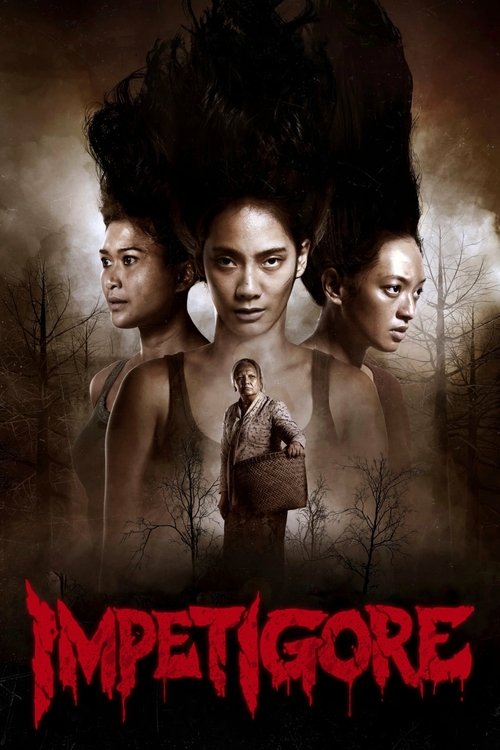
Impetigore
2019 · Joko Anwar
When you want horror with texture and a sense of place — a film to sink into rather than jump through — and you have the stomach for it going hard. Definitely the challenging end of the genre, best appreciated when you're up for something grim and strange.
What it's about
A young woman scraping by in the city learns she may have inherited a house in the remote Javanese village where she was born — and travels there with her best friend to claim it. What she doesn't know is that the village is under a curse its people blame on her family, and that some of them believe killing her is the only way to lift it.
The experience
A thick, sinister slow burn that erupts into genuinely shocking violence — the village feels wrong from the first frame, and the film keeps peeling back layers of folklore, shadow-puppet ritual, and buried family guilt. It's beautiful and brutal in roughly equal measure.
Performances
Tara Basro is a compelling, resourceful lead, and Christine Hakim — a legend of Indonesian cinema — brings unnerving gravity to the village matriarch.
The craft
Anwar shoots the village as a world unto itself: wayang kulit shadow puppets, torchlit roads, a house kept like a wound. The cinematography is lush and oppressive at once, and the film's violence is staged with a folk-tale bluntness that lands harder than standard genre gore. It rewards a dark room and a big screen.
Why it matters
Premiering at Sundance and chosen as Indonesia's Oscar submission, it carried the Indonesian horror wave onto the international stage and confirmed Anwar as a filmmaker festivals watch.
Snapshot
Impetigore (Indonesian title: Perempuan Tanah Jahanam, roughly "Woman from the Damned Land") is Joko Anwar's folk-horror film about inheritance, guilt and a curse. Maya (Tara Basro) is a young woman scraping a living in the city. After an attack by a stranger who calls her by another name, she travels with her friend Dini (Marissa Anita) to Harjosari, the Javanese village of her birth. There she hopes to claim a family house and some money. The village is cursed: for years its babies have been born without skin. The answer to that horror lies in Maya's own forgotten past, in the family of the village's dalang (wayang kulit puppet master), and in a matriarch played by Christine Hakim, a central figure of Indonesian cinema.
The film followed Anwar's commercial breakthrough with Satan's Slaves (Pengabdi Setan, 2017). It moved his horror out of the haunted suburban house and into the rural, ritual landscape of Central Java. It was released in Indonesia in October 2019, played the Midnight section of the Sundance Film Festival in January 2020, and was distributed internationally by the horror streaming service Shudder. It became one of the most visible Indonesian films abroad in that period and was Indonesia's submission for the Academy Award for Best International Feature Film. At home it was the most decorated film at the 2020 Festival Film Indonesia (the Citra Awards).
Industry & production
The film was produced by BASE Entertainment, the company led by producer Shanty Harmayn. Its co-production and financing partners included the Asia-focused Ivanhoe Pictures and the Korean conglomerate CJ ENM (CJ Entertainment). That arrangement is typical of the Indonesian film industry in the late 2010s. Regional capital, especially Korean, had begun investing in local genre production, and CJ had already backed Satan's Slaves. Horror was the most dependable commercial genre at the Indonesian box office in these years. Investors treated a horror film from Anwar, after the very large domestic success of Satan's Slaves, as an unusually safe bet.
Anwar has said in interviews that he developed the core idea of Impetigore over many years, well before Satan's Slaves. He put it aside and returned to it once his commercial standing allowed a more ambitious production. Public sources do not give precise dates for the project's development, and this account does not try to supply them. The film was shot on location in rural Java. Its village settings, open-air wayang performance spaces, forests and old Javanese houses are central to its effect. Exact budget and box-office figures are not reliably documented in the sources available here and are left out. The film was a solid domestic commercial performer within the horror boom, and its international reach came mainly through festival play and streaming rather than theatrical release.
Technology
Impetigore is a digitally shot, digitally finished production of its time. It is technically conventional in format and uses widescreen framing. Its notable technical work is in practical effects and make-up rather than in digital spectacle. The skinless infants, the flayed bodies and the human-skin wayang puppets that sit at the centre of the mythology are rendered mostly through prosthetics, props and controlled lighting. Digital work is restrained. This fits the craft-forward approach Anwar and his team took on Satan's Slaves. Both films treat tactile, physically present horror as a mark of quality in an industry where many low-budget horror films rely on cheap jump scares and rough digital effects.
The wayang kulit puppets themselves were a significant design job. Traditional puppets are carved and perforated from buffalo hide and painted. The film's conceit is that some puppets were made from human skin, so the props had to read convincingly as traditional objects while also being subtly unsettling. Documentation of who designed and made these props is thin in the sources available here.
Technique
Cinematography
The film was shot by Ical Tanjung, Anwar's regular cinematographer on Satan's Slaves and other projects. The images are composed with great control and favour slow, deliberate camera movement over handheld agitation. The opening section, set at a city toll booth at night, uses cramped, fluorescent-lit framing. Maya is alone in her small glass booth and becomes visible to an attacker who slowly closes in. Once the story moves to Harjosari, the palette shifts to greens, earth tones and lantern light. Daylight looks humid and deceptively pastoral. Night scenes use deep darkness pierced by firelight and the backlit screen of the wayang performance.
The wayang screen (kelir) is the film's richest visual motif. Shadows thrown across it echo cinema's own projected images. The film keeps returning to silhouettes, frames within frames and figures seen through doorways or gaps in walls. These choices express a theme of hidden knowledge and lives ruled by unseen hands. Tanjung's cinematography received major recognition at the 2020 Citra Awards.
Editing
The editing favours slow-burn accumulation over shock. Anwar holds shots long enough for viewers to scan the frame and expect a threat, then often delays or displaces the payoff. The narrative is built around withheld information. Maya's real identity and the origin of the curse come out through the village's evasions and finally through a long flashback that reframes earlier events. The editing therefore has to balance mystery-film exposition with horror pacing. Some critics found the late, exposition-heavy revelations less elegant than the film's first two acts. The editor's credit is not reliably confirmed in the sources available here, so this account does not attribute the work by name.
Mise-en-scène / staging
Production design and location choice carry much of the film's meaning. Harjosari looks economically left behind and socially closed. Its houses, graveyard, forest paths and performance ground are staged as a community that has turned inward around a shared secret. The family house Maya inherits is a traditional Javanese structure, and its decay stands in for the lineage she has lost. Anwar stages the village's collective menace through clusters of figures who watch from a distance, women working in silence, and men at the edges of the frame. The film thus builds the folk-horror atmosphere of a community that may be complicit.
The wayang performances are staged as public events and as hidden rituals at once. The dalang Ki Saptadi (Ario Bayu) works behind the screen while the audience watches the shadows in front. The film draws attention to that split between front-stage and back-stage, between the spectacle and the labour and violence that make it.
Sound
The score is credited to Aghi Narottama, Bemby Gusti and Tony Merle, the team that also scored Satan's Slaves. It combines orchestral and ambient horror textures with elements drawn from Javanese musical tradition, including gamelan sonorities and the vocal tembang (sung poetry) tied to wayang performance. Songs and chants work inside the story as ritual and outside it as dread. Anwar's horror films use sound design to build tension through silence, small creaks and the sounds of rural night: insects, wind and distant voices. Loud stingers are saved for key moments. The film won recognition for its music at the Citra Awards; the full category-by-category list of awards should be checked against the festival's official record.
Performance
Tara Basro, who also led Satan's Slaves, plays Maya with a practical, working-class toughness. Her character is resourceful and sardonic, not a passive victim. Marissa Anita plays Dini as comic relief and moral counterweight, and her loyal, wisecracking presence makes the film's later turns hit harder. Ario Bayu plays Ki Saptadi, the dalang, as a man of composure and buried conflict.
The performance most often singled out is Christine Hakim's Nyi Misni, the dalang's mother. Hakim is one of the most celebrated actors in Indonesian film history, with a career running from the 1970s collaborations with Teguh Karya to international work. She gives the character a still, steely authority. Casting her links the film to the prestige tradition of Indonesian art cinema, which the commercial horror genre had long been excluded from. Hakim won the Citra for Best Supporting Actress for the role. Asmara Abigail also has a memorable role as Ratih, a villager whose fate is bound up with the curse.
Narrative & dramatic mode
The film is built as a mystery-horror hybrid. The story is a return-to-origins quest: a dispossessed heroine goes back to the place she was born to claim an inheritance and finds that the inheritance is the curse itself. The first act is an urban thriller. The second is a slow folk-horror investigation, full of hostile villagers, cryptic warnings and gradually uncovered rituals. The third combines a long revelatory flashback with a violent climax.
The dramatic mode is melodramatic in the strict sense. Family secrets, sins of the parents, betrayed marriages and sacrificed children drive the plot, and the horror makes those generational wrongs visible on the body. The curse operates as a moral accounting: a village that profited from an atrocity, or kept quiet about it, is punished through its children. This structure links the film to much older Indonesian horror, where supernatural vengeance often punishes social and sexual transgression. Anwar gives it more psychological and political weight.
Genre & cycle
Impetigore belongs to the folk-horror tradition. That tradition is usually traced to British films such as Witchfinder General (1968), The Blood on Satan's Claw (1971) and especially The Wicker Man (1973). Its basic premise is an outsider entering a closed rural community whose traditions conceal violence, and that premise fits Anwar's film closely. The film rebuilds the form around specifically Javanese material: wayang kulit, the dalang's role as cultural and spiritual authority, village mysticism and dukun practice.
Locally, the film sits inside the Indonesian horror boom that intensified after Satan's Slaves in 2017. Horror became the dominant commercial genre in the national industry, producing dozens of titles a year of very uneven quality. Impetigore stood out as a prestige example: a carefully crafted, critically respected horror film that could also travel internationally. It also helped move Indonesian horror from urban and suburban settings toward village folk horror. That vein grew further in the following years, most visibly in KKN di Desa Penari (2022). That film's very large box-office success came from a different source, a viral online story, and should not be credited to Anwar's influence alone.
Authorship & method
Joko Anwar (born 1976, Medan) came to filmmaking from film journalism and criticism. He wrote the screenplay for Arisan! (2003), directed the romantic comedy Joni's Promise (Janji Joni, 2005), and then made a run of darker genre films: Dead Time: Kala (2007), The Forbidden Door (Pintu Terlarang, 2009) and Modus Anomali (2012). His work is marked by cinephilia, an interest in genre as a vehicle for social critique, and a commitment to craft at a time when Indonesian genre cinema was often made cheaply.
Satan's Slaves, his reimagining of Sisworo Gautama Putra's 1980 horror classic Pengabdi Setan, made him the leading commercial auteur of Indonesian horror. Impetigore is in some ways the more personal follow-up: an original story rather than a remake. Anwar wrote it himself. The same year he also released Gundala, which launched the Bumilangit superhero universe, so 2019 was an unusually productive year for him.
His key collaborators carried over from Satan's Slaves: cinematographer Ical Tanjung, the composing team of Aghi Narottama, Bemby Gusti and Tony Merle, and lead actress Tara Basro. That continuity points to a stable creative unit around the director. Producer Shanty Harmayn of BASE Entertainment matters too. She has long been involved in Indonesian film production and festival culture, and her company's international partnerships shaped the film's financing and reach.
Anwar's method, as shown on screen, combines classical suspense construction with close attention to Indonesian cultural texture. He uses genre structures that international horror audiences recognise and fills them with local myth, ritual and social reality.
Movement / national cinema
The film belongs to post-Reformasi Indonesian cinema. After the fall of Suharto in 1998, film censorship loosened and a new generation of filmmakers emerged. Within that history, horror has a complicated status. The genre flourished in the 1970s and 1980s, especially in films starring Suzzanna, the genre's iconic star, and directed by figures such as Sisworo Gautama Putra. It declined during the industry collapse of the 1990s and came back in the 2000s, often as exploitative, cheaply made sex-horror hybrids that critics despised.
Anwar's horror films, Impetigore among them, are central to a critical and commercial re-evaluation of the genre in Indonesia. They argue that horror can carry national memory, class anxiety and cultural heritage while also succeeding at the box office. The film's Citra wins are notable for that reason. Horror had rarely been honoured at that level in Indonesia's major national awards, and the film's success marked a change in institutional prestige.
Internationally, the film was part of a wider visibility for Indonesian genre cinema in the 2010s. Other markers include Gareth Evans's Jakarta-set The Raid films, the work of Timo Tjahjanto, and Mouly Surya's Marlina the Murderer in Four Acts (2017). Its selection as Indonesia's Oscar submission was an unusual choice of a genre film for that role.
Era / period
Impetigore was released in late 2019, at the peak of the post-Satan's Slaves horror boom and just before the COVID-19 pandemic disrupted theatrical distribution worldwide. Its international life came largely through streaming. Shudder acquired it for several territories and released it in 2020, when lockdowns had made streaming the main channel for genre film. The film is therefore an example of how the platform era widened audiences for non-English-language horror outside the arthouse and festival circuits.
The same period saw a wave of internationally discussed "elevated" folk horror, including Ari Aster's Hereditary (2018) and Midsommar (2019), and Robert Eggers's The Witch (2015). International critics often placed Impetigore in that company. Anwar's film draws on its own national genre history as much as on Anglo-American trends, so the comparison describes how the film was received abroad more than how it was made.
Themes
Inheritance as curse. The premise turns inheritance from gift into burden. Maya goes to Harjosari to claim property. She finds a lineage stained by violence, and an identity — Rahayu — that the village wants to erase. The film treats ancestry as something that claims the individual, not something the individual can claim.
Skin, surface and the body. The central horror, babies born without skin, links bodily violation to cultural production. Wayang kulit literally means "skin puppet," and the film turns that etymology into horror. An art form honoured as national heritage (UNESCO recognised wayang as a Masterpiece of the Oral and Intangible Heritage of Humanity in 2003) is imagined as resting on hidden atrocity. Read allegorically, the film asks what violence lies beneath tradition and its beautiful surfaces.
Women, power and complicity. The title names a woman, and the story is driven by women: Maya, Dini, Nyi Misni, Ratih and the mothers of the cursed children. Patriarchal betrayal and female revenge are central to the backstory. The film refuses to make its female figures simply victims or monsters, and Nyi Misni in particular embodies the vengeful power that much traditional Indonesian horror assigned to wronged women.
Class and the city–village divide. Maya's precarious urban work frames her return as economic need as much as curiosity. The film contrasts city poverty with village isolation, and both are presented as forms of dispossession.
Collective guilt. As in much folk horror, the community's silence is itself a crime. Harjosari's suffering comes from a wrong it allowed. Some critics read this as an echo, deliberate or not, of Indonesia's unresolved national silences about historical violence. That reading is interpretive, and Anwar has not, to this account's knowledge, framed the film explicitly as historical allegory.
Reception, canon & influence
Critical reception. Reviews in Indonesia and abroad were strongly positive. International critics writing after the Sundance and Shudder releases praised the film's atmosphere, cinematography, use of Javanese cultural material and performances, especially Christine Hakim's. The most common reservation concerned the third act. Some reviewers found the long expository flashback, which explains the curse's origins, heavier and less frightening than the slow-building dread before it. Overall the film was taken as confirmation that Anwar was one of Asia's leading genre directors.
At home, the film dominated the 2020 Festival Film Indonesia. It received a very large number of nominations and won major categories, including Best Picture, Best Director for Anwar and Best Supporting Actress for Hakim, along with craft awards that included cinematography. The exact final count of wins should be checked against the official FFI record. It was then chosen as Indonesia's submission for Best International Feature Film at the 93rd Academy Awards. It did not make the shortlist.
Influences on the film (backward). The film draws on several lines:
- Classic Indonesian horror of the 1970s–80s, especially the Suzzanna and Sisworo Gautama Putra films, with their vengeful women, village mysticism and moral punishments. Anwar had already engaged directly with this tradition in Satan's Slaves.
- British folk horror, The Wicker Man above all, for the outsider-in-a-closed-community structure.
- The Javanese wayang kulit tradition, the dalang's role, and the place of tembang and gamelan in ritual life.
- Anwar's own earlier work, especially Satan's Slaves: the family-secret structure, the period-inflected visual polish and the shared creative team.
Legacy (forward). Impetigore helped consolidate Indonesian folk horror both as a commercial category and as a prestige category. Later Indonesian village- and ritual-based horror, including the KKN di Desa Penari phenomenon and other Javanese-mysticism horror films, arrived in a market the film helped shape. Direct lines of influence are hard to document, and the boom had many sources. Internationally, the film's Shudder release made it one of the main entry points for Western audiences to contemporary Indonesian horror. It strengthened Anwar's international standing, which led to further work including the anthology series Joko Anwar's Nightmares and Daydreams (Netflix, 2024), and his return to the Satan's Slaves franchise with Satan's Slaves 2: Communion (2022).
Within Indonesian film culture, its awards success marked a change in how horror was valued: a genre once dismissed as exploitation could now win the national cinema's top prize. That institutional legitimation may prove to be its most lasting influence, alongside its central image of a heritage art form made from skin. That image remains one of the most distinctive in 21st-century Asian horror.
Influences: the films it descends from and the films it influenced
- The Wicker Man (1973) — Supplies the structure Impetigore borrows: an outsider is drawn into a closed rural community whose friendly surface hides a sacrificial plan. Everyone in the village is in on it.
- Satan's Slaves (Pengabdi Setan) (1980) — The Rapi Films model of Indonesian horror that Anwar remade and then built on: a family whose collapse is tied to a hidden pact, and supernatural punishment framed as moral reckoning.
- Sundel Bolong (1981) — A Suzzanna vehicle that set the template of the wronged woman whose violation returns as a village-wide curse, which Impetigore's flashback turns into the generational debt a whole community owes.
- Mystics in Bali (Leák) (1981) — An early Indonesian export that sold indigenous black magic through grotesque practical body effects, the handmade tradition behind Impetigore's skinless-infant prosthetics.
- The Blood on Satan's Claw (1971) — A British folk-horror touchstone in which the curse is marked on villagers' skin and a rural community turns on itself. That makes the body the record of inherited corruption.
- Rosemary's Baby (1968) — Builds a slow-burn conspiracy in which kindly older neighbours turn out to be a coordinated collective with plans for a child's body, the model for Impetigore's complicit village and its warm, menacing matriarch.
- Tjoet Nja' Dhien (1988) — Established Christine Hakim's restrained, still-faced authority as a matriarch, a screen persona Anwar casts against type to make Nyi Misni's calm more frightening than any apparition.
- Satan's Slaves (2017) — Shares Ical Tanjung's cinematography, the Aghi Narottama/Bemby Gusti/Tony Merle score team and Anwar's family-secret structure that withholds information and resolves in a revelatory turn. Impetigore moves this from the Jakarta house to the village.
- Satan's Slaves 2: Communion (2022) — Anwar carries forward Impetigore's mixed palette of harsh fluorescent light and warm earth tones, and its bodies arranged as tableaux, into a collective-menace siege in a housing block.
- KKN di Desa Penari (2022) — Urban outsiders break the rules of a Javanese village and are punished through traditional dance performance and gamelan. This is the outsider-violates-village-adat formula Impetigore made commercially dominant.
- Sewu Dino (2023) — A Javanese santet curse on a family bloodline, worked out through rules that are revealed only gradually and through rotting-body prosthetics, extends Impetigore's model of curse as generational debt.
- The Medium (Rang Song) (2021) — Southeast Asian village horror in which a female shamanic lineage, and the ancestral debts it carries, decides who is possessed, sharing Impetigore's matrilineal inheritance mechanism.
- Incantation (Zhòu) (2022) — A mother returns to a remote village cult whose ritual taboo has cursed her child, and the hidden rite is reconstructed through withheld flashbacks, the same structure of homecoming as inheritance quest.
- Joko Anwar's Nightmares and Daydreams (2024) — An Anwar-produced anthology that applies his method to new stories: Indonesian myth reframed as social critique, polished period production design and a plot twist that reveals what was hidden.
- Grave Torture (2024) — A childhood trauma prologue leads into an adult heroine investigating an inherited curse, the time-jump structure Grave Torture repeats with Sita and Adil.
- The Queen of Black Magic (Ratu Ilmu Hitam) (2019) — Written by Anwar in the same year: an isolated group is punished for a buried communal sin, delivered through heavy practical gore that remakes a 1981 Rapi Films original.
- The Wailing (Gokseong) (2016) — Pan-Asian folk horror that sets an indigenous shamanic ritual inside a rural community and stages the rite as a long set piece with live percussion. Impetigore does the same with wayang performance and gamelan.
- Hereditary (2018) — An inheritance plot in which the protagonist learns her lineage was promised to an occult bargain before her birth. The truth arrives through recovered family history, not investigation.
- Midsommar (2019) — A contemporary update of The Wicker Man released the same year. Traditional craft and ritual art (painted tapestries, as Impetigore uses the shadow-puppet screen) both tell the community's sacrificial logic in advance and hide it.
Similar films
- Satan's Slaves (2017) — influence & lineage
- Midsommar (2019) — influence & lineage
- Exhuma (2024) — same viewing thread
- When Evil Lurks (2023) — same viewing thread
- Incantation (2022) — same viewing thread
- Ju-on: The Grudge (2002) — same viewing thread
- The Medium (2021) — same viewing thread
- Evil Dead Burn (2026) — same viewing thread
All the films related to Impetigore →
Watch it with: curated runs of related films
- Cursed and Contagious — Watch these back to back for how each imagines evil as something that moves — a curse handed off by a smile, a demon incubated in a neighbor, a possession creeping family member by family member.