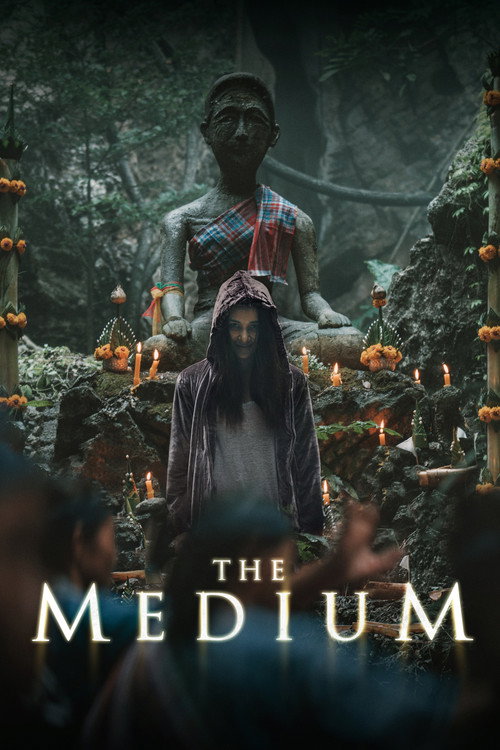
The Medium
2021 · Banjong Pisanthanakun
When you want to be properly shaken — a long, heavy descent for viewers who like their horror extreme and are willing to earn it through a patient build. Not a casual pick; clear your evening and brace yourself.
What it's about
A documentary crew travels to Thailand's rural northeast to film Nim, a village shaman who serves as hereditary medium to a local goddess. Their quiet portrait of inherited faith turns into something else when Nim's niece begins behaving strangely — signs the family first reads as the goddess choosing her next vessel, and then, with growing horror, as something else entirely moving in.
The experience
A slow, documentary-calm first hour that curdles into escalating dread and finally into full-tilt nightmare — one of those horror films that keeps raising the ceiling on how far it will go. The found-footage frame makes the worst of it feel uncomfortably like evidence.
Performances
Sawanee Utoomma brings weary, lived-in dignity to Nim the shaman, and Narilya Gulmongkolpech's transformation as the niece is the film's engine — a descent played with frightening physical commitment.
The craft
Banjong Pisanthanakun, working from a story by Na Hong-jin, uses the mock-documentary form with discipline: talking heads, handheld observation, and night-vision footage that turns the finale into something you watch through your fingers. The Isan setting — rituals, forests, family shrines — is rendered with an anthropologist's patience that makes the supernatural intrusion land harder.
Why it matters
A Thai–South Korean collaboration between two of Asian horror's biggest names, it became one of the most talked-about Asian horror films of the pandemic years and a touchstone for extreme possession cinema.
Snapshot
The Medium (Thai: Rang Song, "the one who is possessed" or "the vessel") is a Thai–South Korean horror film directed by Banjong Pisanthanakun and produced by Na Hong-jin, director of The Wailing (2016). Na Hong-jin is also credited with the original story. It is shot as a mock documentary. A film crew travels to Isan, Thailand's rural northeast, to follow Nim, a village shaman who serves as the hereditary medium of a local goddess, Ba Yan. The crew's project turns into a record of a family coming apart when Nim's niece Mink begins to show signs that look at first like the goddess choosing her next vessel, and later like something much darker. The film premiered and was released in South Korea in 2021, and it became one of the most widely discussed Asian horror films of the pandemic years. It joins two traditions that rarely meet: Banjong's commercial Thai horror, and the dread-laden, theologically uncertain cinema of Na Hong-jin. The result is a film about belief, inheritance and the limits of ritual protection, and it builds steadily toward a long, chaotic climax.
Industry & production
The film was set up as a cross-border co-production. Korean partners, including the distributor Showbox and Na Hong-jin's production side, worked with GDH 559, the Thai studio Banjong had been associated with since its predecessor GTH. By most accounts the project started with Na Hong-jin. He had developed material about a shaman during or after The Wailing, and he chose to have it made in Thailand by a Thai director rather than direct it himself in Korea. Banjong has described the collaboration as one in which Na supplied the story's premise and oversight while he wrote the screenplay and handled the Thai cultural and practical specifics. The exact division of creative labour has been characterised in interviews rather than formally documented, so it should be treated with some caution.
Production took place in Thailand's northeastern provinces, mainly Loei, using real rural locations, temples, houses and local ritual spaces. Release was shaped by the COVID-19 pandemic. The film opened theatrically in South Korea in July 2021, where it drew strong audiences for a foreign-language horror title in a depressed market. It played the Bucheon International Fantastic Film Festival, where it received recognition. Thai theatrical release came later in 2021, after pandemic closures. Shudder acquired it for North American streaming, which gave it substantial reach with English-speaking genre audiences. Precise admissions and gross figures vary by source and are not given here.
Technology
The film depends on the found-footage and mock-documentary toolkit, adapted for a production with a commercial budget. Diegetically, the footage comes from a documentary team using handheld digital cameras with on-camera microphones. Later the crew adds fixed surveillance cameras, including infrared night-vision units installed in Mink's home. That surveillance footage, time-stamped and presented day by day, recalls the domestic CCTV logic of Paranormal Activity (2007) and is among the film's most effective devices.
Inside the fiction, the technology is a means of verification: the crew installs cameras to see whether Mink is possessed and by what. The film keeps showing that recording cannot settle the question. The images document behaviour without explaining it, and the cameras have no access to the spiritual order the characters believe in. In the climax the camera operators themselves are attacked, and the apparatus becomes part of the catastrophe.
Technique
Cinematography
Cinematography is credited to Naruphol Chokanapitak. The visual design moves between two registers. The early "documentary" sections use observational, ethnographic framing: interviews in domestic settings, wide shots of rice fields and roadside shrines, and a patient look at ritual practice. This gives the opening an air of anthropological sincerity, and it misleads the viewer usefully. The second register is the degraded, monochrome-green night-vision of the surveillance cameras and the frantic handheld work of the final act, where framing breaks down into whip pans, obstruction and darkness. The shift from the composed to the chaotic tracks the story's movement from a stable cosmology to its collapse.
Editing
The editing (credits for the editor are not well documented in English-language sources) follows documentary grammar: talking-head interviews, observational sequences, intertitles and time-stamps. The surveillance sections are structured as a countdown of days, so dread accumulates through repetition and variation as Mink's nocturnal behaviour escalates. The film is long for the genre at a little over two hours, and its rhythm is deliberately slow for most of that time before the climax speeds up sharply. Some critics thought the length was a strength because it builds immersion; others thought it a weakness because the middle sags.
Mise-en-scène / staging
The film is anchored in a densely rendered Isan material culture: spirit houses, Ba Yan's shrine and its statue on the hillside, amulets, sacrificial offerings, Buddhist and animist ritual objects, and Christian imagery in the home of Nim's sister Noi, who converted and rejected her inheritance. This layering of religions is central to the drama, because the household is a contested site of belief. The final exorcism is staged as a large ritual production, with assembled shamans, chanting, ritual barriers and offerings, which the film then overruns. Banjong's staging of possessed bodies, especially once the infection seems to spread beyond Mink, draws on both zombie-film choreography and the mass-chaos endings of found-footage horror.
Sound
The soundtrack mostly avoids a conventional score in favour of diegetic sound, as the documentary conceit requires: ambient village noise, ritual chanting, wind, animal sounds and the low hiss of surveillance audio. Silence and slight off-screen sounds carry much of the horror in the night-vision sequences. In the climax, sound becomes an overlapping cacophony of chanting, screaming and the noise of panic, deliberately hard to parse. Credits for sound design and any music have not been widely discussed in critical literature.
Performance
Performance is the film's most praised element. Sawanee Utoomma plays Nim with a grounded, wry, worldly calm that makes her the film's moral and emotional centre, and her final interview is often singled out as its quiet devastation. Narilya Gulmongkolpech's Mink is a physically demanding role. She moves from a sullen, ordinary young office worker to a figure of animal violence and lewd, taunting menace, and critics widely noted the ferocity and commitment of the transformation. Sirani Yankittikan as Mink's mother Noi carries the family melodrama of guilt, denial and desperate faith. Boonsong Nakphoo appears as Santi, the shaman brought in to lead the final ritual. The naturalistic, semi-improvised feel of the ensemble helps sustain the documentary illusion.
Narrative & dramatic mode
The narrative misleads by design. It begins as an ethnographic portrait of a hereditary medium and the goddess Ba Yan. It then becomes a family drama about inheritance, with the role of medium passing down the female line, Noi's refusal of it and Nim's acceptance. Next it presents itself as a possession story in which Ba Yan seems to be choosing Mink. Finally it turns to the true premise: Mink is not being called by the goddess but invaded by a crowd of vengeful spirits connected to the sins of her father's family. Revelations along the way, including the family's dark secrets, recast what the audience has seen. As the TMDB synopsis says, the goddess "has nothing to do with the possession."
Dramatically, the film works in the register of escalating tragedy rather than suspense with a cathartic payoff. Protective ritual fails, and so do knowledge and kinship. The coda puts Nim's final interview after the catastrophe. In it she admits she is uncertain whether Ba Yan was ever present within her, which reframes the whole film as a meditation on faith without guarantees. That retrospective gesture is the film's most distinctive structural choice.
Genre & cycle
The Medium is a possession horror film and a found-footage/mockumentary horror film, with strong ties to the folk-horror and ethnographic-horror strands that became prominent in the 2010s. Its nearest models are:
- Korean shamanic horror, above all The Wailing (2016), which shares its rural setting, its suspicion of all religious authorities, its exorcism set-piece and its refusal of clear theological resolution.
- Found-footage horror from The Blair Witch Project (1999) and [REC] (2007) to Paranormal Activity (2007). [REC]'s contagion climax and Paranormal Activity's surveillance-camera nights are especially relevant.
- Possession and exorcism cinema in the line of The Exorcist (1973), and the more recent family-inheritance horror of Hereditary (2018), a comparison many reviewers made.
- Thai ghost cinema (nang phi), the long Thai tradition of spirit films that Banjong himself had helped renew in the 2000s.
The film belongs to a mid-2010s-to-2020s cycle of Asian horror that sits between art-house ambition and mainstream genre appeal, and that circulates internationally through festivals and streaming platforms such as Shudder.
Authorship & method
Banjong Pisanthanakun became prominent with Shutter (2004, co-directed with Parkpoom Wongpoom). It was a major regional hit, was remade in Hollywood (2008), and helped define Thai horror for international audiences. He and Parkpoom followed it with Alone (2007), and Banjong contributed segments to the anthology films 4bia (2008) and Phobia 2 (2009). He then had broad success outside horror with Hello Stranger (2010) and the horror-comedy Pee Mak (2013), a reworking of the Mae Nak legend that became one of the biggest Thai box-office hits of its time, followed by the romance One Day (2016). His method mixes commercial clarity, audience-oriented pacing and a strong grasp of genre mechanics. The Medium is his most austere and least comic work, a departure that critics usually credit partly to Na Hong-jin's influence.
Na Hong-jin (The Chaser, 2008; The Yellow Sea, 2010; The Wailing, 2016) served as producer and is credited with the story. His thematic preoccupations show clearly in the film: the impotence of ritual, the opacity of the sacred, and the moral contamination of families and communities. The Banjong–Na partnership is the film's defining authorial fact, a meeting of a Thai popular-genre craftsman and a Korean auteur of metaphysical dread.
Collaborators: cinematographer Naruphol Chokanapitak shaped the doubled documentary/surveillance look. Detailed, reliable English-language documentation of the editor, composer and sound team is thin, and those credits are best checked against the film's official credits rather than assumed.
Movement / national cinema
The film sits at the intersection of two national cinemas. In Thai terms, it continues the commercial studio tradition of GTH/GDH 559, which from the 2000s onward produced polished genre films for domestic and regional audiences. It also continues the long national tradition of ghost films rooted in animist belief and in Buddhist ideas of karma and merit. Its setting in Isan matters: the region is culturally distinct (largely Lao-speaking), economically marginal within Thailand, and often treated in Thai cinema as a repository of folk belief. The film's ethnographic attention to Isan ritual life has drawn both praise for specificity and questions about the outsider documentary gaze it dramatises.
In Korean terms, the film extends the international influence of 21st-century Korean genre cinema, particularly the post-Wailing interest in shamanism (musok). It is an example of Korean producers investing in and shaping regional co-productions rather than only domestic features.
Era / period
The film was produced and released during the COVID-19 pandemic. Its Korean release came when theatres were operating under restrictions and audiences were scarce, which made its commercial performance notable. Its international life depended heavily on streaming, which matches the period's acceleration of platform-led distribution for genre cinema. More broadly, it belongs to the late 2010s and early 2020s vogue for "elevated" or folk horror (Hereditary, Midsommar, The Witch) and to a renewed global appetite for Asian horror after a quieter decade following the J-horror remake boom.
Themes
- Inheritance and the female line. The medium's role passes between women in a family, and the burden of spiritual vocation is entwined with the burden of kinship. Noi's refusal of the role, and her conversion to Christianity, are framed as acts with consequences.
- The sins of the fathers. The possession is ultimately traced to the moral debts of Mink's paternal lineage, a karmic structure in which violence and transgression in previous generations return as a haunting.
- Faith, doubt and the failure of ritual. The film sets several religious systems side by side (animist, Buddhist and Christian) and shows none of them able to protect the family. Nim's closing admission of uncertainty is its thematic keystone: belief continues without proof.
- The gaze of documentation. The documentary crew's attempt to capture the sacred on camera, and its ultimate futility, reflects on ethnographic filmmaking, voyeurism and the limits of the visible.
- Rural modernity. Through Mink's job, the family's economic history and the coexistence of shrine and smartphone, the film shows Isan as a place where modern life and older belief systems overlap.
- Contagion. The spreading possession in the climax resonates with the period's anxieties about infection and collective breakdown, though it would be speculative to read the pandemic as an intended allegory.
Reception, canon & influence
Critical reception. The film was received favourably across Asia and in international genre circles. Critics praised its atmosphere, the commitment of its performances (especially Narilya Gulmongkolpech's and Sawanee Utoomma's), its ethnographic texture and the intensity of its final act. Reservations commonly centred on its running time, the slow middle section, and whether the mock-documentary conceit holds up, since some viewers questioned why the crew keeps filming during the escalating violence. Its explicit and transgressive content also divided audiences. Its festival recognition at Bucheon and its strong Korean theatrical showing were widely reported as signs of success.
Influences on the film (backward). The most direct influence is The Wailing, through Na Hong-jin's involvement and the film's shamanic, rural-dread mode. Found-footage precedents (The Blair Witch Project, [REC], Paranormal Activity) supply its formal grammar, while The Exorcist and the family-curse horror of Hereditary inform its possession and inheritance narrative. Within Thai cinema, it draws on the nang phi tradition and on Banjong's own earlier work in Shutter and Alone.
Legacy (forward). The Medium has been widely cited as a high point of 2020s Asian horror and a reference point for found-footage folk horror. It showed that Korean–Thai co-production could succeed creatively and commercially, and it renewed international attention on Thai horror at a time when the domestic genre was again becoming highly visible. Later Thai horror successes of the early-to-mid 2020s came out of the same revived market, though direct causal influence is hard to establish and should not be overstated. It also strengthened Na Hong-jin's standing as a producer-auteur whose sensibility can reach beyond his own directing, and it marked a turning point in Banjong's career, from the defining commercial horror-comedy director of his generation toward something closer to art-horror. Whether its influence will match that of Shutter, which shaped a whole cycle of remakes and imitations, is a question the record does not yet answer.
Influences: the films it descends from and the films it influenced
- The Wailing (2016) — Na's story credit carries over his set-piece of an exhausting, real-time shamanic exorcism that is staged at full ceremonial length and then fails, which The Medium extends into its climactic Isan rite.
- [REC] (2007) — A diegetic camera operator gets pulled into escalating possession chaos inside a closed space, and the final act shifts to green night-vision as the lights die. The Medium's apartment and finale copy this grammar directly.
- Paranormal Activity (2007) — Fixed, locked-off night-vision cameras in a domestic space, shown with timestamped nightly intertitles so each night gets worse, is the source of The Medium's surveillance day-countdown.
- The Blair Witch Project (1999) — The documentary crew becomes the cast, and the framing slides from composed interviews of local people about folklore into frantic handheld panic. The Medium follows the same composed-to-chaotic arc.
- The Exorcist (1973) — A young woman's possession plays out as a gradual bodily and behavioural breakdown, and the family exhausts medical explanations before turning to ritual specialists. Mink's arc follows this structure.
- The Last Exorcism (2010) — A mock-documentary crew profiles a working religious practitioner whose professional confidence collapses when a young woman's possession turns out to be real, which is the same subject-and-camera setup The Medium builds around Nim.
- Noroi: The Curse (2005) — An Asian found-footage film built as a paranormal investigator's ethnographic inquiry into a local deity, its rituals and the bloodline of its priestesses. It is the template for The Medium's folk-religious documentary framing.
- Lake Mungo (2008) — A sober, TV-documentary interview style with grieving family members and a late revelation that changes what came before, an ancestor of The Medium's retrospective coda that throws doubt back onto Nim.
- Hereditary (2018) — Horror is built from a supernatural inheritance passed down the female line, where possession is a family destiny prepared over generations. The Medium recasts this as the Bayan medium lineage.
- Nang Nak (1999) — It revived the nang phi tradition by grounding a ghost story in detailed rural Thai material culture and Buddhist and animist ritual practice rather than shock effects, a realism The Medium carries into documentary form.
- Shutter (2004) — Banjong's breakthrough uses photographic and camera media as the place where the ghost appears, mastering scare timing that The Medium strips back and moves into the logic of the documentary camera.
- It Comes (2018) — Extends the Na Hong-jin school of regional shamanism staged as a doomed ritual battle, ending in a large-scale exorcism that fails catastrophically and wipes out the assembled practitioners, as It Comes's finale does.
- Incantation (2022) — Taiwanese found footage that follows The Medium's success by treating a folk-religious ritual as ethnographic footage, with a cursed-mother/daughter inheritance and a night-vision descent through a village rite.
- Death Whisperer (Tee Yod) (2023) — Rural possession horror set among Thai villagers, centred on a young woman's body being taken over and failed folk exorcisms, and part of the revived Thai market The Medium re-energised (influence plausible, not proven).
- Exhuma (2024) — It puts working shamans at the centre as skilled professionals, showing the gut ritual's procedure, costume and trance in documentary-like detail, which extends The Wailing and The Medium's treatment of the medium as a craftsperson.
- Late Night with the Devil (2023) — Found-media possession built on a single in-world recording format, with the onscreen professionals continuing the broadcast as possession overtakes the young woman. This tests the same 'why keep filming' conceit The Medium was criticised for.
- The Taking of Deborah Logan (2014) — A student documentary crew filming a woman's medical decline realises it is possession, using the same clinical-observational camera turning into night-vision terror and the same mother–daughter bond under strain.
- Satan's Slaves (2017) — Southeast Asian folk horror in which a family's affliction traces back to a mother's past pact, with dread built from domestic ritual objects and a hereditary claim on the children, parallel to The Medium's ancestral debt.
- Svaha: The Sixth Finger (2019) — A Korean procedural investigation into the hidden workings of fringe religious practice, treating cult and ritual material ethnographically, alongside the Na Hong-jin-led Korean move into religious-opacity horror.
- The Pig, the Snake and the Pigeon (2023) — Religious compound as institutional uncanny with spiritual manipulation of a sequestered community, staged with tonal instability between procedural documentary observation and supernatural horror — working the same cult-compound-as-uncanny-institution territory as Wong's pigeon-chapter sequences.
- Gonjiam: Haunted Asylum (2018) — An Asian mockumentary produced in Korea that starts as a calm documentary and turns into chaotic night-vision footage from body-mounted and fixed cameras. It uses the same slow-burn-to-collapse editing.
- Grave Torture (2024) — This Southeast Asian religious horror makes the recording apparatus the test of belief, as Grave Torture's diegetic recorder does: the camera crew's footage is evidence and is undone by what it captures.
Similar films
- Exhuma (2024) — influence & lineage · same viewing thread
- Incantation (2022) — influence & lineage · same viewing thread
- The Wailing (2016) — influence & lineage · same viewing thread
- Noroi: The Curse (2005) — influence & lineage
- Satan's Slaves (2017) — influence & lineage
- Oddity (2024) — same viewing thread
- Impetigore (2019) — same viewing thread
- When Evil Lurks (2023) — same viewing thread
All the films related to The Medium →
Watch it with: curated runs of related films
- Whatever's Wearing That Face — A run of horror-thrillers where the real terror is that you can't trust what a person appears to be — a double, a shapeshifter, a smiling stranger, the one you desire.
- Cursed and Contagious — Watch these back to back for how each imagines evil as something that moves — a curse handed off by a smile, a demon incubated in a neighbor, a possession creeping family member by family member.