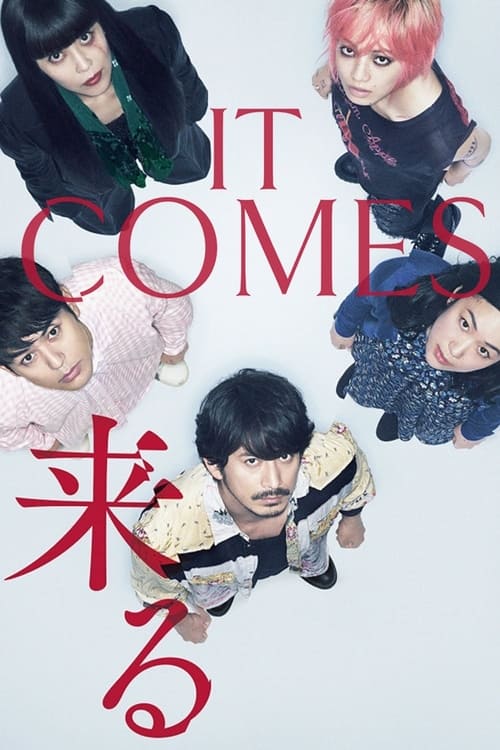
It Comes
2018 · Tetsuya Nakashima
When you want horror that goes big — not a slow-burn chiller but a gaudy, furious spectacle you'll want to argue about after. Choose it for challenge and excess, not comfort.
What it's about
A young husband's picture-perfect family life — new wife, baby daughter, doting-dad blog — is invaded by a nameless entity tied to a half-buried memory from his childhood in the countryside. As the attacks escalate, the fight passes through a cynical occult writer, a chain-smoking young medium, and finally her sister, the most powerful exorcist in Japan, building toward a full-scale ritual showdown.
The experience
Maximalist, loud, and deliberately off-balance — it keeps switching whose story it is, and its sharpest horror is aimed at the gap between how people perform family life and how they actually live it. By the time the big exorcism arrives it's pure sensory overload, equal parts terrifying and exhilarating.
Performances
Takako Matsu is magnetic as the imperious master exorcist, and Nana Komatsu gives the tattooed medium a wounded toughness; Satoshi Tsumabuki is cannily cast against his nice-guy image as the proud young father.
The craft
Tetsuya Nakashima directs like a man conducting a storm: saturated colour, whiplash editing, and a climactic mass-exorcism staged with the scale and choreography of a musical number. The sound design pummels — this one genuinely wants good speakers. Underneath the noise, the script is a barbed social satire about parenting and appearances.
Why it matters
It marked the flamboyant stylist behind revenge dramas and candy-coloured melodramas turning his full arsenal on supernatural horror, and it's become a favourite example of Japanese horror at its most operatic and unrestrained.
Snapshot
It Comes (Japanese title Kuru, "It Comes" or "Coming") is a Japanese supernatural horror film written and directed by Tetsuya Nakashima. It is adapted from Ichi Sawamura's debut novel Bogiwan ga, kuru ("The Bogiwan Is Coming"), which won the Japan Horror Novel Award in 2015. A young salaryman, Hideki Tahara (Satoshi Tsumabuki), marries, has a daughter, and finds his family stalked by a nameless entity tied to a childhood memory from his grandparents' rural home. As the haunting gets worse, the story moves through several characters: Hideki's wife Kana (Haru Kuroki); a cynical freelance writer, Nozaki (Junichi Okada); a tattooed, chain-smoking medium named Makoto Higa (Nana Komatsu); and her sister Kotoko (Takako Matsu), who is presented as the most powerful spiritual practitioner in Japan.
The film is best understood as a meeting of two forces. One is the late-1990s and 2000s J-horror tradition of the vengeful, half-seen presence entering domestic space. The other is Nakashima's maximalist, pop-saturated style: hard, rhythmic editing, saturated colour, abrupt tonal swings, and a fondness for satire. It Comes deliberately goes against the quiet dread associated with J-horror. It builds toward a large-scale, multi-faith exorcism staged as public spectacle, and in the process it criticises the performance of family happiness in contemporary Japan.
Industry & production
It Comes was a mainstream studio production distributed in Japan by Toho, which released it theatrically in December 2018. Toho had handled Nakashima's earlier commercial successes, notably Confessions (Kokuhaku, 2010). The film followed the usual Japanese pattern for a major genre release: it adapts a prize-winning novel, it has a star-heavy ensemble, and it is backed by an established studio. Okada was a well-known member of the idol group V6 and a leading film actor. Tsumabuki, Matsu, Komatsu and Kuroki were all prominent screen performers. The casting itself signalled a prestige, broad-audience horror film rather than a low-budget V-cinema or direct-to-video product, which is where much Japanese horror had moved after the J-horror boom faded.
Nakashima's previous films were often associated with producer Genki Kawamura, and Toho's publicity for It Comes drew on the director's reputation after Confessions and The World of Kanako (2014). Detailed public accounts of the budget, the shooting schedule, and the producing arrangements are thin in English-language sources. This dossier does not attempt to give figures. Internationally, the film reached audiences mainly through genre festivals and later streaming and home-video releases rather than a wide theatrical run.
Technology
The film was shot digitally and finished with heavy post-production. Like Nakashima's other work, it relies on colour grading, compositing and digital effects to build a hyper-stylised image. Its supernatural events are produced through a mix of practical effects (gushing blood, physical destruction of rooms, crowds of performers) and digital elements (spectral phenomena, environmental distortions, the mass ritual's apocalyptic weather). The film deliberately avoids giving its entity a stable, fully realised creature design. That restraint is an aesthetic choice as much as a technical one. The film shows the entity's effects (wounds, voices, possessed bodies, moths and insects, a bloody rain) far more than its form.
No specific camera systems, lenses or effects houses are documented here, because the available record does not reliably establish them.
Technique
Cinematography
Nakashima's films are known for glossy, highly designed images, often lit with saturated colour and bright, commercial-style polish. Much of that comes from his background in television advertising and music videos. It Comes uses this look ironically. The early domestic chapters are shot in a bright, almost advertising-friendly register: weddings, family gatherings, a newly bought apartment, the brand-new father photographing his child. That sheen makes the later intrusions of horror more jarring. As the film goes on, the palette darkens toward night interiors, rain and the red of blood. The finale uses wide, high-angle compositions to show the scale of the assembled ritual.
Nakashima's regular cinematographer on Confessions and The World of Kanako was Shoichi Ato. Sources here do not allow a confident confirmation that Ato shot It Comes, so this dossier does not assert it.
Editing
Editing is central to Nakashima's style, and It Comes is no exception. The film moves at a punishing speed. Montage compresses time, flashbacks break into the present, and rapid cuts are timed to music and sound effects. The most important structural choice is to move the point of view from one protagonist to the next. Each change revises what the viewer believed in the section before. The cutting often favours shock juxtaposition, such as a cheerful domestic scene broken by a sudden act of violence, and some critics found the rhythm exhausting. It is consistent with the director's earlier work, in which editing pace serves both satire and sensory overload.
Mise-en-scène / staging
Staging contrasts ordinary Japanese domestic spaces with the elaborate theatre of religion. The Taharas' apartment, the grandparents' rural house, the hostess bars and the urban streets are all rendered in realistic detail. That realism makes the supernatural incursion feel like a violation of familiar middle-class life. The climax moves into large-scale spectacle. Kotoko assembles a coalition of spiritual practitioners from different traditions, including Shinto, Buddhist and folk/shamanic figures, and the purification rite takes over an entire apartment complex and its surroundings, with police cordons, crowds of participants, ritual structures and choreographed movement. The sequence plays partly as horror, partly as a festival or rock-concert set piece, and partly as a mock-epic of bureaucratic mobilisation. It is the film's most distinctive sequence and the clearest break from J-horror's minimalism.
Costume and character design also carry meaning. Makoto's punk look of tattoos, pink hair and heavy make-up marks her as a marginal, déclassé figure. Kotoko's severe, controlled presence marks her as an establishment authority on the supernatural.
Sound
Sound design builds the entity's presence largely through the voice. The bogiwan imitates familiar people and calls the victims' names, and the phone and the doorbell become channels for the invasion. Insect buzzing, wet bodily sounds and sharp spikes in volume do much of the horror work. In keeping with Nakashima's earlier films, the soundtrack sets contemporary pop and rhythmic music against horrific content, especially in the finale, where ritual chanting, percussion and crowd sound build into a sustained wall of noise.
Credits for the composer and music supervision are not established here with enough confidence to name them.
Performance
The ensemble is pitched at different registers, and the gaps between them are part of the design. Tsumabuki plays Hideki as a smiling, self-satisfied man performing the role of the devoted modern father. The performance is deliberately shallow, and later sections expose how hollow it is. Haru Kuroki's Kana carries the film's emotional realism: exhausted, resentful, increasingly desperate. Her section changes how the audience reads her marriage. Junichi Okada's Nozaki is a guarded, wounded observer whose own buried guilt about a past relationship links him to the story's themes of failed parenthood. Nana Komatsu goes against her ingénue image as the abrasive, self-destructive Makoto. Takako Matsu, who had played the vengeful teacher at the centre of Confessions, brings the same cool, imperious control to Kotoko, an almost superheroic figure of spiritual competence.
Narrative & dramatic mode
The narrative uses a relay structure inherited from Sawamura's novel. Each part is told from a different character's perspective, and each later part reinterprets the earlier one. The first section, centred on Hideki, presents him as an ideal husband and an involved ikumen (the media term for a father active in childcare) who blogs about his family life. The second, centred on Kana, reveals that his devotion is largely for show and that she has been left to raise their daughter alone. The third widens to Nozaki and the Higa sisters as the battle against the entity becomes collective and institutional.
The dramatic mode is unstable on purpose. The film moves among domestic melodrama, social satire, investigative mystery, splatter horror and an action-spectacle finale. Its horror is less a whodunit than a "what-is-it." The mystery concerns the nature of the entity, why it targets this family, and what it has to do with children and neglect. The answers stay partly withheld. The coda ends in a dreamlike, absurdist register rather than with a tidy explanation.
Genre & cycle
It Comes belongs to the long tail of Japanese horror after the international J-horror boom launched by Hideo Nakata's Ringu (1998) and continued by Takashi Shimizu's Ju-on series and Kiyoshi Kurosawa's Pulse (Kairo, 2001). It shares that cycle's core motifs: a curse that spreads through ordinary domestic and technological channels (phones, homes, family ties), the vengeful supernatural force linked to unresolved social and familial harm, and a menace that is heard and felt more than seen.
It also departs from that model. Where classic J-horror is known for long takes, stillness and minimal effects, It Comes is kinetic and excessive. It is also closer to an exorcism or occult-battle film than a pure haunting. The professional medium, the ritual specialist and the coalition of believers recall the occult-detective tradition and big Hollywood exorcism spectacles more than the passive victims of Ringu. Some international critics compared its blend of shamanic ritual and genre-mixing to Na Hong-jin's Korean film The Wailing (2016). That comparison is critical context, not a documented influence.
The bogiwan of the source novel is presented as a folkloric bogeyman, a creature said to take children. Its origin and name are part of the novel's invented mythology rather than an established figure from Japanese folklore. This puts the film within a broader 2010s interest in "folk horror" and regional legend.
Authorship & method
Tetsuya Nakashima (b. 1959) came to feature filmmaking from a prolific career in television commercials. He made his name with Kamikaze Girls (Shimotsuma Monogatari, 2004) and Memories of Matsuko (Kiraware Matsuko no Isshō, 2006), both candy-coloured, musical, tonally volatile films. The fantasy Paco and the Magical Picture Book (2008) followed. With Confessions (2010), a revenge thriller adapted from Kanae Minato's novel, he turned his style toward darker material. The film was a major domestic hit and was submitted as Japan's entry for the Academy Award for Best Foreign Language Film. The World of Kanako (2014), adapted from Akio Fukamachi's crime novel, pushed his violence and fragmented editing further and drew a sharply divided response.
It Comes fits a clear pattern in his mature work. He adapts popular, award-winning genre novels and reshapes them with a hyper-stylised audiovisual method. He is drawn to stories about broken families, cruelty toward children, and social hypocrisy behind respectable surfaces, and he treats these through aggressive irony. Nakashima co-wrote the screenplay adapting Sawamura's novel. Detailed credit attributions for his co-writers and for his cinematographer, editor and composer on this film are not confirmed in the sources available to this dossier, so they are not listed here.
Takako Matsu's return as a lead links the film directly to Confessions. Novelist Ichi Sawamura's Higa sisters went on to recur in his later books, which places the film inside an ongoing literary franchise.
Movement / national cinema
The film sits within contemporary Japanese commercial cinema, a system dominated by large studios (Toho, Toei, Shochiku), adaptations of novels and manga, production committees, and star casting drawn from television and idol culture. Within that system, Nakashima is something of an auteur who works inside the mainstream. He makes studio-backed, star-heavy films whose style is unusually aggressive for the context.
The film's satire is aimed at very local targets. One is the gap between public images of family life (social-media and blog culture, the ikumen ideal) and actual domestic labour, which falls largely on women. The others are corporate conformity, the hostess-club economy, and the persistence of folk and religious practices alongside a secular, urban modernity. The climactic coalition of practitioners from different traditions reflects the syncretic nature of Japanese religious life, in which Shinto, Buddhist and folk elements coexist. The film presents that syncretism as spectacle and as a kind of national mobilisation.
Era / period
It Comes was released in late 2018, during a period in which Japanese horror was no longer the global export phenomenon it had been around 2000. Hollywood had already remade The Ring, The Grudge and Pulse, and the domestic J-horror brand had largely moved to lower-budget and video productions. At the same time, Japanese society was publicly debating work–life balance, gender roles in childcare, low birth rates, and the pressures on young parents. The film's interest in the performance of fatherhood and the invisibility of maternal labour responds directly to those debates.
Internationally, the film arrived in the middle of a revival of "elevated" and folk horror in English-language and Korean cinema. It was programmed at several genre festivals abroad, where it was received as a high-energy, genre-mixing work from a director already known for Confessions.
Themes
- Performed family vs. real family. The film's central irony is that Hideki's public image as a perfect husband and father hides neglect. The supernatural threat feeds on the gap between appearance and reality. Horror becomes a way of exposing domestic hypocrisy.
- Children, abandonment and guilt. The entity is tied to children: taking them, calling to them, punishing those who fail them. Several characters, including Nozaki, carry guilt about unborn or abandoned children. The film suggests a moral economy in which neglected and unwanted children return as a haunting.
- Gendered labour and maternal exhaustion. Kana's section stages the isolation of the mother as a form of horror before the supernatural arrives. The bogiwan both threatens her and grows out of her situation.
- The marginal and the powerful. Makoto's outsider status and Kotoko's institutional authority dramatise different routes to spiritual power and the cost each carries. The sisters' relationship is one of the film's few sincere emotional threads.
- Collective ritual as spectacle. The finale presents spiritual defence as a large public operation, both earnest and absurd. It suggests that Japanese society mobilises for crisis through institutions and display.
- Unknowability. Refusing to fully show or explain the entity keeps the horror tied to the human failings it exposes rather than to a monster that can be defeated.
Reception, canon & influence
Critical reception. Japanese and international responses split roughly along the lines that had greeted The World of Kanako. Admirers praised the film's energy, its ambition in mixing genres, the performances (especially Kuroki, Komatsu and Matsu), and the scale of the finale. They also valued its sharp satire of contemporary family life. Detractors found it overlong, tonally chaotic and exhausting, and some thought the spectacle of the climax diluted the dread built in the first half. Sawamura's source novel was widely regarded as a high point of recent Japanese horror fiction. Discussion of the film often weighed Nakashima's flamboyant changes against the novel's tighter, more folkloric suspense. Box-office figures are not given here, because the record available to this dossier is not reliable enough to cite them.
Backward influences. The film is clearly in dialogue with the J-horror canon: Ringu (1998), the Ju-on films, Pulse (2001), and Nakata's Dark Water (2002), which also centres on an exhausted mother and a lost child. Its exorcism finale belongs to a broader tradition running from The Exorcist (1973) through modern occult-battle cinema, and critics compared its shamanic spectacle to The Wailing (2016). Its most direct authorial antecedents are Nakashima's own films, above all Confessions, with its fractured, multi-narrator structure, cruelty toward children and Takako Matsu's icy authority. Its literary basis is Sawamura's prize-winning novel and the genre conventions of the Japan Horror Novel Award winners.
Forward legacy. It Comes is still recent, and its long-term influence is hard to measure. It is often cited as an example of a mainstream Japanese studio horror film that tried to renew the genre through maximalism rather than J-horror minimalism, and as a key work in Nakashima's filmography. Through the adaptation, Sawamura's Higa sisters became more widely known, and his subsequent books continued their stories. Whether the film shaped later Japanese horror production in a specific, documented way is not well established in the critical record. Claims of direct influence would be speculative and are not made here.
Influences: the films it descends from and the films it influenced
- Rashomon (1950) — Its sequence of conflicting accounts, each one undercutting the last, is the model for It Comes's three-part relay: Hideki's chapter is retold by Kana and then by Nozaki, and each retelling exposes the previous narrator's flattering picture of himself or herself as false.
- The Exorcist (1973) — A long procedural build in which one expert after another fails before the professional exorcists are finally called in; It Comes follows the same escalation, from a folklorist to a lapsed medium (Makoto) to a top-ranked exorcist (Kotoko).
- Hausu (1977) — Obayashi, like Nakashima, moved from TV commercials into features and built a Japanese horror film out of glossy advertising imagery, abrupt optical effects and cheerful music played against carnage. This maximalist strain is the one It Comes takes up instead of J-horror's restraint.
- Poltergeist (1982) — An entity reaches the child through the family home's everyday fixtures, and a small, eccentric female medium (Tangina) takes over the film's tone in its last act. Kotoko Higa's arrival plays the same structural role.
- Ringu (1998) — Uses the ringing telephone as the way the curse arrives. It Comes builds its dread on calls and voices that cannot be trusted, with the entity reaching its victims through phones and borrowed voices.
- Ju-on: The Grudge (2002) — Splits the story into chapters named after characters, each one moving to a new victim's point of view inside a haunted domestic space. It Comes adapts this into its relay of narrators, all circling one cursed household.
- Dark Water (2002) — Builds its horror from an exhausted single mother in a decaying apartment and the threat to her daughter. Kana's chapter takes over this framing, with domestic burnout and maternal guilt treated as the way in for the supernatural.
- Kamikaze Girls (2004) — Where Nakashima first transferred his commercial-director toolkit to features: oversaturated colour, direct address, title-card interruptions and fast comic montage. It Comes uses the same toolkit to give the Tahara family's life an ironic gloss.
- Memories of Matsuko (2006) — Perfects his pop-music counterpoint, setting bright song numbers against a life of abuse and neglect. It Comes uses the same device to puncture its domestic scenes and its moments of shock.
- Confessions (2010) — Passes the narration from one confessing character to the next, uses slow motion and ironic pop tracks against cruelty to children, and casts Takako Matsu as an icy figure of authority. It Comes repeats all of this, with Matsu returning as Kotoko.
- The World of Kanako (2014) — Pushes Nakashima's editing into hyper-fragmented, shock-cut montage that crosses timelines, and gave Nana Komatsu her debut as an unknowable figure. It Comes keeps both the editing grammar and Komatsu.
- The Medium (2021) — Extends the Na Hong-jin school of regional shamanism staged as a doomed ritual battle, ending in a large-scale exorcism that fails catastrophically and wipes out the assembled practitioners, as It Comes's finale does.
- Incantation (2022) — Frames the curse through a parent's online self-presentation (a mother's vlog to her daughter). This mirrors It Comes's satire of Hideki's ikumen parenting blog, where a show of devotion hides neglect.
- Exhuma (2024) — Puts together an ensemble of occult professionals (a shaman, her apprentice, a geomancer and an undertaker) and stages the gut as a star-driven musical performance, as It Comes does when Kotoko assembles her team of exorcists from different traditions.
- Sadako vs. Kayako (2016) — A mainstream J-horror film that drops minimalism for spectacle and centres on a flamboyant pair of professional exorcists, the same playful 'occult specialist' casting that turns the Higa sisters into genre heroines.
- The Wailing (2016) — Its shaman's gut is cross-cut with a rival ritual as a percussive, set-piece spectacle. Critics directly compared It Comes's finale to it: a cross-cultural gathering of shamans, monks, Shinto priests and Okinawan yuta performing at once.
- The Mimic (2017) — Built around a folkloric creature (the Jangsan tiger) that copies the voices of loved ones to lure victims. This is the same mimicking-voice device It Comes uses for its bogeyman, which calls out by name in familiar voices.
Similar films
- Exhuma (2024) — influence & lineage
- Incantation (2022) — influence & lineage
- Ju-on: The Grudge (2002) — influence & lineage
- The Medium (2021) — influence & lineage
- The Wailing (2016) — influence & lineage
- The World of Kanako (2014) — influence & lineage
- Confessions (2010) — influence & lineage
- Satan's Slaves (2017) — shared sensibility