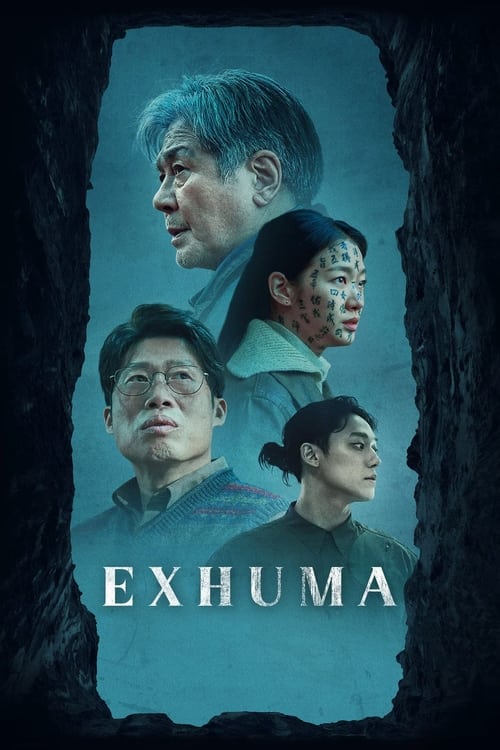
Exhuma
2024 · Jang Jae-hyun
For a full-meal horror night: two hours of mud, fire, ritual drums, and mounting unease. Pick it when you want to be absorbed into a world, not just startled.
What it's about
A wealthy Korean-American family hires four professionals of the uncanny — a young shaman, her scripture-tattooed apprentice, a veteran geomancer who reads the land, and a mortician — to find out why a hereditary affliction keeps striking its newborn sons. The trail leads to an ancestral grave on a remote mountainside, and the job of moving it turns out to be the wrong grave to disturb. What begins as a procedural about ritual craft becomes something much older and angrier.
The experience
A rich, earthy occult thriller that treats shamanic ritual with the detail and swagger of a heist movie — you watch experts work, then watch the job go wrong. It's tense, atmospheric, and genuinely eerie, with a mid-film shift that deepens the dread rather than breaking it.
Performances
Choi Min-sik anchors the film with lived-in gravity as the old geomancer, while Kim Go-eun is electrifying as the shaman — her ritual sequences, performed full-tilt, are the scenes everyone talks about.
The craft
Jang Jae-hyun shoots Korean geomancy and shamanic rites with documentary-level specificity, and the big ritual set pieces — drums, chanting, blades, fire — are staged as thunderous audiovisual showstoppers that demand good speakers. The mountain landscapes and grave-site imagery give the horror real physical weight.
Why it matters
A massive box-office phenomenon in Korea and the capstone of the director's occult cycle, it proved folk-horror rooted in specifically Korean belief and history could be a blockbuster, and it travelled worldwide on that strength.
Snapshot
Exhuma (Korean title Pamyo, "digging up a grave") is Jang Jae-hyun's third feature. It completes what Korean critics and audiences came to call his occult cycle, after The Priests (2015) and Svaha: The Sixth Finger (2019). The film follows four professionals of the uncanny. Lee Hwa-rim (Kim Go-eun) is a young mudang, a shaman. Yoon Bong-gil (Lee Do-hyun) is her apprentice, his body tattooed with protective scripture. Kim Sang-deok (Choi Min-sik) is a veteran geomancer, a pungsu master who reads the land. Ko Yeong-geun (Yoo Hae-jin) is a mortician. A wealthy Korean-American family in Los Angeles hires them because a hereditary affliction has struck its newborn. They trace the cause to an ancestral grave in a remote mountain site and agree to move it.
What starts as a procedural about ritual craft becomes, halfway through, something stranger and more openly allegorical. Beneath the first coffin lies a second one, and in it is something buried by the Japanese colonial order. Exhuma opened in South Korea in February 2024 after premiering in the Forum section of the Berlin International Film Festival. It became the first Korean release of 2024 to pass ten million admissions and finished above eleven million. That made it one of the most commercially successful horror films in the history of Korean cinema. It also won the top film prize at the 2024 Baeksang Arts Awards.
Industry & production
Showbox, one of the major Korean studio-distributors, produced and distributed Exhuma. The production-company credits are not something this account can state with confidence beyond Showbox's central role. The film had a mainstream star package. Choi Min-sik was among the most bankable actors of his generation. Yoo Hae-jin had been a reliable box-office presence. Kim Go-eun was a major star in film and television. Lee Do-hyun was a rising lead from streaming drama. Lee began mandatory military service in 2023, so he could not take part in the film's release promotion.
The timing mattered. Korean theatrical attendance had fallen sharply during the COVID-19 pandemic and recovered unevenly afterward. A handful of event films, 12.12: The Day (2023) among them, showed that audiences would still come out in large numbers for a domestic release. Exhuma's run in the first quarter of 2024 extended that recovery, and it was widely discussed as proof that a genre film built on local folklore could reach the scale of a blockbuster.
The Berlinale Forum premiere placed the film on the international art-cinema circuit before its domestic opening, a route rarely taken by a commercial horror title. The film was then sold widely abroad, with Well Go USA handling North American distribution. It drew notable audiences in several Asian markets, though precise overseas grosses are not documented reliably enough to cite here.
Technology
Exhuma was shot digitally in the polished, high-resolution house style of contemporary Korean studio production. The camera package and capture formats are not well documented in the English-language record. Production accounts and promotional interviews stress practical work. The grave site and the rites around it were staged as physical events. Kim Go-eun was widely reported to have prepared for the gut (shamanic ritual) by studying with practising shamans. The production also consulted on mortuary and exhumation practice.
The most notable choice is how the film shows its central supernatural antagonist. In the second half, the creature appears as a towering armoured figure, a yōkai/oni in the form of a samurai general. Reportedly a very tall human performer played it in costume, enhanced with digital effects, rather than the figure being created entirely in CGI. The fiery, ball-like manifestations around it rely more heavily on visual effects. The overall approach favours tactile presence over spectacle, in line with Jang's earlier films.
Technique
Cinematography
Lee Mo-gae shot the film. His earlier work includes Kim Jee-woon's A Tale of Two Sisters, The Good, the Bad, the Weird, and I Saw the Devil. His images give the film its earthy, overcast texture. Hillsides are wet and grey-green, soil is dark and turned, and the mountain graves sit under heavy skies. The Los Angeles prologue is shot in cleaner, more clinical light: a hospital room and a high-rise apartment. This sets up the opposition between the diaspora's modern surfaces and the old ground it has tried to leave behind.
The exhumation and ritual sequences are covered in long, mobile shots that cut across the parallel actions. The shaman dances, the diggers work, and the geomancer watches the earth. In the night sequences of the second half, the darkness swallows the frame and figures emerge only partly from it. The camera is used for withholding as much as for display.
Editing
The film is divided into six titled chapters. This structure signals its ambitions as a procedural and lets it change register without apology. The first half is cut as a fluent professional thriller in which each expert's job is explained through action. The daesal-gut sequence is the film's central set piece: a large-scale ritual involving pig carcasses, performed while the grave is opened. It is assembled through rhythmic cross-cutting. Kim Go-eun's ritual performance, the drumming, and the physical labour of digging escalate together.
The cut to the second half, built around the discovery of the vertically buried second coffin, is abrupt by design. Many reviewers saw this mid-film turn as the film's boldest and most divisive choice. The editor's credit is not something this account can confirm with confidence.
Mise-en-scène / staging
Jang stages ritual with the attention of an ethnographer. Talismans, shaman's knives, five-coloured flags, salt, mourning garments, and burial goods are presented as working objects whose use the audience is taught to read. The grave site is designed as a contaminated location: a steep, sunless slope where, Sang-deok says, no one should have been buried, marked by the presence of foxes. In the second half the setting moves to a small temple and its grounds. That confined space becomes a siege location.
Bong-gil's body is a key staging device. Tattooed scripture makes him a living talisman, and the camera keeps returning to his skin. The production design also hides a layer of historical code in plain sight. The four leads share names with figures from the Korean independence movement, Yoon Bong-gil the best-known among them. Vehicle licence plates carry numbers associated with the March First Movement and the 1945 liberation. Viewers decoded these details enthusiastically, and they became part of the film's reception.
Sound
Kim Tae-seong composed the score. It is restrained for long stretches and leaves room for diegetic sound: the drums, bells, and chanting of the gut, the scrape of spades, the rain. The ritual soundscape is the film's real musical engine. Its pulse drives the editing in the exhumation sequence. In the second half the sound design becomes more aggressive and percussive, built on low-frequency rumble and the metallic weight of armour. It also uses Japanese-language incantation, which marks the antagonist's otherness.
Performance
Choi Min-sik anchors the film as Sang-deok. He plays a pragmatic, slightly mercenary professional who becomes the moral centre of the story. His performance grounds even the wildest late scenes in bodily weariness and stubbornness. Kim Go-eun's Hwa-rim earned the most praise. Her ritual sequences require sustained physical and vocal commitment: dancing, chanting, possession, and a code-switching between Korean, Japanese, and the shaman's ritual register. She won Best Actress at the Baeksang Arts Awards. Lee Do-hyun, in a smaller role that includes a possession sequence, won the Baeksang for Best New Actor. Yoo Hae-jin supplies humour and warmth and plays a Christian mortician who works next to shamanic practice without fuss. That detail is typical of the film's affectionate pluralism toward Korean belief.
Narrative & dramatic mode
Exhuma is built as a two-part narrative joined at a hinge. The first part is a contained ghost story about inherited sin. The family's patriarch had collaborated with the Japanese colonial regime and grew rich from it. His restless spirit is attacking his own descendants. The family secret and the ancestor's malice resolve this strand.
The second part reveals that the first grave was itself a decoy or placeholder. Beneath it lies a coffin placed vertically, holding a Japanese warrior spirit. A Japanese onmyōji (sorcerer) had planted it in Korean soil as a stake to pin down the land's vital energy. The film turns into a confrontation with that force, resolved through the logic of the five elements rather than through exorcism in a Christian or Buddhist sense.
The dramatic mode is procedural and ensemble-based, with an emphasis on professional competence. The heroes are not chosen ones but practitioners. Tone moves fluidly between dread, humour, and moments close to adventure, a mix typical of Korean popular genre filmmaking. The structural break bothered some critics, who found the second half less frightening and more schematic. Defenders argued that the break is the point, since the film moves from private guilt to a collective historical wound.
Genre & cycle
The film combines occult horror, the mystery-procedural, and the folk-religious thriller. It belongs to a strong recent cycle of Korean and Korean-adjacent films about shamanism and folk belief. The cycle's landmark is Na Hong-jin's The Wailing (2016), which put the gut on screen with operatic force and also linked malign spiritual power to a Japanese stranger. Banjong Pisanthanakun's Thai-Korean co-production The Medium (2021), produced by Na, extended the cycle.
Exhuma also draws on a smaller Korean strand of geomancy dramas, notably Fengshui (Myeongdang, 2018). These treat pungsu as a framework for dynastic intrigue. Jang's own The Priests and Svaha belong to the same wave. Among them, Exhuma is notable for its sheer popular reach. More than any predecessor, it turned the occult procedural into a mass-audience event.
Authorship & method
Jang Jae-hyun wrote and directed Exhuma, as he did his earlier features. His method is consistent across the three films. Each is built on extensive research into a particular religious practice: Catholic exorcism in The Priests, new religious movements and Buddhist cosmology in Svaha, shamanism and geomancy here. Each is structured as an investigation led by specialists, and each treats belief seriously instead of as a pretext for shocks. His feature career grew out of the short film The 12th Assistant Deacon (2014), which he expanded into The Priests.
Key collaborators:
- Cinematographer Lee Mo-gae brings a seasoned genre eye and a feel for weather and landscape.
- Composer Kim Tae-seong provides a score that defers to the ritual soundscape.
- The ensemble cast is unusually starry for the director.
Jang has spoken in interviews about wanting to make a film that dealt with the "wounds" of the Korean land and with Korean history's relationship to Japan. The specific wording of those statements varies across translated sources, so they are summarised here rather than quoted.
Movement / national cinema
Exhuma belongs to the mature mainstream of twenty-first-century Korean cinema. This is a studio industry that has long excelled at high-polish genre filmmaking with nationally specific content. It is less an auteur art film in the tradition of Park Chan-wook or Lee Chang-dong than a commercial genre work with political and historical subtext. In that sense it sits alongside blockbusters that dramatise the colonial period, such as Assassination (2015) and The Battleship Island (2017), but it approaches that history through folk-religious allegory rather than period reconstruction.
Its treatment of shamanism also continues a long thread in Korean cinema. Im Kwon-taek's films, for example, took up indigenous religion as both national heritage and a site of modern unease. Exhuma is more celebratory than many of those predecessors. Its shamans are skilled, modern, and stylish professionals rather than marginal or tragic figures.
Era / period
The film is a product of the post-pandemic theatrical market, when Korean studios relied on a few large domestic hits to sustain cinema-going. Exhuma's ten-million-plus run was followed in 2024 by The Roundup: Punishment, confirming that the high-concept local hit still worked. It also belongs to a period of renewed public argument in South Korea about historical memory and relations with Japan, sharpened by diplomatic rapprochement between the two governments. The film's anti-colonial symbolism landed in that charged climate.
The fable at its centre has a historical basis: the popular belief that Japanese colonial authorities drove iron stakes into Korean mountains to sever the land's vital energy. That belief has circulated widely in Korea for decades. Historians regard many specific claims about it as contested or unsubstantiated, and the film uses it as legend rather than documented fact.
Themes
- Inherited guilt and the collaborationist past. The first half literalises the idea that wealth gained through colonial collaboration curses the descendants who live on it. The Los Angeles diaspora family thinks it has escaped history and is called back to the ground.
- The land as body. Geomancy treats terrain as a living organism with veins of energy. The second half extends this into a national allegory: a foreign power has pinned the peninsula's spine, and the heroes must remove the stake.
- Professional faith and pluralism. A shaman, a geomancer, and a Christian mortician work together. The film imagines Korean belief as layered and practical, a matter of craft rather than dogma.
- Money and moral cost. Sang-deok's arc moves from fee-driven professionalism to a refusal to leave the work unfinished, framed as a debt owed to later generations.
- Exhumation as historiography. The title's act of digging up becomes a figure for confronting what has been buried in national memory.
Reception, canon & influence
Critical reception. Domestic reviews were broadly positive. They praised the performances, especially Kim Go-eun's ritual work, the atmosphere of the first half, and the ambition of the allegory. The most common criticism was that the film changes shape at the midpoint and that the second half trades dread for a more conventional creature confrontation. International critics, after the Berlinale premiere, generally saw it as an accomplished, entertaining genre piece and a strong example of the Korean occult revival. The film also caused off-screen controversy. Some right-leaning Korean commentators criticised it as anti-Japanese, and the director of a contemporaneous documentary about Syngman Rhee was among those who spoke out. Separately, some Chinese online commentary claimed the face-writing imagery was culturally appropriated, and Korean commentators publicly rebutted those claims. At the 2024 Baeksang Arts Awards the film won the Grand Prize (film), Best Director, Best Actress (Kim Go-eun), and Best New Actor (Lee Do-hyun). It received further recognition at other Korean ceremonies, but this account does not list those awards in detail because the record could not be confirmed.
Influences on the film (backward). The clearest precedent is The Wailing, which established the shamanic ritual as a cinematic set piece and tied spiritual menace to Japan. The Medium is another. Jang's own The Priests and Svaha supply the investigative ensemble structure. Geomancy films such as Fengshui and The Face Reader (2013) laid the groundwork for treating divinatory crafts as drama. Behind all of these lie Korean folk belief itself, the iron-stake legend, and the culture's broader traditions of ancestor veneration and grave siting. In the second half, some reviewers saw affinities with Japanese yōkai cinema and the J-horror tradition, which the film quotes in order to oppose.
Legacy (forward). It is too early to give a full account of Exhuma's influence. Some effects are already visible. It confirmed that Korean folk horror could work as a mass-market event, strengthening the commercial case for occult projects in a cycle that also produced Dark Nuns (2025), a follow-up to the world of The Priests directed by another filmmaker. It raised Kim Go-eun's standing as a film lead and made the stylish modern shaman a recognisable screen type. Through its embedded historical codes, it showed that viewers' collective decoding could become part of a film's commercial life. Whether it endures as a canonical horror film or as a phenomenon of its moment is still an open question. In the history of Korean popular cinema it already stands as the film that took shamanic horror to its widest audience.
Influences: the films it descends from and the films it influenced
- The Exorcist (1973) — Sets the template of the religious-specialist procedural: a long investigative build-up of research and consultation before a climactic rite carried out by a mismatched professional team. Jang reworked this first in The Priests and then in Exhuma's shaman–geomancer–mortician team.
- Kwaidan (1964) — In the 'Hoichi the Earless' segment, holy text is painted over the whole body so a spirit cannot see the person. This is the direct visual ancestor of Exhuma's protective face-and-body writing, which the film turns against a Japanese spirit.
- A Tale of Two Sisters (2003) — Lee Mo-gae's earlier horror photography, with heavy, textured period interiors set against cold, exposed exteriors, is an early form of the clinical-versus-earthy light opposition he uses in Exhuma.
- The Face Reader (2013) — Builds a mainstream Korean film around a divinatory expert (physiognomy) whose professional readings drive the plot. Exhuma's geomancer Sang-deok, reading the land, comes out of this approach.
- Fengshui (2018) — Brings grave-siting geomancy to the screen as a craft with real stakes, with terrain read as fortune and lineage. Exhuma extends this into its theme of land as a body that can be wounded by an iron stake.
- The Priests (2015) — Jang's first version of his method: thorough research into Catholic exorcism ritual, a two-specialist team, and a long rite staged in real time with its liturgical objects. Exhuma moves the same structure over to mudang shamanism.
- Svaha: The Sixth Finger (2019) — Builds its investigation on coded religious-historical references the audience must decode, such as sutra numerology and cult genealogies. This is the forerunner of Exhuma's hidden independence-movement codes in character names and licence plates.
- The Wailing (2016) — Makes the gut ritual a cinematic set piece, cross-cut against a rival rite while drums and bells build in rhythm, and ties the spiritual menace to a Japanese figure. Exhuma's grave-site gut and its cross-cut exhumation repeat both moves.
- Onmyoji (2001) — Shows Japanese onmyōdō spirit warfare: talismans, curse-binding and guardian spirits presented as a heroic tradition. In its second half Exhuma uses the same iconography for its antagonist, the stake-bound oni general.
- From Dusk Till Dawn (1996) — The model for the midpoint hinge in genre cinema: a film that resets its genre halfway through, switching from crime procedural to creature siege. Exhuma does the same when it turns from ancestral-grave haunting to its oni confrontation.
- Pan's Labyrinth (2006) — Revives the full-body practical creature played by a tall performer in prosthetics, with little digital work. Exhuma follows this by casting the 2m-plus Kim Byung-oh in armour and makeup as the oni.
- Possessed (2009) — An early modern Korean horror film where shamanic calling and inherited spiritual debt are the source of fear. Exhuma builds on its idea that the sins of ancestors are passed down to their descendants.
- Dark Nuns (2025) — A continuation of Jang's Priests world, made in the commercial wake of Exhuma. It pairs Catholic exorcism with a shaman-adjacent rite and keeps the specialist-team structure with cross-cut rituals.
- The 8th Night (2021) — Another Korean occult procedural built on doctrinal research, here into Buddhist demonology and sarira relics. It uses a chaptered, night-by-night countdown that is close to Exhuma's six-chapter segmentation.
- Incantation (2022) — Taiwanese folk-ritual horror whose fear comes from carefully staged cult paraphernalia and ritual soundscapes. It shares Exhuma's reliance on diegetic chant and percussion over a score.
Similar films
- The Medium (2021) — influence & lineage · same viewing thread
- A Tale of Two Sisters (2003) — influence & lineage · same viewing thread
- Incantation (2022) — influence & lineage · same viewing thread
- The Wailing (2016) — influence & lineage
- Lee Cronin's The Mummy (2026) — same viewing thread
- Impetigore (2019) — same viewing thread
- Ju-on: The Grudge (2002) — same viewing thread
- When Evil Lurks (2023) — same viewing thread
All the films related to Exhuma →
Watch it with: curated runs of related films
- New Korean Cinema — Watch these in a run and you feel one national cinema flip between monster movie, revenge thriller, gothic horror, and slow-burn procedural without ever loosening its grip on class, history, and family.
- Cursed and Contagious — Watch these back to back for how each imagines evil as something that moves — a curse handed off by a smile, a demon incubated in a neighbor, a possession creeping family member by family member.