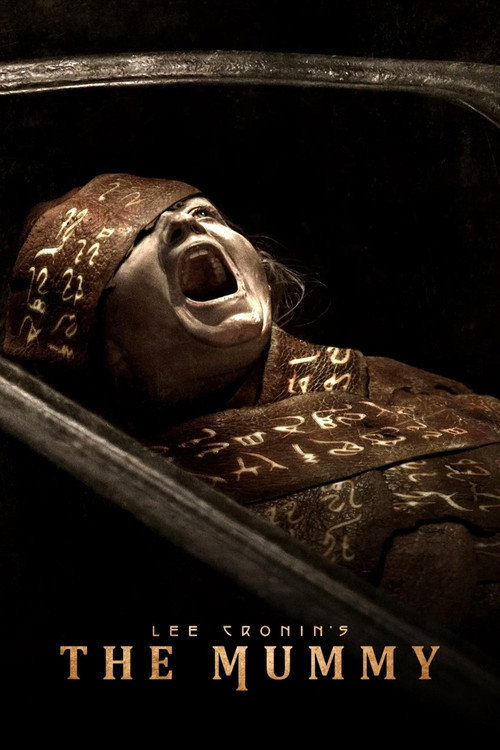
Lee Cronin's The Mummy
2026 · Lee Cronin
For when you want a serious, emotionally heavy horror film — the kind that scares you through a family's pain rather than around it. More gut-punch than popcorn.
What it's about
A journalist's young daughter vanishes without a trace in the Egyptian desert. Eight years later she is returned to her shattered family — and the reunion they prayed for becomes a nightmare, as whatever came back carries something ancient with it. Despite the title, this is no pith-helmet adventure: it's a modern possession-and-curse story that treats the mummy as a body preserved, wrapped and sent home wrong.
The experience
Grief-soaked dread rather than matinee thrills — the horror grows out of a family trying to love someone who returned changed. Expect slow-building unease punctured by hard scares, with an ache underneath.
The craft
Lee Cronin writes and directs, reuniting with his Evil Dead Rise cinematographer David Garbett and composer Stephen McKeon, and the film leans on their strengths: oppressive framing and a score that works under the skin. Reinventing the mummy as domestic horror rather than desert adventure is the central creative swing. The sound design earns a theater or a good system.
Why it matters
The possessive title deliberately stakes out territory apart from Universal's long-running Mummy franchise, repositioning one of horror's oldest monsters as material for intimate, grief-driven horror.
Snapshot
Lee Cronin's The Mummy is a contemporary horror film written and directed by the Irish filmmaker Lee Cronin. It was released theatrically on April 17, 2026. The film does not revive the Egyptological adventure that the title usually suggests. It uses the mummy, a body preserved, wrapped and returned, as the basis for a domestic horror story. A journalist's young daughter vanishes in the desert. Eight years later she is returned to her family, and the reunion turns into a nightmare. Jack Reynor and Laia Costa lead the cast, with May Calamawy, Natalie Grace and Verónica Falcón in prominent roles. Cronin's cinematographer and composer from Evil Dead Rise (2023), David Garbett and Stephen McKeon, both returned.
The possessive title matters. It separates this film from Universal's long-running Mummy property, including the Karloff original (1932), the Stephen Sommers adventure films (1999–2008) and the failed "Dark Universe" launch of 2017. It also presents the film as an auteur's reworking of a classic monster, the same strategy Blumhouse used with Leigh Whannell's The Invisible Man (2020). Reviews were mixed. The film opened modestly but in profit-making territory relative to a reported budget of about $22 million.
Industry & production
The film belongs to the post-2020 period in which classic monster titles were reassigned to mid-budget horror specialists rather than tentpole franchise builders. After Evil Dead Rise became a commercial success for Warner Bros./New Line, Cronin moved straight to another legacy property. This one was developed in the orbit of Jason Blum's Blumhouse and James Wan's Atomic Monster, two companies that merged corporately in 2024. New Line, the Warner label that had released Evil Dead Rise, handled the release.
Trade reporting put the budget at about $22 million. That is modest by studio standards but well above the micro-budgets of early Blumhouse films. It reflects a model that has become standard: contained productions with a small cast and few locations, sold on a recognizable title and a director's signature.
Commercially, the film opened to an estimated $13.5 million in the domestic market, third for the weekend behind The Super Mario Galaxy Movie and Project Hail Mary. International grosses (reported at about $20.5 million) made the worldwide debut roughly $34 million. Coverage at the time described the overseas performance as better than expected. Commentators generally read the result as a sound outcome for the budget, not a breakout, and it prompted speculation about whether the director-branded approach could sustain further entries. Detailed public information about shooting locations, schedule and production design is limited at the time of writing. This dossier does not assert specifics beyond what has been reported.
Technology
The film was made with the current toolkit of studio horror: high-resolution digital capture, digital intermediate grading, and a mix of practical prosthetic effects with digital augmentation. Evil Dead Rise was known for large quantities of practical blood and physical makeup effects, and early promotional material for The Mummy stressed bodily, tactile horror, especially the desiccated, bound body of the returned child. The record does not yet support a full technical account: camera systems, lens packages and the division of labour between practical and digital effects are not well documented in available sources. Reviews have stressed the film's gore and physicality, which suggests the practical-first approach of Cronin's earlier films continued.
Technique
Cinematography
David Garbett shot Evil Dead Rise, where he and Cronin built a claustrophobic visual grammar from a single apartment, low angles and the distorting point of view of things seen through peepholes, under doors and through surfaces. Their reunion on The Mummy suggests a continuous visual sensibility. The film's premise sets two spaces against each other: the open, horizonless desert where the child vanishes, and the enclosed family home where she returns. That opposition gives the cinematography an obvious structuring contrast of exposure and confinement. The film's photographic strategy has not yet received detailed critical analysis, and specific shot-level claims should wait for that work.
Editing
The editing drew the sharpest criticism. The film runs 133 minutes, unusually long for studio horror. James Berardinelli of ReelViews argued that despite the length it "struggles to tell its story," and that its plot hiccups suggest scenes were removed or rearranged in post-production. Whether that reflects re-cutting late in post-production or a script problem is not established in the public record. The complaint points to a tension between Cronin's interest in drawn-out dread and the narrative economy that genre audiences expect. The editor's credit and any account of the post-production process are not widely documented in available sources.
Mise-en-scène / staging
Cronin's films repeatedly stage horror inside the family's own space: the rural Irish house of The Hole in the Ground (2019) and the crumbling Los Angeles apartment block of Evil Dead Rise. The Mummy moves the monster's traditional setting, the tomb and the excavation, into the domestic interior. The returned daughter, a wrapped and preserved figure, becomes an intruder in the home that should be hers. That staging changes the mummy from an exotic archaeological threat into an uncanny relative. Promotional imagery leaned on the child's bound, desiccated body, putting the classic visual iconography of bandages and withered flesh on the least expected figure.
Sound
Stephen McKeon is an Irish composer who has worked with Cronin since The Hole in the Ground and scored Evil Dead Rise. His work for Cronin has favoured textural, dissonant scoring that blurs into sound design rather than a melodic theme. Contemporary studio horror relies heavily on low-frequency rumble, sharp transient stings and bodily foley (cracking, tearing, wet sound), and Cronin's earlier films used all of these aggressively. A detailed account of the soundtrack has not yet appeared in the critical literature.
Performance
Jack Reynor plays the journalist father and Laia Costa the mother. Reynor is an Irish actor whose genre credits include Ari Aster's Midsommar (2019). Costa is a Spanish actor best known internationally for Victoria (2015) and Lola (2022). Pairing two actors trained in naturalistic, often European art-cinema registers fits Cronin's habit of anchoring horror in believable family grief. May Calamawy, known for Ramy and Moon Knight, and Verónica Falcón play key supporting roles. Natalie Grace plays the returned daughter. As in The Hole in the Ground and the possession scenes of Evil Dead Rise, much depends on a performance that is both familiar and wrong, a child the parents recognise and cannot recognise.
Narrative & dramatic mode
The film works in the mode of the uncanny-return narrative. A lost person comes back, and the joy of recovery turns into a suspicion that what came back is not what was lost. The structure is very old, from W. W. Jacobs's "The Monkey's Paw" (1902) to Stephen King's Pet Sematary (1983), and it is close to the changeling folklore that drove Cronin's The Hole in the Ground. The eight-year gap gives the premise a second register: the plausible trauma of a family with a long-missing child, where the returned person really would be partly a stranger. Horror can grow from that ordinary estrangement.
The dramatic mode is family melodrama turned into body horror. The central question is whether the parents can love, or even look at, what their child has become. The journalist father adds an investigative thread, since the mystery of where she was and what happened in the desert runs alongside the domestic horror. Critics' complaints about narrative coherence suggest the two threads do not always fit together smoothly.
Genre & cycle
The film sits where three contemporary cycles meet:
1. The director-branded monster revival. After Universal's shared-universe plan collapsed with the 2017 The Mummy, the classic monsters returned through single, director-led, mid-budget films. Whannell's The Invisible Man (2020) and Wolf Man (2025) are the defining examples. Cronin's film, released by a different studio but following the same logic, extends the model to the mummy and puts the director's name above the title. 2. The legacy-horror rework. Evil Dead Rise moved a cabin-in-the-woods franchise into an urban family home. The Mummy likewise moves a pulp adventure-horror premise into family trauma. The rework keeps the title's iconography and replaces its generic setting. 3. Grief-horror / "elevated" family horror. Since The Babadook (2014) and Hereditary (2018), mainstream horror has often treated the supernatural as an expression of mourning, guilt and the failures of parental love. The lost-and-returned child sits squarely in that tradition.
The film reverses the mummy subgenre's history. Classic mummy films, from Karl Freund's 1932 original through Hammer's The Mummy (1959) to the Sommers blockbusters, used Orientalist fantasy: Western archaeologists violate an Egyptian tomb and a reanimated ancient body pursues them back to the modern world. Cronin's version keeps the motifs of preservation, wrapping, desert and return, but makes the desecrated body a Western child. The question of who is foreign to whom shifts accordingly. How far the film engages with or sidesteps the subgenre's colonial history is a fair question for criticism. The early reviews do not settle it.
Authorship & method
Lee Cronin (writer-director) came to wide attention with The Hole in the Ground, an Irish-Belgian-Finnish co-production that premiered at Sundance in 2019. In it a mother comes to believe her young son has been replaced by something from a sinkhole near their home. Evil Dead Rise moved him into studio filmmaking without losing his central theme. Across all three features the threat is the corrupted family member, especially the mother or child who becomes monstrous inside the home. The Mummy is the third version of that theme and the one that most directly repeats The Hole in the Ground's changeling premise, now at studio scale and on a borrowed monster title. The possessive title declares the continuity.
Cronin's method, as shown in his first two features, combines:
- tight spatial confinement and domestic geography as a source of dread;
- aggressive practical effects and an appetite for bodily violation;
- a mordant streak of dark humour, prominent in Evil Dead Rise;
- a preference for slow-building unease in early acts before an escalating final movement.
Key collaborators:
- David Garbett (cinematographer) shot Evil Dead Rise. A New Zealand cinematographer, he brings experience of the high-gore practical aesthetic.
- Stephen McKeon (composer) is Cronin's longest-standing creative partner, having scored both previous features.
- Producers: the film comes from the Blumhouse–Atomic Monster orbit (Jason Blum, James Wan). Wan's own record, from Saw and Insidious to The Conjuring, defined twenty-first-century mainstream supernatural horror.
- Editor: the editorial credit is not well documented in sources available at the time of writing, which matters given the critical attention to the film's structure.
Movement / national cinema
The film is a US studio production, but it belongs to a notable strand of Irish genre filmmaking. A writer-director from Ireland's small, internationally connected horror scene moves into Hollywood franchise work while keeping a recognisably Irish preoccupation with folklore. Cronin moved from a European co-production to a studio legacy title, a path similar to other recent Irish and UK horror directors. The film's two leads mirror that international make-up: Reynor, Irish-American and raised in Ireland, and Costa, Spanish. Industrially, though, this is American studio horror, made and released inside the Warner/New Line and Blumhouse–Atomic Monster systems.
Era / period
The film appears at a specific moment in mid-2020s Hollywood:
- Theatrical horror as a reliable mid-budget category. As mid-budget dramas and comedies largely moved to streaming, horror remained one of the few genres where a $20–30 million original or semi-original theatrical release could reliably be profitable.
- Intellectual property recycled through auteurs. After the failure of shared-universe planning, studios exploited legacy titles by attaching distinctive directors and promising a fresh take rather than continuity.
- Studio consolidation in horror. The 2024 merger of Blumhouse and Atomic Monster brought two of the genre's most important producing brands under one roof. This is one of the first wide releases associated with both.
The film opened in a crowded April 2026 market alongside family animation (The Super Mario Galaxy Movie) and prestige science fiction (Project Hail Mary). Its third-place opening and comparatively strong international performance show how the market weighted familiar titles against originals that spring.
Themes
- Return and estrangement. The central question is whether a lost person can come back as themselves. The eight-year gap turns the supernatural premise into an extreme version of a real experience: families of long-missing children who return changed by unknown ordeals.
- Preservation as horror. A mummy is a body kept beyond its time. Applied to a child, the image becomes a disturbing figure for parental wishes to freeze a child in memory. The family has, in a sense, been preserving an image of their daughter for eight years, and what comes back is the literal, monstrous fulfilment of that preservation.
- The family home as tomb. In keeping with Cronin's earlier work, the domestic space becomes a place of burial, concealment and siege.
- Investigation and guilt. The father's profession as a journalist links the film to a tradition in which the professional search for truth runs alongside personal complicity: what did the family miss, cause or bury?
- The desert as void. The classic mummy film made the desert a site of exotic antiquity. Here, at least in the premise, it works as a blank space of disappearance where the child goes "without a trace," closer to the abyss in The Hole in the Ground than to the archaeological dig.
Reception, canon & influence
Critical reception. Reviews were mixed. Supporters, including Fangoria's Kimberly Leszak, enjoyed what she called a "gory, giddy ride" and saw the film continuing the visceral pleasures of Evil Dead Rise. Detractors focused on length and structure. James Berardinelli (ReelViews) granted only that it was not the worst film to bear the title, a distinction he gave to the 2017 Tom Cruise version. He faulted its 133-minute running time and episodic, apparently re-cut storytelling. Audience response was also reported as mixed. Overall, critics praised Cronin's craft in set pieces more than the whole film.
Influences on the film (backward):
- The Mummy (Karl Freund, 1932) and Hammer's The Mummy (Terence Fisher, 1959): the source iconography of the wrapped, reanimated body and of preservation as a kind of undead love.
- Pet Sematary (Stephen King's novel, 1983, and its film adaptations, 1989 and 2019), along with "The Monkey's Paw": the archetype of the loved one who returns wrong.
- Don't Look Now (Nicolas Roeg, 1973) and the grief-horror tradition through The Babadook (2014) and Hereditary (2018): the lost child as the centre of parental psychological breakdown.
- Changeling folklore and Cronin's own The Hole in the Ground (2019): the suspicion that a child has been replaced.
- The Invisible Man (Leigh Whannell, 2020): the commercial and critical template for the auteur-branded, mid-budget remake of a classic monster.
- Evil Dead Rise (2023) and Sam Raimi's Evil Dead tradition: the gore-forward, darkly comic register and the monstrous family member.
Legacy (forward). Six months after release, any assessment of the film's influence is provisional. Its main significance so far is industrial. It tests whether the director-branded monster revival works across studios and for creatures other than Universal's most adaptable ones. The modest domestic opening and stronger international returns, set against a lean budget, prompted trade commentary about whether a franchise could follow. No sequel or follow-up has been confirmed in sources available at the time of writing. Within Cronin's filmography it completes a loose trilogy of the corrupted family. Whether it is remembered as the culmination of that theme or as a studio detour will depend on his next work and on how criticism revisits the film outside its opening-weekend context.
Influences: the films it descends from and the films it influenced
- The Mummy (1932) — Jack Pierce's layered cotton-and-collodion makeup on Boris Karloff set the template of the preserved body as a prosthetic surface. Freund's slow, static close-ups of the barely moving face set the stillness-as-dread register that Cronin's practical mummy work inherits.
- The Mummy (1959) — Hammer moved the wrapped body into saturated Eastmancolor with physical, stunt-driven violence: Christopher Lee bursting through doors and windows. That pushed the mummy from a slow stalker into an intruder that breaks into the home, which is the domestic-invasion staging Cronin builds on.
- Pet Sematary (1989) — Its returned toddler Gage combined a very young child performer with a few prosthetic and puppet inserts, so the dead child stays recognisably himself but moves wrongly. That is the 'familiar-yet-wrong child' performance problem The Mummy is built around.
- Don't Look Now (1973) — Graeme Clifford's non-linear, associative cutting splinters a bereaved couple's present with flashes of the dead child. It is the model for grief horror told through fractured editorial structure rather than linear plot.
- The Brood (1979) — Cronenberg's 'psychoplasmics' made marital and parental trauma literal flesh in the children. This is the founding version of family melodrama as body horror, where domestic dysfunction is staged as bodily mutation.
- The Exorcist (1973) — Dick Smith's progressive prosthetic breakdown of Regan's face, shot in a single suburban bedroom, set the method of degrading a child's body in stages inside a domestic room. Cronin reuses that method for the returned daughter.
- The Evil Dead (1981) — Raimi set the gore-as-slapstick register: practical splatter, stop-motion dissolution, and a possessed friend or sibling who taunts the living in a familiar voice. Cronin's darkly comic body violation comes directly out of this tradition.
- The Night of Counting the Years (Al-Mummia) (1969) — Abdel Salam reframed the mummy and tomb-robbing story from an Egyptian point of view: ritual stillness, Arabic classical diction, and the plundered dead treated as heritage rather than menace. It is the cinematic precedent for any inverted-orientalist handling of the mummy myth.
- The Babadook (2014) — Kent and production designer Alex Holmes built a desaturated, grey-black house that closes in as the mother's grief curdles. The domestic interior is designed as a psychological tomb, a staging logic The Mummy carries over to its family home.
- Goodnight Mommy (Ich seh, Ich seh) (2014) — Its bandaged post-surgical face turns a parent into a wrapped, possibly substituted stranger. It is the European arthouse model of the mummified-family-member changeling, played by naturalistic leads in a sterile domestic space.
- Hereditary (2018) — Aster builds family melodrama into body horror through long, steady takes of grief before the bodily shocks. Colin Stetson's breath-and-reed textural score makes dissonance the sound of mourning, a direct antecedent for the film's textural score.
- The Hole in the Ground (2019) — Cronin's own changeling blueprint: a mother's slowly rising suspicion that her son was replaced, Stephen McKeon's droning dissonant score, and a rural Irish home cut against an alien landscape. The Mummy restages this premise at studio scale.
- Talk to Me (2022) — A grieving teenager's longing for her dead mother becomes a doorway for bodily possession, done with practical prosthetic injury makeup. It belongs to the same post-Hereditary wave of grief horror delivered through visceral body effects.
- Bring Her Back (2025) — A mother's ritual preservation of her dead daughter and a corrupted surrogate child stage preservation as horror. The practical self-mutilation effects are close kin to The Mummy's grief logic of 'keeping the body'.
- Wolf Man (2025) — Blumhouse's next director-branded monster revival makes transformation a family melodrama: a father turning monstrous in front of his wife and daughter in an isolated house. Arjen Tuiten's staged practical prosthetic effects run parallel to Cronin's approach.
Similar films
- Bring Her Back (2025) — influence & lineage · same viewing thread
- Evil Dead Rise (2023) — influence & lineage · same viewing thread
- Hereditary (2018) — influence & lineage
- The Invisible Man (2020) — influence & lineage
- The Babadook (2014) — influence & lineage
- Relic (2020) — same viewing thread
- Exhuma (2024) — same viewing thread
- Goodnight Mommy (2015) — same viewing thread
All the films related to Lee Cronin's The Mummy →
Watch it with: curated runs of related films
- Whatever's Wearing That Face — A run of horror-thrillers where the real terror is that you can't trust what a person appears to be — a double, a shapeshifter, a smiling stranger, the one you desire.
- Cursed and Contagious — Watch these back to back for how each imagines evil as something that moves — a curse handed off by a smile, a demon incubated in a neighbor, a possession creeping family member by family member.