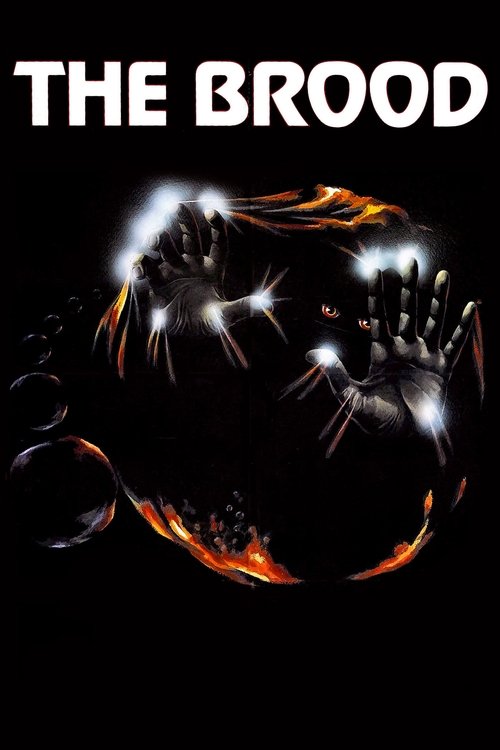
The Brood
1979 · David Cronenberg
For when you're craving a real scare with real weight behind it — horror that hurts because it's about a family. Not comfort viewing; save it for a night when you want to be rattled.
What it's about
Frank Carveth is fighting to keep his small daughter away from the Somafree Institute, where his estranged wife Nola is in the care of a celebrity psychiatrist whose therapy, 'psychoplasmics,' encourages patients' buried rage to express itself through their bodies. As the custody battle hardens, people close to the family start dying at the hands of small hooded figures, and Frank's search for answers leads back to the institute.
The experience
Cold, seething, and genuinely disturbing — less a rollercoaster than a slow clenching of the jaw, building to imagery you won't shake. The horror here is domestic: divorce, custody, and inherited damage, given monstrous physical form.
Performances
Oliver Reed brings brooding, ambiguous authority to the psychiatrist Raglan, and Samantha Eggar is fearless in a role that asks her to go somewhere most actors wouldn't.
The craft
Cronenberg wrote it in the wreckage of his own divorce, and the fury is disciplined into rigorous, wintry Toronto compositions and one of horror's most notorious climactic images — all practical, all the worse for it. Howard Shore's first film score saws away underneath like an exposed nerve.
Why it matters
The moment Cronenberg's body horror became personal rather than conceptual — an acknowledged classic of the genre and a template for horror films that treat family trauma as something the body literally produces.
Snapshot
The Brood is the film in which David Cronenberg's body horror stopped being an abstract proposition about biology and became an argument about families. A man, Frank Carveth, tries to extract his young daughter from the orbit of the Somafree Institute, where his estranged wife Nola is undergoing "psychoplasmics" — a therapy invented by the celebrity psychiatrist Hal Raglan, in which repressed emotion is encouraged to express itself as physical change in the patient's body. While Frank pursues custody and answers, small hooded figures begin killing the people Nola resents: her mother, her father, her daughter's schoolteacher. The film's terrible arithmetic is that these are not metaphors for her rage. They are her rage, gestated externally, birthed from sacs on her abdomen, living only long enough to complete an errand of fury.
Made in Canada on a modest budget within the tax-shelter production environment of the late 1970s, The Brood sits at the hinge of Cronenberg's career. Behind it are the institutional-outbreak films Shivers (1975) and Rabid (1977), which treat the body as a site of contagion and social collapse; ahead of it are Scanners (1981), Videodrome (1983), The Fly (1986), and Dead Ringers (1988), in which the horror becomes progressively more interior, more psychological, and more grievously sad. The Brood is the crossing point: the first Cronenberg film whose monstrousness is unmistakably personal, and the first in which the director's clinical formal manner — flat institutional lighting, unhurried framing, dialogue delivered with the affectless calm of a case conference — is applied to material of raw autobiographical charge. Cronenberg has spoken in interviews across decades about the film's origins in the breakdown of his first marriage and a custody dispute over his daughter, describing the picture in various formulations as his version of Kramer vs. Kramer, a comparison he has repeated often enough that it has become part of the film's standard critical framing.
What makes the film endure is the refusal to soften. Oliver Reed's Raglan is not a charlatan but a serious man whose method works appallingly well. Samantha Eggar's Nola is not a villain so much as an injury with a voice. And the closing images — Nola's explanation of her own body, delivered with the pride of a woman showing off a nursery, and then the last shot of the daughter's arm — commit fully to a bleakness that most horror films of the period reached for and flinched from.
Industry & production
The Brood was produced within the Canadian tax-shelter boom, the period following the federal government's increase of the Capital Cost Allowance for certified Canadian feature films, which briefly made film investment a broadly attractive shelter and produced a large volume of Canadian production in the late 1970s. Cronenberg's earlier features Shivers and Rabid had been made with participation from the Canadian Film Development Corporation (the CFDC, later Telefilm Canada) and with producer Ivan Reitman; The Brood was produced by Claude Héroux, a Montreal producer active across the tax-shelter era, with Victor Solnicki and Pierre David among the executive producers — the same broad producing circle that would carry through to Scanners. Distribution in North America was handled by New World Pictures, Roger Corman's company, which had also released Shivers and Rabid into the American market and which was, in this period, the most reliable conduit for exactly this kind of picture: low-cost, high-concept, exploitable, and occasionally far stranger than its packaging suggested.
The budget was small by American standards and modest even by Canadian ones — figures in the low seven figures are commonly cited, though the precise number varies across sources and should be treated with some caution. The shoot took place in and around Toronto in winter, a fact that is not incidental: the film's snow, its bare trees, its cold northern light, and the institutional interiors of southern Ontario buildings supply the picture with a specific and unglamorous geography. Cronenberg has often noted the value of shooting in Toronto without disguising it as an American city, and The Brood is among the clearest cases — a horror film whose landscape is legibly Canadian in its emptiness and its weather.
The casting of Oliver Reed and Samantha Eggar reflects the tax-shelter logic of the moment: international names to make a Canadian production saleable abroad, surrounded by Canadian character actors. Reed and Eggar had both appeared in major British and American productions in the preceding decade and a half, and their presence gives the film a professional weight that Cronenberg's earlier casts, largely drawn from Canadian television and theater, did not have. Cronenberg has spoken of Reed's professionalism and of the tension of directing an actor of that stature and reputation, and has described the working relationship as productive; accounts of the shoot in the standard interview literature emphasize Reed's discipline on set more than any legendary misbehaviour.
The film's censorship history is significant. The British release was cut, and the film became a recurring reference point in UK debates about horror on video in the early 1980s; longer or uncut versions circulated later. In Canada, provincial censor boards — Ontario's in particular — had already given Cronenberg trouble over Shivers, and the reputation of that film as a scandal of publicly subsidized obscenity, most famously in Robert Fulford's attack in Saturday Night, shadowed his subsequent work. The Brood arrived, in other words, already framed as a provocation by a director the Canadian cultural establishment had decided to be embarrassed by.
Technology
Technologically, The Brood is a conventional late-1970s 35mm production, shot on color negative with anamorphic-free standard framing and finished for ordinary theatrical release; its interest lies not in imaging innovation but in practical special makeup effects, and even there the film is deliberately unshowy compared with what Cronenberg would attempt two years later in Scanners.
The central effects task is the external womb: the sacs on Nola's body from which the brood are born, and the birth itself, in which she tears one open with her teeth and licks the newborn clean. This was achieved with prosthetic appliances and body makeup rather than any optical or mechanical trickery, and the effect works precisely because it is so material — latex, fluid, and an actor's hands. The creature performers themselves are children in hooded snowsuits with facial prosthetics, an approach that solves the scale problem practically and yields the film's most unnerving compositional idea: the monsters are child-shaped, and read at first glance as children.
Cronenberg's effects work in this era belongs to the wider late-1970s shift in horror toward practical makeup as the genre's primary spectacle — the moment of Rick Baker, Dick Smith, Rob Bottin, and Tom Savini, when the visible transformation of the body became the thing audiences came for. The Brood participates in that movement while conspicuously withholding its money shot until the last reel. The film's technology, in the end, is the technology of restraint: everything is built so that one sequence can land.
Technique
Cinematography
Mark Irwin shot The Brood, beginning a collaboration that would run through Scanners, Videodrome, The Dead Zone, and The Fly — arguably the most consequential partnership of Cronenberg's first two decades. The look Irwin establishes here is the one that would define the director's "clinical" reputation: cool, desaturated, evenly lit interiors; a preference for the medium shot held at a slight remove; camera movement that is smooth, motivated, and unhurried even when the content is violent.
The film's most characteristic cinematographic decision is its refusal of horror-movie subjectivity. There is very little hand-held camera, few if any of the prowling stalker POVs that were becoming standard in the wake of Halloween (1978), and almost no expressionist distortion. Attacks are staged in clear, well-lit space and photographed with an almost documentary evenness — the schoolroom killing, in particular, plays out in bright daylight in front of a class of children, its horror amplified by the total absence of atmospheric cover. Cronenberg has repeatedly described his interest in showing things plainly rather than hiding them, and Irwin's photography enacts that: the camera does not tell you to be afraid, it simply declines to look away.
Winter exteriors provide the film's other visual register. White snow, bare gray wood, and the flat light of an Ontario January give the picture a bleached, anaemic palette against which the reds — blood, the brood's parkas in some sequences, the interior of Nola's sac — register with disproportionate force. It is a color scheme of anaemia punctured by hemorrhage.
Editing
Alan Collins cut the film. The editing follows the cinematography's logic: shots are held longer than genre convention requires, coverage is classical, and the cutting rarely accelerates to generate excitement. Violence is not fragmented into impressionistic flashes; it is presented in sustained takes with clear geography, which makes the killings feel less like set pieces and more like events.
The structural editing is more aggressive than the shot-to-shot editing. The film's spine is a cross-cut between two investigations — Frank's search through Raglan's discharged patients and the legal-custodial machinery, and the parallel sequence of murders — and the crucial suspense mechanism is the withholding of a single piece of information: what the brood are and where they come from. The film cuts away from Nola for long stretches, so that when the last act returns to her and stays, the effect is of a door finally opening on something the film has been standing outside of for eighty minutes. The climax, in which Raglan's explanation, Nola's demonstration, and Frank's intervention are braided together, is the only passage where the cutting tightens noticeably — a reserve of pace held back and then spent.
Mise-en-scène / staging
The Somafree Institute is the film's governing space: a low modernist building in the woods, all wood paneling, neutral carpet, and soft-lit consulting rooms, indistinguishable from a conference center or a suburban clinic. Cronenberg's habitual strategy — locate horror inside institutions that look reassuringly professional — is fully formed here, and it is the direct ancestor of ConSec in Scanners, the Institute for Neurological Research in The Dead Zone, and the Mantle clinic in Dead Ringers.
The staging of the psychoplasmics sessions is the film's boldest formal gambit: they are presented as theater. The opening sequence puts Raglan and a patient, Mike, on a bare stage before an audience, with Raglan role-playing Mike's abusive father in a two-hander that is at once therapy, performance, and humiliation. It announces the film's method — that emotion here is externalized, made literally visible, played out in front of witnesses — before a single supernatural event occurs.
Domestic space is staged as its opposite: cluttered, warm-toned, full of the debris of a family in dissolution. The grandmother's house, with its kitchen and its photographs and its liquor, is where the first murder occurs, and the film repeatedly stages violence in kitchens, schoolrooms, and bedrooms — the places where children are fed, taught, and put to bed. The brood themselves are staged with tremendous economy: seen briefly, from behind, at a distance, in the periphery, so that their child-scale silhouettes accumulate dread by resembling something ordinary.
Sound
Howard Shore composed the score for The Brood — his first feature film score, and the beginning of a collaboration with Cronenberg that has now run across most of the director's career, encompassing Scanners, Videodrome, The Fly, Dead Ringers, Naked Lunch, Crash, A History of Violence, Eastern Promises, Cosmopolis, Maps to the Star, and Crimes of the Future. It is one of the longest continuous director-composer partnerships in modern cinema, and it starts here.
Shore's score is written for strings and is deliberately unmelodic in the horror-theme sense: no hummable motif, no stinger-driven cueing pattern. Instead it works in sustained dissonant textures, glissandi, and clusters that recall the mid-century modernist concert repertoire — the Penderecki and Ligeti idiom that 2001 and The Exorcist had recently made available to popular cinema. The strings function less as commentary than as a kind of ambient physiological pressure, present under scenes that contain no threat at all. Shore has described his approach to Cronenberg's films as scoring the interior state rather than the events, and the method is legible from this first collaboration.
Sound design elsewhere is spare and naturalistic — winter silence, the hum of institutional rooms, the ordinary noise of a house. The brood are notably near-silent, which makes their few vocalizations, and the wet sounds of the birth sequence, land with disproportionate force.
Performance
Oliver Reed's Raglan is the film's most surprising performance, because it declines every available opportunity for camp. Reed plays the guru as quiet, contained, intelligent, and genuinely troubled by what he has made — a man whose charisma is expressed through stillness and low volume rather than flamboyance. It is a performance of held-back power from an actor famous for the opposite, and it anchors the film's insistence that psychoplasmics be taken seriously as an idea rather than dismissed as quackery.
Samantha Eggar's Nola is the film's engine, and the performance is structured as a long absence followed by a total presence. For most of the running time she appears only in brief, fragmentary sessions, glimpsed and interrupted; the final sequence gives her the floor, and Eggar plays it not as madness but as maternal pride shading into grief and then into rage. The tonal control of that last scene — tender, boastful, wounded, murderous, sometimes within a single line — is what elevates the material above shock.
Art Hindle's Frank is deliberately unremarkable: a reasonable, tired, increasingly desperate man, played without heroics. His flatness is functional, giving the audience an ordinary vantage from which to watch the extraordinary. Cindy Hinds, as the daughter Candice, gives one of the era's more effective child performances by doing very little — watchful, quiet, and increasingly withdrawn — which makes the film's final image devastating rather than merely ironic. Nuala Fitzgerald and Henry Beckman, as Nola's parents, sketch a history of alcoholism and abuse in a handful of scenes, and the film's willingness to let the grandmother be both a victim and a genuinely damaging person is part of its moral seriousness.
Narrative & dramatic mode
The Brood is built as a detective story grafted onto a domestic drama, with the horror emerging from the intersection. Frank's investigation supplies the forward motion: he interviews a former patient whose psychoplasmic lymphoma is killing him, he consults lawyers and doctors, he tries to establish grounds for custody. This is the procedural spine of a mystery — a man assembling evidence about an institution.
Underneath it runs a divorce narrative of unusual specificity. The film is precise about the machinery of family breakdown: the exchange of the child, the bruises noticed at bathtime, the question of what to tell a school, the impotence of a father who has legal rights but no leverage, the way a grandmother's grievances become a mother's inheritance. Cronenberg's own account of the film's origin in his divorce and custody dispute is well documented in interviews, and the material's rawness is legible without that biography.
The dramatic mode is best described as clinical melodrama. The emotional content is operatic — a mother's rage, a child in peril, three generations of transmitted abuse — but the presentation is diagnostic: calm, evenly paced, explained in dialogue by professionals. The film's crucial structural move is that its exposition is also its climax. Raglan's explanation of what Nola is doing and Nola's own demonstration of it arrive at the same moment, so that understanding and horror are simultaneous. This is a Cronenberg signature — the revelation is the monster — and The Brood is where the pattern is first fully achieved.
The ending is the film's hardest gesture. Frank kills Nola to stop the brood, saves Candice, and drives away with her; in the car, the camera finds welts on the child's arm, the same marks that preceded Nola's own manifestations. The abuse continues in the next generation, and the rescue was not one. It is a refusal of resolution so complete that it converts the whole film retroactively into a study of inheritance.
Genre & cycle
The Brood belongs to several overlapping cycles at once and sits comfortably in none.
It is a late entry in the 1970s cycle of possessed- and monstrous-child films initiated by Rosemary's Baby (1968) and consolidated by The Exorcist (1973), It's Alive (1974), The Omen (1976), and Carrie (1976) — a body of work in which reproduction, childhood, and the family are the sites of dread. Cronenberg's contribution is to remove the supernatural entirely. There is no devil, no telekinesis of unexplained origin, no curse; there is a therapy that works. The film's monstrous children are neither demonic nor mutant in the atomic-age sense. They are affect, incarnated.
It is simultaneously a "medical horror" or "clinical gothic" film, a mode Cronenberg had largely built himself across Shivers and Rabid and which would later be named body horror. And it arrives at the exact moment the American slasher cycle was consolidating — Halloween had opened months earlier, Friday the 13th would follow the year after — while running counter to nearly all of that cycle's tendencies: no teenagers, no subjective stalking camera, no final girl, no sexual-transgression logic.
Its most direct generic descendants are the psychological body-horror films of the 1980s and after: Scanners, Videodrome, and The Fly within Cronenberg's own filmography, and beyond it a wide line of films in which parenthood is the source of monstrosity — a lineage running through Possession (1981), which shares an uncanny amount of DNA with The Brood despite being made independently and in a different national context, and forward to The Babadook (2014), Goodnight Mommy (2014), Hereditary (2018), and Titane (2021).
Authorship & method
The Brood is the film where Cronenberg's authorship becomes fully self-aware. He wrote the screenplay alone — as he did for most of his early features — and the writing is notable for its willingness to let characters explain the film's premise in flat, credible professional language. Raglan's book, the discharged patients, the doctor's diagnosis: the film builds its impossible idea out of ordinary institutional discourse.
The method is consistent across his work of this period: take a speculative biological premise seriously and follow it with rigor, refusing both the supernatural and the comic. Cronenberg has often described himself as coming from a scientific and literary background rather than a cinephile one, and his films of this era feel proposed rather than quoted — they have very little of the referential texture common in his American contemporaries.
The key collaborators assembled here would define his subsequent decade. Mark Irwin's photography established the cool, legible, unsensational style that Cronenberg's ideas required. Howard Shore's score, his first, initiated a partnership that has effectively become co-authorship of the Cronenberg tone. Alan Collins cut the film. Carol Spier, whose long association with Cronenberg as production designer runs from this era through his later career, gave the institutional spaces their bland, plausible menace. The organizing principle across all these departments is the same: make the extraordinary look like a Tuesday afternoon.
Movement / national cinema
The Brood is a foundational text of English-Canadian genre cinema. It emerges from the tax-shelter boom and from a national film culture that was, at the time, strongly oriented toward documentary realism and toward the CFDC's preference for respectable cultural product — a context in which Cronenberg's work was widely regarded as an embarrassment. The Fulford controversy over Shivers had made the political stakes explicit: public money, genre horror, and bodily disgust.
The films nonetheless carry an unmistakably Canadian imprint. The winter, the emptiness, the low modernist institutional architecture, the affectless politeness of the professional class, and the sense of a society organized around clinics, schools, and lawyers rather than around individual heroism are all specific to the setting. Critics have often characterized Cronenberg's early work as a horror cinema of institutions and reasonable people, and that reading depends on the Canadian setting.
Historically, The Brood belongs to the moment when Canadian genre film became internationally visible, alongside Bob Clark's Black Christmas (1974) and a broader run of tax-shelter horror. Cronenberg is the figure who converted that commercial opportunity into a body of work, and The Brood is where the Canadian setting stops being incidental and becomes constitutive.
Era / period
The film sits precisely at the end of the 1970s and registers that moment's preoccupations. The therapy culture it satirizes is specific: the post-encounter-group, post-primal-scream landscape of the 1970s, in which charismatic practitioners marketed emotional release as a technology and published bestselling books about it. Raglan is legible as a figure of that world, and psychoplasmics is a literalization of its central promise — that buried feeling, brought to the surface, can be discharged.
It is equally a film of the divorce decade. No-fault divorce had spread through North America across the 1970s, and custody, access, and the fate of children in dissolved marriages had become a mass social experience. The Brood opened the same year as Kramer vs. Kramer, and the pairing is illuminating: one film treats the custody crisis as a story of adult growth, the other as an evisceration.
Formally, the film belongs to the late-New-Hollywood-adjacent moment when horror was becoming the most artistically ambitious commercial genre in North America — the era of The Texas Chain Saw Massacre, Carrie, Halloween, Dawn of the Dead, and Alien — and when practical makeup effects were about to become the genre's dominant spectacle.
Themes
Rage as reproduction. The film's governing idea is that anger is generative — that it does not dissipate but issues forth, takes form, and acts. Nola's parthenogenetic brood are her feelings given bodies and errands. The horror is not that she is monstrous but that her feelings are legitimate and their expression is lethal.
Inherited abuse. Three generations are laid out with unusual clarity: a grandmother who drank and hit, a mother marked by it, a daughter now marked in turn. The film's last shot is an argument that abuse is transmissible, and that the machinery of rescue — courts, doctors, fathers — cannot interrupt the transmission.
The mind writing on the body. Psychoplasmics is a somatization fantasy taken to its logical end: emotional content producing tissue. The film extends it to the film's minor characters — welts, lesions, a lymphoma — so that Nola's brood are an extreme case of a general law.
Institutional benevolence as threat. Somafree looks like a good place. Raglan means well. The film's suspicion is directed not at villainy but at competence: the danger is a method that works better than anyone anticipated, in the hands of a man who cannot control its consequences.
Custody and the powerlessness of the reasonable. Frank does everything correctly and it avails him nothing. The film is unusually attentive to the impotence of procedure against feeling.
Motherhood without a father. Nola reproduces alone. The brood have no paternal contribution, and the film registers this as both an act of extraordinary power and a form of total isolation — a reading feminist criticism has developed extensively, both as a critique of the film's misogyny and as an account of its unusual willingness to grant its female character a monstrous form of creative authority.
Reception, canon & influence
Critical reception. The Brood was received poorly by much of the mainstream press on release. Cronenberg's early films had already been marked as disreputable in Canada following the Shivers controversy, and the American reception treated The Brood largely as exploitation. Roger Ebert reviewed it harshly, and negative notices emphasizing misogyny and gratuitousness were common. Genre-attentive critics were more receptive from the start, and a serious critical literature developed relatively quickly: Robin Wood's influential writing on the 1970s American horror film engaged with Cronenberg at length and read him as a reactionary figure whose work expressed disgust at the body and at sexuality — a reading that became the central provocation subsequent Cronenberg scholarship responded to. Wood's critique and the counter-arguments to it did more than any positive review to establish Cronenberg as a director requiring interpretation.
Reassessment has been thorough. The Brood is now widely regarded as the pivotal film of Cronenberg's early period and among the most emotionally serious horror films of its decade; its restoration and release by the Criterion Collection confirmed its canonical standing. The performances, particularly Eggar's, have been substantially revalued, and the final scenes are routinely cited among the most disturbing endings in the genre.
Influences on the film (backward). The clearest lineage is the post-Rosemary's Baby horror of reproduction and the family, and the Exorcist-era interest in the child's body as a site of dread. Beyond genre, Cronenberg's speculative-biological premise belongs to a science-fictional tradition of taking an idea literally and pursuing its consequences, a mode more literary than cinematic in origin. The therapy-culture satire draws directly on the observable phenomenon of 1970s encounter and primal-scream movements. The clinical visual manner has affinities with the institutional realism of 1970s American paranoid cinema. And the film's autobiographical charge — Cronenberg's divorce and custody dispute — is the most direct influence of all, one he has discussed openly and repeatedly.
Legacy (forward). Within Cronenberg's own work, The Brood is the origin point of the mature style: the Irwin photography, the Shore scores, the Spier design, and the fusion of clinical premise with personal grief all begin here and lead directly to Videodrome, The Fly, and Dead Ringers, in which the body-horror premise becomes a vehicle for love, addiction, and mourning.
Beyond it, the film is a touchstone for the entire subsequent tradition of parenthood-as-horror. Andrzej Żuławski's Possession (1981) presents such a striking parallel — a disintegrating marriage, a woman whose emotional extremity produces a creature, a custody battle — that the two films are constantly discussed together, though there is no established evidence of direct influence and the resemblance is best understood as convergent. The lineage running through The Babadook, Goodnight Mommy, Hereditary, Saint Maud (2019), and Titane — films in which maternal grief or rage is the monster's actual substance rather than its metaphor — is the clearest measure of The Brood's reach.
Its formal influence is equally durable: the idea that horror is most effective when photographed plainly, explained credibly, and set inside institutions that look entirely normal has become one of the dominant modes of serious horror filmmaking. And Shore's austere string writing for this film established a template — dissonant, textural, psychological rather than illustrative — that the genre has drawn on ever since.
A Deleuzian reading
A woman stands in front of a class of small children.
The full Deleuzian reading of The Brood →
Reception
Slammed on release — Roger Ebert dismissed it as sleazy exploitation — The Brood has since been fully rehabilitated: a Criterion release and a regular spot near the top of Cronenberg rankings turned it from reviled shocker into body-horror cornerstone.
How The Brood was received, from release to now →
How to watch The Brood: what to notice on a first viewing
- Watch Raglan role-play a patient's father on a bare stage. The opening session puts doctor and patient in front of an audience, acting out an abusive relationship as therapy, performance, and humiliation at once. The film announces early that feeling here gets acted out in front of witnesses, not kept private.
- Notice how calm and evenly lit even violent scenes stay. Irwin shoots in cool, desaturated medium shots at a slight remove, with none of the prowling handheld camera other horror films of the period were using. The steadiness makes the film feel like it is simply recording a Tuesday afternoon.
- Notice how pale everything looks except the color red. White snow, bare gray wood, and flat Ontario winter light bleach the whole film, so any red that appears registers with disproportionate force. A color scheme built almost entirely out of anemia makes any hemorrhage impossible to miss.
- Listen for strings that never resolve into a melody. Shore's score works in sustained dissonant textures and clusters rather than a stinger or a theme, present even under scenes that contain no visible threat. The music is scoring a feeling in the air rather than any single event on screen.
- Notice how ordinary the Somafree Institute looks from outside. The building is wood paneling, neutral carpet, and soft-lit consulting rooms, indistinguishable from any professional clinic or conference center. The horror in this film hides inside competence, not inside anything that looks dangerous.
The whole guide to watching The Brood, with the keys for a rewatch →
Influences: the films it descends from and the films it influenced
- Rosemary's Baby (1968) — Establishes the template Cronenberg inherits wholesale — reproduction horror staged inside plausible professional authority (the obstetrician, the case file, the specialist's reassurance) and photographed in unstylized apartment naturalism, with the offspring withheld from the frame until a final-shot reveal.
- The Exorcist (1973) — The arteriogram/clinic sequences model horror as medical procedural — real institutional corridors, flat overhead light, technicians speaking jargon at normal volume — which is exactly the register Mark Irwin uses for the Somafree Institute.
- Village of the Damned (1960) — Blocks a group of children as a single organism — uniform dress, no dialogue, synchronized advance in wide shot — the staging grammar Cronenberg reuses for the brood, who are choreographed as a swarm rather than individuated performers.
- It's Alive (1974) — Obstetric horror in which the practical creature-infant is kept in glimpses and the delivery room itself is the crime scene; Cronenberg's prosthetic external-birth effect and its clinical framing descend directly from this economy of concealment.
- Don't Look Now (1973) — Parental grief structured as a crosscut investigation across a wintry, drained-palette city, culminating in the reveal that the small coated figure pursued as a lost child is the killer — the exact shock architecture of Cronenberg's snowsuited brood.
- Klute (1971) — Uses recorded therapy sessions as a recurring structural device — the patient's self-analysis delivered in near-static long takes — and Gordon Willis's underlit institutional interiors give the paranoid-realist look Cronenberg applies to Raglan's clinic.
- Psycho (1960) — Licenses the closing expository psychiatrist: a professional who stands still and explains the film's pathology aloud in credible clinical vocabulary, the device Cronenberg extends by letting Raglan lecture the mechanism of psychoplasmics in plain sentences.
- Rabid (1977) — First Cronenberg–Mark Irwin collaboration and the immediate rehearsal for The Brood's method — a plastic-surgery clinic shot in even, shadowless daylight, with the biological premise delivered through prosthetic appliance work rather than optical effect.
- Scanners (1981) — Carries the Somafree model forward as ConSec — a research program whose staff explain their pseudoscience in seminar language — and continues the Irwin/Shore/Spier unit, with Shore's dissonant string clusters again scoring institutional corridors rather than shocks.
- Videodrome (1983) — Repeats The Brood's exact production formula — Irwin's flat photography, Shore's textural score, Carol Spier's antiseptic sets, a named institute (the Cathode Ray Mission / Spectacular Optical) — and pushes the practical bodily aperture from external birth to abdominal cassette slot.
- The Fly (1986) — Perfects the Brood's fusion of prosthetic transformation with domestic grief: the appliance work is staged in the same clinical two-hander scenes, and Shore's strings mourn rather than illustrate, treating the effect as the emotional content of a breakup.
- Dead Ringers (1988) — Takes the clinic-as-stage to its endpoint — fabricated gynecological instruments presented as legitimate medical objects in cool, even operating-theater light — with Shore's chamber strings sustaining the same psychological, non-cued dissonance.
- Antichrist (2009) — Restages Raglan's method as a husband-therapist administering exposure therapy to his grieving wife in an isolated retreat, structured as sequential named sessions, and again lets bereavement discharge itself as literal bodily mutilation.
- The Babadook (2014) — Makes maternal rage the monster's actual substance rather than its metaphor, and keeps the creature in practical, stop-motion-adjacent glimpses within an ordinary, drained-of-color suburban house — the Brood's argument that the mother's affect is the effect.
- Hereditary (2018) — Runs grief through institutional forms — the bereavement support group, the séance staged as a family session — in sustained wide takes with a locked camera and cold, even domestic light, so the family home reads as a clinical set the way Somafree does.
- Titane (2021) — Returns to fully practical prosthetic gestation and birth — silicone bellies, fissuring skin, on-set fluids — filmed in unblinking medium shots inside a workplace institution, with the pregnancy again functioning as a parental crisis made corporeal.
- Naked Lunch (1991) — Pioneers his method of literalizing psychic trauma as externalized physical creatures, the template for rendering Lee's repression and guilt as autonomous talking bugs and Mugwump flesh.
- Possession (1981) — Convergent rather than derived: a marriage dissolving into custody warfare produces a literal creature (Rambaldi's practical puppet) that the wife tends in a rented flat — the same decision to make the monster the physical issue of emotional extremity, though shot in hand-held frenzy instead of Cronenberg's stillness.
- Safe (1995) — Transposes the Somafree Institute into the Wrenwood retreat and holds it in long, static, symmetrically composed wides under flat fluorescent light, so the therapy-culture guru's explanation of the patient's symptoms becomes the horror — Cronenberg's clinical distance without prosthetics.
Similar films
- The Fly (1986) — influence & lineage
- Scanners (1981) — influence & lineage
- Videodrome (1983) — influence & lineage
- Hereditary (2018) — influence & lineage
- Dead Ringers (1988) — influence & lineage
- Don't Look Now (1973) — influence & lineage
- Antichrist (2009) — influence & lineage
- The Exorcist (1973) — influence & lineage