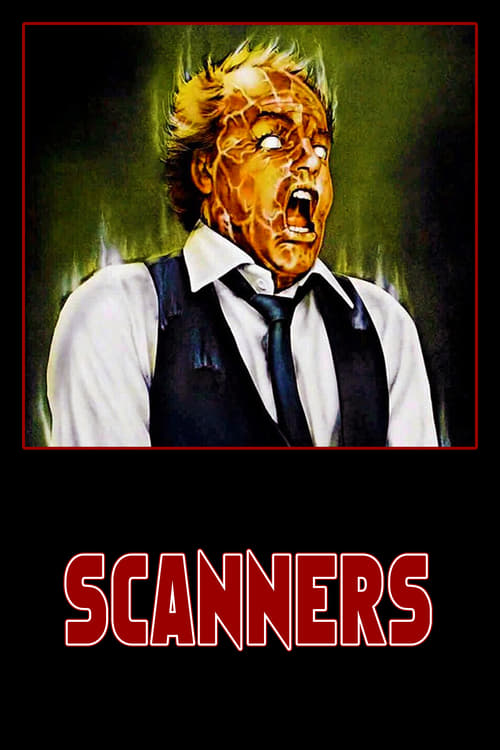
Scanners
1981 · David Cronenberg
For when you're craving vintage practical-effects horror with a brain — a midnight movie that's also a genuine conspiracy thriller. Challenge viewing for the squeamish, catnip for everyone else.
What it's about
'Scanners' are people born with an unusual nervous system that lets them enter — and shred — other minds. Cameron Vale, a derelict scanner who can barely survive the noise of other people's thoughts, is recruited by a scientist inside a shadowy corporation and trained to hunt Darryl Revok, a renegade scanner assembling his own kind for a war on everyone else. What starts as a manhunt opens out into a conspiracy about where the scanners came from in the first place.
The experience
Cold, paranoid, and clinical, punctuated by bursts of shocking prosthetic violence — the famous head-exploding demonstration arrives early and announces exactly what kind of ride this is. The psychic duels are physical, sweaty, vein-popping affairs; the dread between them is all corporate corridors and surveillance.
Performances
Michael Ironside as Revok is the keeper: magnetic, contemptuous menace that made him a career villain.
The craft
Cronenberg shoots telepathy as biology, not magic — the effects work, from the era's most infamous exploding head to the climactic scan battle, is landmark practical craftsmanship that still lands harder than digital ever does. Howard Shore's electronic-tinged score keeps the whole thing humming with unease. The gorier setpieces genuinely reward a good screen and the company of friends.
Why it matters
The film that broke Cronenberg out of the Canadian genre ghetto and into international horror stardom; its exploding head became one of the most reproduced images in the genre, shorthand for horror's early-80s embrace of graphic prosthetic spectacle.
Snapshot
Scanners is the film that made David Cronenberg's name outside the Canadian tax-shelter circuit, and it did so on the strength of roughly two seconds of screen time. The exploding head that arrives some fifteen minutes into the picture — a public demonstration of telepathy gone catastrophically wrong — became one of the most reproduced images in horror history, a shorthand for the genre's early-1980s turn toward graphic prosthetic spectacle. That the film is remembered for a single gag has obscured what it actually is: a paranoid corporate thriller in the mold of the American conspiracy cycle of the 1970s, retrofitted with a biological premise that Cronenberg had been circling since Shivers (1975).
The premise is characteristically clinical. "Scanners" are people with an unusual nervous system — telepathic, capable of interfacing with other nervous systems and, by extension, with any system that behaves like one. They are not superheroes; they are casualties. Most are driven to madness or destitution by the uncontrolled voices of others, and the film opens with its protagonist, Cameron Vale (Stephen Lack), scavenging in a shopping mall, closer to a homeless psychiatric patient than to an action lead. He is recruited by Dr. Paul Ruth (Patrick McGoohan) on behalf of ConSec, a security and weapons corporation, and directed against Darryl Revok (Michael Ironside), a scanner who is organizing his kind into an insurgency. The plot moves through the standard beats of the conspiracy thriller — the sympathetic contact, the safe house, the discovery that the corporation is compromised from within — toward a revelation that reframes the whole conflict as a family matter and a pharmaceutical crime.
What distinguishes the film is the way Cronenberg literalises abstraction. Telepathy in Scanners is not ethereal; it is nosebleeds, seizures, ruptured capillaries, and the nervous system understood as plumbing. The film's most conceptually daring sequence has Vale scan a computer through a telephone line, an idea that reads now as a premonition of the human-machine continuum Cronenberg would pursue through Videodrome (1983) and eventually eXistenZ (1999).
Industry & production
Scanners was produced within the Canadian Film Development Corporation's tax-shelter era, the period in which the Capital Cost Allowance permitted investors to write off a substantial portion of investment in certified Canadian productions. The policy generated a large volume of Canadian features in the late 1970s, of which a considerable proportion were genre pictures aimed at international markets — a context that gave Cronenberg his career and simultaneously shaped its constraints. He had come up through Shivers and Rabid (1977) with producer Ivan Reitman and Cinepix, and by The Brood (1979) and Scanners was working with producer Claude Héroux and Filmplan International, a Montreal-based company operating in the same funding environment.
The production is well documented as having been difficult, and Cronenberg himself has spoken frankly about it in interviews over the decades — principally in the long-form conversations collected in Cronenberg on Cronenberg (ed. Chris Rodley). The core problem was schedule: the film had to begin shooting to meet tax-year deadlines, and Cronenberg has described writing pages during production, sometimes the night before shooting them. The consequence is legible on screen. The film's structure is lumpier than The Brood's or Videodrome's, with expository scenes that carry more weight than they should and a middle act that improvises its way between set pieces. Cronenberg has also discussed the ordeal of shooting a Montreal winter with an incomplete script and a cast assembled under time pressure.
Casting reflects both the constraints and a certain shrewdness. Patrick McGoohan — by then indelibly associated with The Prisoner — brought a ready-made aura of institutional paranoia and enigmatic authority. Michael Ironside, a Canadian stage and television actor, was largely unknown to international audiences; Scanners effectively launched him as a screen villain and established the coiled, contemptuous register he would work in for decades. Stephen Lack, a visual artist rather than a trained actor, was cast in the lead, a decision that has been debated ever since.
The film's commercial performance was, by the standards of Cronenberg's prior work, transformative: it opened in the American market in early 1981 through Avco Embassy and performed strongly relative to its modest budget, which lifted Cronenberg from a regional horror specialist to a director with international leverage. Specific grosses circulate in various secondary sources with enough inconsistency that they are not worth asserting here; what is uncontroversial is that the film was a substantial success and that it directly enabled Videodrome and, subsequently, the Hollywood-financed The Dead Zone (1983).
Technology
The film's technological imagination operates on two levels: the special effects that realize scanning, and the diegetic technology that the plot concerns.
Effects work was executed by Dick Smith — the American makeup artist whose credits include The Exorcist and Taxi Driver — working with Canadian collaborators including Gary Zeller and Stephan Dupuis, with Chris Walas among those credited on the production's effects team. The celebrated head explosion has an unusually well-attested origin story, repeated consistently by Smith and by Cronenberg across many interviews: a plaster head was packed with material including latex scraps and leftover food, and, after attempts at internal detonation proved unsatisfactory, the shot was achieved by firing a shotgun into the back of the head, off-camera, and running the resulting footage as filmed. The result is a single-take practical effect whose violence reads as genuinely uncontrolled — a quality that digital compositing has never quite reproduced.
The film's other major effects sequence, Revok and Vale's final confrontation, involves an escalating catalog of prosthetic transformation: bulging veins, blistering skin, eyes hemorrhaging, and finally a body burning from within. It is achieved through appliance makeup and pyrotechnics rather than optical work, and it commits fully to the idea that a psychic duel is a physiological event.
Diegetically, the film's key technological conceit is the merger of nervous system and computer network. Vale's assault on ConSec's computer via a telephone handset — pressing the receiver to his temple, entering the machine's "nervous system," and ultimately causing a catastrophic overload — is a remarkable moment for 1981. It predates the cyberpunk formalization of the idea (William Gibson's Neuromancer appeared in 1984) and is more concerned with wetware than with data. The other technological object is pharmaceutical: ephemerol, a tranquilizer prescribed to pregnant women, which turns out to be the agent that produced the scanner generation. The drug plot is transparently modeled on the thalidomide and DES scandals, and it locates the film's horror in corporate medicine rather than in the paranormal.
Technique
Cinematography
Mark Irwin shot the film, as he did most of Cronenberg's work from Fast Company (1979) through The Fly (1986), and the visual scheme is consistent with that run: cool, desaturated, evenly lit, with a preference for institutional interiors rendered without expressionist distortion. Cronenberg and Irwin's characteristic strategy is to photograph the extraordinary in the register of the ordinary — the corporate boardroom, the medical office, the light-industrial warehouse — so that when the body ruptures, it does so inside a frame that has offered no stylistic warning. Montreal locations stand in for a deliberately unspecified North American setting, and the winter exteriors contribute a flat, gray palette that keeps the film's temperature low.
Camera movement is restrained and often functional. The film favours static or slowly tracking coverage in dialogue, with the effect that the scanning sequences — which are largely built from held close-ups of faces in strain — acquire their intensity through duration and cutting rather than through camera pyrotechnics.
Editing
Ronald Sanders cut the film, beginning a collaboration that would run through virtually all of Cronenberg's subsequent career. The editing of the scanning duels is the film's most distinctive formal device: because telepathic combat has no physical action to photograph, it is constructed almost entirely through shot/reverse-shot between faces, with cutting rhythm carrying the sense of pressure and counter-pressure. The strategy is closer to the grammar of a gunfight than of a conversation, and it works because Ironside in particular can play escalation with almost no external movement.
Elsewhere the editing bears the marks of the compressed production. Transitions between locations are sometimes abrupt, and exposition arrives in blocks. The film is efficient rather than elegant.
Mise-en-scène / staging
The production design places scanners in a world of corporate modernism and light industry: ConSec's offices and auditorium, an art collective's warehouse, a pharmaceutical facility, a suburban house. The most striking single set piece is the studio of Benjamin Pierce (Robert A. Silverman), a scanner-artist who has retreated into sculpture — his enormous plaster head, which he sits inside, externalizes the film's central image of the skull as a container under pressure. Silverman, a recurring Cronenberg player, gives the film its strangest and most affecting scene.
Staging of the scanning confrontations is consistently frontal and symmetrical: two figures facing each other, often seated, the space between them emptied. Cronenberg stages psychic violence as a duel, and the compositional formality is part of the joke and part of the dread.
Sound
Howard Shore composed the score — his second for Cronenberg after The Brood, and an early entry in one of the most durable director-composer partnerships in modern cinema. The Scanners score is notable for combining orchestral writing with electronic textures produced in collaboration with synthesist Michael Zinger; the result is a sound world of drones, grinding low frequencies, and dissonant clusters that sit somewhere between orchestral horror scoring and musique concrète. Shore's approach here — treating the score as a continuous nervous hum rather than as thematic commentary — established the idiom he would refine in Videodrome and The Fly.
Sound design is equally central. Scanning is rendered aurally as a wash of overlapping voices, whispers, and pressure — the film's opening in the shopping mall establishes the affliction through sound before any effect is shown. The convention that telepathy sounds like an unbearable crowd has been widely borrowed since.
Performance
The performances divide sharply, and the division is much discussed. Stephen Lack's Cameron Vale is affectless and vocally flat, an approach that many contemporary reviewers treated as simple inadequacy. A revisionist reading — advanced by various later critics and, at times, by Cronenberg himself in interviews — holds that the blankness suits a character who has spent his adult life unable to distinguish his own thoughts from other people's. The debate is unresolved and probably unresolvable; what is clear is that Lack's wide, pale-eyed stare is enormously effective in the scanning close-ups, whatever it does elsewhere.
Michael Ironside is the film's engine. His Revok is charming, wounded, and casually cruel, and the performance carries an intelligence that the script only partly supplies. Patrick McGoohan plays Dr. Ruth with a distracted gravity that suggests a man managing several secrets at once. Jennifer O'Neale as Kim Obrist and Lawrence Dane as ConSec's Braedon Keller fill functional roles competently within a script that gives them limited room.
Narrative & dramatic mode
Structurally, Scanners is a conspiracy thriller. Its architecture — a compromised protagonist recruited by an institution, sent to infiltrate an opposing network, discovering that his sponsors and his targets are entangled — belongs to the same lineage as The Parallax View (1974) and Three Days of the Condor (1975), transposed into science fiction. The investigative structure is deliberate: much of the film consists of Vale following leads, and the scanning sequences function as the genre's interrogation scenes.
Onto this, Cronenberg grafts a family melodrama. The final act reveals that Vale and Revok are brothers, sons of Dr. Ruth, whose ephemerol experiments created them. The revelation converts a corporate thriller into a fable about paternal responsibility and inherited condition — a preoccupation that runs from The Brood's parental rage through The Fly's and Dead Ringers' fraternal doublings.
The film's dramatic mode is cool and analytic rather than suspenseful in the Hitchcockian sense. Cronenberg's characters explain themselves in flat, clinical language; the affect is deliberately withheld, and the horror is intellectual before it is visceral. The ending — deliberately ambiguous as to which brother survives in which body — is the film's most sophisticated gesture, resolving the plot while dissolving the question of identity that the plot depended on.
Genre & cycle
Scanners sits at the intersection of three cycles. The first is the psychic-powers cycle that ran through 1970s American cinema, given commercial life by Carrie (1976) and extended through The Fury (1978), The Medusa Touch (1978), and the Stephen King adaptations. The second is the paranoid conspiracy thriller of the post-Watergate 1970s. The third is the practical-effects body horror cycle that Scanners itself helped inaugurate, alongside An American Werewolf in London and The Howling (both 1981) and The Thing (1982) — a brief, intense period in which prosthetic transformation became a genre's principal attraction.
Within Cronenberg's own filmography, Scanners is the hinge between the early "outbreak" films — Shivers, Rabid, The Brood, all concerned with contagion and bodily revolt — and the mature media-and-consciousness films that begin with Videodrome. It carries the earlier films' interest in medicine as the source rather than the cure of catastrophe, and introduces the later films' interest in the nervous system as an information channel.
Authorship & method
Cronenberg wrote and directed. His authorial signature is by this point fully formed: the disease-as-transformation premise, the clinical tone, the recurring figure of the doctor-scientist whose experiment escapes him, and the refusal to treat bodily horror as punishment. Cronenberg has consistently described his interest as existential rather than moralistic — the body as the whole of what a person is, and therefore the only site where anything meaningful can happen to them. Scanners applies that principle to telepathy, a phenomenon that most fiction treats as immaterial.
The collaborators established here proved unusually durable. Mark Irwin shot six Cronenberg features. Ronald Sanders edited essentially everything from Scanners forward, into the twenty-first century. Howard Shore, on his second Cronenberg score, would go on to score nearly all of them, and the Scanners work — abrasive, texture-led, electronically inflected — is where the partnership's method becomes recognizable. Carol Spier, the production designer, likewise began a long association with Cronenberg in this period. Robert A. Silverman became a recurring presence across the filmography. The film is, in effect, where Cronenberg's repertory company assembled.
Method-wise, Scanners is atypical for Cronenberg in one important respect: he has repeatedly characterized it as the film he made without a finished script, and his subsequent practice of extensive pre-production writing appears in part as a reaction against the experience.
Movement / national cinema
The film belongs to English-Canadian genre cinema of the tax-shelter era, and to the loose body of work that Canadian critics — often pejoratively, at the time — grouped under the label of Canadian horror or, in the era's dismissive press coverage, "beaver gothic." Cronenberg's early films were the subject of genuine national controversy: Shivers had been attacked in the Canadian press for having received public funding, and this criticism shadowed the CFDC's genre investments generally.
At the same time, the films are legibly Canadian in ways beyond financing. The institutional settings — corporations, clinics, research bodies — and the recurrent theme of a benign-seeming bureaucracy conducting experiments on its own population have been read by scholars as an expression of a particular Canadian relation to state and corporate authority. Montreal's modernist architecture and industrial fabric give the film a North American anonymity that lets it read as generically continental while remaining physically specific.
Era / period
1981 sits at a threshold. The paranoid political cinema of the 1970s was ending; the effects-driven blockbuster horror of the 1980s was beginning. Scanners faces both ways. Its politics — corporate malfeasance, pharmaceutical harm to an unconsenting population, a security firm with its own agenda — are of the earlier decade. Its spectacle belongs to the new one.
The ephemerol plot connects to a specific historical anxiety. The thalidomide catastrophe of the late 1950s and early 1960s, and the discovery in the early 1970s that diethylstilbestrol caused cancers in the daughters of women who had taken it during pregnancy, made the idea of a drug that damages the next generation a live public fear rather than a fantasy. Scanners takes that fear and inverts it: the children are not damaged but enhanced, and the enhancement is the catastrophe.
Themes
The body as system. Cronenberg's persistent claim is that mind and body are not separable, and Scanners is perhaps his most direct statement of it. Telepathy is not spirit; it is nervous tissue. Consequently, telepathic contact is a physical intrusion, and telepathic violence produces physical wounds.
Inheritance and paternity. The scanners are their father's experiment. Dr. Ruth created them, concealed it, and then attempted to manage the consequences by deploying one son against the other. The film's horror is generational: a condition transmitted through the mother's body by a father's decision.
Corporate medicine. ConSec is a weapons and security firm; ephemerol is a product. The film insists that the scanners' existence is the by-product of commerce, and that the institutional response to them is to weaponize them. There is no scene in which any institution considers helping them.
Networked consciousness. Revok's project is to link scanners into a collective; the film's climactic idea is that a mind can enter a computer network. The equation of nervous system and information system is the film's most prescient move, and it points directly at Videodrome's "long live the new flesh."
Madness and diagnosis. The film opens in a psychiatric register: scanners are found among the homeless and the institutionalized, medicated into stupor. The suggestion that psychiatric illness might be an unrecognised capacity is present, though the film declines to sentimentalize it.
Reception, canon & influence
Contemporary critical reception was divided along predictable lines. The film was widely acknowledged as a commercial and visceral success while being faulted for its script's expository patches and for Lack's central performance; Cronenberg's earlier work had already attracted hostile notices from critics who found the body horror gratuitous, and Scanners inherited some of that. Robin Wood's influential critique of Cronenberg from this period — reading the films as reactionary in their treatment of the body and sexuality — is the most substantial negative account, and it framed academic debate for years. Against it, a body of scholarship developed through the 1980s and 1990s treating Cronenberg as a serious philosophical filmmaker of embodiment; the reappraisal was well established by the time of Dead Ringers (1988) and Naked Lunch (1991).
Influences on the film (backward). The most direct is Carrie, which established the commercial viability of psychokinetic horror. Brian De Palma's The Fury is the closer structural antecedent: two young psychics, an institution attempting to weaponize them, and a climactic bodily explosion. The conspiracy-thriller architecture derives from Pakula and Pollack. In literature, the film's DNA runs through the pulp-SF tradition of psi powers — A. E. van Vogt's Slan, Theodore Sturgeon's More Than Human, and the broader Campbell-era interest in the telepathic mutant as the next evolutionary step. Cronenberg has spoken frequently of William Burroughs as a formative influence, and Burroughs's understanding of control systems and viral language is legible here well before the explicit adaptation of Naked Lunch.
Legacy (forward). The head explosion has been quoted, parodied, and referenced continuously — in television comedy, in music video, in games — to the point where it functions independently of the film. More substantively, Scanners established the template for the psychic-duel-as-physical-strain sequence, visible in a long line of subsequent work up to and including Stranger Things's nosebleed telekinetics and the Akira lineage of psychic-mutant narratives. Its image of consciousness entering a computer network anticipates cyberpunk cinema's central trope.
The film generated a franchise Cronenberg had no creative role in: Scanners II: The New Order (1991) and Scanners III: The Takeover (1992), directed by Christian Duguay, and the loosely related Scanner Cop films of the mid-1990s. None achieved critical standing, and their existence is chiefly evidence of the original's marketability.
Within Cronenberg's career, the film's importance is structural. Its success bought him Videodrome, an uncompromised and commercially unsuccessful film that is now generally regarded as his major work of the period, and then The Dead Zone and The Fly, which established him internationally. Scanners is not Cronenberg's best film — he has said as much, and the production circumstances explain why — but it is arguably his most consequential, the one that converted a Canadian genre specialist into an author whose subsequent work the industry was prepared to finance.
A Deleuzian reading
A man is scavenging for food in a shopping mall.
The full Deleuzian reading of Scanners →
Reception
Critics in 1981 mostly shrugged, but audiences didn't — it became Cronenberg's first film to top the US box office. It's since settled in as canonical early body horror, the film that broke him out of the Canadian genre ghetto toward Videodrome and The Fly.
How Scanners was received, from release to now →
How to watch Scanners: what to notice on a first viewing
- Notice how ordinary and unstylized every office and lab looks. Mark Irwin shoots boardrooms and medical offices in cool, desaturated, evenly lit coverage with no expressionist distortion, offering no stylistic warning before anything goes wrong. The horror arrives inside a frame that never signaled it was coming.
- Watch the scanning duels cut between two still faces. Ronald Sanders builds the telepathic fights almost entirely from shot and reverse shot on faces, paced like a gunfight rather than a conversation. There is nothing physical to photograph, so the cutting itself becomes the fight.
- Notice the two scanners always seated facing each other. Cronenberg stages every confrontation frontally and symmetrically, the empty space between the two bodies doing as much work as anything either of them does. The formal stillness of the setup is part of what makes it dreadful.
- Listen for overlapping whispers before you see any effect. The shopping mall opening establishes scanning as a wash of overlapping voices and pressure entirely through sound, well before the film shows you what it does to a body. You are made to hear the affliction before you ever have to watch it.
- Watch how little expression Cameron Vale's face ever shows. Stephen Lack plays Vale flat and affectless throughout, a blankness some read as a man who can no longer tell his own thoughts from anyone else's. The stare that looks like bad acting to some is exactly what makes the scanning scenes work.
The whole guide to watching Scanners, with the keys for a rewatch →
Influences: the films it descends from and the films it influenced
- Village of the Damned (1960) — Stages telepathic coercion as frontal, symmetrical shot-reverse-shot between unblinking faces at fixed eyeline — the psychic-duel two-shot grammar Cronenberg inherits while stripping out the optical eye-glow and reassigning the effect entirely to strained facial performance.
- The Manchurian Candidate (1962) — Establishes the set piece in which pharmacologically conditioned subjects are demonstrated to an audience in a symmetrically blocked institutional room — the exact staging logic of the ConSec auditorium demonstration, where the corporate presentation itself becomes the horror delivery mechanism.
- The Exorcist (1973) — Dick Smith's foam-latex appliance methodology and his insistence on filming bodily invasion with flat, procedural, medical-documentary coverage; Smith personally supervised Scanners' makeup effects, carrying the technique and the clinical framing directly across.
- The Parallax View (1974) — Supplies the conspiracy architecture of a lone outsider infiltrating a corporation's recruitment-and-testing program, plus the compositional habit of wide, desaturated institutional geometry that reduces the figure to a detail — the visual logic of Irwin's ConSec and Biocarbon Amalgamate interiors.
- Three Days of the Condor (1975) — Models the procedural rhythm of a hunted man working the telephone system and corporate paper trail against his own employer; Scanners literalizes Pollack's phone-line manhunt when Vale routes his consciousness into the network through a handset.
- Carrie (1976) — Codified telekinetic exertion as a held close-up of a straining, sweating face intercut with practical off-screen destruction — power shown as cost to the performer's body rather than as optical overlay — and proved the commercial viability of psychokinetic horror that financed Scanners' pitch.
- The Fury (1978) — The closest structural antecedent: two young psychics, an agency attempting to weaponize them, and a climactic bodily explosion executed with a prosthetic dummy shot by multiple cameras at high speed; Cronenberg's innovation is to move that explosion from the finale to the tenth minute.
- The Brood (1979) — The film where Cronenberg assembled the unit Scanners runs on — Mark Irwin's cold, sourceless institutional lighting and Howard Shore's first film score — and fixed the template of the treatment facility as antagonist, with the doctor-author whose therapy escapes into flesh.
- Videodrome (1983) — Made with the identical Irwin/Sanders/Shore team, it takes Scanners' closing gesture — a consciousness dissolving into a signal network — and expands it into the entire premise, replacing telepathy with broadcast as the carrier of the viral transformation.
- Firestarter (1984) — Lifts the pharmaceutical-origin premise intact — a covert program dosing volunteers with an experimental compound that produces psychic offspring the agency then hunts and tries to weaponize — and renders the power through practical on-set fire and a strained close-up rather than animation.
- Akira (1988) — The Esper program is the ConSec premise in animation — institutionally cultivated psychic subjects, numbered and contained — and Tetsuo's climactic mutation applies Scanners' cranial-rupture logic to an entire body, with the psychic duel again built from strained facial close-ups and pressure damage to the environment.
- Total Recall (1990) — Rob Bottin's cranial-pressure appliances — heads visibly distending and rupturing as practical prosthetics held in shot rather than cut around — descend directly from the Smith/Walas gag, attached to a memory-implant corporate conspiracy of the same pharmaceutical shape.
- Scanners II: The New Order (1991) — A frame-by-frame institutional reprise of the psychic-duel grammar: frontal symmetrical two-shots, veins and nosebleeds as exertion index, and animatronic head-distension rigs rebuilt to repeat the original's rupture effect without Cronenberg's involvement.
- Ghost in the Shell (1995) — Builds its central device from Vale's final act — a mind entering a machine through a phone line — making ghost-hacking a bodily violation routed through visualized network topology, and keeping the affectless, clinically lit performance register Scanners established for the invaded subject.
- Chronicle (2012) — Standardizes the Scanners nosebleed as the legible physiological receipt for telekinetic effort, and stages its climactic duel as two figures locked in mutually straining eye contact — the psychic fight as endurance contest between faces, not as displayed energy.
- Possessor (2020) — Rebuilds the corporate-neural-intrusion framework — an agency inserting an operator into another person's nervous system — with the elder Cronenberg's method intact: in-camera prosthetic gore, affectless lead performance, and desaturated institutional interiors covered in static or slow tracking shots.
- The Dead Zone (1983) — Preserves the Scanners rule that psychic contact must be paid for by the body: Walken's visions are staged as seizure, collapse and physical recoil rather than as optical effect, again photographed by Irwin and cut by Ronald Sanders.
- The Fly (1986) — Chris Walas, who built the exploding head on Scanners under Dick Smith, is promoted to effects designer here; the film extends the Scanners principle that transformation must be a staged, physically present prosthetic event photographed straight, never a dissolve.
Similar films
- Videodrome (1983) — influence & lineage
- The Fly (1986) — influence & lineage
- Possessor (2020) — influence & lineage
- The Brood (1979) — influence & lineage
- Eraserhead (1977) — shared sensibility
- Dead Ringers (1988) — shared sensibility
- Invasion of the Body Snatchers (1978) — shared sensibility
- Manhunter (1986) — shared sensibility