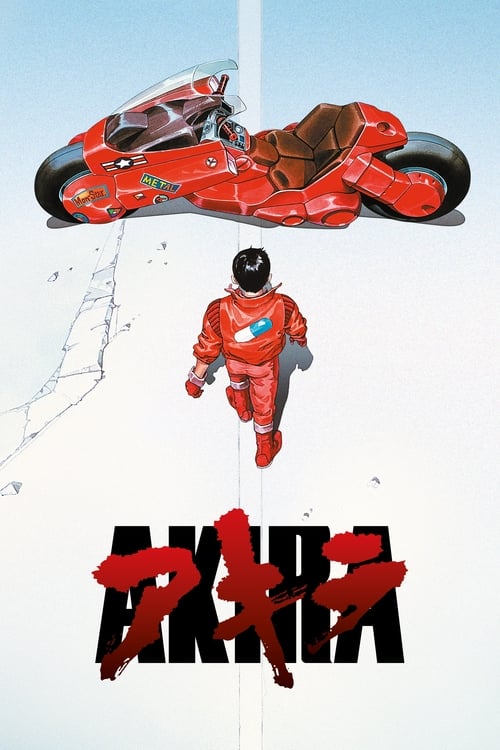
Akira
1988 · Katsuhiro Otomo
For when you want pure spectacle with a dark, serious core — a late-night adrenaline watch that still gives you plenty to chew on. Reach for it when 'mind-blowing' is the actual assignment.
What it's about
In Neo-Tokyo, a neon megacity rebuilt over the crater of a mysterious catastrophe, teenage biker Kaneda runs with a street gang until his friend Tetsuo collides with a secret military project. Tetsuo begins developing psychic powers he can't control, and as they grow, gang rivalry, government conspiracy, and something buried beneath the city all converge. It's a coming-of-age story wired into an apocalypse.
The experience
Overwhelming in the best way — propulsive, loud, dense with detail, escalating from motorcycle chases to full-scale cosmic destruction. It moves fast and hits hard, and the imagery burns itself into you.
The craft
One of the most lavish animated productions ever mounted: hand-drawn at a density few films have matched, with fluid motion, meticulous cityscapes, and light effects that still look startling. The percussive, chanting score is unlike anything else in film music, and the whole thing demands the biggest screen and loudest speakers you can find.
Why it matters
The film that carried anime into Western consciousness, it reshaped science fiction across animation, live action, music, and games — its bike slide alone has been homaged countless times — and set the bar for what animation aimed at adults could be.
Snapshot
Akira is the keystone of late-twentieth-century Japanese animation: a ¥1-billion-class apocalyptic epic that took the visual ambition of the theatrical anime feature to a scale Japan had not previously attempted, and that, more than any single title, carried anime into Western consciousness. Adapted by Katsuhiro Otomo from his own sprawling, then-unfinished manga, the film compresses a vast serialized narrative into roughly two hours set in Neo-Tokyo, a neon megalopolis rebuilt over the crater of a city destroyed in 1988 by what the world believes was a new bomb. Beneath the surface, the catastrophe was Akira — a child whose psychic power was weaponized by the state. When biker Tetsuo Shima brushes against that same buried program, his escalating, uncontrollable abilities pull his friend Kaneda, a clandestine project, a political resistance, and the city itself toward a second annihilation. The film is at once a kinetic action spectacle and a meditation on power without maturity to hold it: a work whose surface velocity and whose thematic gravity are inseparable.
Industry & production
Akira was produced by a consortium assembled specifically for it, the Akira Committee, which pooled the resources of major Japanese media and manufacturing firms — among them the manga publisher Kodansha, Mainichi Broadcasting, Bandai, the advertising agency Hakuhodo, Toho, and the animation house Tokyo Movie Shinsha (TMS), with additional partners contributing financing and home-video and merchandising rights. This production-committee structure, common in later anime, was here marshaled to underwrite a budget reported in the neighborhood of ¥1 billion — figures around ¥700 million to ¥1.1 billion circulate, and precise accounting is not reliably documented, so the exact number should be treated as approximate. Whatever the figure, it made Akira among the most expensive animated films Japan had produced to that point.
The commercial logic was unusual. Otomo's Akira manga, serialized in Kodansha's Young Magazine from 1982, was already a phenomenon; the film was conceived partly as a flagship that would draw on and feed that readership, and it was greenlit with Otomo — a manga artist with limited prior directing experience — installed as director on the strength of the source material's authority. Production fell to TMS, a veteran studio. Crucially, the manga was nowhere near complete when the film was made (Otomo would not finish it until 1990), which forced the screenplay, written by Otomo with Izo Hashimoto, to invent an ending and to radically condense a narrative whose printed form ran to thousands of pages. The film opened in Japan in July 1988.
Technology
Akira is a landmark of traditional cel animation pushed to a technical extreme, with selective early use of computers as a support tool rather than a replacement for hand work. The production is frequently cited as using on the order of 160,000 cels and a custom palette of several hundred colors — a figure around 327 is commonly reported — including dozens of hues mixed specifically for the film to render Neo-Tokyo's nocturnal neon and the glow of explosions and psychic energy. These numbers, widely repeated in the literature, convey the order of magnitude even where exact tallies are hard to verify.
The most consequential technical decision concerned sound rather than image: Akira was pre-scored, with dialogue recorded before the animation was drawn so that mouth movements could be matched precisely to the performed track. This "prescoring" approach inverts the standard anime workflow, in which voices are dubbed to finished footage, and it gave the film an unusually exact synchronization between speech and animation. Computer assistance was also enlisted for certain compositing, tracking, and color-management tasks, and in the integration of the Geinoh Yamashirogumi score — but the film's surface remains overwhelmingly hand-painted, and its reputation rests on the density and consistency of that handcraft at feature scale.
Technique
Cinematography
Animated under director of photography Katsuji Misawa, Akira is "shot" with a cinematographer's eye for lens behavior translated into drawing. The film simulates a wide range of optical effects — racking focus, lens flare, the smearing of light sources in motion, depth staged in layered planes — to give Neo-Tokyo physical weight. Camera movement is conceived dynamically: the film favors sweeping vehicular tracking shots, plunging perspectives down skyscraper canyons, and the now-iconic low rolling moves that chase Kaneda's motorcycle. The famous shot of the bike braking into a long red-streaked slide is built from light trails that read as a long-exposure photograph rendered by hand. Throughout, the "photography" insists that this animated world obeys the optics of a real lens, lending its fantastical events documentary solidity.
Editing
Cut by editor Takeshi Seyama, the film moves at a velocity that was striking for animation of its era, alternating bursts of rapid action cutting — the highway chase, the riot, Tetsuo's rampages — with held, contemplative compositions. The condensation of an enormous manga into feature length produces a narrative that is propulsive and, by design, somewhat elliptical; the editing carries the viewer through compressed exposition by momentum, trusting image and pace to bridge gaps the page would have filled. The rhythmic contrast between kinesis and stillness is one of the film's signatures.
Mise-en-scène / staging
Neo-Tokyo is the film's central achievement of staging. Under art director Toshiharu Mizutani, the city is built as a coherent, exhaustively detailed environment — stratified by class and altitude, glowing with signage, dense with crowds, infrastructure, and decay. Backgrounds carry an almost architectural specificity, and the film repeatedly stages human-scale figures against vast spaces (the stadium, the crater, collapsing towers) to dramatize the disproportion between individual will and the forces in play. Otomo's character designs favor a relative naturalism of proportion against this heightened world, and the staging of bodies in motion — Tetsuo's mutating flesh in the climax, the choreography of the bike gangs — is calibrated for maximum legibility within visual chaos.
Sound
The score by Shoji Yamashiro — the pen name of the scientist and musician Tsutomu Ōhashi — performed by his collective Geinoh Yamashirogumi, is among the most distinctive in any animated film. Drawing on Indonesian gamelan, Balinese vocal traditions, Japanese Noh, and a large chorus, blended with electronic and synthesized elements, it eschews orchestral convention entirely. The result is incantatory and ritualistic rather than illustrative; "Kaneda," with its chanted vocables, and the choral surges of the climax function less as underscoring than as a sonic counter-world. Combined with the prescored dialogue and an aggressive, spatialized sound design for the city and the action, the soundtrack gives Akira a sensory envelope as singular as its images.
Performance
As a prescored production, Akira placed unusual weight on its voice cast, whose recorded performances preceded and guided the animation. In the original Japanese version, Mitsuo Iwata voices Kaneda and Nozomu Sasaki voices Tetsuo, anchoring the film's central friendship and its rupture. The performances register the protagonists as adolescents — bravado, resentment, fear — rather than archetypes, and the prescoring let the animators tie facial and bodily acting tightly to vocal nuance. The film was later dubbed into English more than once, including an initial Streamline Pictures release and a subsequent re-dub; the original Japanese track remains the performance of record.
Narrative & dramatic mode
The film's dramatic mode is tragedy refracted through spectacle. Its engine is the friendship between Kaneda and Tetsuo — a relationship of older-brother dominance and younger-brother resentment — which the awakening of Tetsuo's power converts into catastrophe. Tetsuo's arc is the heart of the film: a slighted, insecure boy granted limitless force, whose inability to govern it destroys him and threatens everything around him. Around this core, the screenplay braids political conspiracy (a coup, a resistance movement, a clandestine military-scientific program), institutional menace (the army colonel, the doctors, the prematurely aged psychic children known as the Espers), and metaphysical mystery (what Akira is, and what evolution into such power means). The compression of Otomo's manga leaves the film deliberately enigmatic at its edges — much is implied rather than explained — and the dramatic logic is less about resolving plot than about staging the collision between adolescent psychology and apocalyptic scale.
Genre & cycle
Akira sits at the confluence of several genres and helped redefine each within anime. It is cyberpunk — a neon dystopia of corrupt power, marginal youth, and bodies altered by technology — arriving contemporaneously with the genre's literary and cinematic crest in the West and standing as its definitive animated statement. It is post-apocalyptic science fiction steeped in atomic memory; it is a teenage delinquent picture, its bike gangs descended from a long line of youth-rebellion stories; and it is an action film of unprecedented animated ambition. Within Japanese animation it belongs to the cycle of ambitious theatrical features that the medium mounted in the 1980s, but its budget, scale, and seriousness set a new ceiling, and it became the template against which subsequent cyberpunk anime — most directly Ghost in the Shell — would be measured.
Authorship & method
Akira is unusually a singular authorial work for an animated feature: Otomo originated the manga, directed the film, co-wrote the screenplay (with Izo Hashimoto), and designed its characters, giving him control across the chain from page to screen that few anime directors of the period commanded. His method was to adapt his own unfinished epic, accepting that the film would diverge from the manga's eventual course and devising a self-contained ending. He worked, however, through a deep collaborative apparatus. The score by Shoji Yamashiro and Geinoh Yamashirogumi is a co-authorial presence, shaping the film's tone as decisively as any image. Art director Toshiharu Mizutani built the world; director of photography Katsuji Misawa realized its optical surface; editor Takeshi Seyama set its pace; and animation director Takashi Nakamura oversaw the consistency and quality of the drawing across an enormous workload. The film is thus both an auteur statement and a feat of large-scale studio coordination — Otomo's vision executed by a craft community operating at the limit of hand animation.
Movement / national cinema
The film is inseparable from postwar Japan. Its premise — a city annihilated, a nation rebuilt atop the wound, a buried power that returns to threaten a second destruction — reads transparently against the atomic bombings and the trauma and reconstruction that followed, a thematic lineage anime had carried since its earliest decades. Neo-Tokyo's bubble-era excess and instability also reflect the Japan of the late 1980s, at the height of an economic boom shadowed by anxiety. As a work of national cinema, Akira represents the maturation of anime as a serious adult medium and the moment of its globalization: it became, for a generation of viewers outside Japan, the introduction to what Japanese animation could be, and a primary vector by which anime entered Western film culture.
Era / period
Made and released in 1988, Akira is a quintessential late-bubble-era artifact, and its imagined 2019 Neo-Tokyo projects that moment's energies — corporate power, technological acceleration, social unrest, youth alienation — three decades forward into dystopia. It arrived as home video was transforming distribution, and it was through video and laserdisc, and a sequence of theatrical and festival showings abroad, that it found its international audience over the following years. The film belongs to the brief window in which traditional cel animation reached its most lavish theatrical expression before digital tools reshaped the craft, and it stands as a high-water mark of that hand-drawn era.
Themes
At its center is power outrunning the maturity to wield it — Tetsuo as a child handed godlike force, the state as an institution that creates what it cannot control, evolution as a threshold humanity may not be ready to cross. Bound to this is the theme of the body: flesh that mutates, augments, and finally engulfs, dramatizing both adolescent transformation and technological-biological anxiety. The atomic motif pervades the film — annihilation, fallout, the recurrence of catastrophe — alongside a critique of authority in all its forms: military, scientific, political, paternal. Friendship and its betrayal supply the emotional throughline, while the recurring question of what Akira is opens onto the metaphysical: the film treats ultimate power as something closer to a force of nature or a stage of evolution than a weapon, beyond moral mastery.
Reception, canon & influence
In Japan Akira was a significant release tied to a major manga property; internationally its reception unfolded over years rather than in a single opening, as theatrical, festival, and home-video exposure built it into a touchstone. Western critics, often encountering it as their first ambitious anime, responded to its visual density and seriousness, and it became a standard entry point for discussions of the form. Over time it has settled firmly into the canon — routinely named among the most important animated films ever made and among the defining works of cyberpunk.
Its influences run backward to Japan's atomic memory and its tradition of apocalyptic and youth-rebellion storytelling, to the cyberpunk current cresting in the 1980s, and to Otomo's own manga, whose unfinished pages the film both honors and departs from. Its forward legacy is immense and well documented in broad strokes: Akira is widely credited with catalyzing the anime boom in the West and with shaping the visual vocabulary of subsequent science fiction, animated and live-action alike. The image of Kaneda's red motorcycle braking into a light-trailed slide has become one of the most homaged shots in modern pop culture, and the film's iconography recurs across decades of filmmakers, musicians, and game designers who absorbed it. Specific, frequently cited debts are easy to find; the safer scholarly claim is the structural one — that Akira enlarged the sense of what animation could attempt, and that much of what followed in global anime fandom and cyberpunk imagery flowed from the door it opened.
A Deleuzian reading
Start with the image everyone keeps: Kaneda's red bike braking into a long slide, the taillight dragged out into a streak of light, a hand-painted long exposure smeared across the dark.
The full Deleuzian reading of Akira →
Reception
A hit in Japan on release, but in the West it lived on grainy VHS tapes and midnight screenings, where it single-handedly converted a generation to anime — now it's routinely called the film that made 'adult animation' a category outside Japan.
How Akira was received, from release to now →
Influences: the films it descends from and the films it influenced
- Blade Runner (1982) — Establishes the stratified, rain-and-neon megacity rendered as dense atmospheric haze with retrofitted decay — the layered optical depth and advertising-saturated night cityscape that Otomo's art department reworks into Neo-Tokyo's vertical worldbuilding.
- 2001: A Space Odyssey (1968) — Its Star Gate light-tunnel and Star Child rebirth model abstract light-as-transcendence and bodily metamorphosis, the template for Tetsuo's psychedelic mutation and engulfing-then-reborn climax.
- Tron (1982) — Pioneers the vehicular light-trail — the light-cycle's persistent luminous ribbon — which Akira translates into hand-drawn cel form as Kaneda's red motorcycle braking into a light-streaked slide.
- Barefoot Gen (1983) — Renders nuclear annihilation as direct animated spectacle — the expanding blast-front and vaporized bodies — establishing atomic-trauma destruction as a subject hand animation could stage, which Akira's silent opening Tokyo detonation inherits.
- Lupin III: The Castle of Cagliostro (1979) — Sets the benchmark for high-velocity vehicular chase animation with full perspective tracking and weighty momentum, the kinetic grammar behind Akira's motorcycle-gang pursuit through the highway.
- Fantasia (1940) — Codifies the prescore method — animation timed and cut to a finished, pre-composed audio track — the Disney workflow Akira adopts via Geinoh Yamashirogumi's prerecorded score and its rare-for-anime prescored, lip-synced voice acting.
- Metropolis (1927) — Architects the vertically stratified industrial megacity and the youth-figure who unleashes power he cannot govern, the worldbuilding-plus-power-without-maturity structure Akira restages (and Otomo would later adapt directly in 2001's Metropolis).
- Godzilla (1954) — Animates Honda's destroyed-metropolis grammar frame by frame: the opening blast rendered as a clean expanding dome over a named city, then civilian-level streets, ministry offices and a military containment apparatus, with the destruction's duration held past the point of spectacle into aftermath.
- Scanners (1981) — The Esper program is the ConSec premise in animation — institutionally cultivated psychic subjects, numbered and contained — and Tetsuo's climactic mutation applies Scanners' cranial-rupture logic to an entire body, with the psychic duel again built from strained facial close-ups and pressure damage to the environment.
- Ghost in the Shell (1995) — Extends Akira's claim that anime could be adult SF cinema, deepening its simulated-lens optics — rack focus, long-lens compression, reflections — across a dense Asian megacity, with a Kawai prescore shaping tone as decisively as the imagery.
- The End of Evangelion (1997) — Inherits the psychic adolescent whose ungoverned power triggers an apocalyptic instrumentality, plus Akira's editing of violent kinesis against held stillness, escalating the body-as-weapon mutation into a planetary dissolution.
- The Matrix (1999) — Absorbs anime cyberpunk's visual grammar wholesale — speed-line trails, code-green digital city, and the kinetic-vs-frozen editing contrast — the Wachowskis openly citing the Akira/Ghost in the Shell lineage as their reference.
- Paprika (2006) — Heir to Tetsuo's morphing-flesh transformation, its parade of fusing objects and bodies extends Akira's animated metamorphosis, joined by match-cut editing that mutates one image into the next.
- Chronicle (2012) — Directly invokes Akira's power-without-maturity tragedy — a teenager acquiring telekinesis and escalating to citywide destruction — Trank citing the film as model for ordinary youth corrupted by unearned power into spectacle.
- Ready Player One (2018) — Stages explicit homage by reconstructing Kaneda's red motorcycle as a hero object and reproducing the light-trailed braking slide, canonizing that single Akira shot as a reusable icon of pop visual vocabulary.
- The Matrix Revolutions (2003) — Established the anime grammar of biomechanical body-horror and apocalyptic scale that the Sentinel swarms and the cathedral-of-light Deus Ex Machina face directly extend.
- The Matrix Reloaded (2003) — Modeled the comic-panel spatial staging and kinetic urban scale that drives the Wachowskis' pre-visualized, anime-derived blocking of the freeway chase.
- Looper (2012) — The telekinetic child as latent apocalypse — the Rainmaker's escalating psychic destruction echoes Tetsuo's power blooming into catastrophe, framing childhood trauma as a weapon.
- Johnny Mnemonic (1995) — Pioneered the body-as-data-overload horror — flesh erupting under informational/biological excess — that Johnny literalizes as neural-storage overload sickness.
- Cowboy Bebop: The Movie (2001) — Sets the benchmark for pre-digital hand-drawn density — cel-animated debris, crowds, and light rendered frame-by-frame without CG — which Bebop's climactic city set-pieces inherit.
- Patlabor 2: The Movie (1993) — Otomo's dense photographic layouts, detailed urban environments, and realistic light established the animation-as-cinematography precision Oshii's Headgear team pushed toward telephoto-camera realism.
- Tetsuo: The Iron Man (1989) — Contemporaneously stages flesh-into-metal body horror as accelerating, uncontrollable bodily expansion — a live-action analog to Tetsuo's mutation, sharing the same year-zero fixation on the body engulfing its surroundings.
- Roujin Z (1991) — Otomo's own written-and-designed follow-up reuses his signature craft of mechanical mass run amok — sprawling apparatus growing organically out of control through the city — animated with the same hyper-detailed machinery.
- Steamboy (2004) — Otomo's later auteur feature reapplies his obsessive mechanical-architectural detailing and full-animation density — every gear, pipe, and collapsing structure drawn — the same craftsmanship-at-the-limit that defined Akira's surfaces.
- Warriors of the Wind (1984) — A sibling apex of hand-drawn animation ambition — thousands of cels, no-shortcut fluidity, and biomechanical apocalypse — matching Nausicaä's refusal to cut corners in depicting mass destruction.
- The First Slam Dunk (2022) — Otomo's full-animation cel realism and weighty, physics-obeying character movement set the benchmark for hand-drawn kinetic bodies that Inoue's mocap-CG pipeline exists to reproduce without the labor cost.
- Ninja Scroll (1993) — Shares the body-horror transformation of flesh and lavish concentrated-budget animation; together they fixed the Western 'gateway anime' trio that established adult credibility abroad.
- Neo Tokyo (1989) — Shares personnel and workshop practice — Takashi Nakamura as animation director on both, prescored dialogue driving full-animation lip sync, and the same obsessive multi-layer debris cascades — making Ōtomo's segment a deadpan bureaucratic miniature of Akira's Neo-Tokyo.
Similar films
- Tetsuo: The Iron Man (1989) — influence & lineage · same viewing thread
- Barefoot Gen (1983) — influence & lineage · same viewing thread
- Ghost in the Shell (1995) — influence & lineage
- Paprika (2006) — influence & lineage
- Tron (1982) — influence & lineage
- The Matrix (1999) — influence & lineage
- Neon Genesis Evangelion: The End of Evangelion (1997) — same viewing thread
- Memories (1995) — same viewing thread
All the films related to Akira →
Watch it with: curated runs of related films
- Bodies at the End of the World — A run of visionary, punishing films where flesh is scarred, melted, mechanized or sacrificed while the world tips into its last days — watch these back to back when you want cinema at its most extreme and transcendent.