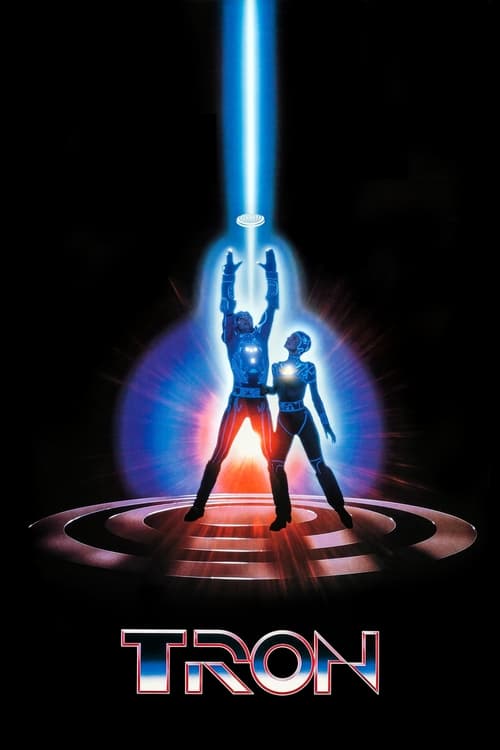
Tron
1982 · Steven Lisberger
For a night of retro-futurist wonder — when you want to see the digital world as 1982 dreamed it, equal parts nostalgia trip and design landmark. Easy, imaginative comfort viewing with a genuinely singular look.
What it's about
Kevin Flynn is a brilliant game designer cheated out of credit for his work, reduced to running an arcade while a corporate climber profits from his creations. Hacking into his old employer's mainframe to find proof, he's digitized by a laser and dropped inside the computer itself — a neon world where programs are people, a tyrannical Master Control Program runs gladiatorial games, and Flynn's only ally is a security program named Tron. To get home, he has to win the very games he helped design.
The experience
Like stepping into an arcade cabinet: glowing grids, humming light cycles, a world that feels both primitive and hypnotic. The story is a straightforward underdog quest, but the visual strangeness keeps you in a mild, pleasant trance throughout.
Performances
Jeff Bridges brings a loose, wisecracking charm that keeps the neon world human — he's the warm center the technology needs.
The craft
One of the first features to fold extended computer-generated imagery into live action, its world hand-built through a mix of early CGI, backlit animation, and design work from some of the great futurist illustrators of the era. Actors glow with circuitry against black voids; nothing before or since looks quite like it. The bigger the screen, the better the grid.
Why it matters
It pioneered the use of CGI in Hollywood and invented the visual language of cyberspace on film — every story about going 'inside the machine' owes it a debt, and it grew into a lasting franchise.
Snapshot
Tron is the film in which Hollywood first tried to imagine the inside of a computer and, in the process, became one of the earliest features to fold extended computer-generated imagery into live action. Produced by Walt Disney Productions at a moment when the studio was anxious about its own relevance, it follows Kevin Flynn (Jeff Bridges), a game designer cheated of credit by a corporate climber, who is digitized by a laser and dropped into the electronic world of the ENCOM mainframe. There he is conscripted into gladiatorial games run by the tyrannical Master Control Program and joins the security program Tron (Bruce Boxleitner) to overthrow it. The picture is remembered less for its narrative, which leans on familiar quest and underdog shapes, than for its look: a hand-built neon cosmos in which human figures glow with circuitry and ride sleek light cycles across a black grid. Commercially modest and critically divided on release, Tron became a touchstone almost in spite of its reception, anticipating a culture in which cyberspace, gaming, and digital labor would be central preoccupations.
Industry & production
Tron originated outside the studio system, with Lisberger, an animator who ran a small studio in Boston and later Los Angeles. He had become fascinated by the early arcade game Pong and by the aesthetic possibilities of backlit animation, developing a glowing character he initially conceived for a separate project before building the Tron concept around the idea of a world inside a computer. After shopping the project, Lisberger and his producing partner Donald Kushner secured backing from Disney, an unusual home for material this technologically speculative.
The production sat at a particular institutional crossroads. By the early 1980s Disney's live-action output had grown cautious and its animation department was in generational turmoil; the studio was searching for a way to look modern, and a film built on computer graphics promised exactly that. Yet the technology was unproven at feature scale, and the budget — substantial for its day, though precise figures should be treated with care — represented a real gamble. The computer-generated sequences were not produced in-house but contracted to outside specialists, principally MAGI (Mathematical Applications Group, Inc.) and Triple-I (Information International, Inc.), with additional work from other firms. This division of labor, parceling distinct environments to different houses with different rendering approaches, partly explains the film's varied visual textures.
On release Tron underperformed relative to the studio's hopes, and a persistent piece of industry lore holds that the Academy declined to consider it for visual-effects honors on the grounds that using computers was "cheating" — a claim often repeated but worth flagging as anecdotal rather than firmly documented. Whatever the exact reasons, the film's commercial reception was lukewarm enough that it became, for a time, a cautionary tale about betting on digital imagery.
Technology
Tron is a landmark precisely because of how it was made, and its technical story is more layered than the phrase "the first computer-animated movie" suggests — a description that overstates the case. Genuine computer-generated imagery accounts for a relatively small share of screen time; estimates commonly cited run to roughly fifteen to twenty minutes of full CGI, with computer elements integrated more broadly. The famous vehicles — light cycles, tanks, the Solar Sailer, Sark's carrier — were rendered on computers by MAGI and Triple-I, the former favoring a solid-geometry approach well suited to the smooth, simple forms of the light cycles.
The larger visual achievement, and the more labor-intensive one, was photochemical rather than digital. The bulk of the film was shot in black and white, with the actors in costumes printed with black circuitry patterns. The glowing "electronic" look was then created frame by frame through backlit animation: technicians produced high-contrast mattes for each element of each frame and exposed them through colored gels on an animation stand, so that the costumes and sets appeared to emit light. This was painstaking, manual rotoscope-adjacent work executed across tens of thousands of frames, and it is responsible for the film's signature luminosity far more than the computers were. The result is a hybrid — digital geometry composited into a hand-finished optical environment — that captures a transitional instant in effects history, when the computer could model a world but not yet light or inhabit it.
Technique
Cinematography
The live-action photography, by cinematographer Bruce Logan, served an unusual master: much of it was a means to an end, generating the high-contrast black-and-white plates that the animation process required. Within those constraints the imagery favors clean, graphic compositions and strong silhouettes, since figures had to read clearly against black for matting. The electronic world is shot to emphasize geometric clarity — wide framings of the grid, emphatic perspective lines, vehicles cutting clean diagonals — while the brief "real world" bookends adopt a more conventional naturalism, throwing the contrast between flesh and circuit into relief.
Editing
The film's cutting alternates between expository passages in ENCOM's offices and the propulsive set pieces of the computer world. The action sequences — the light cycle duel above all — are edited for spatial legibility, letting the audience track competing vehicles across a clearly defined arena, an approach suited to material derived from the logic of games. The pacing has struck many viewers as uneven, with the wonder of the imagery sometimes outrunning the momentum of the plot, a common observation in the film's critical record.
Mise-en-scène / staging
Production design is where Tron most fully realizes its ambition. The conceptual look was shaped by two of the era's most distinctive designers: Syd Mead, the industrial futurist, who designed vehicles and hardware including the light cycles, and the French comics artist Jean Giraud, known as Moebius, who contributed to costumes and the world's overall sensibility. Their combined sensibility — Mead's sleek, plausible machinery and Moebius's clean-lined, otherworldly figuration — gives the electronic realm a coherence that the technology alone could not. Sets are staged as architectural abstractions: vast dark voids, glowing platforms, recognizing geometry over naturalism, so that the human body becomes a graphic element within a designed grid.
Sound
The sound design works to make an abstract space feel physical, lending hums, surges, and mechanical voices to programs and machines. The Master Control Program and Sark are given vocal textures that mark them as authority, and the film's electronic environment is sonically distinguished from the muffled ordinariness of the real world.
Performance
The acting is pitched to the film's allegorical design. Most principals play dual roles — a human "user" and the program created in their image — and the performances lean into archetype: Jeff Bridges brings a loose, ironic charm to Flynn that humanizes the schematic plot; Bruce Boxleitner plays Tron and his user Alan with upright earnestness; Cindy Morgan doubles as Lora and the program Yori; and David Warner, in a triple role as the executive Dillinger, the enforcer Sark, and the voice of the Master Control Program, supplies the film's most relished menace. The mode is closer to fable than to psychological realism, performers embodying functions as much as characters.
Narrative & dramatic mode
Structurally, Tron is a portal fantasy in science-fiction dress: an ordinary protagonist crosses into a hidden world, learns its rules, and returns transformed with the power to right a wrong in his own. Its dramatic mode is allegorical and quasi-mythic. The programs inside the computer worship absent "Users," speak of belief, and frame their struggle against the Master Control Program in nearly religious terms, so that a story about corporate theft of intellectual property is restaged as a contest between faith and tyranny. The doubling of users and programs gives the film a theological undertow — creators and creations, gods and worshippers — that is more interesting than its mechanics of plot. As drama it is schematic, with clear villains and a quest spine, but the conceit of a populated digital cosmos lends the familiar shape genuine novelty.
Genre & cycle
The film belongs to the early-1980s wave of science fiction reshaped by Star Wars' commercial proof that effects-driven spectacle could anchor a franchise. It also sits within a small contemporaneous cycle of films reckoning with computers and emerging digital culture — works preoccupied with hacking, artificial intelligence, and the anxieties and fantasies of the personal-computer age that was just dawning. Tron is distinctive within that cycle for literalizing the metaphor: rather than dramatizing people at terminals, it takes the audience inside the machine, converting abstractions of code and process into landscape, body, and combat. Its fusion of the gladiatorial arena film with the video game gives it a generic identity not quite shared by any contemporary.
Authorship & method
Tron is best understood as a designer's and technologist's film as much as a director's. Steven Lisberger, working from his own story and directing from a screenplay he is credited with writing, was the conceptual originator, and his background in animation rather than live action shapes the picture's priorities: it thinks like an animated film about light and form, with live performers as elements to be composited. His authorship is inseparable from the collaborators who realized the look — Syd Mead and Moebius as visual architects, and the teams at MAGI and Triple-I who built the computer imagery. The result is a notably distributed authorship, where the film's identity emerges from the meeting of a director's vision with specialized houses each contributing a piece of the world.
Among key collaborators, cinematographer Bruce Logan executed the demanding plate photography; the editing assembled a hybrid of live action and laboriously finished effects; and the score was composed by Wendy Carlos, the electronic-music pioneer whose synthesizer work on earlier landmark films made her an apt choice. Carlos's music — blending orchestra with electronics — gives the digital world both grandeur and strangeness, and is among the film's most durable assets. The screenplay is generally regarded as the weaker link, its dialogue and plotting serving the imagery rather than rivaling it.
Movement / national cinema
Tron is a product of mainstream American studio filmmaking, specifically of Disney's early-1980s attempt to modernize. It does not belong to a film movement in the art-historical sense, but it can be placed within a Hollywood tendency of the period to chase technological spectacle, and within the longer American tradition of effects innovation as a commercial draw. Its design DNA, however, is partly transatlantic: Moebius's involvement imports the visual language of European, particularly French, science-fiction comics — the world of Métal Hurlant / Heavy Metal — into a Hollywood frame, one of several points where the film's lineage runs through illustration and comics as much as through cinema.
Era / period
The film is a precise artifact of 1982, a hinge year in popular technology. Arcade gaming was at a cultural peak, the personal computer was entering homes and offices, and the public was beginning to form an imaginative relationship with machines that were still mysterious. Tron dramatizes the optimism and unease of that moment — its faith that the computer might be a frontier to explore, and its worry about centralized systems of control embodied in the Master Control Program, a fear legible against Cold War and corporate anxieties about concentrated, impersonal power. It is also of its era in effects history, arriving just before the digital techniques it gestured toward would mature, which is partly why it reads now as prophecy more than achievement.
Themes
Several themes recur. The first is creation and the creator: users and programs mirror one another, and the film repeatedly stages questions of authorship, belief, and responsibility between makers and what they make — an apt subject for a film about a designer cheated of credit. The second is freedom against control: the Master Control Program's tyranny over an enslaved population of programs frames the central conflict as one of liberation, with the grid as both prison and battleground. The third is the dignity of labor and intellectual property, the human plot turning on stolen work and rightful authorship, themes that resonate with the film's own status as a work made by many uncredited hands. Beneath these runs a persistent fascination with the boundary between the human and the digital — the body rendered as light, the self with a double inside the machine — that the film treats with more wonder than dread.
Reception, canon & influence
Critical reception in 1982 was mixed and remains a fair summary of the film's reputation: reviewers widely admired its visual imagination and conceptual daring while finding the story thin and the characters schematic, and its commercial performance disappointed the studio's hopes. For roughly a decade it carried the reputation of an ambitious near-miss.
Its influences run backward through several channels. The light-and-grid aesthetic draws on the geometric futurism of industrial design (Mead) and the clean-lined cosmologies of European science-fiction comics (Moebius); the arena-combat spine echoes the gladiator and quest traditions; and the whole conceit is unthinkable without the arcade-game culture that gave Lisberger his initial spark. The score extends a lineage of synthesizer-driven film music.
The forward legacy is where the film's stature has grown. Tron is routinely cited as a seminal vision of cyberspace, prefiguring the imaginative vocabulary later developed in cyberpunk fiction and in countless films and games that picture the inside of networks as navigable space. Within effects history it is honored as a proof of concept: figures who worked on or were inspired by it carried digital imagery forward, and its very existence helped legitimize the long road toward computer animation's eventual dominance — a road that ran through the same broad community from which Pixar would later emerge. Its iconography, above all the light cycle, became permanently embedded in popular culture, and its world proved durable enough to support a belated franchise revival decades later, complete with a celebrated electronic score that consciously echoed Carlos's original ambitions. Few commercially modest films of its era have aged into so influential a reference point; Tron is now valued less for what it accomplished than for what it foresaw.
A Deleuzian reading
The light cycle leaves a wall behind it.
The full Deleuzian reading of Tron →
Reception
A box-office disappointment in the crowded sci-fi summer of 1982 — dismissed as a tech demo with a thin story — Tron has since been canonized as the film that dragged computer imagery into the movies, its neon grid now one of the most influential aesthetics in pop culture.
How Tron was received, from release to now →
Influences: the films it descends from and the films it influenced
- Toy Story (1995) — Pixar's first feature is the maturation of the very CGI community (MAGI/Triple-I to Lucasfilm) that Tron helped legitimize, fulfilling the road toward computer animation Tron proved was conceivable.
- Tron: Legacy (2010) — The direct sequel rebuilds the Grid's high-contrast light architecture and commissions a Daft Punk score that consciously echoes Carlos's orchestra-plus-synthesizer ambition for the original.
- Ready Player One (2018) — First feature to render a navigable luminous game-grid interior; the OASIS inherits its convention of dropping live actors into a fully synthetic, gravity-bending digital arena.
- Johnny Mnemonic (1995) — Invented first-person immersion into a geometric, glowing digital cyberspace — the visualization grammar Johnny extends using mid-90s CGI.
- Akira (1988) — Pioneers the vehicular light-trail — the light-cycle's persistent luminous ribbon — which Akira translates into hand-drawn cel form as Kaneda's red motorcycle braking into a light-streaked slide.
- Nimona (2023) — Established the neon-grid, screen-saturated luminous-future palette that Nimona's glowing techno-medieval cityscape and dystopian production design descend from.
- A Minecraft Movie (2025) — First literalizes 'inside the videogame' as an inhabitable geometric place characters step into, the diegetic conceit Minecraft's blocky world extends.
- Detective Conan: The Phantom of Baker Street (2002) — Established the diegetic 'digitized into the game-world' architecture where in-game death is bodily death — the exact Cocoon VR premise the film's Noah's Ark game reproduces.
- Metropolis (1927) — Lang's stylized depiction of the worker-machine as monumental architectural abstraction supplies the visual grammar Tron uses to render the inside of a computer as a vast geometric cathedral-city.
- Forbidden Planet (1956) — Bebe and Louis Barron's all-electronic 'tonalities' score established that a synthesized sound-world could carry an entire science-fiction film, the precedent Wendy Carlos extends to give Tron's grid its strange grandeur.
- 2001: A Space Odyssey (1968) — The Star Gate's abstract corridor of streaming light pioneered non-representational, high-contrast graphic travel through space, the exact register in which Tron stages light-cycle runs and beam-traffic.
- A Clockwork Orange (1971) — Wendy Carlos's Moog realizations of orchestral material here defined her orchestra-plus-electronics signature, which she ports directly onto Tron's score to fuse digital coldness with symphonic weight.
- Westworld (1973) — Its pixelated robot-POV shots were the first use of digital image processing in a feature, the early proof that computer-manipulated imagery could appear on a theatrical screen at all.
- Futureworld (1976) — Catmull and Parke's CGI animated hand and face were the first 3-D computer-generated sequences in a feature, the technical lineage MAGI and Triple-I build on to render Tron's vehicles and figures.
- Wizards (1977) — Bakshi's rotoscoped battle armies, traced and flat-tinted over live photography, model the backlit hand-rotoscope process by which Tron's actors are converted into glowing program-figures.
- Looker (1981) — Crichton's film contained the first CGI photorealistic human character (the digitized model Cindy), a sibling proof-of-concept for compositing a synthetic body into live action the same year Tron tried it at scale.
- Heavy Metal (1981) — This animated anthology imported Moebius's clean-line European SF-comic cosmology into moving images, the same Moebius design idiom that shapes Tron's costumes and world geometry.
- Blade Runner (1982) — Syd Mead's industrial 'visual futurist' design work here is the direct sibling of his Tron vehicle and environment designs, sharing one designer's hard-surface geometric futurism across both films.
- Star Trek II: The Wrath of Khan (1982) — The Genesis Demo was the first fully computer-generated sequence in a feature, produced by the Lucasfilm graphics group that would become Pixar — a parallel 1982 milestone from the same emerging CGI community.
- The Last Starfighter (1984) — Directly extending Tron's wager, Digital Productions rendered its spaceships entirely in CGI on a Cray supercomputer, replacing physical models with computer imagery as integrated photographic elements.
Similar films
- TRON: Legacy (2010) — influence & lineage
- The Matrix (1999) — influence & lineage
- Blade Runner (1982) — influence & lineage
- Toy Story (1995) — influence & lineage
- Ghost in the Shell (1995) — influence & lineage
- 2001: A Space Odyssey (1968) — influence & lineage
- Metropolis (1927) — influence & lineage
- Johnny Mnemonic (1995) — shared sensibility
All the films related to Tron →