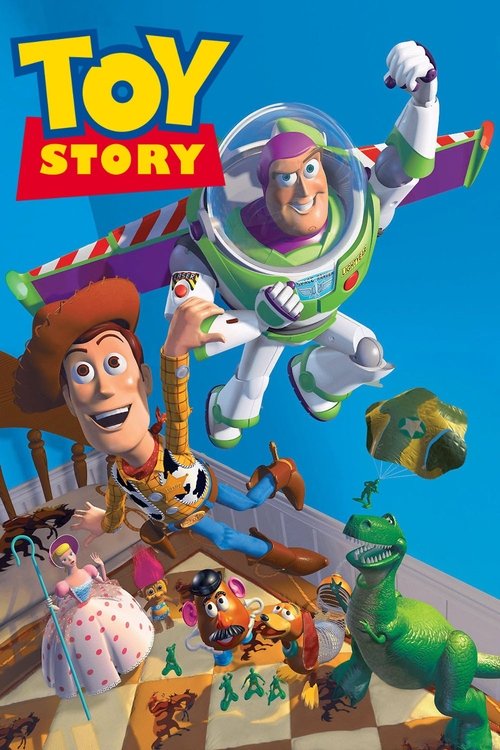
Toy Story
1995 · John Lasseter
For when you want guaranteed delight — a family night, a nostalgic revisit, or just ninety minutes of a story where everything works.
What it's about
In a boy's bedroom, the toys are alive — and Woody, a pull-string cowboy, is top toy until Andy's birthday delivers Buzz Lightyear, a gleaming spaceman who doesn't know he's a toy. Woody's jealousy gets them both lost in the wider world, including the house of a toy-torturing kid next door, and the two rivals have to work together to get home before Andy's family moves away.
The experience
Quick, warm, and endlessly quotable — a buddy comedy that moves like an adventure film. Under the jokes runs a surprisingly sharp anxiety about being replaced, which is why it lands for adults as hard as for kids.
Performances
Tom Hanks makes Woody's insecurity funny and painful at once, and Tim Allen's oblivious, square-jawed sincerity as Buzz is perfect casting — two voice performances that defined how animated leads could be acted.
The craft
The first feature film animated entirely on computers, but its real achievement is the screenplay: a jealousy plot with genuine psychological stakes, gag-dense and structurally airtight. Randy Newman's songs do the emotional narration, and the toy's-eye staging turns a suburban bedroom into an epic landscape.
Why it matters
It launched Pixar, ended the assumption that animation meant hand-drawn musicals, and reshaped the next thirty years of family filmmaking almost single-handedly.
Snapshot
Toy Story is the film that turned a research milestone into a popular art form. Released by Walt Disney Pictures in November 1995 and produced by Pixar Animation Studios, it was the first feature-length motion picture animated entirely on computers — a distinction that has hardened into received history but that undersells the more interesting achievement, which is dramaturgical rather than technological. The premise is a child's animism made literal: toys are conscious, social, and quietly anxious about their usefulness. Woody, a pull-string cowboy doll who reigns as the favorite of a boy named Andy, is displaced by the arrival of Buzz Lightyear, a spaceman action figure who does not know he is a toy. Their rivalry, their accidental exile into the wider and more dangerous world beyond Andy's room, and their eventual partnership form a tight buddy-comedy spine. What makes the film durable is the way it grafts adult workplace insecurity — obsolescence, status, the fear of being replaced — onto objects designed for play. It is a children's film about the dread of not being needed.
Industry & production
The production sits at a hinge point in two corporate histories. Pixar had spent the late 1980s as a small hardware-and-software company, selling the Pixar Image Computer and producing short films and commercials largely to demonstrate its own technology. Its 1991 deal with Disney — to produce a slate of computer-animated features — converted a technology firm into a movie studio. The widely reported budget was roughly $30 million, modest by Disney's hand-drawn standards of the period, and the picture became the highest-grossing domestic release of 1995, with worldwide gross figures generally cited in the region of $360–370 million; readers should treat exact totals as approximate, since reported figures vary by source.
The development is inseparable from the most famous crisis in Pixar's lore: the so-called "Black Friday" of 1993, when a story reel screened for Disney executives — including Jeffrey Katzenberg — landed so badly that production was halted. Disney's notes had pushed Woody toward a sarcastic, abrasive edge, and the version that resulted was, by the filmmakers' own later accounts, mean-spirited and unlikable. Lasseter and his story team were given time to rewrite, recentering Woody's behavior as the product of genuine fear rather than cruelty. The episode is well documented in interviews and Pixar histories and has become a foundational parable about story supremacy at the studio. Edwin Catmull and Steve Jobs functioned as the executive guarantors of the company; Jobs notably timed Pixar's initial public offering to the week of the film's release, leveraging its success into the studio's independence.
Technology
Here the film's claim to history is unambiguous. Toy Story was rendered using Pixar's RenderMan, the company's proprietary rendering system, on a render farm of Sun workstations. Every frame was computed rather than drawn or photographed, and the computational cost was substantial: the production is routinely described as having consumed hundreds of thousands of machine-hours, with individual complex frames taking many hours apiece to render. Precise figures circulate in several versions, so they should be cited cautiously.
The technical constraints shaped the film as much as any aesthetic choice. Computer animation in 1995 handled hard, manufactured, plastic surfaces far better than it handled organic ones — skin, hair, cloth, and foliage. Casting the world as a society of plastic and vinyl toys was therefore both a story idea and an engineering accommodation: the medium's weakness at rendering convincing humans became the film's alibi. The human characters are deliberately stylized and kept to the margins, and even Andy's dog and the outdoor scenes are managed to avoid the surfaces the software rendered least convincingly. This is a rare case where one can read a film's entire conceit as a negotiation with its tools.
Technique
Cinematography
Toy Story has no cinematographer in the photographic sense; its imagery is entirely synthetic, built from virtual cameras, modeled lights, and shaders. What is striking is how thoroughly the filmmakers chose to imitate live-action camera grammar rather than the flat, planar look of traditional cel animation. The virtual camera observes lens-like behavior — depth of field, perspective, the suggestion of focal length — and the staging assumes a physical camera moving through a three-dimensional space. Lasseter, who admired the staging discipline of classical Disney and the comic timing of silent cinema, pushed for compositions that read as if shot rather than drawn. The toy's-eye scale is exploited throughout: low angles make a domestic interior cavernous, and the gas-station and the neighbor Sid's house become genuinely threatening through the geometry of size.
Editing
The cutting (editorial work is credited to Robert Gordon and Lee Unkrich) follows the conventions of live-action narrative film rather than the looser rhythms of much animation, which is unusual for the period and consistent with the project's general strategy of borrowing live-action grammar. The tempo is brisk — the film runs around eighty minutes — and the action set pieces, particularly the climactic chase to rejoin Andy's moving van, are built on accelerating cross-cutting and clear spatial geography. Because every shot had to be modeled and rendered, editing decisions carried unusual weight: there was no inexpensive coverage to discard, so cutting was effectively pre-committed in story reels long before final rendering.
Mise-en-scène / staging
Staging is arguably the film's deepest craft inheritance. Lasseter's training under the principles of Disney's veteran animators emphasized clear silhouette, weight, and readable acting, and Toy Story applies these to fully dimensional figures. Space is dramatized rather than merely depicted: Andy's room is a kingdom with a hierarchy, Sid's house a torture-chamber underworld, the suburban street an abyss. Production design contrasts the warm, ordered domestic world with the chaotic, mutilated toys of Sid's room — a horror-tinged register that the film stages with real menace before resolving it humanely.
Sound
The sound design works to give plastic objects physical presence — the clack and rattle of toys, the mechanical whir of Buzz's wings, the pull-string mechanism that gives Woody his canned phrases. Randy Newman's score and songs are integral rather than incidental, and the film's signature device is the use of Newman's narrative songs to compress emotional transitions that the still-developing animation could not yet carry through facial nuance alone.
Performance
The performances are vocal, but the film treats voice casting as genuine acting rather than celebrity decoration. Tom Hanks gives Woody a frayed, anxious warmth that keeps the character sympathetic even at his most scheming, and Tim Allen plays Buzz's earnest delusion straight, which is what makes his discovery that he is "just a toy" genuinely poignant. The supporting bench — Don Rickles as Mr. Potato Head, Wallace Shawn as the anxious Rex, John Ratzenberger as Hamm, Jim Varney as Slinky Dog, Annie Potts as Bo Peep — is cast for vocal character. The animation then performs to the recorded voice, a workflow closer to live-action than to the music-and-dialogue tracks of much earlier animation.
Narrative & dramatic mode
The film operates as a classical buddy comedy welded to a journey-and-return structure. Two antagonists are forced into partnership, exiled from safety, and must cooperate to get home, learning to value each other along the way. The dramatic engine is Woody's jealousy and the moral correction it requires; the emotional payoff is Buzz's confrontation with the truth of his own nature. Crucially, the film plays its fantasy by strict rules — toys freeze when humans look — which generates much of the suspense and comedy through the threat of exposure. The mode is comic but the stakes are treated with sincerity; the picture never winks at its own premise.
Genre & cycle
Toy Story belongs simultaneously to the family-animation tradition and to the buddy-movie cycle, and it self-consciously folds in genre pastiche: Buzz is a parody of space-opera action figures and Saturday-morning toy marketing, Woody a Western archetype. It arrived during and helped extend the so-called Disney Renaissance of the late 1980s and 1990s, but it broke from that cycle's Broadway-musical model. Where The Little Mermaid, Beauty and the Beast, and The Lion King were song-driven fairy tales, Toy Story is a contemporary comedy with a sung score it does not stage as musical numbers — a deliberate departure that defined the Pixar house style to come.
Authorship & method
The film is the clearest expression of John Lasseter's authorial program: marry the emotional and staging discipline of classical character animation to digital tools, with story placed above spectacle. Lasseter's earlier Pixar shorts — Luxo Jr. (1986) and the Academy Award–winning Tin Toy (1988) — are direct precursors, the latter literally a film about a toy's point of view. The screenplay credit (Joss Whedon, Andrew Stanton, Joel Cohen, and Alec Sokolow, with story by Lasseter, Pete Docter, Stanton, and Joe Ranft) reflects Pixar's collaborative "brain trust" method, in which story problems are worked communally through reels and revisions rather than authored in isolation. Whedon's contribution to structure and character voice has been frequently noted in subsequent accounts. Randy Newman's songs and score constitute a second authorial signature; "You've Got a Friend in Me" became the studio's de facto anthem. The producing team included Ralph Guggenheim and Bonnie Arnold, with Catmull and Jobs as executive producers.
Movement / national cinema
As American studio filmmaking, the picture belongs to no national art movement in the European sense, but it inaugurated something like a studio "movement" of its own — the Pixar model of digitally animated, story-first features that would dominate American family cinema for two decades. It also sits within the longer lineage of American commercial animation running from Disney through the 1990s, of which it is both an heir and a disruptor.
Era / period
Toy Story is a mid-1990s artifact in the most telling sense: it captures the moment when digital tools became capable of carrying a feature, and when the personal-computer culture that produced Pixar was about to remake entertainment. Its release coincided with Pixar's IPO and with the broader 1990s surge in computing's cultural authority. The toys themselves are period-specific — pull-string cowboy, plastic spaceman — and the film's nostalgia for analog childhood play, rendered through the most advanced digital means then available, is itself characteristic of the decade.
Themes
The governing theme is obsolescence and the fear of being replaced — a remarkably adult anxiety for a children's film, and one that resonates with workplace and middle-age dread. Around it cluster related concerns: identity and self-knowledge (Buzz's crisis when he learns what he is), loyalty and friendship as chosen rather than given, and the ethics of how we treat what is in our care. There is a quieter meditation on purpose: a toy exists to be played with, and to be set aside is a kind of death the film treats with surprising gravity. Sid, the toy-torturing neighbor, introduces a moral counter-theme about cruelty and stewardship.
Reception, canon & influence
Critical reception was strongly positive on release, with reviewers singling out the wit of the script and the emotional substance beneath the technical novelty; the film is widely regarded as one of the best-reviewed pictures of its year. It received three Academy Award nominations — Best Original Screenplay, Best Original Score, and Best Original Song — and John Lasseter received a Special Achievement Academy Award recognizing the film as the first feature-length computer-animated picture. It has since been selected for preservation in the United States National Film Registry by the Library of Congress, a marker of its canonical standing.
Looking backward, the film's influences are legible: the staging and character-acting principles of classical Disney animation; the comic timing Lasseter admired in silent and slapstick cinema; the buddy-comedy and journey structures of mainstream Hollywood; and Pixar's own short films, which had rehearsed both the technology and the toy's-eye conceit. Looking forward, its legacy is enormous and structural. It established the commercial and artistic viability of computer animation, triggering an industry-wide shift that, within roughly a decade, displaced traditional hand-drawn features as Hollywood's default mode for animation. It launched Pixar as a major studio and a brand synonymous with story quality, spawned a franchise of sequels widely regarded as rare instances of sequels matching or exceeding the original, and set the template — emotionally sincere, comedically sharp, technically ambitious — that competitors spent years trying to reproduce. Few films can claim to have changed the production base of an entire art form; this one did.
A Deleuzian reading
The bedroom door swings open and, in the same instant, the room dies.
The full Deleuzian reading of Toy Story →
Reception
An instant hit in 1995 — the first fully computer-animated feature, it earned Lasseter a Special Achievement Oscar. Thirty years on it's less a movie than a founding document: the film every Pixar (and every CG animation) conversation starts from.
How Toy Story was received, from release to now →
Influences: the films it descends from and the films it influenced
- Snow White and the Seven Dwarfs (1937) — Established the Disney principles of weight, squash-and-stretch, and personality animation that Pixar ported wholesale to 3D rigs so toys read as characters before they read as renders.
- Pinocchio (1940) — Modeled the wooden-toy-yearning-to-be-real and the multiplane illusion of depth that Pixar reconstituted as genuine dimensional space via the virtual camera.
- Sherlock Jr. (1924) — Source of the silent-slapstick comic timing and full-body physical gag construction Lasseter cites — gags staged in unbroken space with the body's weight as the punchline.
- Luxo Jr. (1986) — Lasseter's own proof that a RenderMan-shaded inanimate object could be given convincing character-animation acting, the direct technical and aesthetic dry run for the toys.
- Tin Toy (1988) — Literally a film from a toy's point of view, rehearsing the toy's-eye conceit, the menacing-giant-baby staging, and the CG character rigging that became Toy Story.
- Young Sherlock Holmes (1985) — Contained the first fully CG animated character (the stained-glass knight) built by the Lucasfilm/Pixar group, the seed of integrating a digital performer into a narrative.
- Tron (1982) — First feature to commit to extended computer-generated imagery as a world, establishing the production pipeline ambition that Toy Story finally carried to a full feature.
- The Defiant Ones (1958) — Template for the mismatched-pair buddy structure — two antagonists chained by circumstance into reluctant partnership — that Woody and Buzz inherit beat for beat.
- Beauty and the Beast (1991) — The fully computer-generated, freely moving virtual-camera feature that Beauty and the Beast's 2D/3D ballroom and digital ink-and-paint hinge pointed the industry toward.
- A Bug's Life (1998) — Pixar's immediate follow-up scaled the same RenderMan pipeline and brain-trust story method to crowds and organic environments while keeping the staging-first acting discipline.
- Toy Story 2 (1999) — Extended the franchise with deepened virtual-camera live-action grammar and the obsolescence/identity themes, becoming the rare sequel matching the original's craft.
- Monsters, Inc. (2001) — Advanced the buddy-comedy pairing and the emotionally-sincere-plus-comedically-sharp template while solving fur and complex shading as the next RenderMan frontier.
- Finding Nemo (2003) — Carried forward the journey structure and brain-trust storytelling, pushing the virtual camera and rendering into translucent water and caustics.
- The Incredibles (2004) — Inherited the genre-pastiche and live-action cinematographic grammar, applying Toy Story's character-acting discipline to human figures and kinetic action staging.
- Shrek (2001) — DreamWorks' direct competitive answer, built on the commercial model Toy Story established that CG features with star vocal acting and pop-scored comedy could displace hand-drawn animation.
- Ice Age (2002) — Blue Sky's entry into the CG-feature gold rush Toy Story triggered, reusing the mismatched-trio buddy structure and accelerating-cross-cut comic set pieces.
- Finding Dory (2016) — Originated Pixar's articulated character-rigging and deformation pipeline from which Hank the septopus's boneless, seven-arm, surface-mimicking rig is a direct technical descendant.
- Cars (2006) — Same author's arrogant-hero-humbled redemption arc and buddy dynamic, plus the Pixar pipeline of giving soul to manufactured objects, is recycled almost beat-for-beat in McQueen's chastening.
- Toy Story 3 (2010) — Establishes the character rigs, the buddy-comedy Woody/Buzz dynamic, and the strict toy-POV rules (freeze when humans look) that TS3 brings to completion.
- Star Wars: Episode II - Attack of the Clones (2002) — Demonstrates entirely computer-rendered characters sustaining a feature's emotional load, validating the leap to a wholly synthetic Yoda over the earlier puppet.
- Big Hero 6 (2014) — Founds the CG-animated feature and the mismatched-buddy dynamic between a human-surrogate and a naive artificial companion that Hiro-and-Baymax structurally reprises.
- Jurassic Park (1993) — ILM's photoreal CG creatures proved digital characters could carry screen weight and lighting, the live-action counterpart to Pixar's bet on computer animation's viability.
- Terminator 2: Judgment Day (1991) — The T-1000's CG morphing demonstrated seamless digital character integration and pushed the rendering and motion tools Pixar's contemporaries were maturing in parallel.
Similar films
- Toy Story 2 (1999) — influence & lineage
- A Bug's Life (1998) — influence & lineage
- Monsters, Inc. (2001) — influence & lineage
- Finding Nemo (2003) — influence & lineage
- The Incredibles (2004) — influence & lineage
- Tron (1982) — influence & lineage
- Toy Story 5 (2026) — same viewing thread
- Toy Story 3 (2010) — same viewing thread
All the films related to Toy Story →
Watch it with: curated runs of related films
- Pixar and the Fear of Being Replaced — Watch these together for Pixar's quiet obsession with obsolescence — the toy outgrown, the newer model, the town the highway forgot.