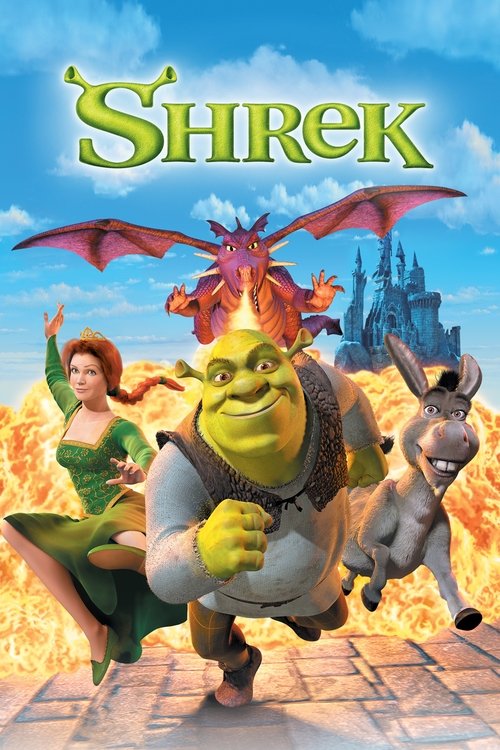
Shrek
2001 · Andrew Adamson
For a family movie night when nobody can agree, or when you want to laugh at something that also leaves you a little soft-hearted. Pure comfort with a smirk.
What it's about
An ogre who wants nothing more than to be left alone in his swamp finds it overrun with evicted fairy-tale creatures, so he strikes a deal with the preening ruler responsible: rescue a princess from a dragon-guarded castle, and get his solitude back. Along for the quest is a donkey who will not stop talking, and a princess who turns out to have ideas — and secrets — of her own.
The experience
Fast, cheeky, and stuffed with jokes that fly at two altitudes — pratfalls and pop songs for the kids, sly fairy-tale sabotage for the adults — yet it sneaks up on you with real warmth about being loved as you actually are.
Performances
Eddie Murphy's Donkey is one of the great voice performances — motor-mouthed, needy, and impossible to dislike — while Mike Myers gives the ogre a gruffness that keeps cracking to reveal the hurt underneath.
The craft
The film weaponizes its whole toolkit against the storybook tradition: a gleaming, theme-park-perfect kingdom played for satire, a pop soundtrack where you'd expect an orchestra, and a script that flips every fairy-tale rule it touches. The CG was cutting-edge for 2001, but it's the comic timing in the editing that still lands.
Why it matters
It won the first-ever Oscar for Best Animated Feature and competed at Cannes, proving animation could be irreverent, adult-witted, and hugely popular all at once — and it reset the tone of American family films for a generation.
DreamWorks' fairy-tale demolition job, adapted from William Steig's slim picture book into a pop-culture landmark: an ogre who likes his swamp, a princess with secrets, and a kingdom whose gleaming theme-park perfection is a barely veiled raspberry blown at Disney — reportedly with Jeffrey Katzenberg's post-Disney grudges baked into the villainous Lord Farquaad. The film's irreverence was structural, not just tonal: Smash Mouth on the soundtrack, fairy-tale creatures processed like refugees, a princess who belches. It won the first-ever Academy Award for Best Animated Feature and screened in competition at Cannes, the first animated film to do so since Disney's Peter Pan in 1953 — an almost comically perfect irony. Its legacy cuts two ways: it opened animation to adult wit and genuine sweetness about self-acceptance, and it licensed two decades of smirking, pop-scored imitators. The production's great what-if is audible in its history: Chris Farley recorded most of the role before his death, and Mike Myers, cast in his place, re-recorded the entire part in a Scottish accent — at a cost of millions in redone animation.
A Deleuzian reading
The film opens on a gold-leafed storybook, read aloud in the voice of a bedtime.
The full Deleuzian reading of Shrek →
Reception
A smash in 2001 — it won the very first Best Animated Feature Oscar, beating Monsters, Inc. — then spent a decade as ironic internet punchline before Gen Z looped all the way back around to sincere love; in 2020 it entered the National Film Registry.
How Shrek was received, from release to now →
Influences: the films it descends from and the films it influenced
- Rocky and Bullwinkle: Fractured Fairy Tales (1959) — Established the knowing-narrator storybook opening that curdles into parody — Shrek literally tears a page out of the fairy-tale book, the same gag of weaponizing the illuminated-manuscript frame against itself.
- Monty Python and the Holy Grail (1975) — Model for anachronistic medieval satire built on deflating chivalric pomp with lowbrow, contemporary-register dialogue and scatological undercutting of the quest structure.
- The Princess Bride (1987) — Blueprint for affectionate fairy-tale deconstruction that keeps the romance sincere while mocking its clichés — the reluctant-hero-rescues-princess arc played straight and satirized at once.
- Who Framed Roger Rabbit (1988) — Pioneered the mass cross-property fairy-tale/cartoon ensemble — dozens of licensed and public-domain storybook figures crammed into one frame, the crowd-of-fairy-tale-refugees logic Shrek runs on.
- Beauty and the Beast (1991) — The exact Disney template Shrek inverts: the monstrous suitor redeemed by love and a transformation — except Shrek keeps the beast form, weaponizing the audience's memory of this film's ending.
- Aladdin (1992) — Robin Williams' improvised, anachronism-slinging celebrity-voice performance created the mold for Myers' and Murphy's ad-libbed pop-culture riffing as the animated comic engine.
- Blazing Saddles (1974) — Genre-subversion via lowbrow anachronism — the campfire fart scene is the direct comic ancestor of Shrek's scatological gags puncturing a mythologized genre.
- Antz (1998) — DreamWorks PDI's first CGI feature built the studio's photoreal-lit, star-voiced production pipeline (and the neurotic celebrity lead) that Shrek inherited wholesale.
- Toy Story (1995) — Established the CGI-feature grammar Shrek adopts and one-ups — the mismatched buddy road-trip duo and the push toward believable subsurface skin/texture rendering (Shrek famously chasing convincing digital humans and mud).
- The Jungle Book (1967) — Carries the celebrity-voice-cast plus mismatched-buddy-comedy road structure into the DreamWorks era, monetizing the star-persona casting logic Jungle Book pioneered for animated features.
- Shrek 2 (2004) — Directly extends the craft — Adamson returns to double down on Hollywood/Disney-satire (Far Far Away as Beverly Hills) and the celebrity-cameo, pop-needle-drop structure Shrek established.
- Hoodwinked! (2005) — Whole-cloth imitation of the fairy-tale-deconstruction premise — a Rashomon retelling of a Grimm tale with wisecracking recast fairy-tale figures, chasing Shrek's revisionist formula.
- Madagascar (2005) — Codified the post-Shrek DreamWorks house style: celebrity-voiced ensemble, wall-to-wall pop-soundtrack needle-drops, and pop-culture-reference gag density as the studio's brand.
- Enchanted (2007) — Disney self-parodying its own storybook tropes — the fish-out-of-water fairy-tale princess and knowing subversion of 'true love's kiss' descend directly from Shrek's anti-Disney meta-comedy.
- Frozen (2013) — Extends Shrek's signature twist on the fairy-tale climax — 'true love' redefined away from the handsome prince and toward self-acceptance, the same subversion of the redemptive-kiss/transformation ending.
- Trolls (2016) — The endpoint of Shrek's pop-jukebox innovation — DreamWorks builds an entire feature around licensed pop needle-drops as narrative spine, exactly the 'pop-scored imitators' Shrek spawned.
- Minions & Monsters (2026) — Set the template for anarchic, pop-culture-literate family animation built on ugly-cute creature design and irreverent sidekick energy, the comedic sensibility the Despicable Me line commercialized.
- Megamind (2010) — The DreamWorks house architecture Megamind inherits wholesale: genre inversion as premise, celebrity-voice casting as primary characterization, and the pop needle-drop as act punctuation — redeployed with tighter diegetic motivation, since Megamind cues his own soundtrack in-world.
- The Lego Movie (2014) — DreamWorks codified the register the film runs on: pop needle-drop as structural punctuation, celebrity voices cast for the friction between star and figure, and a second joke layer pitched over the child's head at the parent — with the sincerity turn withheld until the final reel.
- Chicken Run (2000) — Aardman/DreamWorks partner release that shares the studio's genre-parody-for-adults strategy, layering film-buff pastiche (a POW-escape movie) under family comedy.
- The Emperor's New Groove (2000) — Concurrent snarky, fourth-wall-nudging animated comedy that abandoned earnest Disney sincerity for wisecracking, self-aware pacing — the tonal sibling to Shrek's irreverence.
- Toy Story 2 (1999) — DreamWorks' rival pop-culture pastiche feature, lifting TS2's mode of dense cross-referential genre quotation into computer-animated comedy.
- A Bug's Life (1998) — DreamWorks' CG fairy-tale ensemble extends the Pixar-vs-DreamWorks rivalry begun with Antz, working the same misfit-hero-and-comic-troupe template in a rival pipeline.
- Monsters, Inc. (2001) — Same-year CG counterpart that also rehabilitated a monster into a lovable lead while advancing skin and expressive-face rendering, the competing pole of 2001's early-CGI-feature moment.
Similar films
- Shrek 2 (2004) — influence & lineage
- Aladdin (1992) — influence & lineage
- The Princess Bride (1987) — influence & lineage
- Toy Story (1995) — influence & lineage
- How to Train Your Dragon (2010) — same viewing thread
- Puss in Boots: The Last Wish (2022) — same viewing thread
- Kung Fu Panda (2008) — same viewing thread
- Monsters, Inc. (2001) — shared sensibility
All the films related to Shrek →
Watch it with: curated runs of related films
- The DreamWorks Fable — A run of DreamWorks' own canon — the studio that answered Disney with ogres, pandas, Vikings and swashbuckling cats — half fairy-tale satire, half genuine heart.