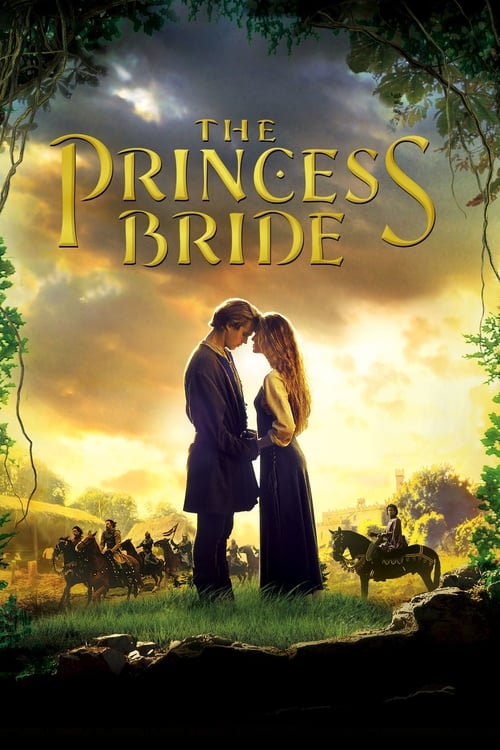
The Princess Bride
1987 · Rob Reiner
For a cozy night in when you want to feel good, whether you're introducing it to kids or reciting it with friends who know every word. The ultimate comfort movie — zero challenge, endless charm.
What it's about
A grandfather reads a bedtime story to his skeptical, sick grandson, and the story takes over the movie: farm boy Westley and the beautiful Buttercup, separated by fate and menaced by an evil prince, with kidnappers, a six-fingered swordsman, a giant, pirates, and rodents of unusual size between them and true love. The film keeps cutting back to the boy's protests — too much kissing — even as the tale wins him over.
The experience
Pure delight: funny, sweeping, and quotable line after line, sincere about romance while winking at every fairy-tale convention it uses. It's a swashbuckler and a comedy at once, and somehow neither undercuts the other.
Performances
Cary Elwes and Robin Wright make the romance genuinely dashing, Mandy Patinkin turns a revenge-driven swordsman into the film's warm beating heart, and Wallace Shawn, André the Giant, and Peter Falk each steal their scenes.
The craft
William Goldman adapted his own novel and the screenplay is the engine — a nested storybook structure and dialogue so precise that dozens of lines entered the language. The fencing is real and beautifully staged, and Rob Reiner keeps the tone balanced on a knife's edge between earnest and arch.
Why it matters
A modest performer in 1987 that became one of the most beloved cult films of its era through home video and endless quotation — the template for how a movie can spoof a genre and be its best example at the same time.
Snapshot
The Princess Bride is a fairy-tale adventure that never lets you forget it is a fairy tale being told. Rob Reiner's fourth feature adapts William Goldman's 1973 novel — with Goldman writing the screenplay himself — and preserves the book's defining conceit: the swashbuckling romance of Westley and Buttercup is nested inside a frame in which a grandfather (Peter Falk) reads the story to his skeptical, sick grandson (Fred Savage). The result is a film that delivers genuine sword-fighting, kidnapping, torture, and true love while continually winking at the machinery of genre. Modest at the box office in 1987, it became one of the most durably beloved cult films of its era through home video, cable rotation, and endlessly quotable dialogue. Its balance of sincerity and irony — earnest about romance, self-aware about storytelling — is the source of both its charm and its influence.
Industry & production
The film's long road to the screen is itself part of its history. Goldman, already an established screenwriter (Butch Cassidy and the Sundance Kid, All the President's Men) and novelist, regarded The Princess Bride as a personal favorite among his own works, and the property circulated in Hollywood for well over a decade with various filmmakers and stars attached at different points before it was actually produced. The record on exactly who was attached and when is anecdotal and inconsistent, so it is safest to say the project languished in development for years without finding a stable configuration of director, studio, and financing.
The film that finally got made came together because Reiner, a devoted admirer of the novel, had accumulated commercial and critical credibility with This Is Spinal Tap (1984), The Sure Thing (1985), and especially Stand by Me (1986). It was produced through Act III Communications, the company associated with Norman Lear, with Reiner and Andrew Scheinman producing; 20th Century Fox handled the theatrical release. The budget was in the mid-teens of millions of dollars — a moderate figure for a period fantasy requiring castles, swordplay, and creature effects. Principal photography took place in England and Ireland. The film opened in the fall of 1987 to a respectable but unspectacular theatrical run; its reputation and profitability were built afterward, on the ancillary markets that were reshaping film economics in the late 1980s.
Technology
The Princess Bride is a fundamentally practical production made just before digital compositing transformed fantasy filmmaking. Its illusions are analog: real cliffside locations, physical castle interiors and sets, matte work, forced perspective, animatronics, and stunt performance. The Fire Swamp — with its flame spurts, lightning sand, and Rodents of Unusual Size — relies on on-set pyrotechnics, physical set construction, and performers in creature suits rather than optical or computer effects. André the Giant's Fezzik is, of course, "practical" in the most literal sense: the effect is a genuinely enormous human being framed to emphasize his scale.
The film sits at the tail end of an era when a fantasy adventure of this ambition was executed almost entirely in-camera and on stage. That technological modesty is inseparable from its texture; the hand-built quality suits a story explicitly presented as an old book read aloud, an artifact from before the age of seamless spectacle.
Technique
Cinematography
Adrian Biddle — fresh from photographing James Cameron's Aliens (1986) — shoots the film with a clean, bright, storybook clarity rather than gritty realism. The palette is saturated and legible: green English hillsides, the pale chalk of the Cliffs of Insanity (the Cliffs of Moher in Ireland), the warm interiors of the frame story. Biddle favors compositions that read like illustrations, giving key set pieces — the duel above the cliffs, the silhouetted figures against sky and sea — a poster-like graphic strength. The lighting is largely soft and even, keeping faces and expressions readable, which supports the comedy; the film wants you to catch every reaction. There is little of the chiaroscuro or handheld nervousness of contemporaneous "serious" cinema. The camera generally stays composed and classical, appropriate to a tale being narrated from a well-worn book.
Editing
Robert Leighton, Reiner's regular editor, cuts for comic timing above all. Much of the film's humor is in the beat — the pause before a punchline, the reaction shot, the rhythm of Vizzini's monologues and Inigo's exchanges with Fezzik. The frame-story interruptions are the most conspicuous editorial device: the cuts back to the bedroom repeatedly puncture and then re-enter the adventure, controlling suspense (the grandson's anxious questions cue the audience's own) and modulating tone. Leighton's cutting of the celebrated Westley–Inigo duel keeps the choreography legible, holding wider framings so that the audience can see the fencing is genuinely being performed, then tightening for the verbal jousting that runs alongside the swordplay.
Mise-en-scène / staging
Norman Garwood's production design — Garwood had worked on Terry Gilliam's Time Bandits and Brazil — grounds the fantasy in tangible, slightly weathered detail rather than glossy opulence. Castles, hovels, the Fire Swamp, and Miracle Max's cluttered cottage each have a specific, lived-in materiality. Staging tends to be theatrical in the best sense: scenes are frequently built around two performers in sustained verbal combat (Westley and Vizzini's battle of wits, Inigo and the Man in Black on the cliff), blocked so the dialogue and physical action share the frame. The frame-story bedroom is deliberately ordinary and contemporary, its normalcy setting off the heightened world of the tale.
Sound
Mark Knopfler, the Dire Straits guitarist and songwriter, composed the score — an unusual choice that yields a distinctive, un-bombastic sound. Rather than a wall-to-wall symphonic fantasy score, Knopfler's music is often spare, melodic, and touched with acoustic guitar and synthesizer textures characteristic of the mid-1980s, leaning gentle and romantic where a conventional fantasy might swell. The film's song "Storybook Love," written and performed by Willy DeVille, earned the picture its single Academy Award nomination, for Best Original Song. On the dialogue and effects side, the sound design serves comedy and story clarity — the film is built to let its lines land cleanly, which matters enormously to a movie whose legacy is largely verbal.
Performance
The ensemble is the film's engine, and its tonal control is remarkable given how many registers coexist. Cary Elwes plays Westley with a knowing, Errol Flynn–inflected romantic-hero poise that stays just this side of parody. Robin Wright, in a breakout role, gives Buttercup an earnest gravity that anchors the romance. Mandy Patinkin's Inigo Montoya — the vengeful Spanish swordsman with his mantra "Hello, my name is Inigo Montoya. You killed my father. Prepare to die." — is the film's emotional core, played with wounded dignity beneath the comedy. Wallace Shawn's Vizzini ("Inconceivable!") and André the Giant's gentle, rhyme-loving Fezzik form an unlikely, beloved pairing. Chris Sarandon and Christopher Guest supply smoothly menacing villainy as Humperdinck and the six-fingered Count Rugen. In extended cameos, Billy Crystal (as Miracle Max, under heavy makeup) and Carol Kane provide a comic set piece, while Peter Falk and Fred Savage carry the frame with unforced warmth. Patinkin and Elwes famously trained to perform much of the climactic fencing themselves, and the sincerity of the acting — nobody plays it as a joke — is precisely what makes the comedy work.
Narrative & dramatic mode
The film's signature is its metafictional frame. Goldman's novel presented itself as an abridged "good parts" version of a book by a fictional author, and the film translates that device into the grandfather reading to the grandson, complete with interruptions, editorializing, and reassurances ("She does not get eaten by the eels at this time"). This structure lets the movie have it both ways: it plays its romance and adventure straight while acknowledging their conventions, so irony and sincerity reinforce rather than cancel each other. Dramatically, the main tale is a classic quest-and-rescue romance — separation, apparent death, kidnapping, revenge, resurrection, and reunion — organized around a handful of bravura set pieces (the cliff duel, the battle of wits, the Fire Swamp, the storming of the castle). The frame continually manages tone and suspense, using the child's reactions as a proxy for the audience's, and closes the emotional loop when the initially resistant grandson asks to have the story read again.
Genre & cycle
The Princess Bride belongs to the 1980s cycle of Hollywood fantasy and fairy-tale adventures — a wave that includes Time Bandits (1981), Ladyhawke (1985), Legend (1985), Labyrinth (1986), The NeverEnding Story (1984), and Willow (1988). Within that cycle it is the most explicitly self-reflexive: a fairy-tale pastiche and gentle parody that is also a sincere example of the form. It braids swashbuckler, romance, and comedy, and it draws visibly on the swashbuckling tradition of Douglas Fairbanks and Errol Flynn even as it comments on it. Unlike the darker or more effects-driven entries in the cycle, it foregrounds language and character, which is one reason it aged better than many of its contemporaries.
Authorship & method
The film is best understood as a meeting of two authorial sensibilities. William Goldman, adapting his own novel, is the primary voice: the film's wit, structure, and quotability are his, and the frame device is his novel's DNA. Rob Reiner brings the tonal discipline — a director who, across wildly different genres, consistently trusts performance and script, and who here keeps a story full of potential camp grounded in real feeling. Their collaboration is supported by a distinctive team: cinematographer Adrian Biddle's clean storybook images; editor Robert Leighton's comic timing; production designer Norman Garwood's tactile world-building; composer Mark Knopfler's atypical, un-bombastic score; and fight arrangers Bob Anderson and Peter Diamond, whose choreography of the cliff-top duel — laced with references to historical fencing masters (Bonetti, Capo Ferro, Agrippa, Thibault) — is among the most admired swordfights in American film. Reiner's method throughout privileges casting and rehearsal over spectacle: the film's effects budget is spent on wit and character as much as on the Fire Swamp.
Movement / national cinema
This is mainstream American studio filmmaking of the late 1980s, made largely with British and Irish crews and locations. It carries traces of the postmodern turn in popular narrative — the self-aware framing, the affectionate genre citation — that runs through much of the era's smarter entertainment, but it is not avant-garde; it is a commercial fantasy that smuggles a formal idea into a family adventure. Its production in the U.K. connects it to a lineage of British-facilitated fantasy and period filmmaking of the period (the same craft ecosystem that produced Gilliam's fantasies and much of the decade's genre output).
Era / period
1987 sits in the middle of a decade defined commercially by the blockbuster and, increasingly, by home video. The Princess Bride's trajectory — a soft theatrical opening followed by an enormous afterlife on VHS and cable — is emblematic of how films of this moment found their audiences. It also arrives as the frankly sincere fantasy of the early-to-mid 1980s was beginning to give way to more ironic, self-aware popular storytelling, and it straddles both: too heartfelt to be mere parody, too knowing to be naive. That in-between quality is very much of its time.
Themes
At its center is true love treated as a genuine, almost sacred value — declared without embarrassment ("As you wish" as a coded "I love you") even as the film jokes about it. Revenge drives Inigo's arc toward a hard-won catharsis, and the film is unusually thoughtful about the emptiness that can follow it. Storytelling itself is the overarching subject: the frame dramatizes how tales are transmitted across generations, how a child learns to love a story, and how the "boring parts" and the "good parts" alike shape meaning. Running beneath all of it is a theme of loyalty and found family — Westley, Inigo, and Fezzik bound together — and a gentle argument that sincerity and irony need not be enemies.
Reception, canon & influence
Critical reception in 1987 was generally warm if not universally rapturous; a number of prominent critics admired its wit and charm, while the film's theatrical performance was modest rather than a hit. Its single Academy Award nomination was for the song "Storybook Love." What followed is the more important story: through home video and repeated cable broadcast, The Princess Bride accumulated a devoted, growing audience and passed into genuine cultural canon. Its dialogue became part of the popular lexicon — "Inconceivable!", "As you wish," "Have fun storming the castle," and Inigo's vengeance speech are quoted far beyond the film's viewership.
Backward, the film draws on the Hollywood swashbuckler (Fairbanks, Flynn), the European fairy-tale tradition it gently satirizes, and the metafictional literary playfulness of Goldman's source novel. Forward, it became a touchstone for the ironic-yet-sincere fantasy that flourished afterward — an influence felt in later works that pair earnest adventure with self-aware humor, and a frequent reference point for filmmakers and writers describing that tonal balance. It also anchored careers: Robin Wright's in particular, and it deepened the beloved public images of Patinkin, Elwes, and André the Giant. Its afterlife includes reunions, tributes, and its steady presence on lists of the best fantasy and comedy films — evidence that a picture greeted as a pleasant modest success in 1987 became, over decades, one of the most cherished popular films of its generation.
A Deleuzian reading
Buttercup is in the water and the eels are circling.
The full Deleuzian reading of The Princess Bride →
Reception
A modest performer in 1987 that marketing famously couldn't figure out how to sell, it became a giant on VHS and cable — one of the defining examples of a movie the home-video era rescued into classic status.
How The Princess Bride was received, from release to now →
Influences: the films it descends from and the films it influenced
- Robin Hood (1922) — Establishes the acrobatic, actor-performed swashbuckler athleticism — Fairbanks doing his own leaps and blade-work — that the cliff-top duel revives with Elwes and Patinkin trained to fence on camera rather than cut around doubles.
- The Adventures of Robin Hood (1938) — The Flynn–Rathbone climactic staircase duel is the swashbuckler-romance blueprint — a sustained one-on-one fight where wit, gallantry, and courtship happen through the swordplay — which Reiner reproduces as the Inigo/Man-in-Black exchange.
- The Mark of Zorro (1940) — Basil Rathbone's precise screen fencing set the standard of technical, historically-literate blade-work that Bob Anderson and Peter Diamond deliberately invoke when Inigo and Westley trade named masters (Bonetti, Capo Ferro, Agrippa, Thibault).
- The Court Jester (1955) — Danny Kaye's comic swashbuckler fuses rapid verbal patter ('the pellet with the poison') with genuine duel choreography — the exact two-hander of dueling-plus-wordplay, played straight and funny at once, that structures the fencing and battle-of-wits scenes.
- Monty Python and the Holy Grail (1975) — Deadpan anachronism and the puncturing of medieval-epic solemnity with modern comic rhythm model the tonal tightrope Reiner walks — mocking fairy-tale convention while never sneering at it.
- Captain Blood (1935) — The cliff duel is the Flynn–Rathbone set piece reconstructed by Bob Anderson and Peter Diamond: a long-take, full-body exchange in which characterization is delivered through dialogue spoken across the blades rather than through cutting.
- The Mask of Zorro (1998) — Choreographed by the same fight arranger, Bob Anderson, extending his athletic, character-driven duel philosophy — swordplay as flirtation and personality — directly out of the cliff-duel methodology.
- Shrek (2001) — Codifies the ironic-sincere fairy tale for a generation: self-aware jokes at the genre's expense wrapped around an unironic true-love core, the tonal balance this film pioneered and made bankable.
- Pirates of the Caribbean: The Curse of the Black Pearl (2003) — Revives the tongue-in-cheek swashbuckler at blockbuster scale — comic, quotable rogues fencing with wink and flourish — the classic-duel-plus-irony template restored to the multiplex.
- Big Fish (2003) — Builds its whole structure on the storytelling frame, cross-cutting embellished tall tale against sober reality and arguing that the telling is itself an act of love — the metafictional theme foregrounded in the frame device.
- Ella Enchanted (2004) — Directly imitates the anachronism-laced fairy-tale-parody register — modern idiom and knowing gags inside a straight-faced quest-romance — that this film licensed for family fantasy.
- The Fall (2006) — Reworks the exact bedside-storyteller/child-listener conceit, dramatizing how the teller and listener negotiate the tale in real time — a formal expansion of the grandfather reading to the sick grandson.
- Stardust (2007) — The most direct tonal heir — a Gaiman fairy-tale-adventure that pairs earnest romance and quest with self-aware comedy and star cameos, frequently cited as the film reaching for this one's ironic-sincere balance.
- Enchanted (2007) — Sustains the affectionate-satire mode — gently mocking storybook clichés (true love's kiss, the villain, the ballad) while committing sincerely to them — the postmodern-pastiche-yet-heartfelt stance modeled here.
- The Grand Budapest Hotel (2014) — Nests narrators inside narrators and pairs the frame with flat, storybook-clear compositions and metronomic comic timing — the same marriage of metafictional structure and picture-book staging, taken to a formal extreme.
- Shrek 2 (2004) — Set the tone Shrek 2 extends: earnest fairy-tale action played straight while the dialogue winks, the swordfight-as-comedy set piece, and self-aware fractured-storybook romance.
- The Little Prince (2015) — Wraps the tale in a grandparent-reads-to-a-child frame where the listening child, not the story's hero, is the true subject — the load-bearing framing device Brignull and Persichetti invented for the adaptation.
- The NeverEnding Story (1984) — A near-contemporary that also frames its fantasy through a sick/reluctant child reader, cutting between the storyteller's reality and the tale — the story-within-a-story architecture Goldman's frame turns into the grandfather/grandson device.
- Ladyhawke (1985) — Sets earnest medieval fantasy-romance to an atypical, contemporary-textured score (Powell/Parsons synths), the same anti-bombast scoring gamble Knopfler makes here to keep the storybook grounded rather than swollen.
- Willow (1988) — Immediate heir in the late-'80s practical-effects quest-adventure mode, spending its budget on tactile creatures and location world-building — Garwood-style physical fantasy — rather than the emerging optical spectacle.
- Flipped (2010) — Product of the same Reiner collaborator company (editor Robert Leighton, producer-writer Andrew Scheinman) and its nested-narration architecture framing a story as retold memory.
- Lisbela and the Prisoner (2003) — Ancestor of the storybook meta-frame: an affectionately self-aware fairy-tale romance told with a saturated, illustrative palette and knowing tonal winks that flatter genre convention rather than deconstruct it.
- The Muppet Christmas Carol (1992) — Wraps an earnest tale in a self-aware framing narrator who comments on and pauses the story — the frame-breaking storytelling device Gonzo/Rizzo perform from inside the fiction.
- The Adventures of Baron Munchausen (1988) — Builds the same interruptible frame: a teller narrates an implausible adventure to a skeptical child whose objections cut into the tale, so the film's suspense is about whether the listener will accept the story, not whether the hero survives.
Similar films
- The Adventures of Robin Hood (1938) — influence & lineage
- Big Fish (2003) — influence & lineage
- Shrek (2001) — influence & lineage
- Pirates of the Caribbean: The Curse of the Black Pearl (2003) — influence & lineage
- Stand by Me (1986) — often watched together
- The Little Prince (2015) — often watched together
- Star Wars (1977) — shared sensibility
- Fantastic Mr. Fox (2009) — shared sensibility