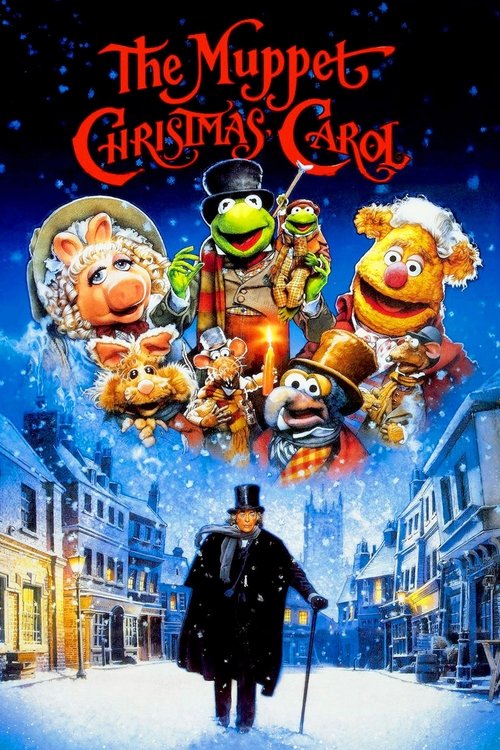
The Muppet Christmas Carol
1992 · Brian Henson
The definitive cozy December watch — for a night in with family, hot drinks, and the express intention of feeling good about humanity. Pure comfort, and an annual-tradition kind of film.
What it's about
It's Dickens's Christmas Carol, told straight — miserly Ebenezer Scrooge, visited on Christmas Eve by three ghosts who force him to look at his past, his present, and where he's headed — except the whole of Victorian London is populated by Muppets. Gonzo plays Charles Dickens himself, narrating from the sidelines with Rizzo the Rat heckling, while Kermit takes on the role of Scrooge's long-suffering clerk, Bob Cratchit.
The experience
Funnier than it has any right to be and far more moving than you expect — the jokes and the genuine Victorian melancholy sit side by side without undercutting each other. By the end it earns real warmth, and a song or two may leave you misty.
Performances
Michael Caine plays Scrooge completely straight — no winking, no camp — acting opposite felt frogs and rats as if they were the Royal Shakespeare Company, and that commitment is exactly why the redemption lands.
The craft
The film's great gamble is fidelity: it keeps chunks of Dickens's actual prose (via Gonzo's narration) and treats the story's sorrow as real, wrapping it in Paul Williams songs and wonderfully inventive puppetry. It looks like a proper Victorian Christmas card, snow and all.
Why it matters
The first Muppet feature made after Jim Henson's death and his son Brian's directorial debut, it has become for many households the standard screen version of the Carol — proof the Muppets could carry sincerity as well as anarchy.
Snapshot
The Muppet Christmas Carol is a family musical adaptation of Charles Dickens's 1843 novella, produced by Jim Henson Productions and released through Walt Disney Pictures at Christmas 1992. It occupies a singular place in the Muppet canon as the first theatrical Muppet feature made after the death of Jim Henson in May 1990, and it doubled as the feature directorial debut of his son, Brian Henson. The film's central formal gamble is to play the source material largely straight: Michael Caine's Ebenezer Scrooge is performed without wink or camp, embedded in a company of puppets who treat the Victorian tragedy of a wasted life as genuinely felt. Framed by the Great Gonzo impersonating Dickens himself as on-screen narrator — with Rizzo the Rat as skeptical sidekick — the picture braids Dickens's actual prose, new songs by Paul Williams, and the Muppet troupe's vaudeville sensibility into a work that is at once faithful literary adaptation and self-aware entertainment. Modestly received on release, it has since become one of the most durable perennial Christmas films and is frequently cited as among the more emotionally credible screen versions of the Carol.
Industry & production
The film was made under acute institutional strain. Jim Henson had died suddenly in 1990, midway through negotiations to sell his company to Disney (a deal that ultimately collapsed at the time), leaving Jim Henson Productions to define its future without its founder. Compounding the loss, veteran Muppet performer Richard Hunt — the voice and hands behind Scooter, Statler, Beaker, and others — died in early 1992, during or near the film's production window. The Muppet Christmas Carol thus functioned as both a creative project and an act of institutional continuity: a demonstration that the Muppets could persist as a going concern. Brian Henson, who had been building his craft as a performer and puppet builder, stepped into the director's chair, and Steve Whitmire assumed the role of Kermit the Frog (cast here as Bob Cratchit), the character Jim Henson had performed for three decades.
Disney distributed the film through its Buena Vista arm, continuing the corporate relationship that would eventually lead to Disney's outright acquisition of the Muppets in 2004. Production was based in England, at Shepperton Studios, drawing on British crews and the Henson organization's London operation. The budget was modest by studio-tentpole standards, and the commercial performance on initial release was respectable rather than spectacular; precise box-office figures are best treated cautiously, but the film did not open as a blockbuster and built its reputation over subsequent decades through home video and holiday-television rotation.
Technology
The picture is a hybrid of practical puppetry and emerging optical and mechanical techniques. Its most demanding technical set-pieces involve full-figure characters moving through space in ways older Muppet productions avoided — most notably the floating, ethereal Ghost of Christmas Past. That figure was realized as a puppet whose otherworldly, weightless drift was achieved through specialized rigging and, by well-documented accounts, filming in a fluid-filled tank to lend the movement a dreamlike suspension; the resulting element was then composited into the scene. The Ghost of Christmas Yet to Come, a towering Grim Reaper figure, likewise required large-scale puppet construction and careful staging to keep the operators concealed. The production sat at the transitional moment just before digital compositing became routine, so its illusions lean primarily on in-camera and optical methods, animatronics, and traditional hand-and-rod puppetry rather than computer imagery.
Technique
Cinematography
Shot by cinematographer John Fenner, the film adopts a warm, storybook palette that shifts deliberately with Scrooge's moral journey — the cold blue-gray of his counting-house and the miserly present, the golden nostalgia of the Fezziwig past, the abundant candlelit warmth of Christmas Present, and the fog-bound monochrome dread of the future. Crucially, the camera treats the Muppets as full actors: framings and eyelines are composed to sustain the illusion that a three-foot frog and a human movie star share the same room and the same dramatic stakes. The staging must constantly negotiate the practical constraint of hiding puppeteers below frame, which shapes a cinematography of tabletops, waist-high walls, snowbanks, and elevated sets.
Editing
The cutting balances two registers that could easily collide: the sincere Dickensian drama carried by Caine and the metatextual comedy of Gonzo-as-Dickens and Rizzo. Editing rhythm is used to license the tonal shifts — cutting to the narrators for a joke, then returning to Scrooge's genuine anguish — so that comedy punctuates rather than deflates the pathos. The film's editor is credited as Michael Jablow; specifics of the cutting-room process are not richly documented in the public record.
Mise-en-scène / staging
The production reconstructs a stylized Victorian London — cobbled streets, a bustling marketplace, Scrooge's shadowed offices, the Cratchits' humble home — as a self-consciously theatrical world in which vegetables sing, rats keep books, and Muppet townsfolk populate the crowd scenes. The design leans into artifice rather than realism, an approach well suited to a story delivered by a narrating Gonzo who cheerfully reminds us we are being told a tale. Frank Oz's characters are folded in as period figures, most pointedly Fozzie Bear reimagined as the jolly employer "Fozziwig," and Statler and Waldorf refigured as the deceased partners Jacob and Robert Marley — the invention of a second Marley brother a neat solution to give two beloved hecklers a duet.
Sound
Paul Williams — who had written "Rainbow Connection" and the songs for The Muppet Movie (1979) — composed the film's original songs, with orchestral score by Miles Goodman. The song cycle ranges from the bustling opening "Scrooge" and Kermit/Cratchit's yearning "One More Sleep 'Til Christmas" to the ghostly music-hall turn "Marley and Marley," the expansive "It Feels Like Christmas," and the redemptive "Thankful Heart." The film's sound design integrates Dickens's narrated prose, dialogue, and song into a continuous texture, and the vocal performances — human and puppet alike — are mixed to keep the storytelling legible for a family audience.
Performance
The performance principle at the film's core is Michael Caine's decision, often recounted, to play Scrooge with complete sincerity — approaching the role, in his own framing, as though performing serious classical theater, never acknowledging that his scene partners are puppets. That commitment anchors the entire production: because Caine grieves, repents, and rejoices in earnest, the Muppets' more comic register gains dramatic ballast. The puppeteer performances are correspondingly disciplined — Steve Whitmire's Kermit-as-Cratchit and Frank Oz's Miss Piggy-as-Emily Cratchit carry the film's emotional center in the Tiny Tim scenes — while Dave Goelz's Gonzo and Steve Whitmire's Rizzo supply the affectionate authorial commentary.
Narrative & dramatic mode
The film's most distinctive structural choice is its framing device: Gonzo, "as" Charles Dickens, narrates the story directly to the audience, frequently quoting the novella's actual text, while Rizzo interjects as an audience surrogate who is variously frightened, hungry, and unconvinced. This double narration solves a perennial adaptation problem — how to preserve Dickens's celebrated prose voice — by literally embodying the author inside the fiction. The mode is thus simultaneously faithful (much dialogue and description is Dickens verbatim) and Brechtian-lite (the narrators repeatedly break the frame). Beneath that playful apparatus, the film follows the Carol's classic five-part ghost structure — Marley's warning, then the three spirits, then redemption — with fidelity, allowing the underlying tragedy of Scrooge's isolation and the possibility of moral rebirth to unfold without ironic undercutting at the decisive moments.
Genre & cycle
The Muppet Christmas Carol sits at the intersection of several cycles. It belongs to the long tradition of screen Carol adaptations that stretches back to the silent era and includes definitive versions such as the 1951 Scrooge with Alastair Sim; against that lineage it is the first to fully integrate puppet comedy and original musical numbers into the canonical structure. It is also the fourth theatrical Muppet feature, following The Muppet Movie (1979), The Great Muppet Caper (1981), and The Muppets Take Manhattan (1984) — but the first to adapt a pre-existing literary classic rather than tell an original Muppet story, inaugurating a new sub-cycle of Muppet literary adaptations continued by Muppet Treasure Island (1996). Finally, it is a family Christmas musical, competing in a crowded holiday-perennial genre that prizes annual rewatchability over first-release grosses.
Authorship & method
The film is a collaboration among interlocking authorial voices. Brian Henson, directing his first feature, is both custodian of his late father's legacy and a working puppeteer in his own right; his method fuses reverence for the Muppet tradition with the ambition to place the characters inside a "real" dramatic story. Jerry Juhl, the longtime head writer of the Muppets and a close Henson collaborator, wrote the screenplay, and his contribution is the film's signature achievement — the seamless weave of Dickens's language with Muppet comedy and the Gonzo/Rizzo narration. Paul Williams, returning to the Muppet fold, supplies the songbook that carries the emotional arc. Cinematographer John Fenner and composer Miles Goodman shape the visual and orchestral texture, and editor Michael Jablow governs the tonal balance. The animating creative principle across all of them is tonal integration: keeping the comedy and the sentiment from canceling each other out.
Movement / national cinema
The film does not belong to a formal film "movement," but it is a product of a distinct institutional tradition — the Jim Henson organization's fusion of American television variety comedy with sophisticated puppet engineering, transplanted here to a British production base. Shot in England with British crews and steeped in an English literary source, it also participates loosely in a transatlantic tradition of British-set, American-financed literary adaptation. Its truest "movement" affiliation is to the Henson house style itself: an authorial workshop culture, carried forward by Jim Henson's collaborators and family after his death.
Era / period
Two periods bear on the film. Diegetically, it recreates Dickens's early-Victorian London of the 1840s, the world of the novella's first publication. Industrially, it is a product of the early-1990s family-film marketplace, made at the cusp of the digital-effects revolution and just before the Disney-Muppet corporate relationship consolidated. It is a transitional artifact: rooted in analog puppetry and optical craft, yet released into an era that would soon transform how such illusions were achieved. It also marks a generational passage within the Henson enterprise — the first Muppet production to define itself explicitly in the absence of its founder.
Themes
The film's themes are inherited from Dickens and honored rather than reinvented: the moral cost of avarice and isolation; the possibility of redemption through memory, empathy, and second chances; the sanctity of community and generosity against the cruelty of a purely transactional life; and the vulnerability of the poor, crystallized in Tiny Tim. The Muppet framing adds a distinct metatextual thread — a gentle meditation on storytelling itself, as Gonzo and Rizzo remind us that the tale is being told, and that stories are a means of moral instruction and shared feeling. Read against its production circumstances, the film also carries an unspoken elegiac charge: a story about loss, mourning, and carrying on made by an organization freshly bereaved of its founder.
Reception, canon & influence
Backward, the film draws on the deep well of prior Carol adaptations and on the Muppets' own screen history, particularly the Williams-scored The Muppet Movie; its narrator-driven fidelity to Dickens's text reflects a scholarly respect for the source unusual in a puppet comedy. On release, critical reception was generally warm, with reviewers frequently singling out Caine's straight-faced sincerity and the film's surprising emotional weight, though it did not register as a major commercial event; specific contemporary review scores and grosses should be regarded with caution absent the exact record.
One reception detail is well documented: the ballad "When Love Is Gone," sung during the Christmas Past sequence, was cut from the theatrical release — a decision associated with Disney's concern that the slow, adult number would tax younger viewers — and was subsequently restored in some home-video editions, becoming a long-running point of interest for fans and a case study in how home formats can recover a director's preferred cut.
Forward, the film's legacy has been one of steady canonization. It helped establish that the Muppets could survive Jim Henson's death as a creative force, and it launched the literary-adaptation strand continued by Muppet Treasure Island. Over three decades it has hardened into a holiday standard, routinely named among the best film versions of A Christmas Carol and cited for demonstrating that a work can be simultaneously a faithful literary adaptation and an unabashed Muppet comedy — the pathos and the puppets reinforcing rather than undercutting one another. Its enduring critical affection rests, finally, on the paradox at its heart: that one of the most sincerely moving screen tellings of Dickens's ghost story is narrated by a blue whatever-Gonzo-is and populated by singing vegetables.
Reception
In 1992 it was a modest performer that got squeezed at the box office (it opened against Home Alone 2) and drew respectful-but-muted reviews; three decades on it's routinely called the best screen adaptation of A Christmas Carol, full stop — a genuine slow-burn canonization.
How The Muppet Christmas Carol was received, from release to now →
Influences: the films it descends from and the films it influenced
- The Muppet Movie (1979) — Established the Paul Williams songcycle as a Muppet feature's emotional spine — a single sincere ballad anchoring the arc — the exact structure Williams returns to build here.
- Emmet Otter's Jug-Band Christmas (1977) — Henson's Williams-scored holiday special proved foam-and-fleece puppets could carry un-ironic Christmas pathos through song, the tonal proof-of-concept this film scales to Dickens.
- The Great Muppet Caper (1981) — Jim Henson's own feature-directing codified the characters-know-they're-in-a-movie narration that Gonzo-as-Dickens and Rizzo extend into a metatextual frame device.
- The Muppet Show (1976) — Fixed the house convention of the human guest playing dead-straight against the puppets — the sincerity register Michael Caine adopts wholesale as Scrooge.
- The Dark Crystal (1982) — Pioneered the below-frame trench ('tank') rig letting fully standing full-body puppets share a built set with hidden operators — the staging technique that lets Muppets walk Victorian London.
- Scrooge (1951) — The fidelity benchmark whose faithful five-stave ghost structure and moral gravity the film reproduces almost beat-for-beat beneath the comedy.
- Scrooge (1970) — Established Carol-as-book-musical, threading original songs directly into the redemption arc rather than around it — the integrated-number model Williams follows.
- Mary Poppins (1964) — Disney's template for songbook-driven sentiment anchored by a straight human lead moving through fantastical practical staging without winking at it.
- Babe (1995) — Extends puppet-realism into animatronic creature performance played with total sincerity against a straight human, earning genuine tears from fabricated co-stars.
- Muppet Treasure Island (1996) — Brian Henson directly continues the literary-adaptation-as-Muppet-comedy strand this film launched, reusing its faithful-text-plus-Muppet-cast formula on Stevenson.
- Team America: World Police (2004) — Inverts the lineage by foregrounding the marionette/practical-puppetry artifice — strings and seams visible — that Henson's hidden-puppeteer staging works to conceal.
- The Muppets (2011) — The revival is built on this film's proof that frame-breaking meta-narration and sincere sentiment can reinforce rather than cancel each other — its central tonal-integration principle.
- A Muppet Christmas: Letters to Santa (2008) — Reprises the Muppet Christmas-special formula this film canonized — straight holiday sentiment braided with comedy and a song score — for the same seasonal register.
- Who Framed Roger Rabbit (1988) — Bob Hoskins's committed straight-faced acting opposite absent co-stars is the same eyeline-and-conviction method Caine uses to make singing puppets read as real scene partners.
- Labyrinth (1986) — Henson practical puppetry integrating a live human lead into a full puppet ensemble in-frame — the human-among-puppets blocking this film inherits directly.
- The Nightmare Before Christmas (1993) — A practically-fabricated family Christmas musical built on a composer's through-sung songcycle (Elfman) carrying the emotional arc, the same genre fusion arriving a year later.
- The Princess Bride (1987) — Wraps an earnest tale in a self-aware framing narrator who comments on and pauses the story — the frame-breaking storytelling device Gonzo/Rizzo perform from inside the fiction.
Similar films
- Scrooge (1951) — influence & lineage
- The Great Muppet Caper (1981) — influence & lineage
- The Nightmare Before Christmas (1993) — influence & lineage
- Labyrinth (1986) — influence & lineage
- Mary Poppins (1964) — influence & lineage
- The Princess Bride (1987) — influence & lineage
- Edward Scissorhands (1990) — shared sensibility
- Guillermo del Toro's Pinocchio (2022) — shared sensibility