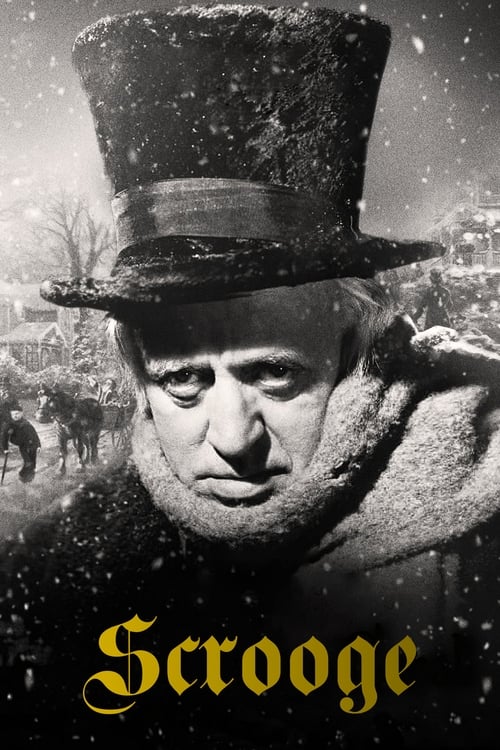
Scrooge
1951 · Brian Desmond Hurst
The definitive Christmas-night watch: when you want the season's warmth with some actual weight behind it, or a redemption story that makes you feel scrubbed clean by the end.
What it's about
On Christmas Eve in Victorian London, a cold, grasping businessman who has shut out every human warmth is visited by three spirits who force him to walk back through his own life — the lonely childhood, the choices that hardened him, and where it's all heading. It's the Dickens story everyone knows, told with unusual attention to how a frightened man slowly turns cruel.
The experience
Darker and more haunted than most tellings — genuinely ghostly in its shadowy black-and-white — but it earns a finale of pure, giddy joy that can catch you off guard with how moving it is. Melancholy first, then medicine.
Performances
Alastair Sim is, for many people, simply THE Scrooge — playing the miser not as a cartoon but as a wounded man, and letting loose in the final stretch with a near-hysterical delight that has become the film's signature.
The craft
Noel Langley's screenplay takes bold liberties with Dickens, building out a middle-life backstory that turns a morality tale into a psychological portrait. The atmospheric black-and-white photography leans into the ghost story, giving the spirits real chill.
Why it matters
Widely held up as the finest screen version of A Christmas Carol, it set the standard every later adaptation gets measured against and made Sim's performance a permanent part of Christmas.
Snapshot
Scrooge — released in the United States as A Christmas Carol — is a British adaptation of Charles Dickens's 1843 novella, produced by George Minter's Renown Pictures and directed by the Irish-born Brian Desmond Hurst. It is remembered above all for Alastair Sim's central performance, which for many viewers remains the definitive screen Ebenezer Scrooge: a portrait built less on caricatured miserliness than on woundedness, and, in the closing reel, on a giddy, near-hysterical joy that has become the film's signature. Noel Langley's screenplay is unusually free with Dickens, inventing a substantial middle-life backstory that reframes Scrooge's cruelty as the slow hardening of a frightened man rather than innate villainy. The result is one of the darker and more psychologically ambitious Dickens adaptations of the postwar British cinema, and — after a slow start with audiences — the version that has arguably shaped popular expectations of the story more than any other. At roughly 86 minutes, in black and white and the Academy frame, it belongs to a distinguished cycle of British literary adaptations that also produced David Lean's Dickens films of the late 1940s.
Industry & production
The film was made by Renown Pictures, a modest British production and distribution company run by George Minter, who is generally credited as producer. Renown operated well outside the scale of the Rank Organisation or Ealing, and Scrooge has the character of a carefully mounted mid-budget picture rather than a prestige blockbuster: economical in its locations, reliant on studio interiors and on the strength of a deep bench of British character actors. Brian Desmond Hurst directed and is sometimes also credited as producer or presenter, reflecting the fluid producer-director arrangements common in the independent British sector of the period.
The production drew on the extraordinary depth of the British character-acting profession. Alongside Sim, the cast assembled Mervyn Johns as Bob Cratchit, Kathleen Harrison as the charwoman Mrs. Dilber, Michael Hordern as Jacob Marley, Hermione Baddeley as Mrs. Cratchit, George Cole — Sim's real-life protégé — as the young Scrooge, Jack Warner as the invented industrialist Mr. Jorkin, Miles Malleson as Old Joe, and Ernest Thesiger in a small role as an undertaker. This casting strategy, stacking even minor parts with recognizable faces, is characteristic of British studio filmmaking of the era and gives the picture a density of playing that compensates for its restrained budget. The precise financial terms of the production are not well documented in the public record, and I will not manufacture figures for them.
Technology
Scrooge is a conventional product of early-1950s British studio technology: 35mm black-and-white photography in the standard Academy aspect ratio, with an optical monaural soundtrack. The film makes no claim on the widescreen or color innovations that would reshape the industry across the 1950s; its ambitions are theatrical and photographic rather than technological. Where it does exploit the tools of its moment is in optical effects for the supernatural passages — dissolves, superimpositions and matte work to render Marley's ghost, the passage of the spirits and the transitions between past, present and future. These are the standard optical-printing techniques of the period rather than novel processes. The film's later life includes a computer-colourised version produced in the 1980s, part of the broader and controversial colourisation wave of that decade; the original black-and-white photography remains the authoritative form of the work.
Technique
Cinematography
The cinematography is credited to C.M. Pennington-Richards, who lights the film in a broadly expressionist register appropriate to a ghost story. The everyday London of the counting-house and Cratchit household is rendered in relatively naturalistic tones, but the visitations are staged with hard pools of light, deep shadow, fog and chiaroscuro that owe something to the Gothic tradition and to the atmospheric British literary adaptations of the immediately preceding years. Marley's arrival, the graveyard of the final spirit, and the nocturnal cityscapes are the most visually charged passages. The camera style is generally classical — composed, unshowy, built around the performances — with the stylization concentrated in the fantastical sequences rather than dispersed across the whole film.
Editing
The film was edited by Clive Donner, then early in a career that would later turn to direction (and who would, decades on, himself direct a television version of the same story). The editing serves the screenplay's ambitious temporal architecture: the narrative moves fluidly between Scrooge's present, an expanded past and a foreshortened future, and the cutting must knit these strata together without confusion. Dissolves and superimpositions carry much of this work, easing the viewer across time and between the natural and supernatural planes. The pacing is measured, allowing the extended backstory room to breathe, and quickens markedly in the euphoric final movement.
Mise-en-scène / staging
The production design leans into a Victorian London of narrow interiors, cramped counting-houses, candlelit rooms and snow-bound streets. Much of the drama is staged in enclosed spaces — Scrooge's chambers, the Cratchit parlor, the offices of Scrooge and Marley — which reinforces the story's themes of confinement and isolation. The staging is essentially theatrical in its confidence with actors in rooms, but Hurst and Pennington-Richards open it out for the spectral journeys. The invented business-world sequences give the film a wider social canvas than most adaptations, populating Scrooge's rise with boardrooms and industrial ambition.
Sound
The sound design is functional and of its period — monaural, dialogue-forward — but it is put to expressive use in the supernatural passages, most famously the clanking of Marley's chains. The score is the dominant sonic element (see below), and the film weaves traditional Christmas carols into its texture, using the familiar music both diegetically and as underscore to sharpen the contrast between communal warmth and Scrooge's isolation.
Performance
Performance is the film's center of gravity, and Alastair Sim's Scrooge is its reason for enduring. Sim resists the temptation to play the miser as a mere grotesque; his early Scrooge is curdled and defensive, and the film's psychological screenplay gives him the material to trace a genuine arc from fear to grief to release. The redemption is not sentimental restraint but something closer to mania — Sim plays the reborn Scrooge as almost unhinged with delight, laughing at his own reflection, unable to govern his limbs — and this choice, risky in its excess, is what audiences have most remembered. Around him, the ensemble supplies texture: Michael Hordern's tormented Marley, Mervyn Johns's gentle Cratchit, George Cole's younger Scrooge bridging the two selves, and Kathleen Harrison's comic charwoman. The playing is theatrical in the best sense — precise, legible, generous to the story.
Narrative & dramatic mode
The film's most consequential departure from Dickens lies in its narrative construction. Where the novella keeps Scrooge's backstory brief and emblematic, Langley's screenplay expands the middle of his life into a developed dramatic arc. It invents the character of Mr. Jorkin, an ambitious businessman under whom the young Scrooge and Marley rise, and stages Scrooge's moral corrosion as a gradual capitulation to commerce — culminating in his and Marley's takeover of the firm. It deepens the death of Scrooge's beloved sister Fan, who dies giving birth to his nephew Fred, so that Scrooge's coldness toward Fred is retrospectively charged with buried grief and guilt. His estrangement from his fiancée (named Alice in the film) is likewise given emotional weight.
The effect is to convert Dickens's parable into something nearer a tragic character study. The supernatural machinery — the three spirits, the visions of past, present and future — remains, but it functions less as allegory than as a psychoanalytic excavation: the ghosts uncover causes, not merely warnings. The dramatic mode is thus a hybrid of moral fable and interior drama, and it is this seriousness of psychological purpose that distinguishes the 1951 film from lighter or more strictly faithful adaptations.
Genre & cycle
Scrooge sits at the intersection of several traditions. It is a ghost story and a fantasy, a Christmas film, and — most importantly for its industrial context — a literary adaptation within the rich postwar British cycle of prestige Dickens filmmaking. That cycle's high-water marks were David Lean's Great Expectations (1946) and Oliver Twist (1948), and Hurst's film shares their commitment to atmospheric black-and-white photography and to Dickens's social conscience. It also belongs to the long, still-continuing lineage of A Christmas Carol screen adaptations, a story filmed repeatedly since the silent era and in every subsequent decade. Within that specific lineage the 1951 version is the touchstone of the "serious" or "dark" interpretive strand, as against the more overtly musical, comic or family-oriented treatments that would follow.
Authorship & method
Brian Desmond Hurst, born in Belfast, was among the more colorful figures of the British industry, a prolific and versatile director whose earlier credits include the wartime Dangerous Moonlight (1941). His authorship here is that of a skilled orchestrator rather than a stylistic auteur imposing a signature: he serves the screenplay and, above all, the performances, marshalling a strong technical team and giving Sim the space to build his portrait.
The key collaborators are essential to the film's identity. Screenwriter Noel Langley — who had worked on the script of The Wizard of Oz (1939) — is responsible for the bold structural reinvention that defines this adaptation. Composer Richard Addinsell, celebrated for the "Warsaw Concerto" written for Hurst's Dangerous Moonlight, supplies a score that integrates traditional carols with original underscoring; his prior partnership with Hurst points to a working relationship of some continuity. Cinematographer C.M. Pennington-Richards provides the expressionist lighting that sustains the film's Gothic atmosphere, and editor Clive Donner manages its intricate movement across time. The collaboration is a genuinely collective achievement, with Langley's script and Sim's performance as its twin pillars.
Movement / national cinema
The film is a product of the British cinema's postwar period, made in the independent sector rather than by the dominant Rank empire. It reflects a national film culture that prized its literary heritage and produced adaptations of canonical authors as a matter of cultural prestige and export appeal. Its Irish-born director and thoroughly British ensemble locate it within the broader traditions of British and Irish filmmaking of the era. Unlike the more formally radical continental movements of the moment, this is a classical, craft-based cinema, confident in narrative and performance, with stylistic ambition reserved for its fantastical passages.
Era / period
Made in 1951, the film emerges from an austere, still-recovering postwar Britain. It is tempting — and historically defensible — to read its emphasis on charity, want and social conscience against the backdrop of the early welfare-state years, though the film does not editorialise about its own moment. Technologically and industrially it belongs to the last phase of the classical black-and-white studio era, before widescreen and color became standard. Its expanded critique of ruthless commerce, embodied in the Jorkin subplot, gives the Victorian material a resonance that a mid-century audience could readily feel, without the film ever stepping outside its period setting.
Themes
The film's governing themes are inherited from Dickens but sharpened by the screenplay's psychological method. Chief among them is redemption — the possibility that even a hardened man may be remade — treated here not as easy uplift but as something wrenched from grief and fear. Isolation and its causes form a second major theme: the film painstakingly traces how loss (of his sister, his fiancée, his youthful self) and the seductions of money combined to wall Scrooge off from human warmth. Related is a critique of avarice and unchecked commerce, made explicit through the invented business narrative, which frames greed as a social pathology and not merely a personal vice. Memory and time run throughout — the ghosts function as instruments of recollection and reckoning — as does the Dickensian insistence on charity, community and the moral claims of the poor, embodied in the Cratchits and Tiny Tim. Underlying all of these is the theme of self-knowledge: Scrooge's salvation depends on being forced to see himself truly.
Reception, canon & influence
The reception history of Scrooge is a study in slow canonization. On its initial release the film was not the immediate triumph its later reputation might suggest; it is widely reported that American audiences and exhibitors found its tone unusually grim for a Christmas offering, and it did not at first achieve the affection it would later command. Over the following decades, however — aided substantially by repeated television broadcasts during the holiday season — its standing rose steadily until it came to be regarded by many critics and viewers as the finest screen version of Dickens's story, with Sim's performance singled out as definitive. I would caution that some frequently repeated anecdotes about its premiere and early exhibition circulate without firm sourcing, and I will not assert specific box-office figures or first-run details that I cannot ground.
Looking backward, the film draws on Dickens's novella as its foundation, on the Victorian and Gothic traditions of the ghost story, and on the immediate example of the prestige British Dickens adaptations of the late 1940s, particularly the Lean films' atmospheric visual template. Langley brought to it a screenwriter's instinct, honed on earlier fantasy material, for dramatizing interior transformation.
Looking forward, the 1951 film has cast a long shadow over subsequent adaptations of A Christmas Carol and over the popular image of Scrooge himself. Sim's interpretation — the ferocity of the miser and the almost delirious release of the redeemed man — established a template that later performers have variously honored or reacted against. The film's willingness to treat the material seriously, as psychological drama rather than seasonal confection, helped legitimize a darker interpretive tradition that runs through many later versions. Its enduring presence as a holiday broadcast staple has kept it continuously in circulation, so that its influence operates less through any single acknowledged homage than through its diffuse, decades-long role as the version against which others are measured.
Reception
On US release (retitled A Christmas Carol) it was turned down by Radio City Music Hall for being too grim for holiday audiences and did only modest business — yet decades of TV airings turned it into the version most fans now call definitive.
How Scrooge was received, from release to now →
Influences: the films it descends from and the films it influenced
- Great Expectations (1946) — Established the deep-shadow, expressionist chiaroscuro template for prestige Dickens (Guy Green/Robert Krasker lighting of fog and cavernous interiors) that Pennington-Richards' photography directly echoes.
- Oliver Twist (1948) — Modeled the looming, Gothic staging of enclosed Victorian interiors and menacing London — the atmospheric visual grammar the 1951 film adopts for its ghost sequences.
- The Wizard of Oz (1939) — Screenwriter Noel Langley honed here his method of dramatizing an interior/psychological transformation as a structured fantasy journey, the instinct he brought to reinventing Carol's chronology.
- Dangerous Moonlight (1941) — Forged the Hurst–Addinsell partnership and the concerto-style thematic underscoring (the 'Warsaw Concerto') that Addinsell reworks into Scrooge's carol-integrated score.
- A Christmas Carol (1938) — The MGM studio template Langley's script revises, and the source of the dissolve/superimposition convention for conjuring spirits that the 1951 film inherits and deepens.
- Scrooge (1935) — First sound Scrooge; Seymour Hicks' definitive-until-Sim miser gave the role its ferocious baseline that Sim's manic-redemption reading answers and supersedes.
- Nosferatu (1922) — Pioneered the in-camera superimposition and stark chiaroscuro for rendering a specter, the expressionist ghost-effect grammar behind Marley's transparent apparition and the Yet-to-Come passages.
- A Christmas Carol (1984) — Directed by the 1951 film's own editor, carrying forward its serious psychological approach and Sim-era invented-backstory beats into George C. Scott's grimly realist Scrooge.
- Scrooge (1970) — Musical descendant that retains Langley's expanded psychological backstory (Fan, the lost fiancée) while reacting against the 1951 grimness by releasing redemption through song.
- The Muppet Christmas Carol (1992) — Michael Caine plays the miser with deadpan gravity against the puppets, explicitly honoring Sim's template of treating the material as genuine drama rather than confection.
- A Christmas Carol (1999) — Patrick Stewart's version extends the psychological-character-study interpretive tradition the 1951 film legitimized, foregrounding Scrooge's traumatic backstory as motive.
- A Christmas Carol (2009) — Extends the nonlinear-time dissolve into digital motion-capture, staging the flight across past/present/future as continuous morphing superimposition.
- Scrooged (1988) — Bill Murray's frantic, near-delirious final on-air redemption directly descends from Sim's manic-release performance, transposed to a modern satire.
- Blackadder's Christmas Carol (1988) — Inverts the canonized structure — a good man turned miser by the spirits — a parody legible only against the earnest redemption arc the Sim version made definitive.
- It's a Wonderful Life (1946) — Independently deploys the same supernatural guided life-review structure — a despairing man shown his past and a counterfactual future to earn redemption through grief.
- A Christmas Carol (1954) — Fredric March's live-TV musical adaptation works the same seriously-dramatised miser out of the immediate postwar prestige-Dickens moment, a parallel branch to Hurst's film.
- The Phantom Carriage (1921) — Shares the Dickensian moral architecture Lagerlöf drew on: a spectral guide, a New Year's/Christmas-eve reckoning, and a flashback-driven conversion narrative of temperance and redemption.
Similar films
- It's a Wonderful Life (1946) — influence & lineage · same viewing thread
- The Muppet Christmas Carol (1992) — influence & lineage
- Great Expectations (1946) — influence & lineage
- Oliver Twist (1948) — influence & lineage
- Nosferatu (1922) — influence & lineage
- The Nightmare Before Christmas (1993) — shared sensibility
- The Phantom Carriage (1921) — shared sensibility
- Oliver! (1968) — shared sensibility
All the films related to Scrooge →
Watch it with: curated runs of related films
- Grace in the Dead of Winter — A run of cold-season films where a lonely or cynical soul, snowbound and nearly out of hope, stumbles into connection — watch them across one dark week.