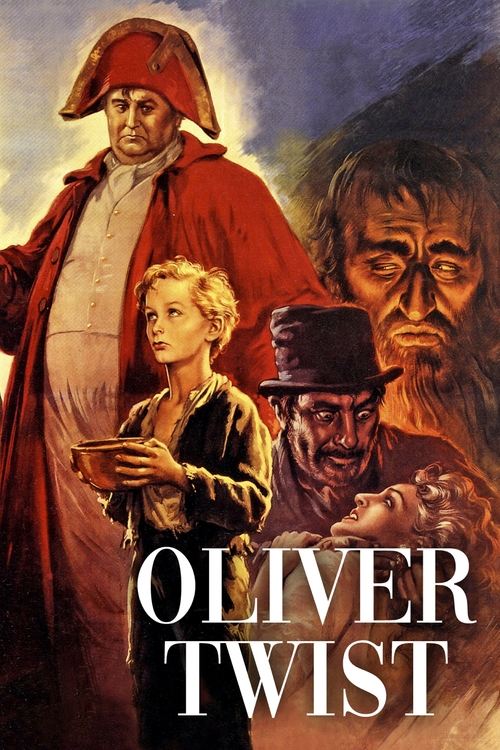
Oliver Twist
1948 · David Lean
When you want a classic with teeth — a rainy-night literary adaptation that plays like a nightmare rather than a costume piece. More challenge than comfort, and better for it.
What it's about
An orphan boy in Victorian England, born in a workhouse and hired out after daring to ask for a second serving of gruel, escapes to London and falls in with the Artful Dodger's gang of child pickpockets, run by the wheedling Fagin. When a kindly gentleman takes Oliver in, the underworld — above all the brutal Bill Sikes — isn't ready to let him go.
The experience
Far darker and more gripping than 'Dickens adaptation' suggests: a shadow-drenched thriller with real menace, opening with ten nearly wordless minutes of storm and childbirth that hit like a horror film. Tense, atmospheric, and moving, with flashes of sly comedy.
Performances
Alec Guinness transforms utterly as Fagin, and Robert Newton's Bill Sikes radiates genuine threat — villainy with real weight, not pantomime.
The craft
David Lean renders Dickens as expressionist nightmare: looming studio-built streets, boiling skies, and some of the most aggressive black-and-white photography of postwar British cinema. The compression of the sprawling novel into a lean, driving narrative is a masterclass in adaptation.
Why it matters
The darker half of Lean's celebrated two-film Dickens project, it set the visual template for how Victorian London looks on screen — the fog, the alleys, the shadows later films still borrow.
Snapshot
David Lean's Oliver Twist is the second and darker half of a two-film Dickens project that began with Great Expectations (1946), and it remains the most visually aggressive picture of his British studio years. Made at Pinewood by Cineguild under the Rank umbrella, it takes Dickens's 1838 serial — a novel of the New Poor Law, of orphanhood as a form of unpersoning — and renders it as a black-and-white expressionist nightmare built almost entirely inside a sound stage. The film opens with roughly ten minutes of near-wordless cinema: a woman in labor struggling across a thorn-lashed moor under a boiling sky, the storm cut against her contractions, arriving at a workhouse gate to give birth and die. Nothing else in postwar British cinema quite announces itself that way.
What follows is a ruthless compression of the novel — the entire Maylie household is gone, Monks reduced to a functional shadow — into a single downward-and-out line: workhouse, undertaker, road to London, Fagin's kitchen, Brownlow's drawing room, the rooftops of Jacob's Island. Alec Guinness's Fagin, buried under Stuart Freeborn's prosthetic nose and modeled on George Cruikshank's original etchings, made the film notorious; charges of antisemitism delayed its American release until 1951 and provoked protest and prohibition abroad. That controversy has shadowed the film ever since, and it is inseparable from any honest account of it. So is the fact that, as filmmaking, it is superb.
Industry & production
The film was produced by Cineguild, the production company formed by Lean, Ronald Neame and Anthony Havelock-Allan, operating within Rank's Independent Producers consortium at Pinewood alongside Powell and Pressburger's The Archers, Launder and Gilliat's Individual, and Wessex. Neame — who had shot Great Expectations — produced; Stanley Haynes co-wrote with Lean and worked closely on the production. By this point Havelock-Allan had moved on, and Cineguild was effectively Lean's instrument.
The timing matters. Oliver Twist was mounted at the high-water mark of J. Arthur Rank's ambition to build a British cinema capable of competing with Hollywood on Hollywood's terms — large budgets, prestige literary properties, studio-built spectacle — and it arrived just as that ambition collapsed. The 1947 "Dalton Duty," a punitive ad valorem tax on imported American films, triggered an American distributors' boycott; the hastily negotiated Anglo-American agreement of 1948 and an unrealistic exhibition quota left Rank badly overextended, and by 1949 the organization was posting heavy losses and John Davis was imposing austerity across the group. Films like Oliver Twist — expensive, artisanal, designed to travel — were the exact bet that did not pay off in time.
It performed respectably in Britain after opening in London in the summer of 1948. Its American prospects were destroyed by the Fagin controversy: the picture was withheld from US release until 1951, and then released in a shortened form, with material involving Fagin trimmed to answer objections from Jewish organizations. Screenings abroad drew protest — a Berlin engagement in 1949 provoked demonstrations, and the film was banned in Israel. Restored versions circulating today reinstate the cuts. Precise contemporary revenue figures are not something the standard literature records reliably, and this dossier will not guess at them.
Technology
Standard for its moment and unremarkable in itself: 35mm black-and-white panchromatic negative, Academy ratio (1.37:1), optical mono sound, shot entirely on Pinewood stages with no location work of consequence. What is notable is how far the film pushes conventional 1940s tools.
Guy Green's photography demands very high lighting levels — hard arcs, deep blacks, apertures stopped well down for depth of field — in a period when British studios were still working with slower stocks than the look implies. The famous London vistas and rooftop panoramas are achieved through John Bryan's forced-perspective sets, scenic backings and matte work rather than through any optical novelty; the illusion is carpentry and painting, executed with unusual rigor.
The one genuinely technical landmark is makeup. Stuart Freeborn's build-up for Guinness — a full prosthetic nose, aged skin, matted hair — was ambitious appliance work by British standards of 1948, and Freeborn went on to become one of the most consequential makeup artists in the industry (the apes of 2001: A Space Odyssey, Yoda). That the film's most advanced piece of craft is also the source of its scandal is not incidental: the prosthetic exists to reproduce a caricature.
Technique
Cinematography
Green — who had won the Academy Award for Great Expectations, the first British cinematographer to do so — works here in a far harsher register. The film is built on extreme contrast: pooled lamplight in Fagin's den with the surrounding room dropped to black, faces lit from below, figures reduced to silhouette against fog and whitewash. The debt to German expressionism and to the Universal horror idiom it fathered is open and unembarrassed; so is the debt to silent cinema generally, which Lean revered.
Two strategies recur. The first is scale distortion: low angles and wide lenses that make Bumble monumental and Oliver a doll, doorways and beadles and coffins looming over the child. The second is the withheld view — Fagin frequently glimpsed through banisters, doorframes, hanging cloth, so that the audience shares Oliver's position as someone watching adult conspiracy from the edge of the room. The opening storm sequence is the showpiece: whip-pans across bending thorn branches, lightning cut on the woman's cries, a gate looming out of blackness. It is closer to Murnau than to anything else in British cinema of the decade.
Editing
Jack Harris cut the picture, but Lean had been one of Britain's foremost editors before he directed — Pygmalion, Major Barbara, 49th Parallel, One of Our Aircraft Is Missing — and the film's cutting bears his signature everywhere. The opening reel is essentially montage: no dialogue, meaning built entirely from juxtaposition. Oliver's seventy-mile walk to London is compressed into a sequence of signposts and dwindling figure. The workhouse scenes are cut for percussive rhythm, culminating in the beat of silence after "Please, sir, I want some more."
The most discussed passage is Nancy's murder, which Lean stages almost entirely by elision. The blow is withheld; the camera stays with Bull's-eye, Sikes's dog, hurling himself at the closed door. The horror is transferred wholesale onto an animal, and the dog's subsequent behavior becomes the instrument of Sikes's exposure. It is a textbook demonstration of displacement as a dramatic engine, and it did more to keep the sequence censorable than any restraint in the writing.
Mise-en-scène / staging
John Bryan's production design is the film's controlling intelligence. Where Great Expectations gave him decayed grandeur, Oliver Twist gave him the rookery, and he built a London that is deliberately not archaeological: streets narrowing to impossible vanishing points, upper storys reduced in scale to exaggerate depth and height, ceilings pressed down onto the actors, staircases that seem to fold in on themselves. The forced perspective is not decoration; it is the film's argument, an environment that physically shrinks the child inside it.
The visual template is George Cruikshank's original illustrations for the novel — figure grouping, silhouette, the sooty crosshatched density of the etchings translated into lighting and set dressing. This is the same method Lean and Bryan had used on Great Expectations, and it gives the film its peculiar authority: it does not look like Victorian London, it looks like the book.
Sound
The soundtrack is organized around the alternation of din and silence. The wordless opening runs on wind, thunder and Arnold Bax's score alone; the workhouse is a space of scraping spoons and institutional echo; Fagin's kitchen hums with the low murmur of boys and the hiss of the fire. Against this, Lean deploys silence surgically — the hush after Oliver's request for more, the sealed room during the murder, the pause before the mob's roar at Jacob's Island.
Bax's score is itself a landmark. Master of the King's Musick since 1942, he wrote here his only substantial original score for a feature film, conducted by Muir Mathieson and played by the Philharmonia. It belongs to the distinguished British tradition of concert composers working in film — Bliss on Things to Come, Vaughan Williams on 49th Parallel and Scott of the Antarctic, Walton for Olivier's Shakespeare — and it is symphonic rather than functional, especially in the storm prelude, later drawn into a concert suite. Technical sound credits on Cineguild productions are thinly documented in the standard sources, and are not asserted here.
Performance
The film's register is frankly theatrical, and deliberately so. Guinness's Fagin, made two years after his screen debut as Herbert Pocket in Great Expectations, is a study in accumulated mannerism — the sidelong shuffle, the rubbed hands, the wheedling cadence — a virtuoso act of self-erasure by a young actor who would build a career on exactly this capacity. It is also the performance the controversy is about, because the caricature it inhabits is a specific and injurious one, drawn from Cruikshank and from Dickens's own text, and reproducing it with this much craft magnified rather than mitigated it.
Robert Newton's Sikes is enormous, sweating, permanently at the edge of violence, an approach he carried two years later into Treasure Island. Francis L. Sullivan's Bumble is inflated pomposity, played almost as grotesque. Against them, Kay Walsh's Nancy is the film's only fully modern performance — worn, contradictory, aware of her own entrapment — and she anchors what would otherwise be a gallery of gargoyles. (Walsh, then married to Lean, had also contributed to the screenplay of Great Expectations.) John Howard Davies plays Oliver as a still, watchful, almost affectless center, which is the right choice for a character who is more a moral vacancy for others to fill than a psychology; Davies later became a significant BBC comedy producer and director. Anthony Newley's Artful Dodger, all cocked hat and swagger, is the film's one source of pleasure, and Diana Dors appears early as Charlotte.
Narrative & dramatic mode
Lean and Haynes solve the adaptation problem by amputation. Dickens's serial sprawls across coincidence, disguised parentage and the Maylie household; the film discards the Maylies entirely, shrinks the Monks inheritance plot to a vestigial thread, and reorganizes everything around a single spatial logic — Oliver falls, is briefly rescued into light and warmth at Brownlow's, is dragged back down, and is retrieved. The dramatic mode is melodrama in its precise sense: moral positions legible in bodies, spaces and lighting rather than argued in dialogue.
This costs the film Dickens's comedy and much of his social breadth, and it costs Oliver himself any real agency; he is acted upon from first frame to last. What it buys is momentum and a terrifying coherence of tone. The climax — the siege at Jacob's Island, Sikes on the rooftops with the boy as hostage, the mob below — is pure kinetic melodrama, and it is where the compression pays off.
Genre & cycle
The film sits at the intersection of three cycles. It is a prestige literary adaptation, the dominant mode of respectable British production in the 1940s and the sector Rank most wanted to export. It is a costume melodrama, adjacent to but tonally opposed to the Gainsborough bodice-rippers then filling British cinemas. And in its lighting, its criminal underworld and its doomed protagonist, it borrows freely from the crime film and from the darker strain that American critics were just then beginning to call film noir — Fagin's kitchen and Sikes's flight belong recognizably to that visual family, transposed to 1830s London.
It also belongs to a smaller cycle of its own making: the Lean–Bryan Dickens, of which there are only two entries, and which stands as one of the most complete design-led statements in British cinema.
Authorship & method
Oliver Twist is a director's film, but it is unmistakably a collaboration among a settled team. Lean's method here — worked out on Great Expectations and never quite repeated after — was to storyboard from a nineteenth-century illustrative source, build everything on stage where every element could be controlled, and cut with an editor's ear for rhythm rather than a dramatist's ear for dialogue. His script credit is shared with Stanley Haynes; the writing's virtue is subtraction rather than invention.
Ronald Neame produced and had shot the previous film, giving continuity of visual thinking. Guy Green's photography and John Bryan's design are so mutually dependent that they function as one department: Bryan's forced perspectives only read because Green lights them to hide the joins, and Green's contrasts only bite because Bryan's sets are built to swallow light. Jack Harris cut both Dickens pictures and much of Lean's early work. Bax provided the symphonic weight, Mathieson the studio-music professionalism that connected British features to the concert hall.
This is the last full expression of Lean the British studio craftsman. What follows — The Passionate Friends, Madeleine, The Sound Barrier — is transitional, and by The Bridge on the River Kwai (1957) he has become something else entirely: a director of landscape, location and scale. The controlled artifice of Oliver Twist is precisely what he later abandoned.
Movement / national cinema
The film is a central document of the British "quality" cinema of the 1940s — literary source, studio craft, cultural respectability — and simultaneously a rebuke to it, because its visual method is not realist at all. Where the Griersonian documentary movement and its wartime descendants (Jennings, Cavalcanti, the Crown Film Unit) had pushed British cinema toward observation, and where Ealing was building its comedies on social texture, Lean and Bryan built an entirely artificial world out of European expressionist grammar. In this they stand closer to Powell and Pressburger, their Independent Producers stablemates, than to anything in the realist line — though Lean's temperament is colder and more architectural than theirs.
The film's later critical fortunes track the fortunes of that tradition. When 1970s criticism turned against "quality" British cinema as genteel and repressed, Lean's Dickens films were caught in the indictment; subsequent reassessment has largely restored them, on the grounds that the design and cutting are doing work no realist framework could do.
Era / period
The historical coincidence is almost too neat to state. Oliver Twist — a film whose first act is an indictment of the workhouse and the Poor Law regime Dickens attacked in 1838 — opened in London in the same weeks that the National Health Service came into being and the National Assistance Act swept away the last statutory remnants of that Poor Law. A country in the grip of rationing and austerity, dismantling the institutional architecture of Victorian pauperism, was watching a lavish reconstruction of what it was abolishing.
The film does not editorialise about this; the Beveridge settlement is nowhere in the text. But the workhouse sequences plainly land differently in July 1948 than they would have in 1938, and the film's confidence that the audience will read Bumble as a defeated species rather than a live threat is itself a marker of the moment.
Themes
The governing theme is institutional cruelty as ordinary procedure. Bumble is not a villain in the Sikes sense; he is an administrator, and the film's most chilling material is the board-room scene where starving children are discussed as a budget line. Fagin's operation is presented in explicit parallel — another institution that takes in unwanted children, feeds them badly and extracts labor, differing from the parish chiefly in candor.
Running beneath that is a preoccupation with inheritance and legibility: Oliver's gentility is visible, in his diction and his face, before it is documented, and the plot exists to confirm what the audience has already been invited to read. This is Dickens's own class metaphysics, and the film reproduces it without critique — Oliver is rescued because he was never really one of them.
The third theme is the child as witness. Almost every major scene is constructed around what Oliver can and cannot see, and the film's ethical position is located there rather than in dialogue: the world is a set of adult transactions conducted just out of a child's hearing.
Finally, and unavoidably, there is the film's own relation to prejudice. Fagin is repeatedly identified by physiognomy, gesture and setting with an antisemitic caricature inherited from Dickens's text and Cruikshank's plates. The film neither invents this nor interrogates it; it renders it with enormous skill. That is the honest description, and it is why the picture remains genuinely contested rather than merely dated.
Reception, canon & influence
British reviewers in 1948 broadly admired the film's visual command and its opening reel while dividing on its temperature; the recurring reservation was that it lacked the warmth and narrative satisfaction of Great Expectations and traded Dickens's comedy for grotesquerie. That comparative judgment — Great Expectations the greater film, Oliver Twist the more startling one — has proved durable, and both remain fixtures in surveys of the best British films.
The Fagin controversy dominated its international life. Objections from Jewish organizations in Britain and the United States, protests at overseas screenings, prohibition in Israel, and a three-year delay before a shortened American release in 1951 cost the film both money and reputation at the moment it most needed both. The debate has never really closed, and modern restorations that reinstate the trimmed footage have if anything sharpened it.
Backward: the film descends from Dickens's novel and, at least as directly, from Cruikshank's etchings, which supply its compositions wholesale. Behind that stand German expressionism and the silent cinema Lean had grown up cutting — the storm prologue is unthinkable without Murnau. Earlier screen versions existed (Frank Lloyd's 1922 film with Lon Chaney as Fagin and Jackie Coogan as Oliver; a 1933 American production), and Chaplin had already fused Dickensian orphanhood with screen comedy in The Kid (1921), but Lean's picture owes them little. There is also a suggestive theoretical frame: Eisenstein's essay "Dickens, Griffith, and the Film Today," written in 1944 and collected in Film Form in 1949, argued that cinematic montage and parallel action descended from Dickens's own prose. Lean's Dickens, cut for rhythm and juxtaposition, is an unusually literal vindication of that claim — arrived at independently, but arriving nonetheless.
Forward: the Lean–Bryan London became the default screen image of Victorian poverty for decades, reproduced across British television and film to the point of invisibility. Carol Reed's Oliver! (1968) — designed by John Box, another Lean collaborator — works visibly in its shadow even while inverting its tone, and Roman Polanski's Oliver Twist (2005) engages it directly. Guinness's Fagin established the character-transformation mode that made Kind Hearts and Coronets (1949) possible a year later. Freeborn's prosthetic work fed into a British makeup tradition of lasting consequence. And within Lean's own career, the film marks the end of one artist and the beginning of another: the last great work of the studio miniaturist before the landscapes took over.
A Deleuzian reading
A dog throws itself at a closed door.
The full Deleuzian reading of Oliver Twist →
Reception
A hit in Britain in 1948, it was engulfed by international protest over Alec Guinness's Fagin — demonstrations in Berlin, and a US release delayed until 1951 with several minutes of Fagin footage cut. Today it's ranked with Lean's Great Expectations as one of the definitive Dickens films, with the controversy now part of its history rather than a bar to its reputation.
How Oliver Twist was received, from release to now →
How to watch Oliver Twist: what to notice on a first viewing
- Watch how enormous the adults and doorways look next to Oliver. Low angles and wide lenses make Bumble monumental and Oliver tiny, with beadles, coffins, and doorframes looming over the boy in nearly every scene. The camera itself argues that this is a world built at a scale no child could match.
- Notice streets that narrow to an impossible vanishing point. John Bryan's sets shrink upper stories and press ceilings down onto the actors, a forced-perspective London built entirely on a soundstage to squeeze the child inside it. The environment isn't just backdrop. It's built to close in on Oliver, literally.
- Notice how often you view adults through a banister or a doorframe. Fagin and the other adults are repeatedly glimpsed through hanging cloth, banisters, and half-open doors, putting you at the exact edge of the room where Oliver stands. You end up watching adult conspiracy from precisely where a child would be allowed to watch it.
- Watch the nearly wordless first ten minutes of the film. The opening runs almost entirely without dialogue, a woman crossing a storm-lashed moor to a workhouse gate, meaning built from image and cutting alone. The film announces its method before a single word of dialogue: this will be told in pictures.
- Listen for the silence that follows key lines of dialogue. After Oliver's famous request for more food, the soundtrack drops into a held, total hush rather than any musical response or reaction from the room. The silence itself becomes the loudest thing in the scene, more than any word could be.
The whole guide to watching Oliver Twist, with the keys for a rewatch →
Influences: the films it descends from and the films it influenced
- Great Expectations (1946) — The same unit — Green, Bryan, Harris, Neame — worked out the method here that Oliver Twist perfects: storyboard every setup from a period illustration source, build it all on stage, and open on a child's subjective terror (wind, thrashing branches, a face lunging into low-angle close-up) before any plot is spoken.
- Sunrise: A Song of Two Humans (1927) — Murnau's entirely studio-built landscape with forced-perspective village and marsh, plus a storm sequence cut to weather and gesture rather than dialogue, is the direct model for Bryan's built moor and Lean's near-wordless storm prologue.
- The Cabinet of Dr. Caligari (1920) — Supplies the grammar of scale distortion — raked flats, ceilings crushed onto the actor, doorways narrowing to trap a figure — which Bryan rebuilds in three dimensions as forced perspective and Green lights specifically to hide the joins.
- Broken Blossoms (1919) — Griffith and Hendrik Sartov's fog-diffused, wholly studio-built Limehouse, lit for pools of dark rather than legibility, is the first screen London constructed as an expressive interior — the ancestor of Lean's Jacob's Island.
- M (1931) — Lang charts a criminal underworld as fixed vertical geography (den, stair, attic, rooftop) and uses dead silence and offscreen sound as the threat itself — the structural and aural template for Fagin's den and the wordless approach to Nancy's murder.
- Oliver Twist (1922) — Lon Chaney's self-applied Fagin — built-up nose, matted wig, hunched carriage copied from Cruikshank — sets the makeup-as-total-transformation precedent that Stuart Freeborn's prosthetic and Guinness's performance follow almost to the letter.
- Les Enfants du paradis (1945) — Alexandre Trauner's Boulevard du Crime, a complete period street erected on stage so that depth, crowd, and light could be composed rather than found, is the continental precedent for Bryan's built-to-be-lit London.
- Brief Encounter (1945) — Lean and Jack Harris's habit of deleting the connective scene outright — entering mid-action and letting a sound cue or a held face carry the transition — is the elision technique later applied to compress a 500-page novel.
- Kind Hearts and Coronets (1949) — Guinness's Fagin proved a lead could vanish under prosthetics and invented vocal mannerism without losing the audience; the eight D'Ascoynes, made a year later, are the direct commercial consequence of that demonstration.
- Scrooge (1951) — Adopts the Lean–Bryan Victorian London wholesale — built alley, pooled lamplight, low-key contrast — and casts its star buried in age makeup to play Dickens as grotesque rather than as sentiment.
- Oliver! (1968) — Designed by John Box, another Lean collaborator, on the same principle of a London built to be lit and composed from Cruikshank; it reproduces the 1948 blocking and set geography while inverting the tone from menace to spectacle.
- 2001: A Space Odyssey (1968) — Stuart Freeborn's Fagin nose begins the appliance lineage that culminates in the Dawn of Man apes — prosthetics engineered to be performed through and lit hard, rather than disguised by soft light and distance.
- The Elephant Man (1980) — Reunites the two traditions this film codified: Christopher Tucker's appliance-built face in the Freeborn line, and Freddie Francis's black-and-white chiaroscuro over a studio-built Victorian London of crushed blacks and obstructed doorways.
- Oliver Twist (2005) — Engages Lean composition by composition — Allan Starski's Prague-built London reconstructs the same Cruikshank set-ups while Kingsley's prosthetic Fagin is staged as an explicit revision of Guinness's caricature.
- The Cider House Rules (1999) — Lean's canonical Dickensian-orphanage idiom (cavernous institutional interiors, the Victorian text read aloud) is the visual-literary vocabulary the film consciously invokes when Dr. Larch reads Dickens to the boys at lights-out.
- Slumdog Millionaire (2008) — Lean's Dickens adaptation gives the orphan-in-a-criminal-underworld template — Fagin's child pickpocket gang reworked as Maman's syndicate of maimed child beggars — that Beaufoy restructured.
- Odd Man Out (1947) — Robert Krasker's night city built and lit as a field of black voids, with long passages carried by effects and silence instead of dialogue — British studio expressionism arriving at the same solutions in the same months.
- Nicholas Nickleby (1947) — Ealing's rival Dickens, worked from the same compression problem but solved episodically and with theatrical-grotesque casting rather than by cutting for rhythm — the immediate benchmark against which Lean's method defined itself.
- Hamlet (1948) — Roger Furse's forced-perspective Elsinore and Desmond Dickinson's deep-focus chiaroscuro, shot on neighboring British stages the same year, share the conviction that scale and light must be authored in a built space rather than discovered on location.
- The Third Man (1949) — Krasker pushes the same vocabulary to its extreme: canted low angles that inflate adults into threats, streets lit as chiaroscuro traps, and figures framed through arches, railings and grilles — obstructed framing as the dominant compositional logic.
- The Fallen Idol (1948) — The parallel Dickens case: a small boy alone in a predatory adult household, Guy Green's high-contrast deep-focus interiors, and a non-professional child (John Howard Davies) directed toward the same flat, unperformed reactions Reed extracted from Bobby Henrey.
Similar films
- Oliver! (1968) — influence & lineage
- Great Expectations (1946) — influence & lineage
- Scrooge (1951) — influence & lineage
- The Elephant Man (1980) — influence & lineage
- The Third Man (1949) — influence & lineage
- Odd Man Out (1947) — influence & lineage
- The Kid (1921) — shared sensibility
- The Muppet Christmas Carol (1992) — shared sensibility