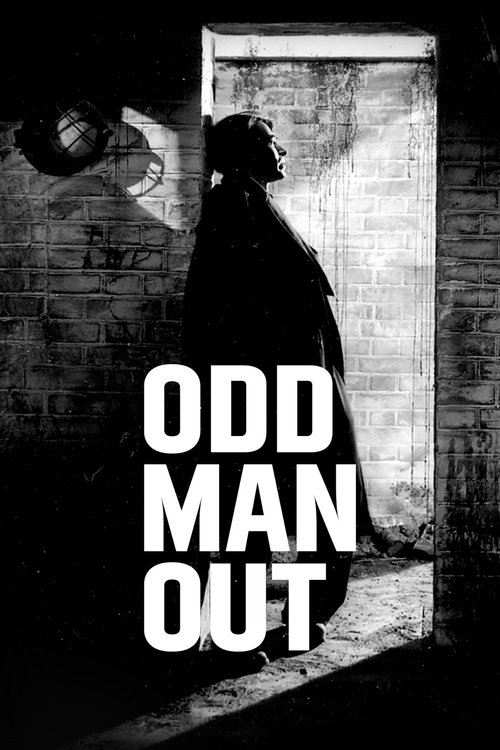
Odd Man Out
1947 · Carol Reed
For when you want a serious, atmospheric night-time noir to sink into — something tense but soulful, closer to tragedy than to a caper. Choose it when you're up for a challenge and a downbeat mood, not a comfort watch.
What it's about
After a robbery goes wrong, a wounded IRA gunman is left behind in a Northern Irish city as police mount a door-to-door manhunt through a single snowy night. Bleeding and increasingly delirious, he drifts through back alleys, pubs, and strangers' rooms while the people who find him — some loyal, some frightened, some looking to profit — argue over what to do with a dying man everyone recognizes. His comrades and the woman who loves him search the same eight hours from the other side.
The experience
It starts as a taut, clock-driven thriller and slowly turns into something stranger and sadder — a fever dream of a city at night, where the tension gives way to a mounting, mournful intensity. It's gripping, but the grip is emotional as much as suspenseful; expect to end the night somber and a little haunted.
Performances
James Mason, in the role that announced him internationally, does astonishing work with very little dialogue — a whole performance of fading consciousness, carried in his eyes and his stagger. The gallery of characters who orbit him, played by cream-of-the-crop British and Irish stage actors, gives every brief encounter real weight.
The craft
Carol Reed and cinematographer Robert Krasker turn wet cobblestones, snowfall, and lamplight into some of the most beautiful black-and-white imagery in British cinema, with tilted angles and deep shadows that grow more hallucinatory as the night wears on. The sound and score swell operatically as the manhunt thins into reverie — this one rewards a dark room and a good screen.
Why it matters
The film that made Carol Reed the most admired director in Britain and set the visual template he'd carry into his later masterpieces; it won the first-ever BAFTA for Best British Film. It remains a benchmark for how a genre picture can shade into something like a passion play.
Snapshot
A wounded gunman staggers through a nameless Northern Irish city for eight hours, and the film that follows him gradually stops being a thriller and becomes something closer to a passion play. Odd Man Out was Carol Reed's first unambiguously major work — the film that made him, briefly, the most admired director in Britain — and it remains the most formally daring of the three pictures (with The Fallen Idol and The Third Man) on which his reputation rests. Adapted from F. L. Green's 1945 novel, with Green himself collaborating on the screenplay alongside R. C. Sherriff, it takes the armature of a manhunt picture and progressively dissolves it: the pursuit narrative thins out, the protagonist loses consciousness and coherence, and the film's attention disperses among the citizens who find him, use him, argue over him, and pass him along.
James Mason plays Johnny McQueen, leader of "the Organization" — the film never says IRA, and the city is never named Belfast, though it was shot there and the geography is unmistakable to anyone who knows it. Johnny is shot during a mill payroll robbery, kills a man in the struggle, falls from the getaway car, and spends the remainder of the film bleeding into doorways, air-raid shelters, cabs, and finally snow. Around him Reed assembles one of the great British character-actor ensembles: Robert Newton as a half-mad painter who wants to capture the look of a dying man's eyes, F. J. McCormick as the scavenging Shell, William Hartnell as a barman who wants him gone, Kathleen Ryan as Kathleen, who wants him alive or wants to die with him.
What lifts the film is the willingness to abandon realism as the night deepens. Reed and cinematographer Robert Krasker begin in something like documentary observation and end in expressionist delirium — bubbles in spilled beer turning into faces, Johnny hallucinating his own trial before a jury of everyone he has met. It is a film about a political actor from which politics has been carefully, and controversially, drained; and it is a film about a city in which the city, more than any character, does the acting.
Industry & production
Odd Man Out was made by Two Cities Films, the production company then operating within J. Arthur Rank's expanding empire, and released in Britain in January 1947. It belongs precisely to the moment of maximum British ambition in the cinema — the postwar window when Rank's money, wartime-trained technicians, and a domestic audience at historic peak attendance combined to support pictures made with confidence that they could stand beside anything from Hollywood. The same span produced Brief Encounter, Great Expectations, Black Narcissus, Hamlet, and Reed's own subsequent The Fallen Idol and The Third Man. Reed had come out of the war with enormous credit: he had directed The Way Ahead (1944) and co-directed, with Garson Kanin, the Allied compilation documentary The True Glory (1945), which won the Academy Award for Documentary Feature. That combination — fiction craftsman and documentary supervisor — is legible in every reel of Odd Man Out.
Reed produced as well as directed, which mattered: it gave him unusual latitude over a subject that was, in 1947, genuinely delicate. The film's studiously non-specific treatment of the Organization, and the decision never to name Belfast on screen, are best understood as products of that delicacy rather than as pure aesthetic choice. British censorship and political nervousness about republican paramilitarism were real constraints, and the film negotiates them by abstracting: the cause is never articulated, its grievances never stated, its enemy never described as the British state. Critics from the 1940s onward have divided over whether this abstraction is the film's evasion or its liberation — whether draining the politics is a failure of nerve or the move that converts a topical thriller into a moral fable.
Location shooting in Belfast was substantial, and it gives the film its documentary spine: the mill, the streets, the trams, the terraces, the wet setts. Interiors and the more controlled sequences were completed at Denham Studios. The mixture is characteristic of the period's best British practice — real place established on location, then extended and stylized in the studio, with the joins concealed by consistent lighting design. The winter setting allowed Reed the falling snow of the final act; the snow accumulates across the last reels, and the timing of the shoot and the manufacture of that effect are among the production details on which the surviving record is thinner than one would like.
Commercially the film performed respectably in Britain and traveled — its critical standing abroad, particularly in the United States and France, was higher than its earnings. It won the BAFTA for Best British Film (that award's inaugural year), and its editor, Fergus McDonell, received an Academy Award nomination for editing, a rare recognition for a British picture in a craft category at that date.
Technology
Nothing in Odd Man Out is technologically novel in the sense of first use; what is remarkable is the pressure applied to entirely conventional 1947 equipment. The film is black-and-white 35mm, Academy ratio, optical mono sound — the standard configuration for a British feature of its year. Its achievements are achievements of lighting, lens choice, and camera mounting rather than of apparatus.
Two areas deserve note. The first is the handling of low-light location and night work. Postwar British stocks and lamps made genuinely dark exteriors difficult; the film's night city is largely built rather than found — wet streets deliberately hosed to make surfaces read as reflectors, practical lamps positioned to justify pools of light, and the whole scheme calibrated so that darkness is legible as darkness rather than as underexposure. This is the technical basis of the "Reed–Krasker look" that would be pushed further in The Third Man.
The second is optical and in-camera trickery in the hallucination passages. The film uses distortion, superimposition, and rack focus to render Johnny's dissolving consciousness — most famously the sequence in which the bubbles of spilled beer resolve into the faces of characters, and the delirium in the painter's studio where portraits animate into a jury. These are achieved with the ordinary optical-printing and matte resources of the period, deployed with unusual boldness for a mainstream British release. Reed's willingness to break the realist surface with such devices, at a point in the film where the audience is invested in a suspense narrative, is the single most consequential technical decision in the picture.
Sound recording is likewise standard, but the mix is not: the film's use of near-silence, of ambient street noise cutting abruptly against William Alwyn's orchestral score, and of subjective muffling as Johnny loses consciousness, exploits the optical track's limited dynamic range as an expressive resource rather than fighting it.
Technique
Cinematography
Robert Krasker shot Odd Man Out two years before he and Reed made The Third Man, and the film is where their shared visual vocabulary is worked out. Krasker had photographed Brief Encounter for David Lean; his instinct for shooting faces in low key and for making ordinary British interiors look charged transfers directly here.
The film's photographic argument is progressive derangement. The opening reels are shot relatively straight — high overhead establishing views of the city, level compositions, the mill robbery covered with clarity so the audience understands the geography of the crime. As Johnny's condition worsens, the camera's relation to the horizon loosens. Canted framings appear and multiply. Low angles push ceilings and cobbles into the frame. Faces are lit from below or raked from the side so that eye sockets go black. By the final movement the compositions are frankly expressionist: figures reduced to silhouettes against snow-glare, iron railings and lamp standards slicing the frame into bars, the city rendered as a graphic system of verticals through which a dying man moves.
Reed's famous Dutch angles — later so identified with The Third Man that they became a critical shorthand and, for some critics, a mannerism — are here motivated with real rigor. They arrive with Johnny's disorientation and intensify with it. William Wyler's often-repeated gibe about sending Reed a spirit level applies, if at all, to the later film; in Odd Man Out the tilt is a subjective instrument.
Krasker's deep-focus work in the interior scenes is also worth attention: the pub, the shelter, the priest's house, and the studio are staged with foreground and background action in simultaneous legibility, letting Reed hold arguments about Johnny's fate in a single frame with Johnny's body.
Editing
Fergus McDonell's cutting earned an Oscar nomination, and the structure it serves is unusual. The film runs on a clock — the opening establishes an eight-hour span, and clock faces recur as punctuation — but the editing does not build the tightening acceleration a manhunt normally demands. Instead it does something closer to the opposite: the film starts fast and taut through the robbery, then progressively slows, lengthens, and disperses.
The dispersal is the point. After Johnny falls from the car, the film repeatedly leaves him. It follows the other members of the Organization, the police inspector, Kathleen, the two women who bring Johnny into their parlor and then argue about the risk, the cabbie, the birdcatcher, Shell, Lukey, the priest. Each is given real screen time. The cross-cutting is not the classical suspense pattern of pursuer-and-pursued closing in; it is a survey, a sampling of a city's moral positions, with Johnny as the object each position must respond to. Only in the last movement does the film reconverge, and by then the convergence is not toward capture but toward a rendezvous that reads as fate.
The delirium sequences give McDonell his showiest material — quick associative cutting, dissolves, superimpositions — but the more skillful work is the long middle, where he sustains momentum across a narrative that has, strictly speaking, stopped advancing.
Mise-en-scène / staging
Belfast is the film's principal set, and Reed stages against it with an eye trained on the wartime documentary he had just finished supervising. The mill and its wall, the terrace streets, the tram, the pub, the junkyard, the derelict baths — these are not backdrops but the film's argument about a society: a working city, densely inhabited, in which a wounded man cannot be anywhere without being somebody's problem.
The staging is organized around thresholds. Doorways, gates, cab doors, the mouth of an air-raid shelter, the pub's snug — Johnny is perpetually being admitted or refused, carried in or put back out. Each interior is a small jurisdiction with its own rules, and the drama of each episode is whether he will be granted sanctuary there. The cumulative pattern makes the film a moral inventory of a city, staged as a sequence of tests.
Two set-pieces stand out. The pub interior, with its snug partitions and Hartnell's anxious calculations, is staged so that Johnny's presence contaminates every corner of a room built for privacy. And Lukey's studio — cluttered with canvases, lit like a chapel, with the birdcatcher and the priest and Shell all contending for the dying man — turns the mise-en-scène frankly allegorical: art, faith, and greed each claiming a body that can no longer answer.
The snow that begins falling in the last act is the film's most decisive staging choice. It whitens the city, flattens depth, muffles sound, and converts a specific place into an abstraction — the transformation the whole film has been working toward.
Sound
William Alwyn's score is one of the major British film scores of the decade, and it is used with unusual restraint at the start and unusual force at the end. Alwyn writes with a symphonic weight that pushes the film toward tragedy rather than thriller; the recurring material attached to Johnny functions less as a theme than as a pulse, and it thins and staggers as he does.
The sound design proper is where the film is most inventive. Reed uses ambient city sound — trams, footsteps, children, rain — as a realist floor, then withdraws it. Passages of Johnny's subjective experience are handled by muffling, by hollowing out the ambience, by letting a single sound (dripping water, a clock) dominate. Voices float free of their speakers in the delirium sequences. The famous falling-snow finale is scored and mixed so that the city noise recedes almost to nothing, leaving orchestra, wind, and the ship's siren.
The film's treatment of Belfast speech is also of its moment: an ensemble drawn substantially from Dublin's Abbey Theatre gives the film an Irish vocal texture rare in British features of the period, though the mixture of Northern and Southern accents is a recognized inconsistency.
Performance
James Mason's Johnny is a performance built on subtraction. He is at his most conventionally magnetic in the opening reels — the leader, planning, doubting, giving orders — and after the shooting he steadily surrenders the tools of screen acting: mobility, then dialogue, then focus, then consciousness. What is left is a face and a voice, and Mason's control of the diminishing register is remarkable. He was already a British star, and the film's willingness to make its star inert for most of its length is part of its audacity. Mason himself regarded it highly among his own films.
Around him, the ensemble does the work. F. J. McCormick's Shell — bird-fancier, scrounger, negotiating Johnny's value with the priest — is the performance most often singled out by critics, and deservedly; it is comic, pitiable, and morally slippery all at once. Robert Newton's Lukey is the film's most divisive turn: theatrically enormous, on the edge of camp, and either the moment the film's allegory tips into indulgence or the moment its expressionism finds a human vessel, depending on the critic. Kathleen Ryan's Kathleen carries the ending's terrible resolve. Denis O'Dea's inspector supplies a police presence that is procedural rather than villainous — another way the film refuses the political frame. William Hartnell, Cyril Cusack, and Dan O'Herlihy fill out an ensemble in which even one-scene parts are given specificity.
Narrative & dramatic mode
The film announces a countdown and then declines to behave like a countdown. Structurally it is a stations narrative — a wounded man passed from hand to hand through a series of encounters, each a self-contained moral episode. The nearest generic relatives are the passion narrative and the picaresque; the nearest cinematic ones are the odyssey films in which a protagonist's journey is a pretext for a portrait of a society.
Crucially, agency migrates away from the protagonist. For the first twenty minutes Johnny drives events; thereafter events happen to him, and the dramatic questions belong to everyone else: will she shelter him, will he sell him, will he absolve him, will she save him. This is the formal inversion that distinguishes Odd Man Out from the manhunt thrillers it superficially resembles. Suspense in the ordinary sense decays; what replaces it is a mounting inevitability, closer to tragedy's rhythm than to the thriller's.
The film's shift in register — realist observation to expressionist delirium — is managed as a gradient rather than a rupture, but by the studio sequence the film has openly entered subjectivity, staging Johnny's imagined trial and his fragmentary recollection of scripture. The ending, on the quayside in the snow, resolves the plot in a few seconds and resolves the moral action not at all, which is the point: the film has spent two hours asking what a city owes a dying man, and it answers by killing him without a verdict.
Genre & cycle
Odd Man Out sits at the intersection of three currents. It is a crime picture, with a heist and a manhunt. It is, by the criteria that were being retrospectively assembled in France at exactly this period, a film noir — doomed protagonist, nocturnal city, fatalism, expressionist lighting, a woman who chooses death — and it is frequently anthologized as one of the outstanding British contributions to noir, alongside Brighton Rock (1948) and Reed's own The Third Man.
It is also part of the specifically British postwar cycle of "spiv" and crime pictures — films that took the disordered, rationed, black-market Britain of the late 1940s as their subject. Odd Man Out is the most morally serious of that group, and it converts the cycle's usual materials into something with religious weight.
Finally it belongs to a small and difficult category: the British film about Ireland. Here its position is genuinely contested. By declining to name the IRA, Belfast, or the conflict, the film has been read both as a humane refusal to take sides and as a depoliticizing move that renders the republican gunman into an abstract sufferer. Irish critical writing has often taken the harder line. Reed returned to comparable ground in The Man Between (1953), transposing the divided-city structure to Berlin, which suggests the divided city interested him as a formal condition more than as a specific politics.
Authorship & method
Reed's method is best described as documentary realism used as the launchpad for stylization. He came to Odd Man Out directly from The True Glory, and the film's first act — the mill, the streets, the trams — has the observational density of that training. He then deliberately erodes it. This trajectory, established here, becomes the Reed signature: begin in a real place, film it with respect, then let the place turn strange as a character's grip on it fails.
Reed was also an actor's director of unusual patience, drawn to ensembles of eccentrics and to child performers (The Fallen Idol), and to protagonists who are morally compromised without being villains. The concentration of talent on this production is exceptional: Krasker's camera, McDonell's editing, Alwyn's score, Roger Furse's design, and F. L. Green adapting his own novel with R. C. Sherriff, the veteran dramatist of Journey's End. Green's novel is more explicit about politics than the film; the adaptation's most consequential authorial act is what it removes.
The Krasker collaboration is the one with the longest shadow. What is proved here — that a real European city can be photographed as a psychological landscape, tilted and barred and drowned in shadow, without the picture ceasing to be about that actual city — is the technique Reed and Krasker take to Vienna two years later. Krasker won the Academy Award for The Third Man; Odd Man Out is where he earned it.
Movement / national cinema
The film is a central document of the British postwar "quality" cinema, but it does not belong to that movement's dominant realist wing. Its lineage runs instead through the strain of British filmmaking that admitted the fantastic and the subjective: Powell and Pressburger's A Matter of Life and Death (1946), Cavalcanti's contributions to Dead of Night (1945), and the Gothic energies of the Gainsborough melodramas. What is distinctive is Reed's fusion of that strain with the documentary movement's ethics of place — the Grierson-descended commitment to filming real work, real streets, real faces.
The German Expressionist inheritance is direct and acknowledged in the film's late passages, arriving in Britain through the same channels — émigré technicians, the international circulation of the 1920s German canon — that shaped Hollywood noir. Reed's synthesis of Expressionist lighting with location naturalism is close to what Continental and American filmmakers were arriving at independently around 1946–48, and Odd Man Out stands with the best of them.
As Irish-set cinema, the film's position is more complicated. It is a British film about the North, made by an English director, drawing heavily on Abbey Theatre performers. Its influence on later Irish and Northern Irish cinema is real but often oppositional: subsequent filmmakers have engaged it as the canonical text to be argued with.
Era / period
1947 is the hinge. Britain was in its harshest postwar winter, under rationing, with an exhausted infrastructure and a Labor government building the welfare state; cinema attendance was near its all-time peak. The film's physical world — cold, wet, shabby, crowded, provisional — is not stylization but observation.
The war's proximity is everywhere in the film's texture: an air-raid shelter used as a hiding place, a population practiced at surveillance and denunciation, a moral vocabulary of duty and betrayal freshly exercised. And the political moment is exact: Ireland's partition unresolved, the North's tensions banked rather than settled, republican activity present but not yet in the phase the world would know after 1969. That a mainstream British production could treat a republican gunman as a tragic figure at all is a fact about 1947 that would be difficult to reproduce in most decades since.
Reception, canon & influence
Contemporary British reception was strong and treated the film as a serious artistic achievement rather than a genre entry; it won the inaugural BAFTA for Best British Film, and McDonell's Academy Award nomination for editing confirmed international notice. American and French critics received it warmly, and it helped establish Reed's brief but real standing as Britain's foremost director — a standing that the Academy would later formalize with his Best Director win for Oliver! (1968), long after his critical high-water mark had passed.
Its subsequent critical fortunes have been shaped by the auteurist reappraisals of the 1960s, which were unkind to Reed. Andrew Sarris's placement of him well below the first rank, and the general downgrading of British "quality" cinema in that period, pushed Odd Man Out out of the conversation for some years. It has since returned firmly: the film appears regularly in surveys of the best British films ever made, has been restored and issued in prestige home-video editions, and is now routinely discussed as Reed's most personal work — the one where his interest in moral ambiguity is least mediated by genre machinery.
Backward. The film draws on German Expressionism for its lighting and its late-reel distortions; on the British documentary movement for its treatment of place and labor; on Irish theatrical realism, particularly the Abbey tradition and the shadow of Sean O'Casey's Dublin plays, for its combination of political violence with comic, garrulous, self-interested bystanders; and on Christian passion iconography for its structure of stations, betrayals, and a death at a fixed hour. F. L. Green's novel supplies the armature; the film's contribution is the visual and aural language wrapped around it.
Forward. The most direct legacy is The Third Man (1949), which reuses the Reed–Krasker method — real European city, canted angles, wet stone, a doomed man in a maze — and became the more famous film. Beyond Reed's own work, Odd Man Out is a foundational text for British noir and for the wounded-fugitive picture generally; its structure of a dying man passed between indifferent hands recurs across later crime cinema. Roman Polanski has repeatedly named it as a favorite and an influence, and its imprint is legible in his early work's fusion of realism with claustrophobic subjective distortion. John Boorman and others of the British generation that came up in the 1960s have acknowledged its example. Its most direct descendant is arguably The Crying Game (1992), which takes up the Irish gunman and the question of what he is owed with a full awareness of Reed's precedent; a strand of Northern Irish cinema from the 1980s onward can be read as an extended argument with Odd Man Out's decision to abstract the politics.
The film also has a specific afterlife in the culture of cinephilia: it is frequently cited as evidence that British cinema of the 1940s produced work of Continental ambition, and it has served, for successive generations of critics, as the case study for the proposition that a thriller can shed its plot mid-flight and become a tragedy without losing the audience.
A Deleuzian reading
Twenty minutes in, James Mason falls out of a moving car, and the film never puts him back in.
The full Deleuzian reading of Odd Man Out →
Reception
A hit in 1947 — it won the very first BAFTA for Best British Film — but it spent decades in the shadow of Reed's The Third Man. It's since been steadily reclaimed as its equal, maybe its better, with champions like Roman Polanski calling it their favorite film.
How Odd Man Out was received, from release to now →
How to watch Odd Man Out: what to notice on a first viewing
- Watch how level and clear the opening robbery is shot. Krasker covers the mill robbery with high overhead views and level compositions, so the geography of the crime is completely legible. The clarity of the opening sets a baseline the rest of the film will slowly abandon.
- Watch faces get lit from below as the night goes on. Low, raking light starts pushing eye sockets into shadow and canted framings begin appearing, tracking a disorientation that grows as the hours pass. The lighting itself starts to feel unstable well before anything in the plot explains why.
- Watch every doorway and threshold Johnny is pushed through or kept out of. Doorways, gates, cab doors, and the mouth of an air-raid shelter each function as a small jurisdiction with its own rules about whether he'll be let in. The film turns a city into a series of tests, each one a verdict on whether this stranger deserves shelter.
- Listen for the city noise dropping away into a single sound. Trams, footsteps, rain, and children establish a grounded floor of ambient noise that the film then withdraws, letting one sound, dripping water, a clock, take over a scene. The narrowing soundscape tells you when the film has moved from observing the city to feeling someone's private state.
- Watch how much Mason's performance gives up as the film goes on. He starts commanding, giving orders as a leader, and steadily surrenders mobility, then dialogue, then focus, until only a face and a voice remain. A star performance built on subtraction rather than display, settling into almost pure stillness.
The whole guide to watching Odd Man Out, with the keys for a rewatch →
Influences: the films it descends from and the films it influenced
- The Last Laugh (1924) — Murnau's 'unchained camera' and its drunken-vision distortions — warped optics, doubled faces, the world bending to a failing consciousness — are the direct technical model for Krasker's final reels, where Johnny's hallucinated faces bubble out of a spilled pint and the frame stops obeying the street.
- M (1931) — Lang's dispersed crosscutting — a manhunt sliced between police, underworld, and gossiping bystanders so the city itself becomes the pursuing apparatus — supplies the editorial architecture McDonell reuses, cutting away from the wounded protagonist to the people arguing over what he's worth.
- The Informer (1935) — Ford's studio-fog Dublin gives the armature Reed both inherits and repudiates: a doomed Irish republican tracked through one night's stations toward a death in a place of sanctuary, scored with heavy Steiner leitmotif — Alwyn's cues work the same way, but Reed swaps Ford's soundstage mist for real Belfast weather.
- The Plough and the Stars (1936) — The O'Casey-via-Abbey Theatre performance idiom — garrulous, self-interested, comically venal civilians talking around a political killing, played by Abbey company members including Denis O'Dea — is the exact ensemble tradition Reed imports wholesale for Belfast's publicans, cabbies, and bird-keepers.
- Le Jour se lève (1939) — Carné's poetic-realist countdown — a cornered man, a fixed hour, a crowd gathering below, fatalism built into the clock rather than the plot — is the structural precedent for the eight-hour clock and for Alwyn's romantic-fatalist scoring of a death that is decided before the film starts.
- Fires Were Started (1943) — The British documentary movement's method of shooting real working people in real labor spaces, with ambient noise carrying as much information as dialogue, gives Reed the observational density of the mill, the trams, and the terraced streets in act one — the realism he then deliberately erodes.
- The True Glory (1945) — Reed's own war documentary trained him in multi-strand construction — dozens of anonymous voices and locations cut into one forward movement — and he brings that habit directly into the fiction, where the narrative keeps abandoning Johnny for whoever holds him next.
- 49th Parallel (1941) — Reed passes a doomed fugitive hand to hand through a chain of Belfast citizens, each cameo a self-contained moral test of the person who takes him in — the relay structure retained but the episodes now judging the hosts, exactly as the Canadian encounters do.
- Brighton Rock (1948) — Shares the specific British-noir device of a real, documented city (pier, racecourse, boarding houses) photographed as a moral trap, with a Catholic vocabulary of damnation and last rites doing the work that Reed assigns to his stations-of-the-cross structure and the priest's parlor.
- The Fallen Idol (1948) — Reed extends the threshold motif into an entire grammar: doorways, staircases, and banisters as framing devices that trap and partition characters, with the camera privileging a limited, distorting point of view — the same architectural blocking used on Johnny's doorways, now serving a child's misreading.
- The Third Man (1949) — The most literal continuation — same director, same cinematographer, same method: Dutch angles as a default rather than an accent, wet cobbles lit from low and raking, a real ruined European city turned into a maze, and a hunted man run to ground in its underside.
- Night and the City (1950) — Dassin builds a whole film out of the second half of Reed's: a doomed man running an all-night circuit through an actually-shot city, passed hand to hand between people calculating his price, photographed with low-key location lighting and ending in a fixed, foreordained death at the water's edge.
- Du rififi chez les hommes (1955) — The final act — a mortally wounded man driving through Paris as the image blurs, the sound recedes, and hallucination overtakes the street — is Odd Man Out's dying-consciousness technique transplanted whole into the French policier.
- Repulsion (1965) — Polanski, who has repeatedly named Odd Man Out an influence, systematizes its subjective apparatus: muffled and selectively amplified ambient sound, wide-angle spatial warping, and hallucinated faces emerging from surfaces — the third-act technique of Reed's film expanded to feature length.
- Point Blank (1967) — Boorman, from the British generation that cited Reed, uses dispersed crosscutting and aggressively subjective sound — footsteps continuing over unrelated images, ambient noise dropping out — to render a wounded man's passage through an indifferent city as a fracturing perceptual state rather than a plot.
- Angel (1982) — Jordan's debut restages the Northern Irish gunman as a nocturnal drift through episodic encounters, each one a fresh set of hands deciding what to do with him — deliberately reopening the politics Reed abstracted, while keeping his loose, station-by-station narrative shape.
- The Crying Game (1992) — The most self-aware descendant: it re-poses Reed's central question — what is owed to a man made helpless by the organization he served — and reuses the device of a captive/wounded body handed between reluctant keepers, with the moral weight shifted onto the keeper rather than the gunman.
- The Long Good Friday (1980) — Reed's Belfast countdown — an IRA commander bleeding through a city whose social fabric cannot absorb him — supplied the structural template of a criminal leader destroyed by political-historical forces exceeding his personal power, the architecture TLGF transplants directly to Thatcherite London with a literal IRA reprisal as its triggering mechanism.
- The Wind That Shakes the Barley (2006) — Earlier Troubles cinema's romantic-expressionist mode, with its doomed lyrical gunman and chiaroscuro fatalism, serves as the anti-model against which Loach's flat naturalist daylight is a deliberate rebuke.
- The Defiant Ones (1958) — Renders the wounded fugitive's nocturnal cross-country flight as a passion play in expressive high-contrast monochrome, the manhunt-as-moral-ordeal photography Sam Leavitt echoes.
- They Made Me a Fugitive (1947) — The other 1947 British film to put expressionist chiaroscuro over authentically grubby location texture — bombsite London shot with Continental lighting and canted geometry — proving the same wartime-documentary-plus-UFA synthesis was being worked out in parallel.
- The Small Back Room (1949) — Takes Reed's exact move — sober realist British frame suddenly rupturing into subjective expressionist hallucination (the giant whisky bottle, the swelling distorted soundtrack) — as a set-piece, confirming that Odd Man Out had licensed distortion inside British quality cinema.
- H-8... (1958) — Robert Krasker's rain-slicked nocturnal chiaroscuro trailing a doomed man through a wet city is the noir night-photography idiom Slavko Zalar extends to the highway.
- Great Expectations (1946) — Robert Krasker's hard-key, deep-black night exteriors and delirium inserts pursue the same postwar British project of lighting a studio-built Britain with Weimar contrast ratios, on the same Rank money and within months of Lean's film.
- Oliver Twist (1948) — Robert Krasker's night city built and lit as a field of black voids, with long passages carried by effects and silence instead of dialogue — British studio expressionism arriving at the same solutions in the same months.
Similar films
- The Third Man (1949) — influence & lineage
- Daybreak (1939) — influence & lineage
- The Crying Game (1992) — influence & lineage
- Night and the City (1950) — influence & lineage
- Out of the Past (1947) — shared sensibility
- The Woman in the Window (1944) — shared sensibility
- The Man from London (2008) — shared sensibility
- Hamlet (1948) — shared sensibility