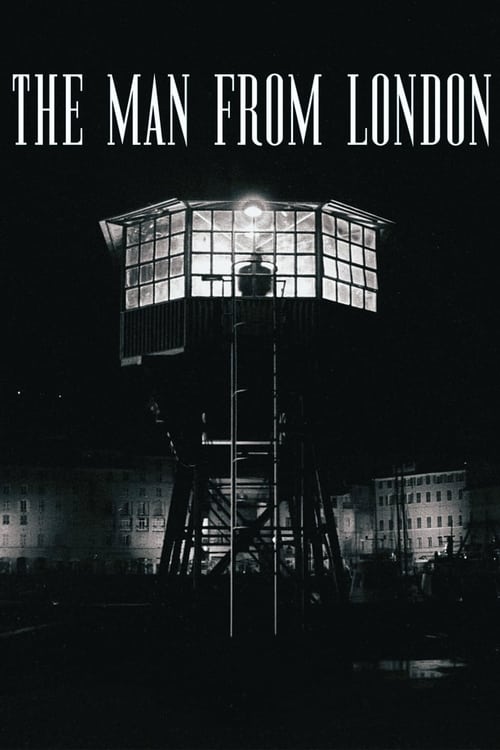
The Man from London
2008 · Béla Tarr
For when you want to slow your pulse to a film's — a late-night, phone-off, total-immersion watch for patient viewers in the mood for atmosphere over plot. Not comfort viewing; more like a long walk in cold weather that leaves you altered.
What it's about
A railway switchman works nights in a glass signal cabin above a foggy harbor town, watching the same boats, trains, and faces pass below. One night he witnesses a quarrel on the dock, a man goes into the water, and a suitcase full of money is left behind. He takes it and tells no one — and the film watches what that silence does to him, his family, and his grinding daily routine.
The experience
Immensely slow, heavy, and hypnotic — a crime story with the suspense deliberately drained out and replaced by fog, duration, and dread. If you surrender to its rhythm it becomes trance-like; if you fight it, it will feel endless. This is challenge viewing, and proudly so.
The craft
Béla Tarr shoots in sculptural black and white, in enormously long takes that turn a harbor, a cabin, and a café into a whole world of light, fog, and texture. The sound and droning score are as physical as the images; on a big screen with good speakers it's genuinely enveloping.
Why it matters
The penultimate film of one of slow cinema's defining directors, it premiered in competition at Cannes and stands as a pure demonstration of his method: a pulp noir premise transformed entirely into mood and duration.
Snapshot
The Man from London (A Londoni férfi) is Béla Tarr's penultimate feature, an austere black-and-white adaptation of Georges Simenon's 1934 crime novel L'Homme de Londres. A railway switchman named Maloin, working a night shift in his glass cabin above a foggy harbor, watches two men quarrel; one falls, or is pushed, into the water, and a suitcase is left behind. Maloin retrieves it, discovers it is full of money, and says nothing. From this thin thread of noir plot Tarr constructs one of the slowest, most physically weighted films of his career — a meditation on guilt, temptation, and the grinding routine of poverty in which the "crime story" is almost entirely drained of suspense and replaced by duration, texture, and dread. It premiered in competition at the Cannes Film Festival in 2007 and circulated internationally through 2007–2008; the 2008 dating reflects its wider release. The film is best understood as a companion piece to Werckmeister Harmonies (2000): the same collaborators, the same monumental long-take grammar, applied here to genre material Tarr deliberately hollows out.
Industry & production
The film was a multi-country European co-production — Hungarian, French, and German — assembled through the kind of patchwork financing typical of Tarr's late work, where an art-cinema auteur with a devoted festival following required capital from several national funds and public broadcasters to realize an uncompromising vision. Its production history is defined by a genuine catastrophe: the French producer Humbert Balsan, who was central to the project, died by suicide in February 2005 while the film was in early production. This is one of the most widely documented facts about the film. Balsan's death halted the shoot and threw the financing into crisis; the production had to be reconstituted and refinanced over the following two years, which accounts for the long gap between commencement and the 2007 premiere. Tarr has spoken in interviews about the shattering effect of Balsan's death on the film's momentum, and the delay became part of the picture's lore. The film was shot on location in Bastia, on Corsica, whose old port and stone architecture provided the harbor setting; the choice of a real, weathered Mediterranean town rather than a studio-built Simenon France is consistent with Tarr's insistence on found, tactile environments. Financing and distribution ran through the art-house circuit, and while the film had a modest commercial life, reliable box-office figures are not part of the established record and should not be invented.
Technology
The film was shot on 35mm black-and-white film, the format Tarr used throughout his mature career, and its images depend entirely on the physical properties of monochrome celluloid: the deep silver blacks of the night harbor, the grain in the fog, the way electric lamps bloom against darkness. This is analog cinematography of a demanding kind, executed as the digital transition was already underway elsewhere; Tarr's fidelity to film stock is itself a technological statement about texture and light that a period-typical video pipeline could not reproduce. The signature technical apparatus is the camera crane and dolly: Tarr's long takes require elaborate, precisely engineered camera movement, and the film's celebrated opening — a single extended shot that climbs the flank of a moored ship and studies its rivets, railings, and the human figures aboard before drifting toward Maloin's cabin — is a feat of mechanical choreography as much as of composition. The glass switchman's cabin, elevated above the quay, functions as a purpose-built vantage and lighting instrument, allowing the camera to observe the harbor through and past panes of glass. No claim of unusual proprietary technology is warranted here; the achievement is one of rigorous, traditional craft — crane, dolly, film stock, and controlled artificial light — pushed to an extreme of patience.
Technique
Cinematography
The cinematographer is Fred Kelemen, himself an accomplished director of dark, nocturnal European art films, and his sensibility is deeply congruent with Tarr's. The film is composed almost entirely of long takes — extended, slowly gliding shots in which the camera moves with grave deliberation across faces, walls, water, and floors. The palette is a high-contrast monochrome of enveloping blacks and cold whites, with fog and reflected harbor light doing much of the expressive work. Kelemen and Tarr favour compositions that observe rather than dramatize: the camera holds on Maloin's watchful face for long stretches, or tracks the slow traversal of a figure across a room, letting the passage of time itself become the subject. The opening ship shot is the most quoted example, but the whole film is built from such sustained gestures. Where classical noir uses cutting and chiaroscuro to generate anxiety, Tarr and Kelemen generate it through unbroken duration and the near-abstract beauty of surfaces — wet stone, misted glass, the corrugation of a ship's hull.
Editing
Editing is credited to Ágnes Hranitzky, Tarr's lifelong collaborator and, on this and other films, effectively his co-director; she shares the directing credit on the project. In a cinema of very long takes, editing is less about assembly of fragments than about the rhythm of when — rarely — to cut, and the film's few transitions carry enormous weight precisely because shots are held so long. Hranitzky's work here is the management of tempo across the entire film: the extraordinary slowness is not accidental but shaped, a deliberate metering of scenes so that the viewer inhabits Maloin's dead time, his waiting, his sleeplessness. The result is a running time of roughly two and a quarter hours composed of comparatively few shots.
Mise-en-scène / staging
Tarr's staging is architectural and choreographic. Characters and camera move through space in long, unbroken arcs, and the physical world — the tavern, the cabin, Maloin's cramped home, the butcher's shop where his daughter is put to menial work — is rendered with oppressive tactility. Interiors are sparse, worn, and lit by isolated practical sources; the harbor town feels simultaneously specific and dreamlike. Staging privileges bodies in real space and real time: a woman scrubbing a floor, a man drinking, a slow walk down a cobbled street. The mise-en-scène expresses the film's moral world — poverty as a material condition, temptation as something that arrives in a physical object (the suitcase) and lodges in a real house.
Sound
The soundtrack pairs Mihály Víg's music — a spare, circling, melancholic score by Tarr's regular composer, built on repeated motifs that seem to turn in place — with a dense field of ambient harbor sound: lapping water, foghorns, footsteps, the creak of the port. Dialogue is sparse; long passages pass with almost no speech, so that the accordion-like recurrence of Víg's theme and the environmental noise dominate. Because the international cast was assembled across languages, the film's audio track involved dubbing into Hungarian; Tilda Swinton's performance, in particular, was post-synchronized in Hungarian, a fact often noted in discussion of the film's slightly estranged, dreamlike vocal texture.
Performance
Performances are deliberately opaque and interiorized. Miroslav Krobot, a Czech stage actor and director, plays Maloin with a heavy, near-mute stillness — his guilt registers in posture, gaze, and the physical burden of the secret rather than in speech. Tilda Swinton, an international star cast against her usual register, plays his wife Camélia and submits fully to Tarr's austerity, her performance dubbed into Hungarian. Erika Bók, who as a small child had appeared in Tarr's Sátántangó (1994), plays Maloin's daughter Henriette; her scenes of demeaning labor are among the film's most quietly wrenching. The acting mode throughout rejects psychological explication in favour of behavior observed at length.
Narrative & dramatic mode
Tarr systematically dismantles the mechanics of the crime thriller he inherits from Simenon. The novel's engine — a witnessed death, stolen money, an investigator on the trail — is retained in outline but stripped of momentum. There is a murder, a suitcase, an inspector (Morrison) who eventually arrives, and a resolution, yet almost none of the pleasures of suspense survive; the film refuses the ratcheting tension, the reveals, the chase. Instead the drama is moral and existential: what does it do to a poor man to hold a secret and a small fortune? The narrative mode is contemplative and elliptical, organized around waiting, watching, and the slow corrosion of conscience. Events are withheld or shown obliquely; the "plot" advances in the gaps between very long observational scenes. This is genre-as-pretext, a noir premise repurposed as a vehicle for Tarr's fixed preoccupations with fate, entrapment, and the weight of existence.
Genre & cycle
Nominally the film sits within crime, mystery, and film noir — Simenon's romans durs were foundational to a whole tradition of European crime fiction and its screen adaptations, and L'Homme de Londres had been filmed before, notably by Henri Decoin in France in 1943 and, as Temptation Harbour, in Britain in 1947. Tarr's version belongs to that lineage only formally. In practice it belongs to the cycle of "slow cinema" — the international art-film tendency toward long takes, minimal narrative, and durational realism with which Tarr's name is almost synonymous — and to his own late-career cycle of monumental black-and-white films (Sátántangó, Werckmeister Harmonies, and later The Turin Horse). It is, in effect, a noir refracted through the aesthetics of contemplative modernism.
Authorship & method
The film is a near-perfect index of Tarr's collaborative authorship. It is co-directed by Béla Tarr and Ágnes Hranitzky, his editor and creative partner of decades. The screenplay is by Tarr and the novelist László Krasznahorkai, Tarr's essential literary collaborator, whose fiction underpins Sátántangó and Werckmeister Harmonies and whose sensibility — apocalyptic, patient, metaphysically bleak — shapes the adaptation's tone even when working from Simenon rather than his own prose. Cinematographer Fred Kelemen brings his own director's eye for nocturnal despair. Composer Mihály Víg supplies the hypnotic, repetitive score that is by now inseparable from the Tarr signature. This constellation of long-standing collaborators means that The Man from London, despite adapting an outside source, feels wholly authored: Tarr's method — the pre-planned long take, the found location, the non-star and star bodies subordinated to the frame, the refusal of conventional dramatic tempo — governs every element. Tarr's stated worldview, his professed distrust of narrative uplift and his attention to the materially poor and trapped, is fully legible here.
Movement / national cinema
Tarr is the central figure of post-war Hungarian art cinema's late chapter and, internationally, one of the presiding names of slow cinema. His early work in the late 1970s and early 1980s emerged from a documentary-inflected social realism; from Damnation (1988) onward, in partnership with Krasznahorkai and his cinematographers, he developed the mature long-take style that made him a festival institution. The Man from London is a product of Hungarian cinema's transnational, co-production-dependent condition after the collapse of the state-socialist studio system: financed across borders, shot outside Hungary, cast internationally, yet unmistakably rooted in the Hungarian modernist tradition and dubbed into Hungarian. It belongs to a European auteur cinema sustained by festivals, national film funds, and cinephile distribution rather than by any domestic mass market.
Era / period
Made in the mid-2000s and released 2007–2008, the film arrives at the tail end of the celluloid era and near the end of Tarr's own career — he would make only The Turin Horse (2011) before announcing his retirement from filmmaking. It reflects a moment when the international art-house was consolidating "slow cinema" as a recognized and much-debated tendency, and when auteurs like Tarr commanded intense critical devotion even as their films reached small audiences. Its troubled, multi-year production, shadowed by Humbert Balsan's death, also makes it a document of the precariousness of European co-production financing in that period.
Themes
The film's abiding themes are guilt and complicity — Maloin's silence makes him a party to a death and a thief, and the money buys him nothing but anxiety. Closely bound to this is temptation as a material intrusion: evil, or fortune, arrives as an ordinary object dropped into an ordinary life. Poverty and drudgery pervade the film, most painfully in the daughter's humiliating labor, so that the stolen suitcase reads as a fantasy of escape from an existence of grinding routine. Above all the film dramatizes time itself — waiting, watching, the dead hours of a night shift — as the medium in which conscience and despair accumulate. Fate and entrapment, the sense that the characters cannot escape their circumstances, connect the film to Tarr's larger metaphysical pessimism. Water, fog, and darkness function throughout as an atmosphere of moral obscurity.
Reception, canon & influence
Critical reception was respectful and, in cinephile circles, admiring, though the film was widely received as difficult and divisive even by Tarr's standards — its extreme slowness and its deliberate evacuation of thriller mechanics tested some viewers while confirming for others Tarr's mastery. It competed for the Palme d'Or at Cannes in 2007 and was covered as a major auteur event, but it is generally regarded as a lesser peak than Sátántangó or Werckmeister Harmonies, a magnificent but somewhat more hermetic work. Detailed award tallies and figures beyond the Cannes competition berth are not something I can assert with confidence, and I will not invent them.
Looking backward, the influences on the film are clear: Simenon's source novel and the broader tradition of French poetic realism and film noir; Tarr's own prior films and his collaborations with Krasznahorkai and Víg; and the lineage of long-take modernist cinema (Tarr has often been linked to Tarkovsky, Antonioni, and Jancsó) from which his style descends. Looking forward, the film's legacy is bound up with Tarr's outsized influence on twenty-first-century slow cinema — his championing of duration, the observational long take, and antinarrative rigor has been felt across a generation of international art directors, and after retiring from directing he became an influential teacher and mentor to emerging filmmakers. Within his own body of work, The Man from London stands as the bridge between the towering middle films and the terminal severity of The Turin Horse: a noir dissolved into pure Tarrian time.
A Deleuzian reading
The film opens on a ship's hull.
The full Deleuzian reading of The Man from London →
Reception
It landed at Cannes 2007 to a famously muted, even hostile response — the dreaded 'minor Tarr' verdict — and it's still the middle child between Werckmeister Harmonies and The Turin Horse, though slow-cinema devotees have been quietly upgrading it ever since.
How The Man from London was received, from release to now →
How to watch The Man from London: what to notice on a first viewing
- Watch Maloin watch, through the glass of his cabin. Kelemen's camera holds on his watchful face for long stretches, framing him as a man who sees the whole harbor and does almost nothing about it. Maloin has perfect vision and no power to act on what he sees.
- Watch the fog and wet stone hold the light. Kelemen shoots high-contrast black and white, letting fog and reflected harbor light do the expressive work instead of the actors' faces. The harbor town stops feeling like a specific place and starts feeling like the inside of a mood.
- Watch how long each shot holds after nothing else happens. The film is built almost entirely from long, slowly gliding takes; scenes are permitted to run well past the point where the information has landed. The extra duration is not padding; it is what the film is actually about.
- Listen to the ambient harbor sound instead of dialogue. Long passages pass with almost no speech; lapping water, foghorns, footsteps, and Mihaly Vig's circling score fill the space where talk would normally be. The port itself narrates the film more than anyone in it does.
- Watch Maloin's guilt show up in posture, not speech. Miroslav Krobot plays him with a heavy, near-mute stillness; the secret shows as weight in his shoulders and the way he sits down. The performance rejects confession; everything you learn about him you learn by watching his body.
The whole guide to watching The Man from London, with the keys for a rewatch →
Influences: the films it descends from and the films it influenced
- Damnation (1988) — Established the mature Tarrian grammar The Man from London perfects — a rain-soaked found-location noir built from slow tracking long takes over a betrayal plot, with Víg's circling accordion motif as structuring pulse.
- Sátántangó (1994) — Codified the pre-choreographed minutes-long take that walks bodies through real space, cut by Hranitzky, the exact durational method inherited wholesale here.
- Werckmeister Harmonies (2000) — Its virtuoso choreographed opening set-piece and Krasznahorkai-co-authored metaphysical bleakness feed directly into the harbor-crane overture of The Man from London.
- L'Eclisse (1962) — Pioneered dissolving plot into architecture and dead time — the anti-suspense subordination of characters to buildings and empty space that Tarr adopts as method.
- Stalker (1979) — Made durational long takes that render time and material texture the subject rather than the vehicle of narrative — Tarr's avowed model for temporal patience.
- The Round-Up (1966) — The Hungarian gliding long take across found architecture, camera movement itself as the primary formal device, from which Tarr's mobile framing descends.
- Le Quai des brumes (1938) — French poetic-realist harbor noir — fog, fatalism, a doomed working-class man — the tonal and atmospheric wellspring for the port setting and its fated protagonist.
- La Nuit du carrefour (1932) — A Simenon adaptation drowned in atmospheric fog rather than plot mechanics — the precedent for treating the crime source as pretext for mood over detection.
- The Turin Horse (2011) — Pushes The Man from London's method to terminal severity — repetitive Víg score, black-and-white durational long takes, near-total evacuation of story into ritual gesture.
- Norte, the End of History (2013) — Diaz, Tarr's most direct heir, dilates a Dostoevskian crime plot into fixed durational long takes that suppress suspense in favour of moral and temporal endurance.
- Once Upon a Time in Anatolia (2011) — Stretches a police-procedural search into nocturnal landscape and dead time, using genre as pretext and anti-suspense pacing in the Tarrian manner.
- Son of Saul (2015) — Extends the Hungarian sustained long take with the body trapped and subordinated within the frame, married to a dense post-synced soundscape doing narrative work the image withholds.
- Hard to Be a God (2013) — Immersive black-and-white long takes wading through mud-and-body materiality, with extreme post-synchronized dense sound design — a parallel maximalist descent into durational grime.
- Colossal Youth (2006) — Rigorous, patient framing of found architectural locations and the materially poor and trapped — a contemporaneous durational cinema of the dispossessed.
- Silent Light (2007) — Bookends the film in slow crane long takes over landscape and natural light, contemplative anti-drama that shares Tarr's faith in duration as revelation.
- Fallen (2005) — The Man from London's own cinematographer directing his signature nocturnal-despair long-take style — the black-and-white low-light aesthetic Kelemen brought directly to Tarr's frame.
Similar films
- Damnation (1988) — influence & lineage
- The Turin Horse (2011) — influence & lineage
- Satantango (1994) — influence & lineage
- Once Upon a Time in Anatolia (2011) — influence & lineage
- Werckmeister Harmonies (2001) — shared sensibility
- Nostalgia (1983) — shared sensibility
- What Time Is It There? (2001) — shared sensibility
- Ivy (2015) — shared sensibility