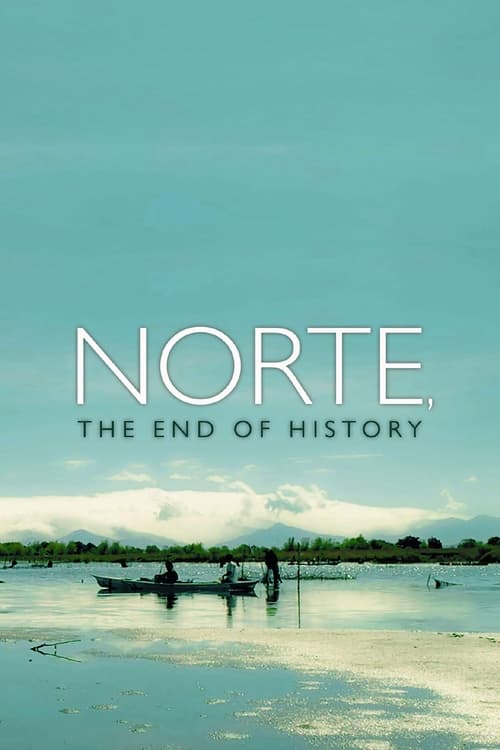
Norte, the End of History
2014 · Lav Diaz
For when you want to commit an entire day to something monumental — a film to chew on for weeks. This is a challenge, not a comfort: bring stamina, and clear your evening (and afternoon).
What it's about
In the Ilocos region of the northern Philippines, an embittered former law student commits a brutal double murder — and walks free, while a poor family man is convicted in his place and sent away for years. The film follows all three lives: the killer unraveling under the weight of his own ideas, the innocent man enduring prison, and the prisoner's wife and children wandering the countryside trying to survive. It is a four-hour reckoning with guilt, class, and a country's unhealed history.
The experience
Slow, vast, and quietly overwhelming — long unbroken takes let scenes breathe until they ache. It demands patience and rewards it with a moral seriousness few films attempt; expect to emerge stunned rather than entertained.
The craft
Diaz composes in patient, wide-angled long takes, letting landscape and duration do the storytelling; the four-hour-plus running time is not indulgence but method, making you live inside consequence rather than watch it. Notably, it's among his more accessible works — in color, with a driving narrative borrowed from a great novel.
Why it matters
Premiering at Cannes, it became the breakthrough that carried Filipino slow cinema — and Lav Diaz's name — to a much wider international audience.
Snapshot
Norte, the End of History (Filipino: Norte, hangganan ng kasaysayan) is a roughly four-hour-and-ten-minute crime drama by the Filipino director Lav Diaz, freely adapted from Fyodor Dostoevsky's Crime and Punishment. It transposes Raskolnikov's fever of intellectual pride to the Ilocos region of the northern Philippines, splitting the Russian novel's protagonist into two men whose fates diverge after a single crime: Fabian, an embittered former law student who murders a moneylender and her daughter and walks free, and Joaquin, a poor vendor wrongfully convicted of the killing. Around them Diaz builds a patient, wide-angled study of guilt, class, and the exhaustion of political conviction in a nation still metabolizing the Marcos era. Premiering in the Un Certain Regard section at the 2013 Cannes Film Festival before its 2014 international rollout, Norte became, for many critics, the most accessible entry point into Diaz's forbiddingly long and austere body of work — partly because, at "only" four-plus hours and in luminous color, it is one of his most conventionally beautiful and narratively legible films. It is a signal work of what has come to be called "slow cinema," and among the strongest arguments for that mode's moral seriousness.
Industry & production
Norte was produced within the low-budget, artisanal economy that has defined Diaz's career since the early 2000s. Diaz works largely outside the commercial Philippine studio system, financing long-gestating projects through small production companies, festival and co-production support, and a tight repertory of trusted collaborators. Norte was mounted with backing associated with producers including Moira Lang and the Philippine independent milieu around Sine Olivia and related outfits; the exact financing structure is not exhaustively documented in the public record, and I will not invent figures. What is clear is that the film represented a relatively "resourced" Diaz production by his own standards — shot in color, on location across Ilocos and Manila, with a professional principal cast — rather than the near-guerrilla conditions of some earlier works.
The film's institutional life ran through the festival circuit rather than domestic box office. Its Cannes Un Certain Regard berth in 2013 was a watershed for Diaz's international profile, and it was subsequently picked up for arthouse and streaming distribution abroad, where its length was marketed as a feature rather than an obstacle. As with most Diaz films, theatrical returns were negligible relative to critical capital; the picture's value has been cultural and canonical, not commercial.
Technology
Norte was shot digitally, the technological precondition for nearly all of Diaz's cinema. Digital acquisition is what makes his method economically possible: it removes the per-minute cost pressure of celuloid, allowing takes to run for many minutes and total runtimes to stretch past four hours without the budget catastrophe that would attend shooting equivalent footage on film. The choice here to shoot in color rather than the high-contrast black-and-white of much of his other work is significant — Diaz's monochrome is usually understood as an aesthetic and economic signature, and Norte's naturalistic color, with its greens, tropical light, and saturated interiors, is a deliberate departure. Beyond acquisition format, the film is technologically unshowy: no visible effects work of note, no elaborate camera rigs, the toolkit deployed in service of duration and stillness rather than spectacle.
Technique
Cinematography
The cinematography, by Larry Manda, is among the film's most discussed elements and a large part of why Norte reads as "beautiful" in a way some of Diaz's starker films do not. Manda works in Diaz's characteristic grammar — predominantly static, wide, deep-focus long takes that hold on a fixed frame while action enters, unfolds, and exits — but renders it in supple natural color and light. The camera tends to observe from a middle distance that refuses both the intimacy of close-up and the abstraction of extreme distance; figures are placed within landscapes and rooms whose full geography remains legible. The film is notable for a small number of camera movements that acquire enormous weight precisely because motion is otherwise withheld, including a late, much-cited passage whose upward drift lends a scene an almost transcendent charge. Composition consistently subordinates the individual to the environment, a visual argument about how social and historical forces frame private acts.
Editing
Diaz edits his own films, and Norte is no exception; the cut is inseparable from the direction. The editing logic is one of duration and juxtaposition rather than continuity in the classical sense. Scenes are permitted to run to and past the point where mainstream cinema would cut, so that the viewer experiences real-time weight — waiting, labor, boredom, dread. Structurally, the film cross-cuts between its parallel destinies (Fabian's corrosive freedom; Joaquin's imprisonment; Joaquin's wife Eliza and their children in the countryside), letting moral rhyme and contrast emerge from adjacency. The refusal to compress is the point: the length is an ethical instrument, insisting that consequence be lived through rather than summarized.
Mise-en-scène / staging
Diaz stages in depth and in full figure. Blocking is theatrical in scale but observed with documentary patience: characters move through the whole depth of a room or a field, and the frame does not chase them. Domestic interiors, prison spaces, roadside stalls, and the northern landscape are rendered with attention to lived texture rather than production design flourish. The staging repeatedly situates the body within work and within place — selling goods, cooking, walking long distances — so that class is legible in posture and routine. Where the film reaches toward the metaphysical, it does so through staging as much as image, allowing a gesture or a held tableau to carry weight the dialogue never states.
Sound
Diaz's soundtracks are typically spare, favoring ambient, diegetic sound — wind, insects, traffic, the hum of rooms — over non-diegetic scoring, and Norte largely honors that austerity, using environmental sound to sustain the sense of real duration and place. There are musical passages, but the film does not lean on an orchestral emotional guide; silence and ambience do much of the affective work, forcing the viewer to supply attention rather than receive cues. I won't overstate the specifics of the film's music credits, which are not something I can attribute with confidence here.
Performance
The performances anchor the film's abstractions in flesh. Sid Lucero plays Fabian as a man whose intellectual arrogance curdles into nihilism and then into something closer to derangement; it is a performance of deteriorating control, charismatic early and increasingly repellent. Archie Alemania's Joaquin is its moral counterweight — a decent, ordinary man whose suffering is borne with a gentleness that the film treats as a kind of grace rather than mere passivity. Angeli Bayani, as Joaquin's wife Eliza, gives perhaps the film's most quietly devastating turn, carrying the domestic and economic burden of the wrongful conviction across long, unhurried scenes. The acting is calibrated to Diaz's durational style: restrained, naturalistic, built for takes that give the actor nowhere to hide.
Narrative & dramatic mode
The dramatic mode is tragic realism inflected by moral parable. Diaz keeps Dostoevsky's central provocation — the "extraordinary man" who believes himself licensed to transgress ordinary morality — but detonates the novel's mechanism of confession and redemption. Where Raskolnikov breaks and is spiritually reborn through punishment, Diaz separates crime from punishment across two bodies: the guilty man escapes legal and psychological reckoning (his conscience corrodes rather than converts), while the innocent man is punished and, paradoxically, finds a form of spiritual elevation in his suffering. The narrative advances less through plot turns than through the slow accretion of consequence, and it braids a triadic structure — perpetrator, scapegoat, and the abandoned family — into a meditation on how injustice distributes itself. Late in the film Diaz permits ruptures of the naturalistic surface — gestures toward the miraculous on one side and toward horrific violence on the other — that push the drama from realism into moral allegory.
Genre & cycle
Nominally a crime drama, Norte uses the genre's furniture — a murder, an investigation, a wrongful conviction, a prison sentence — as scaffolding for something closer to philosophical tragedy. It belongs less to any crime-film cycle than to two other lineages: the literary-adaptation tradition of transposing Dostoevsky to national contexts, and the international "slow cinema" tendency of the 2000s and 2010s. Within Diaz's own filmography it sits alongside his other epic-length moral chronicles of Philippine life, and it is frequently positioned as the "gateway" title in that cycle because its narrative clarity and color cinematography make its four hours less forbidding than the black-and-white marathons that surround it.
Authorship & method
Norte is a Lav Diaz film in the fullest auteurist sense: he directed, co-wrote, and edited it, and its formal signature — the long static take, the epic runtime, the fusion of political history and metaphysics — is entirely continuous with his project. His method is one of patience as ethics: he treats duration not as an endurance test for its own sake but as the only honest way to represent how time bears on the poor and the guilty alike. The screenplay was written by Diaz with the playwright and screenwriter Rody Vera, whose collaboration helped shape the film's Dostoevskian architecture into a specifically Filipino frame. The cinematography by Larry Manda is the film's other decisive authorial contribution, translating Diaz's rigor into color and light. As editor, Diaz retains total control over the film's most defining variable — its tempo. The recurrence of certain performers, notably Angeli Bayani, reflects the repertory-company method that runs through his cinema.
Movement / national cinema
The film is a landmark of contemporary Philippine independent cinema and a central document in the global slow-cinema conversation. Diaz emerged from the digital-enabled wave of Filipino independents in the 2000s and became, internationally, the movement's most visible figure; Norte consolidated that standing. But the film is emphatically national, not merely festival-international. Its setting in the Ilocos Norte region is politically charged — this is the Marcos family's home territory — and the film's preoccupation with disillusioned radicalism, betrayed idealism, and the long shadow of dictatorship situates it squarely within a Filipino reckoning with the post-Marcos, post-EDSA order. The "End of History" of the title invokes Francis Fukuyama's thesis, which Fabian debates: the film stages the collapse of leftist conviction in a country where revolutionary hope has curdled, and Fabian's nihilism reads as the psychic residue of a defeated politics.
Era / period
Set in the contemporary Philippines of its making, Norte is a film of the early 2010s that is nonetheless saturated with historical memory. Its present tense — mobile phones, small-vendor economies, an overburdened justice system — is inseparable from the recent past it keeps invoking: activist pasts, the Marcos dictatorship, the failed promises of the People Power aftermath. The title's engagement with "the end of history" places the film precisely in a post-Cold-War, post-ideological moment, asking what remains of moral and political commitment once the grand narratives have exhausted themselves. The period, in other words, is both 2013 and the long arc of Philippine political disillusion that produced it.
Themes
Chief among the film's themes is the divorce of guilt from punishment — the modern possibility that the wicked go free while the innocent suffer, and the question of what conscience means when it is unmoored from consequence. Around this cluster others: class as fate, and the specific vulnerability of the poor to a justice system that reads them as guilty by circumstance; suffering as a possible route to grace, staged in Joaquin's arc without ever quite endorsing it as consolation; the corrosion of the intellect that believes itself exempt from ordinary morality; and the political disenchantment named in the title, the "end" of a history that once promised liberation. Diaz threads these through the everyday textures of labor, family, and place, so that the philosophical stakes are always carried by ordinary bodies doing ordinary things.
Reception, canon & influence
Critical reception was strong and, for a four-hour Filipino art film, unusually broad. Norte was widely praised in the international press following its Cannes premiere as a major achievement and, frequently, as the ideal introduction to Diaz — the film that could persuade skeptics that his durational method yields real rewards. It appeared on a number of critics' year-end and decade-retrospective lists and is routinely cited among the essential works of 2010s slow cinema; I'll avoid attributing specific poll placements or quotations I can't verify precisely.
Its influences run backward to Dostoevsky above all — the film is an avowed Crime and Punishment adaptation — and, formally, to the traditions of the long take and observational realism that inform slow cinema broadly, from the durational aesthetics associated with directors like Tarr and the broader Bazinian faith in the unbroken shot. Its politics draw on the specific history of the Philippine left and the Marcos period, and its title on Fukuyama's post-historical thesis.
Forward, the film's principal legacy has been to elevate Diaz's international standing and, with it, the visibility of Philippine independent cinema and the legitimacy of extreme-duration filmmaking on the festival circuit. Diaz would go on to win top prizes at major festivals in the years after Norte, and the film is often credited with widening the audience prepared to meet that later work. More diffusely, Norte stands as a demonstration case, cited in the ongoing critical argument that length and slowness can be instruments of moral and political seriousness rather than mere difficulty — an argument the film makes not by manifesto but by holding its gaze until the viewer, too, has had to sit with consequence.
A Deleuzian reading
Somebody walks out of the frame and the frame stays.
The full Deleuzian reading of Norte, the End of History →
Reception
It premiered in Un Certain Regard at Cannes 2013 to instant acclaim as the 'accessible' Lav Diaz film, the one that finally broke him through to Western audiences after years as slow cinema's best-kept secret — and it's only consolidated since, turning up on best-of-the-2010s lists as the standard gateway into his work.
How Norte, the End of History was received, from release to now →
How to watch Norte, the End of History: what to notice on a first viewing
- Watch how long the camera holds after someone leaves the frame. Diaz and cinematographer Larry Manda keep the shot running well past the point where a character has finished what they came to do. The cut arrives when the situation is finished with the people in it, not when the information has been delivered.
- Notice the camera's steady middle distance from every face. Manda shoots from far enough back that a room or a road keeps its whole geography, but close enough that you can still read a face. You're never told where to look inside the frame. The whole space stays legible and yours to search.
- Watch Eliza sell goods, cook, and walk long distances. Angeli Bayani plays the hardship of Joaquin's wife through long, unhurried scenes of ordinary labor rather than through a single dramatic breakdown. You spend the same hours she spends, which is a different thing than being told she suffered.
- Watch how figures move through the full depth of a room. Diaz stages in full figure and depth, letting people move through the whole space of a field or a house while the frame refuses to chase them. How a body stands at a roadside stall tells you someone's class before a word of dialogue does.
The whole guide to watching Norte, the End of History, with the keys for a rewatch →
Influences: the films it descends from and the films it influenced
- Pickpocket (1959) — Established the template Norte inherits — externalizing Dostoevsky's interior study of a criminal conscience into observed physical behavior rather than voiceover, making guilt legible through gesture and duration alone.
- L'Argent (1983) — Its moral-chain architecture — one man's crime propagating downward until an innocent is imprisoned and destroyed in the guilty party's place — is precisely the structural engine of Fabian's murder and Joaquin's wrongful conviction.
- Andrei Rublev (1966) — Modeled epic runtime as spiritual-moral inquiry, holding the long take on suffering and labor until duration itself becomes the argument about conscience — the 'patience as ethics' Diaz practices.
- Sátántangó (1994) — Codified the extreme-duration long take as an entire grammar rather than a device, the durational-slow-cinema method Diaz adopts wholesale as his baseline tempo.
- Werckmeister Harmonies (2000) — The choreographed sustained take that fuses metaphysical gravity with political-apocalyptic content — Tarr's welding of philosophy to slow camera movement that Norte's post-history frame echoes.
- A City of Sadness (1989) — Its static, deep-focus, full-figure staging of a family melodrama against national political trauma is the exact compositional strategy Norte uses for the Marcos-shadowed Philippines.
- A Brighter Summer Day (1991) — Pioneered the epic-length, deep-focus ensemble tragedy in which a personal crime crystallizes an entire nation's political disillusion — the split-protagonist realism Norte scales up.
- Jeanne Dielman, 23 quai du Commerce, 1080 Bruxelles (1975) — Its real-time durational observation of quotidian labor established that holding on the unremarkable in fixed frame is itself dramaturgy — the durational editing logic Norte applies to the poor and the imprisoned.
- The Travelling Players (1975) — The sequence-shot that spans political epochs within a single unbroken take — the 'end of history'-scale duration marrying long take to historical sweep that Diaz's title and method invoke.
- Melancholia (2008) — Diaz's own earlier durational study of Philippine-left trauma and mourning that established, within his oeuvre, the static-take-plus-political-history method Norte refined into its most accessible form.
- The Turin Horse (2011) — Takes up Turin Horse's challenge of extreme long-form duration in unbroken takes with a black-and-white visual register, extending Tarr's formal proposition that sustained viewer attention in the face of minimalist austerity constitutes an ethical act rather than an aesthetic luxury.
- Tropical Malady (2004) — Embodies the contemplative, extreme-duration register Tropical Malady helped legitimize, fusing patient long-take realism with folk and moral-mythic undercurrents in Southeast Asian art cinema.
- A Lullaby to the Sorrowful Mystery (2016) — Extends the exact method to an eight-hour scale fusing revolutionary history and metaphysics — the later work whose audience Norte is credited with preparing on the festival circuit.
- The Woman Who Left (2016) — Carries forward Norte's crime-and-conscience architecture — wrongful imprisonment, released guilt, moral reckoning — into black-and-white static long takes, extending the durational tragic-realism directly.
- Colossal Youth (2006) — Shares the static long-take portraiture of the dispossessed performed by a repertory of non-professionals in durational-naturalist registers, the same ethics-of-attention toward the marginalized.
- Uncle Boonmee Who Can Recall His Past Lives (2010) — Contemporaneous Southeast Asian slow cinema built on fixed long takes and dense diegetic-ambient soundscapes, sharing Norte's festival-circuit legitimation of regional durational filmmaking.
- Winter Sleep (2014) — A same-year Dostoevsky-inflected moral drama that trusts extended durational dialogue scenes to anatomize guilt, conscience and self-justification without dramatic compression.
- Jauja (2014) — A contemporaneous slow-cinema work using static landscape tableaux and naturalistic color to let figures move through depth in real time, sharing Norte's Bazinian faith in the uncut frame.
- Kinatay (2009) — The other pole of the Philippine independent crime-realism wave Norte belongs to, prosecuting guilt and complicity through raw diegetic sound and immersive real-time duration of a single atrocity.
- Magellan (2025) — Same authorial signature applied to classical-tragedy structure (here Dostoevsky), proving Diaz's habit of grafting a borrowed literary/historical tragic architecture onto static-wide Filipino landscapes.
- An Elephant Sitting Still (2018) — Contemporary slow-cinema durational endurance and moral bleakness, using extended real-time takes to trap characters inside stalled, hopeless lives.
- Syndromes and a Century (2006) — Radical durational observation with fixed long takes and ambient natural sound, part of the same 2000s–2010s slow-cinema current that took structural duration as serious form.
- The Wayward Cloud (2005) — Runs the same wager at greater scale — static wides sustained past the point of narrative usefulness so that endurance becomes the viewer's moral position — making Diaz and Tsai the two poles of the ongoing duration-as-instrument-or-mannerism argument.
- From What Is Before (2014) — The immediately preceding counter-experiment: color, a credited cinematographer in Larry Manda, and a Dostoevsky armature — the deliberate control against which the monochrome, self-shot austerity of the following year defines itself.
Similar films
- Winter Sleep (2014) — influence & lineage
- Twenty Years Later (1984) — same viewing thread · often watched together
- Satantango (1994) — influence & lineage · same viewing thread
- Evolution of a Filipino Family (2004) — same viewing thread
- Magellan (2025) — same viewing thread
- The Official Story (1985) — same viewing thread
- A Brighter Summer Day (1991) — influence & lineage · often watched together
- Uncle Boonmee Who Can Recall His Past Lives (2010) — influence & lineage · often watched together
All the films related to Norte, the End of History →
Watch it with: curated runs of related films
- The Long Shadow of the Coup — A run of films tracing political violence from the mutiny and the massacre through martial law to the decades-long reckoning that follows — watch them near each other and the same machinery of power keeps rhyming across continents and eras.