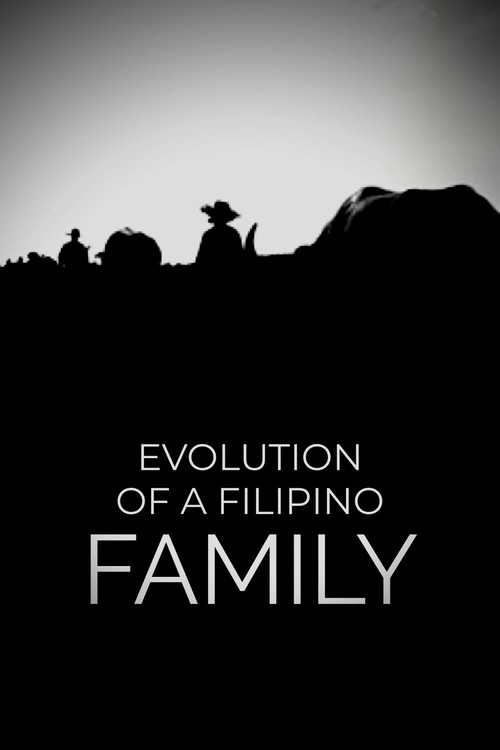
Evolution of a Filipino Family
2004 · Lav Diaz
For when you want cinema as a pilgrimage — a full day (or several evenings) given over to one immersive, demanding experience. This is the opposite of comfort viewing; reach for it when you want to be changed by duration itself, not entertained by incident.
What it's about
A poor farming family in the rural Philippines tries to hold itself together across sixteen years, from 1971 — the eve of Marcos declaring martial law — through the 1986 uprising and its uneasy aftermath. Land, hunger, corruption, and the slow grind of dictatorship press on parents, children, and cousins as the household scatters and regathers. It runs nearly ten hours, in black and white, and treats that span of history at the pace the family actually lived it.
The experience
Watching it is less like following a plot than like moving in with these people: long, quiet stretches of field work and waiting, punctured by grief and small mercies. It asks for real patience and repays it with a cumulative weight few films ever reach — by the end you feel you've lived alongside a family, not observed one.
The craft
Shot piecemeal over roughly a decade, mixing 16mm film and video, its rough black-and-white textures become part of the story — the years of making are visible in the image itself. Diaz composes in long, fixed takes where landscape and weather do as much narrative work as dialogue. It rewards a committed, distraction-free setting more than any technical spectacle.
Why it matters
This is the film that made Lav Diaz's name as world cinema's foremost practitioner of extreme duration, and it became a touchstone for a generation of Filipino independent filmmakers reckoning with the Marcos years.
Snapshot
Ebolusyon ng Isang Pamilyang Pilipino is the film that made Lav Diaz's reputation as the cinema's great practitioner of duration and, simultaneously, the film almost nobody has seen. Shot piecemeal over roughly a decade — Diaz began in the mid-1990s and completed it in 2004 — it follows an extended peasant household in the rural Philippines from 1971, on the eve of Ferdinand Marcos's declaration of martial law, through the 1986 EDSA uprising and into the disillusioned aftermath of 1987. Its running time is most often given as 593 minutes, just under ten hours, though festival listings and press accounts have circulated figures approaching eleven; Diaz screened work-in-progress cuts of varying lengths during the shoot, and no single authoritative runtime has settled. It is in black and white, moves between 16mm film and consumer-grade digital video, has no musical score, and consists largely of static wide shots held far past the point at which conventional narrative cinema would cut.
The film's argument is that a nation's political history is not an event but a weather system, and that its damage registers in households rather than in headlines. Marcos appears only as a voice on the radio. The dictatorship arrives as rumor, as absence, as a son who does not come back, as land that changes hands. Diaz's wager is that only extreme duration can render this — that a two-hour film about martial law would necessarily become a film about martial law's dramatic moments, and thereby falsify the experience of living inside it.
Industry & production
The production history is inseparable from the film's form, and it is worth stating plainly that the detailed record is thin. Diaz has recounted the making of Evolution in numerous interviews, but crew credits, precise shooting dates, and budget figures were never systematically documented, and accounts vary in their particulars. What is firmly established: Diaz began the project in the mid-1990s with no financing, shot on black-and-white film stock, ran out of money, and continued in irregular bursts across roughly ten years, funding the work himself and returning to the material whenever he could afford to.
Diaz was, during this period, a working commercial director. He had trained at the Mowelfund Film Institute in Manila — the workshop arm of the Movie Workers Welfare Foundation, and for decades the effective training ground for Philippine independent filmmaking — and had spent time in the United States before entering the domestic industry. Through Regal Films, one of the major Manila studios, he made genre pictures: The Criminal of Barrio Concepcion (1998), Burger Boys (1999), Naked Under the Moon (1999). Batang West Side (2001), a roughly five-hour investigation of a Filipino teenager's death in Jersey City, was the break — the point at which Diaz stopped fitting his material to standard feature length. Hesus Rebolusyonaryo (2002), a dystopian near-future political film, sat between. Evolution was accumulating across all of it.
This is not a film that was produced so much as one that was maintained, and the ten-year gestation shows on screen in ways Diaz chose not to conceal. Actors visibly age. Formats change. A child playing a child becomes an adolescent playing the same character's later years — the historical span of the fiction and the biological span of the shoot converge. Few narrative films have so literally been marked by the time it took to make them.
Technology
Evolution straddles a genuine technological rupture, and it is one of the clearest artifacts of that rupture in world cinema. The early portions were shot on 16mm; by the time Diaz was finishing, he had moved to MiniDV, the consumer digital format that transformed independent production worldwide in the late 1990s and early 2000s. The resulting image is heterogeneous: film grain in some passages, the flatter contrast and different noise structure of digital video in others, with black-and-white functioning as the connective tissue that makes the mismatch legible as texture rather than error.
The shift was economic before it was aesthetic. Digital video removed the per-minute cost of shooting, and for a filmmaker whose central resource was time rather than money, that removal was decisive. Diaz has been explicit about this in interviews: digital is what made his mature practice possible. The long take stops being an expensive gamble once stock is free. What began as necessity on Evolution became method — from this point forward Diaz would operate his own camera on most projects, work with skeletal crews, and treat the shoot as an open-ended process rather than a scheduled production.
The film thus sits at a hinge. It is one of the last major works to begin as a photochemical project and one of the first to demonstrate what unlimited digital duration could yield artistically rather than merely cheaply.
Technique
Cinematography
The dominant unit is the static wide shot from a fixed tripod, held for minutes at a time, with the camera at a middle distance that admits both figure and landscape. Diaz composes for depth: a hut in the foreground, a rice field receding, a treeline, sky. Human figures are frequently small within the frame and sometimes enter or exit while the shot continues, so that the space rather than the person becomes the subject of attention. There are few close-ups and little camera movement; when the frame does move, the departure registers as an event.
Black and white is not a nostalgic gesture toward period. It abstracts, flattens the tropical landscape's chromatic seduction, and pushes the image toward document. Combined with the absence of costume-drama signaling, it produces a curious temporal suspension — the film's 1971 and its 1986 look much alike, which is precisely the point about rural time under a regime.
The full cinematography credits are among the details obscured by the decade-long shoot; the camera passed through several hands and increasingly Diaz's own. Any confident single attribution should be treated skeptically.
Editing
Diaz edits his own work, and Evolution is where the principle governing all his subsequent films is established: the cut is a scarce resource. Shots continue after the dramatic information has been delivered, through the dead time of walking, waiting, eating, sleeping, weather. This is not padding but the film's epistemology — it insists that the residue after the "scene" ends is where a life actually happens.
At the macro level the editing is associative and modular rather than causal. The film moves among several strands — different family members in different places, over different years — without the connective signposting of conventional multi-plot construction. Documentary and archival material is interpolated, so that the fictional household is periodically pressed against unstaged reality. Viewers must assemble chronology retroactively; the ten-hour length is what makes that assembly possible, since only across such a span can pattern emerge from what initially reads as accumulation.
Mise-en-scène / staging
Almost everything is location work in the countryside: fields, dirt paths, forest, small wooden houses, the interiors of which are lit by whatever comes through the doorway. Diaz stages in depth and in long duration, letting performers occupy real distances and take real time to cross them. There is minimal production design in the conventional sense — the period is established through absence of anachronism rather than through the assembly of period signifiers.
Weather and light are structural. Rain, heat, and the fall of night are permitted to dictate the shape of scenes. The recurring image of a figure walking a long path through open terrain — which becomes a Diaz signature across the entire subsequent filmography — receives its first sustained development here.
Sound
There is no score. Diaz has consistently refused non-diegetic music, and the soundtrack of Evolution is ambient: insects, wind, rain on roofing, footsteps, distant voices. Against this, the radio functions as the film's principal channel to history. Broadcasts — news, serialized drama, official pronouncement — enter the household as sound, which is how the Marcos state largely enters the film at all. Power is audible before it is visible, and often never becomes visible. Music, when it appears, tends to be diegetic and unaccompanied: someone singing.
The effect is to make the political sphere seem simultaneously omnipresent and unreachable. The family cannot answer the radio.
Performance
Diaz works with a mix of professional Filipino actors and non-professionals, and directs toward behavioral rather than expressive performance. Pen Medina, Angie Ferro, Ronnie Lazaro and Elryan de Vera are among those associated with the film; Medina and Lazaro would become recurring presences across Diaz's work. The long take places extraordinary demands on performers, who must sustain presence without the protection of coverage, and the register that results is quiet, undemonstrative, occasionally close to documentary self-presentation.
The decade-long shoot introduces something no casting decision could produce: real aging, real physical change, carried into fictional characters across fictional years.
Narrative & dramatic mode
The mode is chronicle, not plot. Evolution has no protagonist in the ordinary sense and no arc of goal, obstacle, and resolution. It has a household, a stretch of land, and sixteen years. Events that a conventional film would build toward — a death, a departure, a betrayal — occur laterally, sometimes off-screen, sometimes reported.
The dramatic logic is closer to the nineteenth-century novel than to any film tradition, and Diaz has repeatedly named Dostoevsky and Tolstoy as his formative influences, literature over cinema. What the novel offers is permission for scale: the assumption that a serious account of a society requires hundreds of pages and years of fictional time, and that the reader will supply patience. Diaz simply transfers the assumption to film and declines to apologize for it.
The result is a work whose emotional effects are cumulative and delayed. Individual scenes are frequently undramatic; the accumulated weight is devastating. This is a structural argument about historical suffering — that its nature is attritional, and that any form which delivers it in concentrated doses has already misrepresented it.
Genre & cycle
The film sits at the intersection of several traditions without belonging cleanly to any. It is a family saga and a historical epic, forms usually associated with lavish production; it is also a peasant film in the lineage that runs from Italian neorealism through the Third Cinema of the 1960s and 1970s. Its most obvious cycle affiliation, applied retrospectively, is what critics began calling "slow cinema" in the later 2000s.
Diaz has resisted the label, arguing that the rhythm of his films is not a formal strategy imported from festival art cinema but the actual tempo of Malay life — that what looks like slowness to a Western viewer is simply the pace at which things happen where he is from. The claim is contestable as film history but essential to understanding the work: Diaz does not conceive of duration as a difficulty imposed on the audience.
Authorship & method
Diaz's practice is close to total authorship. He writes, directs, edits, and from this period onward frequently operates the camera and produces. He works without a score, without a large crew, and without the scheduling apparatus of normal production. On Evolution this consolidation was forced by circumstance and then retained by choice.
Born in 1958 in Mindanao to schoolteacher parents who were part of the settler migration to the south, Diaz grew up amid the militarization and displacement that would supply his recurring material. The autobiographical pressure on Evolution is evident even where it is not explicit — the film's rural family under a regime is not researched from outside.
The collaborator record is, again, unusually incomplete for a film of this standing. There is no composer, by design. The editing is Diaz's. Cinematography was distributed across the decade. The most durable collaborators are the actors — Medina, Lazaro, Ferro among them — who form the repertory company Diaz would draw on for two decades of subsequent work.
Movement / national cinema
Evolution arrives at the front edge of the Philippine digital independent wave of the 2000s. Cinemalaya, the independent film festival that would institutionalize that wave, launched in 2005; the surrounding years produced Khavn de la Cruz, Raya Martin, Brillante Mendoza, John Torres, Sherad Anthony Sanchez and others working cheaply on video outside the studio system. Diaz, older and already industry-trained, functions as that generation's precursor and elder rather than its member.
Behind him stands the Philippine cinema of the 1970s and 1980s — Lino Brocka above all, whose Manila in the Claws of Light (1975) and Insiang (1976) established a socially engaged Filipino realism under the very dictatorship Evolution depicts, alongside Ishmael Bernal and, in a different register, Kidlat Tahimik's Perfumed Nightmare (1977). Evolution extends Brocka's political commitment while abandoning his melodramatic engine entirely.
Era / period
The film's span, 1971 to 1987, is the exact arc of Philippine martial law and its immediate aftermath: Marcos's declaration of martial law in September 1972, the long dictatorship, the 1983 assassination of Benigno Aquino Jr., the 1986 EDSA People Power uprising that removed Marcos, and the sobering first year of the successor government — 1987, the year in which farmers marching for land reform were fired on at Mendiola Bridge in Manila. Ending there rather than at EDSA is the film's sharpest historiographic decision. The revolution is not a conclusion; the countryside's dispossession outlasts the dictator.
The film's own production period, the mid-1990s to 2004, was a second era of Philippine political turbulence, and Evolution was completed at a moment when the martial-law years were passing from memory into contested history.
Themes
Land is the master theme — its ownership, its loss, its capacity to be worked and taken. Around it cluster the film's other concerns: the disintegration of the family as a unit of survival; the drift of the young toward the city, toward the mountains and armed insurgency, or toward simple disappearance; corruption as an ecology rather than a set of villainous acts; and the peculiar cruelty of a regime experienced as absence, in which those responsible are never present to be confronted.
Underneath runs a theological question Diaz returns to across his career: what endurance means when it produces no redemption. The film's characters persist. Persistence is not rewarded. Diaz declines both the consolation of tragedy and the consolation of political optimism, and the length is what forecloses them — a shorter film would have to shape suffering into meaning simply to reach an ending.
Reception, canon & influence
Evolution circulated on the festival circuit from 2004 onward and was, from the beginning, more written about than watched. Its length made ordinary distribution impossible; it became a canonical object primarily through the advocacy of critics and programmers, and any account of its reception must acknowledge that the audience was small and specialized.
The Filipino critic Alexis Tioseco — who wrote extensively on Diaz before his death in 2009 — was central to establishing the international case for the work, as was Noel Vera, whose criticism has been the most sustained domestic engagement with Diaz's cinema. Anglophone critics including Robert Koehler and Michael Sicinski helped carry Diaz into North American festival discourse. By the end of the decade the film was a fixed reference point in the debate over "slow cinema" — Jonathan Romney's 2010 Sight & Sound essay on the tendency and Nick James's skeptical editorial in the same magazine that year framed a controversy in which Diaz's name was unavoidable.
Backward, the influences are clear and mostly acknowledged: Brocka's political realism; the Russian novel; the durational European art cinema of Béla Tarr, whose Sátántangó (1994) is the film's most obvious formal antecedent, and of Theo Angelopoulos and Andrei Tarkovsky. Diaz has generally emphasized literature and his own biography over cinematic models, and the resemblance to Tarr is best understood as convergence rather than derivation — the shoot began the same year Sátántangó was released.
Forward, Evolution is the foundation of everything Diaz did afterward, and his subsequent career supplied the institutional validation the film itself never received: Death in the Land of Encantos (2007), Melancholia (2008), Norte, the End of History (Cannes, 2013), From What Is Before (Golden Leopard, Locarno, 2014), A Lullaby to the Sorrowful Mystery (Alfred Bauer Prize, Berlin, 2016), and The Woman Who Left (Golden Lion, Venice, 2016). Each of those honors is retroactively also an honor for Evolution, which established the method.
Its wider legacy is a permission. Evolution demonstrated that a filmmaker with no money, working in a national cinema with no infrastructure for such work, could produce an epic on the scale of the great national novels simply by refusing the industry's assumptions about length, coverage, scoring, and pace. For the Philippine digital generation and for durational filmmakers well beyond it, that demonstration mattered more than any individual scene in the film.
A Deleuzian reading
A man walks out of the bottom of the frame and the shot stays where it is.
The full Deleuzian reading of Evolution of a Filipino Family →
Reception
In 2004 it was a festival legend more talked about than actually seen — a near-11-hour dare that most coverage reduced to its runtime. Two decades on it's canonized as the founding monument of slow cinema and the film that made Lav Diaz a fixture of world-cinema conversation.
How Evolution of a Filipino Family was received, from release to now →
How to watch Evolution of a Filipino Family: what to notice on a first viewing
- Notice how long a shot holds after the action stops. Diaz keeps the camera running through walking, eating, waiting, and weather long after a scene's information has already arrived. The residue that follows is not padding. The time after a scene is where the film insists a life actually happens.
- Watch for a hut, a field, and a treeline in depth. Diaz composes almost every shot in layers, a dwelling up front, land receding behind it, sky above. People often enter small within that depth rather than filling the frame. The landscape carries as much weight in the frame as any person standing inside it.
- Notice how little the actors perform for the camera. Diaz mixes professional and non-professional performers and directs toward behavior rather than expression. Faces stay quiet and undemonstrative even in emotionally loaded moments. You come to read these people by posture and routine, the way you read a neighbor.
- Listen for news arriving in the house only by radio. Official pronouncements, serialized drama, and news all drift into the household through the radio while Marcos himself is never shown onscreen at all. Power reaches this family as something heard, never as something they can face directly.
- Watch how black and white erases the film's decades. There is no color to date a scene and little costume-drama signaling either. The monochrome flattens the tropical landscape toward document rather than toward a specific year. Without color cues, you feel duration itself rather than a calendar passing.
The whole guide to watching Evolution of a Filipino Family, with the keys for a rewatch →
Influences: the films it descends from and the films it influenced
- La Terra Trema (1948) — Visconti's method of casting Aci Trezza villagers as themselves and holding them in deep-focus wide compositions inside their own houses and boats is the template for Diaz's non-professional/repertory mix staged in real barrio interiors, where the frame is held long enough for the space to do the exposition.
- Pather Panchali (1955) — Ray shot a rural family saga piecemeal over years with untrained villagers, structuring it around seasons, departures and deaths rather than plot — the precedent for a peasant chronicle whose cast physically ages between shooting blocks.
- Andrei Rublev (1966) — Tarkovsky partitions national history into discrete titled chapters of unequal duration, many of which proceed without the nominal protagonist present — the black-and-white modular chronicle structure Diaz adopts wholesale.
- Out 1 (1971) — Rivette's twelve-hour serial made duration itself the structuring device — episodes accumulating with no obligation to climax or coverage — establishing the formal permission behind Evolution's ten-hour-plus assembly.
- Manila in the Claws of Light (1975) — Brocka's political realism — shooting in actual Manila streets and shanties, casting faces that carry class history, indicting a regime through one displaced provincial family — is the Filipino ground Diaz builds on before slowing its tempo to a crawl.
- The Travelling Players (1975) — Angelopoulos lets years of national history elapse inside a single sustained take carried by a troupe rather than a hero, the direct antecedent for Diaz's chronicle-without-protagonist and his refusal to cut for dramatic emphasis.
- Mirror (1975) — Tarkovsky cuts newsreel and archival footage directly into private family memory and orders the result associatively rather than chronologically — the precedent for Diaz's documentary interpolations and his use of broadcast material as the historical record.
- Sátántangó (1994) — Tarr's seven-hour black-and-white grammar of static and slow-tracking long takes over a collapsing rural collective, scoreless with weather and ambient sound carrying whole scenes, is the closest formal antecedent — though Diaz's shoot began the year it premiered, making the relation as much convergence as descent.
- Why Is Yellow the Middle of the Rainbow? (1994) — Tahimik's self-financed thirteen-year shoot, assembled from accumulated footage rather than a schedule and letting his own children visibly grow between reels, is the Philippine precedent for Evolution's decade of intermittent, unfunded production and on-camera aging.
- Werckmeister Harmonies (2001) — Diaz cites Tarr as primary formal influence on his extension of the extreme long take into ten-hour black-and-white durational cinema; the accumulation-not-causation narrative structure, nonprofessional ensemble, and black-and-white photographic texture are direct formal inheritances scaled to the conditions of Philippine political history.
- La Commune (Paris, 1871) (2003) — Eleven hours of black-and-white long takes narrating a national history through the people who endured it, with running time treated as an explicit argument about the viewer's autonomy from broadcast rhythm.
- Batang West Side (2001) — Extends Batang West Side's durational contract from five hours to ten and migrates it to digital, retaining the mosaic-of-witnesses construction while discarding the noir frame that had justified it.
- A Short Film About the Indio Nacional (2005) — Martin reconstructs the Philippine revolution in black-and-white long takes with non-professionals and silent-cinema pastiche, the first-generation Filipino digital work that Evolution made thinkable: national history staged at feature scale with no industrial infrastructure.
- Death in the Land of Encantos (2007) — Diaz's own extension: nine hours in which documentary footage of post-typhoon Bicol is cut directly into the fiction, formalizing as a principle the documentary interpolation Evolution had improvised.
- Imburnal (2008) — Sanchez takes Evolution's permission literally — three-plus hours of static long takes with non-professional street kids in a Davao drainage canal, no score, every scene allowed to run well past its dramatic point.
- Years When I Was a Child Outside (2008) — Torres builds a first-person Filipino chronicle out of personal digital footage gathered without a schedule and assembled associatively — Evolution's modular, accumulate-then-edit production method redirected into autobiography.
- From What Is Before (2014) — Diaz returns to the same barrio material with the same static black-and-white wides and makes Marcos's martial-law proclamation, heard on a radio, the film's decisive event — the radio-as-history device Evolution established.
- La Flor (2018) — Llinás's fourteen-hour epic, partitioned into discrete episodes and shot over a decade with a fixed company of four actresses whose faces visibly age between segments, is the clearest inheritance of Evolution's fusion of extreme duration, modular structure and decade-long production.
- Platform (2000) — Jia's decade-spanning provincial chronicle keeps its actors small inside static wide shots and uses radio and loudspeaker broadcasts to date the political present — the same two devices, staging-in-depth and radio-as-history, that Diaz uses to timestamp his barrio.
- Tie Xi Qu: West of the Tracks (2002) — Wang's nine-hour DV record of a dying industrial district makes the identical craft bet — consumer digital cameras plus unlimited running time substituting for crew and budget — producing an epic on a scale no financed production would have authorized.
- Colossal Youth (2006) — Costa shoots non-professionals playing versions of themselves in fixed, very long digital takes accumulated across years of returning to the same neighborhood — the European parallel to Diaz's decade-long, crewless method with a standing repertory.
- Magellan (2025) — Diaz's foundational durational rewriting of Philippine history, where his total-authorship method (writing/shooting/editing himself) and extreme runtime first turn national memory into long-take cinema—the project Magellan extends at festival scale.
Similar films
- Satantango (1994) — influence & lineage · same viewing thread
- From What Is Before (2014) — influence & lineage
- Manila in the Claws of Light (1975) — influence & lineage
- Pather Panchali (1955) — influence & lineage
- Norte, the End of History (2014) — same viewing thread
- Magellan (2025) — same viewing thread
- Twenty Years Later (1984) — same viewing thread
- La Terra Trema (1949) — often watched together
All the films related to Evolution of a Filipino Family →
Watch it with: curated runs of related films
- The Long Shadow of the Coup — A run of films tracing political violence from the mutiny and the massacre through martial law to the decades-long reckoning that follows — watch them near each other and the same machinery of power keeps rhyming across continents and eras.