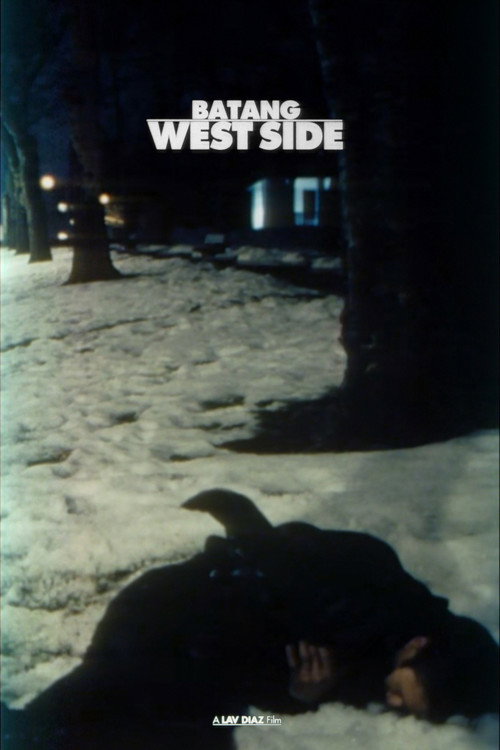
Batang West Side
2001 · Lav Diaz
For when you want to disappear into something vast and serious — a full-day commitment, not a casual pick. Choose it when a two-hour film feels too small for what you're carrying.
What it's about
A Filipino-American teenager is found shot dead on West Side Avenue in Jersey City, and a Filipino-American detective takes the case. But the investigation refuses to behave like a thriller: each interview — family, girlfriend, dealers, neighbors — opens onto the wider life of an immigrant community wrestling with methamphetamine, poverty, faith, and old wounds carried over from the Philippines. The detective's own past starts to press in as he works.
The experience
Slow-burning and immersive at five-plus hours — the case dilates rather than accelerates, and grief settles in as the real subject. Wintry, mournful, and quietly gripping if you give yourself over to its rhythm.
The craft
Shot on 35mm in the cold winter light of Jersey City, it uses the murder-mystery skeleton to hold a mosaic of long, patient interview scenes that accumulate into a community portrait. The duration is the technique: time itself becomes the way the film makes you feel the weight of loss and displacement.
Why it matters
The film where Lav Diaz stopped being a genre journeyman and became one of world cinema's defining long-form filmmakers — and his only feature shot in the United States, a landmark of Filipino diaspora cinema.
Snapshot
Five hours and fifteen minutes long, shot on 35mm in the winter light of Jersey City, Batang West Side is the film in which Lav Diaz stops being a working Philippine genre director and becomes Lav Diaz. It takes the shape of a homicide investigation — a Filipino-American teenager, Hanzel Harana, is found shot dead on West Side Avenue; a Filipino-American detective, Juan Mijares, works the case — and then declines almost every obligation the shape implies. The investigation does not accelerate; it dilates. Interviews with the dead boy's family, girlfriend, dealers and neighbors accumulate into a portrait of a diasporic community fractured by methamphetamine, poverty, evangelical fervor and inherited political trauma reaching back to Mindanao and the Marcos years. It remains Diaz's only feature shot in the United States, one of his last on celluloid, and at the time of release the longest film made by a Southeast Asian director. Restored photochemically by the Austrian Film Museum in 2015 and given a belated North American release in 2025, it has moved from near-invisibility to the front rank of the Philippine canon.
Industry & production
The film emerged from a Philippine industry in freefall. The mainstream Tagalog studio system that had sustained roughly two hundred features a year through the 1980s and early 1990s was contracting sharply by the turn of the millennium, squeezed by piracy, Hollywood's share of local screens, and the collapse of the cheap-genre programmer. Diaz had come up inside that system: after training at the Mowelfund Film Institute he directed studio assignments — Serafin Geronimo: Ang Kriminal ng Baryo Concepcion (1998), Burger Boys (1999), Hubad sa Ilalim ng Buwan (1999) — and has spoken bitterly since about producers recutting his work to commercial specification. Batang West Side is the answer to that experience.
Its production history is unusual on almost every axis. The screenplay reportedly won a Carlos Palanca Memorial Award — the Philippines' senior literary prize — in 1997, several years before shooting; the film thus arrives with a literary pedigree rather than a studio greenlight. It was produced by Joey Gosiengfiao, best known as the director of camp landmarks such as Temptation Island (1980), with Antonio S. Veloria as executive producer, under the banners JMCN Productions and Hinabing Pangarap Productions. Financing and logistics ran through the Filipino-American community in the New York–New Jersey corridor, where Diaz had himself lived and worked during the 1990s; the film is in that sense both about and made by a diaspora. Reports describe a shoot stretched across roughly two years, with the winter cold of Jersey City visible in nearly every exterior.
Precise budget and returns are not reliably documented, and nothing here should be assumed about box office: a 315-minute Tagalog-and-English film had no commercial exhibition path in either the Philippines or the United States. It premiered in December 2001 at the Cinemanila International Film Festival and traveled the festival circuit thereafter. For roughly a decade afterward it was extremely difficult to see — a film more cited than watched.
Technology
The technology is the argument. Batang West Side was shot on 35mm color negative at a running time that makes celluloid economically punitive: raw stock, processing, and release printing all scale linearly with duration, and a five-hour feature requires multiple reels, multiple projectors or an interval, and a projectionist willing to cooperate. Diaz absorbed that cost once and never again. From the mid-2000s onward his practice migrated to digital video, and it is not coincidental that his longest works — Evolution of a Filipino Family, Melancholia, Death in the Land of Encantos — belong to the digital period. Video removed the meter that celluloid runs on the take; duration became free, and Diaz spent the surplus.
Within the film, the dominant technical decision is available light. Interiors are lit by what the room has: window light, fluorescent tubes, lamps. The resulting image is cold, desaturated, granular in low light — a look that reads as documentary austerity rather than stylization, and one the Austrian Film Museum's restoration preserves rather than corrects. The 2015 restoration was itself photochemical, producing a new 35mm print, an appropriate gesture for a film whose material identity is bound up with the medium it nearly bankrupted itself using.
Technique
Cinematography
Miguel V. Fabie III shoots in long, largely static takes, the camera set at a middle distance that refuses both the close-up's intimacy and the establishing shot's mastery. Figures are frequently placed in depth within doorways, corridors, parking lots and kitchens, and left to occupy the frame for the duration of an action rather than the duration of a dramatic point. When the camera moves it is usually a slow reframing rather than a designed movement. The palette is winter: gray asphalt, sodium light, snow, the flat institutional color of American rental interiors. Jersey City is filmed as a landscape of thresholds — stoops, hallways, storefronts, the anonymous avenue of the title — which suits a film about people who live between two countries and are fully resident in neither. It is worth noting that this is one of the few Diaz features in color at feature length; the black-and-white severity of the later work (From What Is Before, A Lullaby to the Sorrowful Mystery, The Woman Who Left) is not yet his default.
Editing
Ron Dale's cutting is where the film's temporal politics live. Within scenes the cut is withheld: shots run past the point of narrative sufficiency into a residue of dead time, so that the viewer registers hesitation, exhaustion, the silence after an answer. Across scenes, by contrast, the film is boldly discontinuous, interleaving the present-tense investigation with flashbacks, memories, and dream material whose ontological status is not always announced. The effect is a mosaic rather than a chain: the five hours do not build tension, they build sediment. Crucially, the film's length is not the product of a padded plot but of a decision about what a shot owes the story — which is why the runtime feels structural rather than indulgent.
Mise-en-scène / staging
Diaz stages in real rooms at real scale. Domestic interiors are cramped and overfull; the Filipino household abroad appears as a compressed space where three generations, a television, religious iconography and a shrine to the homeland coexist. Blocking tends to be frontal and undramatic, with characters seated, standing, waiting. The interview scenes that structure the investigation put witnesses in ordinary chairs in ordinary rooms and let them talk at length, so that testimony arrives as monologue rather than as extracted clue. Against these interiors the film sets the American exterior: wide, cold, underpopulated, offering no visual compensation for what has been lost. The contrast is the film's central spatial idea.
Sound
The soundtrack is built primarily from location ambience — traffic, wind, refrigerators, off-screen television — with dialogue recorded close and left unpolished. The score is by Joey Ayala, one of the most significant Filipino musicians of his generation, whose work with Bagong Lumad fused indigenous instrumentation and Mindanao musical idiom with folk-rock songcraft. His involvement is not incidental casting of a composer: Ayala's ethno-nationalist musical project and Diaz's Mindanao-rooted political imagination share a lineage, and the score functions less as emotional underscoring than as a periodic reminder of a cultural source the characters have been severed from. The film's sound work was recognized at the Gawad Urian; detailed credits for the sound department are not well documented in accessible sources.
Performance
Diaz directs toward flatness and duration rather than intensity. Joel Torre — a veteran of Philippine cinema since Peque Gallaga's Oro, Plata, Mata (1982) — plays Mijares as a man being slowly emptied out, his authority as investigator continually undercut by insomnia, hallucination and his own unresolved Philippine past. Yul Servo's Hanzel exists mostly in flashback and testimony, less a character than a contested reconstruction. Gloria Diaz (Lolita Fordham) and Angel Aquino (Elvira Pareño) anchor the film's women, with Aquino going on to become a recurring presence in Diaz's later work. The acting register is naturalistic to the point of affectlessness; the long take does the work that in conventional performance would be done by inflection.
Narrative & dramatic mode
The film adopts the procedural's engine and disables it. A body, a detective, a sequence of interviews: the machinery promises resolution, and the film's real subject is the insufficiency of that promise. Testimony contradicts testimony; the boy assembled from these accounts is not one boy. The architecture — a death investigated through incompatible witnesses — invites comparison with the investigative mosaics of Citizen Kane and Rashomon, though the resemblance is structural rather than a documented citation. What distinguishes Diaz's version is that the detective is not a neutral instrument but a second case: Mijares's deterioration runs parallel to the investigation and eventually overwhelms it, so that the film's final subject is the investigator's own inheritance of violence. Dream and memory are given the same textural weight as evidence, and no hierarchy separates them. The dramatic mode is accretive and elegiac; the closest literary analog is the social novel, and Diaz has repeatedly named Dostoevsky as a governing influence — a debt he would make explicit in Norte, the End of History (2013), an adaptation of Crime and Punishment.
Genre & cycle
Batang West Side sits at the intersection of three cycles it belongs to only partially. It is a crime film and a noir — night, snow, a detective's voice, a corrupted community — but drained of noir's velocity and fatalism-as-style. It is a drug film, made at the height of Philippine and Filipino-American anxiety about shabu (crystal methamphetamine), but it refuses the addiction narrative's arc of descent and redemption. And it is an immigrant film, in the lineage of diasporic cinema about first- and second-generation dislocation, but it treats assimilation not as a dilemma to be resolved but as a condition of permanent unbelonging. Within Philippine cinema it descends most directly from the urban social realism of Lino Brocka (Maynila sa mga Kuko ng Liwanag, Insiang) and, in its ensemble-city construction, from Ishmael Bernal's Manila by Night (1980) — with the crucial displacement that the city is no longer Manila.
Authorship & method
Diaz (b. 1958, Datu Paglas, Maguindanao) is the son of public school teachers who worked in Mindanao resettlement areas, and the political violence of that region — martial law, insurgency, displacement — underwrites his entire filmography. Batang West Side is the point at which he asserts total authorship: he wrote and directed it, and he has since described length as an ethical rather than aesthetic choice, a refusal of the imposed rhythms of commercial cinema and, in his framing, a recovery of a Malay or pre-colonial relation to time. From this film forward he progressively absorbed more of the production apparatus himself — shooting, editing and scoring his later work — making Batang West Side also the last of his films with a fully staffed collaborative crew of this kind.
Those collaborators matter. Fabie's available-light photography establishes the visual grammar Diaz would carry into digital. Ron Dale's editing establishes the durational contract. Joey Ayala's score establishes the specifically Filipino cultural counter-voice within an American setting. Gosiengfiao's involvement as producer is one of the odder facts in Philippine film history — the impresario of glossy camp bankrolling a five-hour existential procedural — and a reminder that the film's independence was practical and improvised, not institutional.
Movement / national cinema
The film arrives at a hinge in Philippine cinema. The Second Golden Age of Brocka, Bernal and Mike de Leon had ended; the studio system was disintegrating; and the digital independent movement that would define the following decade — Cinemalaya, founded 2005; the .MOV digital festival; Raya Martin, Khavn de la Cruz, John Torres, Brillante Mendoza, Sherad Anthony Sanchez — had not yet consolidated. Batang West Side belongs to neither era and prefigures the second. It demonstrated, before cheap digital made it easy, that a Filipino film could be made entirely outside commercial logic and find its audience internationally. It also complicates any tidy national framing: it is a Philippine film shot in America, in Tagalog and English, about people who are legally American and imaginatively Filipino.
Era / period
Made and set at the turn of the millennium, the film registers a specific moment in Philippine political consciousness: the aftermath of the Marcos dictatorship and the EDSA revolution, the disappointments of the post-Marcos republic, the second People Power upheaval of 2001, and above all the mass export of Filipino labor that had made overseas remittance a pillar of the national economy. The methamphetamine epidemic it depicts was a live crisis in both countries. Its Jersey City is a pre-9/11 America, filmed months before the attacks that would reorganize how immigrant communities in the New York metropolitan area were seen and policed — an unintended historical seal on the film.
Reception, canon & influence
Initial reception was strong but narrow, concentrated in the festival world. The film took Best Picture at the Singapore International Film Festival and at the Belgium Independent Film Festival, and swept the Gawad Urian — the Manunuri ng Pelikulang Pilipino critics' awards — with honors including Best Picture, Best Director and Best Screenplay, alongside craft awards for cinematography, production design, music and sound. Reviewing for Variety, Ronnie Scheib called it "a masterpiece," "mesmerizing from first frame to last." But acclaim did not translate into access: without a viable exhibition format, the film effectively vanished for a decade, sustained by reputation.
Its influences run backward through Brocka's social realism, Bernal's ensemble structures, the American crime film, and the nineteenth-century social novel. Forward, its consequences are clearest in Diaz's own work — Evolution of a Filipino Family (2004), Death in the Land of Encantos (2007), Melancholia (2008) — which extended the durational method to nine, eleven, eight hours, and eventually brought him a Golden Leopard at Locarno (From What Is Before, 2014), a Silver Bear at Berlin (A Lullaby to the Sorrowful Mystery, 2016) and the Golden Lion at Venice (The Woman Who Left, 2016). Those prizes retroactively canonized Batang West Side as the origin text.
More broadly, the film became a reference point in the critical discourse around "slow cinema" that crystallized later in the 2000s alongside Béla Tarr, Tsai Ming-liang, Pedro Costa, Apichatpong Weerasethakul and Wang Bing — a grouping the film predates and helps explain rather than one it joined. Its most concrete legacy is domestic: for a generation of Filipino independent filmmakers it functioned as proof that scale, seriousness and total authorial control were available without a studio.
The 2015 Austrian Film Museum restoration, circulated through retrospectives including the Harvard Film Archive's Life in Real Time: The Cinema of Lav Diaz, made the film visible again; Kani Releasing's North American theatrical release in April 2025 and subsequent home-video edition made it, for the first time, ordinarily available. That twenty-four-year gap between premiere and accessibility is itself part of the film's history — and the reason its canonical position is still, in 2026, being actively settled rather than merely maintained.
A Deleuzian reading
A witness stops talking.
The full Deleuzian reading of Batang West Side →
Reception
It swept the 2001 Cinemanila festival (NETPAC prize, a shared best-acting haul) and took Best Film in Singapore — then effectively vanished, circulating for years only in a cut-down version. The Austrian Film Museum's preservation of the full five-hour cut turned a near-lost legend into settled canon: the film now routinely called Diaz's first masterpiece.
How Batang West Side was received, from release to now →
How to watch Batang West Side: what to notice on a first viewing
- Watch how long a shot holds after a witness stops talking. Diaz refuses to cut away once an answer ends, staying on the room, a hum of a refrigerator, a person just sitting there, well past the point the scene needed for its information. The held silence after the words is where the film keeps its real evidence.
- Notice the gray asphalt, sodium light, and snow in every exterior. Jersey City is shot in a cold, flat winter palette, the same institutional colors recurring across stoops, hallways, storefronts, and the avenue of the title. The cold, gray look tells you these are people living between two countries, at home in neither.
- Notice how full and crowded the family's apartment always looks. Three generations, a television, religious objects, and a shrine to the homeland share one small room, staged against the wide, empty American streets outside. The cramped interior and the empty exterior make the same point from opposite directions.
- Listen for the traffic, wind, and refrigerator hum under every scene. Dialogue is recorded close and left unpolished against a constant bed of location noise, so the ordinary sound of a place keeps intruding on the investigation. The case never gets a clean soundtrack, because the neighborhood never stops being there.
- Watch Joel Torre's face for how little it explains. As detective Mijares, Torre plays a man absorbing the case rather than cracking it, his authority worn down by insomnia and an unresolved past that the film never fully states. He watches and endures more than he solves, which is its own kind of performance.
The whole guide to watching Batang West Side, with the keys for a rewatch →
Influences: the films it descends from and the films it influenced
- Manila in the Claws of Light (1975) — Brocka's method of embedding melodrama inside verifiable social geography — real slum locations, documentary attention to wage labor and hustle — is the armature Diaz transposes intact from Manila's Misericordia to Jersey City's West Side Avenue.
- Insiang (1976) — Establishes the blocking logic Diaz uses for the diasporic apartment: entire dramatic crises staged in a one-room interior where bodies must physically negotiate past each other and no one can exit the frame, so conflict has nowhere to discharge.
- Manila by Night (1980) — The mosaic-ensemble city film in which a drug economy is the only connective tissue among a dozen otherwise unrelated lives; Batang West Side's accumulation of a community around one corpse is Bernal's structure decelerated and rebuilt as testimony.
- Oro, Plata, Mata (1982) — Source of Joel Torre's screen grammar — long-take ensemble blocking that obliges an actor to sustain interiority across whole minutes with no cutaway or reaction shot to lean on; Diaz builds Detective Mijares entirely on that capacity.
- Perfumed Nightmare (1977) — Established the Filipino production model Diaz adopts wholesale — self-financed, self-written, personally scaled work made outside the studio system, with running time and form answerable only to the author.
- Citizen Kane (1941) — The dead-man-reconstructed-through-interviews architecture: each witness returns an incompatible fragment, the investigation organizes the film's chronology, and the assembled portrait refuses to resolve into a person.
- Rashomon (1950) — Contradictory eyewitness testimony treated as formal structure rather than a plot reversal; Diaz extends the refusal by withholding any authorial arbitration at all, including from his own investigator's memory.
- The Third Man (1949) — The expatriate noir template — an outsider investigating a friend's death in a city whose language of power he doesn't speak, with a racket (penicillin there, shabu here) functioning as the moral floor of a displaced postwar community.
- Andrei Rublev (1966) — Diaz's declared model for duration as moral instrument rather than style: an epic partitioned into discrete titled panels, each held long enough that the viewer must live through the time rather than watch it be summarized.
- Serafin Geronimo: Kriminal ng Baryo Concepcion (1998) — Diaz's own debut supplies the seed device — a crime recounted in fragments by a compromised narrator to an interviewer — which Batang West Side expands from a framing conceit into the film's entire deposition-driven organization.
- Evolution of a Filipino Family (2004) — Extends Batang West Side's durational contract from five hours to ten and migrates it to digital, retaining the mosaic-of-witnesses construction while discarding the noir frame that had justified it.
- Death in the Land of Encantos (2007) — Converts the film's interrogation device into a documentary-fiction hybrid: real Typhoon Reming survivors deliver actual testimony to camera inside a fictional armature, making the deposition scene load-bearing for a whole film.
- Norte, the End of History (2013) — Returns to the crime armature — a killing whose punishment lands on the wrong man — with the same anti-procedural refusal of investigative payoff, now articulated in color and widescreen with the long static take held from greater distance.
- Transit (2013) — Rebuilds the overlapping-testimony mosaic for Filipino workers in Israel, retelling the same compressed span of days from successive characters' vantage points and staging the drama in the same cramped rented interiors of undocumented life.
- Kinatay (2009) — Takes the shabu-economy nocturne and pushes the durational ordeal to real time with available light and raw location sound, inverting Diaz's locked frame into handheld while keeping the central discipline: refusing to elide the passage the audience wants cut.
- From What Is Before (2014) — Diaz's first extreme-duration work (315 min), where he discovered that an unresolved investigation could be built from braided testimony strands rather than plot — the novelistic architecture he later applies to a whole barrio instead of one death.
- Sátántangó (1994) — Parallel invention of the seven-hour film built from static long takes and overlapping retellings of the same hours from different vantage points; Diaz arrived at the durational contract independently, which is why the two are read as a pair rather than a line.
- Tie Xi Qu: West of the Tracks (2002) — Contemporaneous proof that unbroken observational takes plus unmixed location ambience — no score cueing, no narration — can carry nine hours of social history on their own; the same sonic austerity Diaz uses under his interiors.
- Colossal Youth (2006) — Static available-light compositions of a displaced immigrant community, with performance built from testimonial monologue delivered by people playing versions of themselves — the diasporic deposition scene, arrived at from Lisbon rather than New Jersey.
Similar films
- Evolution of a Filipino Family (2004) — influence & lineage
- Manila in the Claws of Light (1975) — influence & lineage
- Norte, the End of History (2014) — shared sensibility
- Magellan (2025) — shared sensibility
- From What Is Before (2014) — shared sensibility
- L.A. Confidential (1997) — shared sensibility
- Kisapmata (1981) — shared sensibility
- Once Upon a Time in America (1984) — shared sensibility